Does Weed Increase Estrogen? What the Studies Measured
Does weed increase estrogen? The claim comes from smoke condensate tested on cells and young rats, and the same lab called that smoke antiestrogenic a year earlier. Here is what human studies and the gynecomastia record actually show.

Does weed increase estrogen? It is a common worry, especially for men who have read that cannabis causes breast growth, and for women wondering what it does to their hormones. Most pages repeat one line about marijuana being "estrogenic". Follow that line back and it leads to smoke condensate tested on cells and young rats, not to people. Here is what each study actually measured, what the gynecomastia record says from 1972 to 2026, and what is still unknown.
The short answer. No controlled human study has shown that THC raises estrogen. The "estrogenic" claim comes from a 2006 experiment that tested marijuana smoke condensate on cells and young rats, and the same lab had called the same smoke antiestrogenic a year earlier. Both times, THC, CBD and CBN on their own did nothing. In people the record is mixed: young Swiss users had higher estradiol together with higher androgens, while a genetic analysis and a women's cohort found no difference. A link between cannabis and male breast growth (gynecomastia) has been reported in some samples but has not been established.
Where the idea that weed raises estrogen comes from
Almost every page that calls weed estrogenic is pointing, directly or not, at two papers from one forensic laboratory, the National Institute of Scientific Investigation in Seoul. Both tested marijuana smoke condensate (MSC), the tar-like residue collected from burned cannabis. Neither tested a person.
In a 2005 paper in Archives of Pharmacal Research, the lab put that condensate on human breast cancer cells and ran a set of tests: cell growth, binding to the estrogen receptor, a reporter-gene assay that signals when the receptor is switched on, and the activity of aromatase, the enzyme that turns androgens into estrogens. The condensate acted as an antiestrogen: it worked against estrogen through the receptor and inhibited aromatase. THC, CBD and CBN, tested on their own, had no antiestrogenic activity. The authors suggested that pyrogenic products (compounds created by burning), including polycyclic aromatic hydrocarbons, or PAHs, might be responsible.
One year later, the same lab's 2006 paper in Toxicology and Applied Pharmacology, the one most pages quote, used the same kind of condensate and reported the opposite label. This time it stimulated estrogen activity through the receptor in cell assays. The paper also ran an immature female rat uterotrophic assay, in which young rats are given a substance and checked for uterine growth, because estrogens make the uterus grow: condensate at 10 and 25 mg/kg produced a significant uterine response. Once again, THC, CBD and CBN did not act. This time the authors pointed to phenolic compounds in the condensate.
“MSC stimulated the estrogenicity related to the ER-mediated pathway, while neither THC, CBD, nor CBN did.”
Read together, the two papers say much less than the headline. The effect belonged to the smoke, not to the cannabinoids, and the lab blamed a different family of burned compounds each time. The rats received condensate, not smoke breathed in. And neither paper tested a vape, an edible or anything that is not burned. So "weed is estrogenic" is really "one lab found burned-cannabis residue pushed estrogen activity down in cells one year and up in cells and young rats the next, while THC did nothing".
Does THC act on estrogen receptors?
Estradiol, the main estrogen in your body, works by attaching to estrogen receptors, proteins inside cells that switch genes on when the hormone binds. A compound can do three things at that receptor: act like estrogen, block it, or do nothing. For THC, the lab work mostly lands on "do nothing". A 1983 rat study in the Journal of Pharmacology and Experimental Therapeutics found that crude marijuana extract and condensed smoke competed with estradiol for the estrogen receptor in rat uterine tissue, but pure THC did not interact with the receptor, and of the other cannabinoids tested only CBD bound at all, "only at very high concentrations". When the researchers then gave cannabis extract to immature rats in large doses, it showed neither estrogenic nor antiestrogenic effects.
In a 1997 Saint Louis University experiment in Biochemical Pharmacology, a 10 picomolar dose of estradiol made MCF-7 breast cancer cells grow. THC at concentrations up to 10 micromolar, a million times higher, produced no response, CBD produced none either, and THC did not block estradiol. A plant estrogen tested alongside, formononetin, did behave as an estrogen at high concentrations. In a 2025 Ottawa experiment on a human granulosa cell line (granulosa cells make estradiol in the ovary; this line was derived from a tumor), THC and CBD did not change basal or stimulated estradiol output, or the aromatase gene CYP19A1. The cell literature is not unanimous: one Japanese lab argues that THC can dampen estradiol signaling in cells indirectly, through a second receptor type called ER-beta, while agreeing that it does not bind the main receptor, ER-alpha. All of these are cell or tissue studies.
If THC does not act on the estrogen receptor, how could cannabis touch sex hormones at all? The more plausible route runs through the brain. Your sex hormones are controlled by a chain called the HPG axis (hypothalamus, pituitary, gonads): the hypothalamus signals the pituitary, the pituitary releases LH and FSH, and those tell the testes or ovaries to make testosterone and estradiol. A 2002 Johns Hopkins review in the Journal of Clinical Pharmacology describes cannabinoids acting through CB1 receptors in or near the hypothalamus, with animal studies showing acute suppression of gonadal steroids, growth hormone, prolactin and thyroid hormone. In humans, the review says, results have been inconsistent, possibly because of tolerance, and long-term consequences remain unclear. The CB1 receptor is explained in our guide to the endocannabinoid system, and the differences between THC, CBD and CBN in what cannabinoids are and how they differ.
Does weed increase estrogen? The evidence ladder
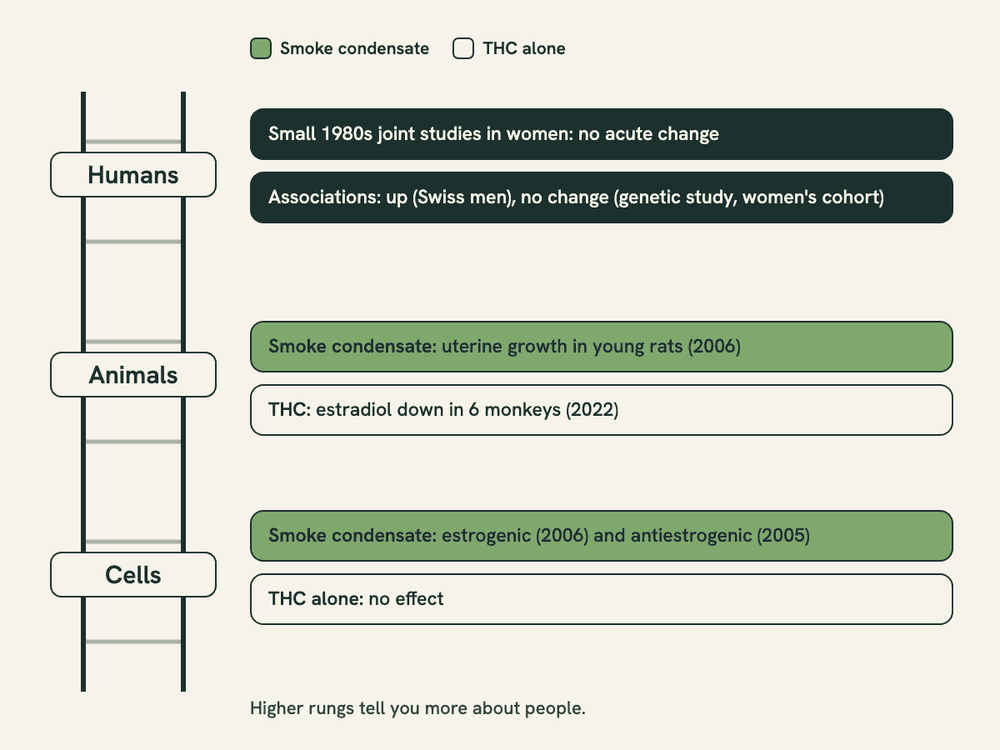
Here is every study on this page that measured estrogen activity or estradiol, sorted by what was tested. Read the "What was given" column first. The results that sound alarming come from smoke condensate; the results with THC alone mostly come back null; and the human data are mostly associations, not experiments. The only human experiments we found are small 1980s lab studies in which women smoked a joint, and they found no acute change.
| Rung | Study | What was given | What was measured | Direction | The catch |
|---|---|---|---|---|---|
| Cells | Lee 2005 | Smoke condensate; THC, CBD, CBN alone | Estrogen receptor activity and aromatase in breast cancer cells | Condensate antiestrogenic; cannabinoids inactive | Smoke residue on cells |
| Cells | Lee 2006 | Smoke condensate; THC, CBD, CBN alone | Estrogen receptor activity in cells | Condensate estrogenic; cannabinoids inactive | Same lab, opposite label a year later |
| Cells | Ruh 1997 | THC up to 10 micromolar; CBD | Breast cancer cell growth, receptor reporter gene | No estrogen or anti-estrogen effect | One cell line |
| Cells | Kadhim 2025 | THC; CBD | Estradiol output and aromatase gene in granulosa cells | No change | Tumor-derived cell line |
| Animals | Lee 2006 | Smoke condensate, 10 and 25 mg/kg | Uterine growth in young female rats | Up | Condensate, not inhaled smoke |
| Animals | Sauer 1983 | Pure THC (binding); cannabis extract in large doses (live rats) | Receptor binding in rat uterine tissue; uterine growth in young rats | THC did not bind; extract had no effect in live rats | Rat, 1983 |
| Animals | Hedges 2022 | Daily THC edible, rising dose | Blood estradiol in male rhesus monkeys | Down | Six animals |
| Humans | Zufferey 2024 | Usual cannabis use | Blood hormones in young Swiss men | Higher estradiol, with higher androgens and SHBG | Cross-sectional; cannot show cause |
| Humans | Zhang 2025 | Genetic tendency to use cannabis | Estradiol | No causal effect | Lifelong tendency, not a dose |
| Humans | Mumford 2021 | Usual use, by urine test or self-report | Urinary estrogen metabolite in 1,228 women | No significant difference | Only 62 users; women with a prior pregnancy loss |
| Humans | 1980s lab studies, per Jukic 2007 | A smoked joint | Blood estradiol in women | No acute change | Small, older studies, summarized secondhand |
What human studies measured in men
The clearest human estradiol data in men come from Switzerland. In a 2024 Andrology study of young Swiss men, cannabis users had higher estradiol than non-users. They also had higher androgens (the testosterone family of hormones), higher sex hormone binding globulin (SHBG, the blood protein that carries both), and higher anandamide, a cannabinoid your body makes itself, particularly among chronic, recent and CBD-positive users. LH and FSH, the pituitary signals that drive the testes, did not differ, and prolactin was lower. The abstract does not give the size of any of these differences. This is a cross-sectional association in one group of young men who chose to use cannabis, not a measured rise caused by smoking, and a later paper reanalyzed the same blood samples, so it is not independent confirmation.
Notice what moved together. A common story online is that weed lowers testosterone and estrogen "takes over". In this cohort, estradiol and androgens were both higher. Genetic studies come at the question from another angle. A Mendelian randomization analysis in the International Journal of Impotence Research used genetic variants linked to cannabis use, with FinnGen data and UK Biobank replication, to ask whether a genetic tendency to use cannabis changes estradiol. It found no causal effect for cannabis use disorder (beta 0.00, 95% CI 0.00 to 0.01, P = 0.37) or lifetime use (beta 0.00, 95% CI -0.02 to 0.01, P = 0.62). Genetic studies estimate a lifelong tendency in mostly European populations, not what a joint does on a Saturday night.
The only animal estradiol number in males points the other way. In six adult male rhesus monkeys given a daily THC edible at rising doses, estradiol fell by 3.8 pg/mL (95% CI 2.2 to 5.4) for each step up in dose, testosterone fell too, LH and FSH rose, and testicular volume shrank by 58% on average. That is six animals in one lab, not people, and the dose cannot be translated into a human amount.
Testosterone matters here only because the gynecomastia story is about the balance between the two hormones. A Danish study of 1,215 men aged 18 to 28 found that marijuana smokers had higher testosterone, "within the same range as cigarette smokers"; its estradiol results are not in the abstract, so we do not report them. The claim of lower testosterone usually traces to a small 1974 New England Journal of Medicine study of chronic heavy users, which did not control for other factors; larger later studies found the opposite direction or no difference. A 1991 Iowa study of about 150 regular users found no hormone differences from non-users, in men or in women. The training and muscle side of the testosterone question is covered in whether weed kills your gains.
One confounder almost nobody mentions is tobacco. In a 1984 American Journal of Medicine study of two groups of men, 41 young men and 35 husbands seen at an infertility clinic, cigarette smokers had significantly higher estradiol than non-smokers, and the authors said the difference could not be attributed to differences in marijuana or alcohol use. Many cannabis users also smoke cigarettes. Any study that compares cannabis users with non-users without separating out tobacco has a built-in problem, and as you will see below, that includes the most quoted gynecomastia study.
Does weed cause gynecomastia?
Gynecomastia is the growth of breast gland tissue in males. It is common and often temporary: according to MedlinePlus, the National Library of Medicine's consumer reference, more than one half of boys develop some breast enlargement during puberty, and it often goes away in 6 months to 2 years. Drugs cause about 10% to 25% of all cases, according to a 2012 evidence review in Expert Opinion on Drug Safety. The question is whether cannabis is one of them. Here is the record in order.
| Year | Record | Design | What it says |
|---|---|---|---|
| 1972 | Harmon, New England Journal of Medicine | Letter | "Gynecomastia in marihuana users": the first published link |
| 1974 | Harmon, Surgical Forum | Clinical and laboratory report | "Marijuana-induced gynecomastia"; no abstract available |
| 1977 | Cates and Pope, American Journal of Surgery | Case-control: 11 soldiers whose gynecomastia needed surgery vs matched soldiers | No difference in cannabis use |
| 1993 | Thompson and Carter, Pharmacotherapy | Review of drug-induced gynecomastia | "Data for marijuana are contradictory" |
| 1993 | Dardick, Annals of Internal Medicine | Letter | "Holiday gynecomastia related to marijuana?": a question, not a study |
| 2012 | Deepinder and Braunstein, Expert Opinion on Drug Safety | Evidence review of drug causes | Marijuana on neither the "definitely" nor the "probably" associated list |
| 2014 | Maseroli, Journal of Endocrinological Investigation | Retrospective, 4,023 men at a sexual-medicine clinic | Gynecomastia (3.1%) associated with cannabis abuse, among other factors |
| 2023 | Murtha, Radiology | Chest CT case-control; gynecomastia a secondary finding | 38% of marijuana smokers vs 16% of non-smokers; tobacco co-use |
| 2023 | Braunstein, Radiology | Letter in reply | "Causal Relationship between Smoking Marijuana and Gynecomastia Remains Unproven" |
| 2025 | Wu, Annals of Pediatric Endocrinology and Metabolism | Genetic (Mendelian randomization), UK Biobank | No causal link (odds ratio 1.000) |
| 2026 | Ashamalla, Journal of Craniofacial Surgery | Case series, 3 teenagers | Recurrence after surgery in cannabis users; "causality cannot be established" |
The idea starts with a 1972 letter to the New England Journal of Medicine titled "Gynecomastia in marihuana users", followed by a 1974 surgical report from the same author. Neither has an abstract we could read, so we do not repeat the case counts that circulate online. Five years later, a US Army study compared 11 soldiers whose idiopathic gynecomastia required surgery with matched soldiers and found no difference in their history of cannabis use; the authors wrote that it does not support the previously reported relationship. It was small, but it was the first comparison with a control group.
The newest and most quoted number comes from a 2023 Radiology study from Ottawa that reviewed chest CT scans taken from 2005 to 2020, mainly to look at lung damage. Gynecomastia was a secondary finding: 13 of 34 men who smoked marijuana (38%) had it, against 5 of 32 non-smokers (16%, P = .039) and 2 of 18 men who smoked only tobacco (11%, P = .040). The groups were small, and the marijuana group included people who also smoked cigarettes; the authors wrote that this concomitant cigarette smoking limits their ability to draw strong conclusions. A Cedars-Sinai endocrinologist answered in the same journal with a letter titled "Causal Relationship between Smoking Marijuana and Gynecomastia Remains Unproven".
A 2014 study of 4,023 men at a Florence sexual-medicine clinic found gynecomastia in 3.1% (after excluding men with Klinefelter syndrome), and it was associated with delayed puberty, a history of testicular or liver disease, and cannabis abuse. That is a clinic population, the abstract gives no effect size, and "abuse" is a heavier category than occasional use. The 2012 evidence review listed the drugs definitely associated with gynecomastia (including spironolactone, estrogens and anti-androgens) and those probably associated (including alcohol, opioids and anabolic steroids). Marijuana made neither list. And a 2025 genetic analysis using UK Biobank data, with gynecomastia data from 167,020 participants, found no causal link: an odds ratio of 1.000 for lifetime cannabis use (95% CI 0.998 to 1.001) and for cannabis use disorder (0.997 to 1.002). It is a short, letter-length report limited to people of European ancestry, and it measures a genetic tendency, not actual use.
Most recently, a 2026 report from Vancouver described 3 teenage boys whose gynecomastia came back after surgery and who had all used cannabis afterward. Their hormone work-ups were normal, and after revision surgery and stopping cannabis, none had a recurrence at 1 year. The surgeons write that causality cannot be established: three cases with no comparison group cannot separate cannabis from everything else going on in adolescence.
So what can you take from 54 years of this? Associations show up in a clinic sample and in a lung-imaging study whose marijuana group included cigarette smokers. A matched comparison and a genetic analysis do not confirm them. Authoritative sources also disagree: MedlinePlus lists marijuana among the substances that can cause breast enlargement in males, while the 2012 evidence review did not include it. The honest summary is the 2023 letter's title: a causal link has not been shown. That also means nobody can promise that stopping cannabis will change breast tissue that is already there.

Whatever the cause, some breast changes should be checked promptly. The list below combines the signs named by MedlinePlus and by the NHS guide to gynaecomastia.
- A lump that feels hard or firm.
- Recent swelling, pain or enlargement of the breast tissue.
- Pain that does not go away.
- Nipple discharge, especially dark or bloody discharge, or any bleeding.
- A sore, ulcer or other skin change over the breast.
- Breast growth in a boy who has not yet started puberty.
What about estrogen in women?
There are fewer data here than you might expect. The one study we found that measured an estrogen as an outcome in women who use cannabis is a 2021 analysis in Human Reproduction from the EAGeR trial: 1,228 women trying to conceive after a prior pregnancy loss, 62 of whom used cannabis by urine test or self-report. Users had higher LH, the pituitary hormone that triggers ovulation, but no significant difference in estrone-1-glucuronide (E1G), a urinary breakdown product of estrogen. The fully adjusted difference was 10% higher, with a 95% confidence interval running from 23% lower to 57% higher, so the data are compatible with no difference at all. E1G is not blood estradiol, and this was one specific group with few users.
Older lab studies that gave women a joint found no acute effect on progesterone or estradiol, as a 2007 paper in the Journal of Women's Health summarizes them. What cannabis does to LH and cycle length is covered in our look at whether weed can delay your period, and conception and CBD's reproductive data in what has and hasn't been measured on CBD and fertility. On menopause, we found one 1985 lab study of 10 menopausal women in which a joint did not change LH compared with placebo, and no study of estrogen levels in menopausal cannabis users. Nothing here speaks to menopause symptoms.
Is weed a phytoestrogen?
Phytoestrogens are plant compounds that can act on estrogen receptors; soy isoflavones are a familiar example. Cannabis does contain one candidate: apigenin, a flavonoid, which showed high affinity for the estrogen receptor in the 1983 rat tissue study, where pure THC showed none. In the 1997 cell experiment, the plant estrogen formononetin behaved as an estrogen at high concentrations, and THC did not. What is missing is any human data showing that the flavonoids in cannabis have an estrogenic effect in people who use it, and in that same 1983 study, cannabis extract given to live rats in large doses had no estrogenic effect. So cannabis contains a phytoestrogen-type molecule, but that is not evidence that cannabis acts as a phytoestrogen in you. Our guide to cannabis flavonoids covers apigenin and the rest of that chemistry.
Thyroid and prolactin, briefly
Prolactin, a pituitary hormone best known for milk production, comes up in the same searches. Two human studies point the same way: in pooled Yale lab studies, frequent users had lower baseline prolactin than controls, and the Swiss cohort above found lower prolactin in users. The Yale authors could not tell whether that reflects tolerance or a difference that existed before cannabis use. For the thyroid, an analysis of 5,280 adults in the US NHANES survey (2007 to 2012) found that recent marijuana use was not associated with thyroid dysfunction but was associated with lower TSH, the pituitary hormone that drives the thyroid. Both are cross-sectional associations, not treatment effects, and neither is a reason to use or avoid cannabis for a thyroid or prolactin problem. The stress hormone has its own record in what weed does to cortisol.
Does CBD affect estrogen?
In every lab test on this page that included CBD, it did not act as an estrogen: the 2005 and 2006 Seoul assays found CBD inactive, the 1997 cell experiment saw no response, the 2025 granulosa cell experiment saw no change in estradiol output, and the 1983 rat tissue study found CBD bound the receptor only at very high concentrations. In the Swiss cohort, men whose blood tested positive for CBD were among those with higher hormone levels, an association that cannot separate CBD from THC or from smoking. We found no human study that measured estrogen after CBD alone, so nobody can say that CBD has no effect on hormones in people.
The interaction people do need to know about is a different one: CBD can change how the liver processes some drugs, which is why our guide to CBD and birth control walks through contraceptive metabolism. For how the two main cannabinoids differ in general, see CBD vs THC, and for the adverse effects reported in human trials, the side effects of CBD.
What nobody has measured yet
On October 6, 2026, we searched PubMed for controlled trials of cannabis or THC that mention estradiol or estrogen, using this query: (cannabis[tiab] OR marijuana[tiab] OR tetrahydrocannabinol[tiab] OR THC[tiab]) AND (estradiol[tiab] OR oestradiol[tiab] OR estrogen*[tiab]) AND (randomized controlled trial[pt] OR clinical trial[pt]). It returned 2 records, both from one Chicago trial of 60 women that drew estradiol before the dose to sort participants by cycle phase. Neither measured whether THC changed it. A second search on the same date, for gynecomastia in the title with cannabis or marijuana in the title or abstract, returned 9 records, none of them a prospective study.
- A modern controlled trial that gives people THC and measures estradiol afterward. As of October 6, 2026, we found none; the only acute data are small 1980s lab studies in women.
- Route. Every estrogenic result involved burned smoke condensate; we found no study comparing smoked, vaped and eaten cannabis on estrogen.
- A prospective gynecomastia study that follows men over time, with tobacco measured separately, instead of looking back at clinic charts or scans.
- Blood estradiol in women who use cannabis regularly, rather than a urinary metabolite or a single joint in a 1980s lab.
- CBD alone in people. Every result on this page for CBD by itself comes from cells or rat tissue.
Frequently asked questions
Not in any human study we found. In cells, results point both ways: marijuana smoke condensate acted as an antiestrogen in a 2005 experiment, and one Japanese lab reports THC can dampen estradiol signaling indirectly. In six male rhesus monkeys given daily THC, estradiol fell as the dose rose, but that is animal data. In people, young Swiss users had higher estradiol, and a genetic analysis and a women's cohort found no difference.
Pure THC did not bind the estrogen receptor in rat uterine tissue in a 1983 study, and in 1997 breast cancer cell experiments it neither activated nor blocked the receptor at concentrations up to 10 micromolar. An earlier 1977 report that THC competed for the receptor was disputed in 1978. Crude cannabis extract and smoke condensate did bind, which points to other compounds in the plant or in smoke, not THC.
It has not been established. A 2023 CT study and a 2014 clinic study found associations, but the CT study's marijuana group included cigarette smokers, and a matched 1977 Army study and a 2025 genetic analysis found no link. Breast changes in males have many possible causes, including puberty and some medicines, so any new lump, pain or discharge should be checked by a clinician.
We found no study that followed men after stopping cannabis to answer that. The only data are a 2026 report of 3 teenagers whose gynecomastia did not return in the year after revision surgery and stopping cannabis, and the authors say causality cannot be established. Breast enlargement during puberty often goes away in 6 months to 2 years on its own; tissue that persists is a question for a clinician.
The data are thin. In a US cohort of 1,228 women trying to conceive, the 62 who used cannabis had higher LH but no significant difference in a urinary estrogen marker. Older lab studies that gave women a joint found no acute change in estradiol. We found no study of estrogen levels in menopausal cannabis users.
Not in the lab tests that included it: CBD was inactive in the 2005 and 2006 cell assays and in a 1997 cell experiment, did not change estradiol output from ovarian cells in 2025, and bound the rat receptor only at very high concentrations in 1983. We found no human study of estrogen after CBD alone, so its effect in people is unknown.
Two human studies found lower prolactin in frequent or regular users, which may reflect tolerance or a pre-existing difference. In a US survey of 5,280 adults, recent marijuana use was linked to lower TSH but not to thyroid dysfunction. Both are associations, not treatment effects.
We found no study that answers this for any kind of hormone therapy. Talk to the clinician who prescribes it before adding cannabis or CBD, and do not change your treatment on your own.
Where to go next. To see why cannabinoids can reach your hormones at all, start with how the endocannabinoid system works, including the CB1 receptors in the brain that sit upstream of the hormone chain described above.
Writing about hemp, wellness and the small rituals that keep us balanced.