CBD and Birth Control: What the One Trial Actually Measured
One randomized trial was built to measure whether cannabidiol changes the hormones in a combined oral contraceptive. It completed on March 2, 2022 with nine participants and has never reported a result. Here is what the trial record and the FDA labels actually say.
CBD and birth control is a question with an uncomfortable answer: nobody has published the measurement. If you take a hormonal contraceptive and you also take CBD, what you want to know is whether one changes the other. One trial was designed to find that out, in people, with a placebo and a crossover. It finished on March 2, 2022, and as of August 2, 2026 it has never reported a result. Everything else written about this, in both directions, is an argument about mechanism rather than a report of what happened in anyone's blood.
A gap like that does not stay empty, and this one has been filled in twice over, in opposite directions. On the first page of results today, one site tells readers there is a strong possibility that estrogen-based contraception becomes ineffective with CBD. Another tells readers we can definitely say CBD will not make birth control less effective, on a page that also states no studies exist. Neither cites a measurement, and both cannot be right. This article does something narrower and more useful. It names the trial that was built to settle it, prints the searches that show it never reported, and then walks the mechanism argument through the primary documents instead of the summaries. If cannabidiol itself is new to you, what cannabidiol is covers the ground this page assumes.
The short answer on CBD and birth control
Read that list carefully, because it is easy to hear as reassurance and it is not. Nothing in it says cannabidiol leaves a contraceptive alone. Nothing in it says cannabidiol interferes. Those are two different claims, and neither one has been measured in a person and published. What has been established is narrower: the popular explanation for how the interference would work does not survive contact with the FDA-approved labels, and the one experiment that would settle it has not reported. This is not a rare combination, which is why the gap matters. In the 2022-2023 National Survey of Family Growth, 54.3% of US females aged 15 to 49 were currently using contraception, with the pill at 11.4%. And in a 2024 survey of 99 patients aged 14 to 25 at a family planning clinic, cannabidiol was the second most commonly reported supplement, behind green tea. That same survey flagged 62 moderate-risk supplement-drug interactions, 50 of them involving hormonal contraception, but the flags came from a drug-interaction database rather than from measuring anyone's hormone levels, which is the distinction this whole subject keeps losing.
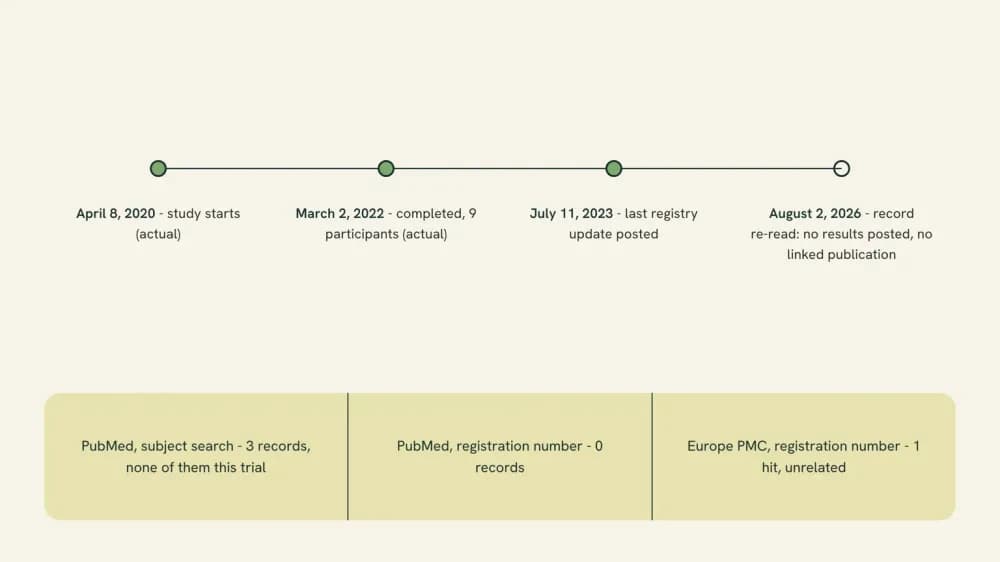
Here is the absence, as a search you can repeat. On August 2, 2026 we searched PubMed for cannabidiol AND (contracept* OR "ethinyl estradiol" OR levonorgestrel). It returned three records: an in vitro study of ion channels in human sperm, which is not a study of contraception; a survey of supplement use in a family planning clinic; and a 2016 review of pharmacokinetic interactions involving tobacco and cannabinoids. None of them is the OHSU trial. Searching PubMed and Europe PMC for the trial's own registration number, NCT04396730, returns nothing that reports it, and Europe PMC matters here because it also indexes preprints and conference abstracts. Searching the trial registry itself, with cannabidiol as the intervention and contraception as the condition, returns exactly one study, which is that same trial. A 2019 review of cannabidiol's adverse events and drug interactions contains, in its full text, zero occurrences of contracep, estradiol, levonorgestrel or estrogen. You can re-run all of that in about a minute. A search is never proof that nothing exists anywhere; it is a dated record of what three databases held on one day, which is the strongest form this claim can honestly take.
The one trial built to answer this question
One study was built to answer exactly this question. Registered as NCT04396730 at Oregon Health and Science University with the Society of Family Planning, it was a randomized, double-blind, crossover Phase 4 trial in which nine healthy volunteers took a combined oral contraceptive with either 400 mg of cannabidiol oil daily or a placebo for 24 days, then crossed over after a washout cycle, while researchers measured ethinyl estradiol and levonorgestrel in their blood. The registry lists it as completed on March 2, 2022. Pulled again on August 2, 2026, the record still reports no results posted, no linked publication and no plan to share individual data. Three separate listings of that record appear on the first page of search results for this topic. None of the pages around them reads it.
| Field | What the registry record says |
|---|---|
| Registration | NCT04396730, organization study ID STUDY00020906 |
| Title | Cannabidiol and Oral Contraceptive Pills: Exploring a Drug-Drug Interaction |
| Sponsor | Oregon Health and Science University, with the Society of Family Planning as collaborator |
| Design | Interventional, Phase 4, randomized, crossover, double masked (participant and investigator) |
| Enrollment | 9 (actual) |
| Intervention | "400 mg Cannabidiol oil will be administered daily along with oral contraceptives daily for 24 days", against placebo |
| Schedule | Cycle 1 cannabidiol or placebo, cycle 2 washout, cycle 3 the opposite |
| Who could take part | Healthy females aged 18 to 35 with regular menses of 21 to 35 days, not at risk of pregnancy |
| Key exclusions | BMI above 25, smoking or vaping, any known CYP450 inhibitor or inducer, CBD, THC or marijuana in the last 30 days, impaired liver or kidney function |
| What it measured | Plasma ethinyl estradiol and levonorgestrel: peak concentration, time to peak, half-life, area under the curve, elimination rate constant |
| Dates | Started April 8, 2020. Primary completion and completion March 2, 2022. First posted May 21, 2020. Last update posted July 11, 2023 |
| Results | Results posted: false. No references module in the record at all. Individual participant data sharing: "NO" |
Two details in that record deserve a closer look, because they are exactly what a summary smooths over. First, the record's own outcome titles and descriptions disagree about the primary endpoint: the titles read maximum plasma concentration of ethinyl estradiol and of levonorgestrel, while the descriptions underneath those same titles read area under the plasma concentration versus time curve. Peak height and total exposure are different questions, and the registry entry holds both. Second, when we read the university's own page for the study on August 2, 2026, it still presented the study as recruiting, with an age range of 18 to 39 and a BMI limit of 29 or under, against the registry's 18 to 35 and its exclusion above 25. We are not adjudicating which page is current, and we are not printing a page-footer date we cannot re-read. We are telling you what each page said on the day we read it, which is the part you can check for yourself.
It is worth being precise about what a registry record is, because this one is the strongest document on the subject and it still contains no finding. A registry record is a plan plus a status. It tells you what the investigators intended to do, who they enrolled, and whether the study ended. It does not tell you what they found, and this record carries no hint of one: the field that flags posted results reads false, the module that would carry a linked publication is absent rather than empty, and the data-sharing field says no. Nine participants is small, and that matters in a way most readers do not expect. A small crossover design is a reasonable way to detect a large change in hormone exposure and a poor way to rule out a small one. So even a published result from this trial would have had limits. What we have instead is no result at all.
Does CBD affect birth control? What the mechanism argument actually says
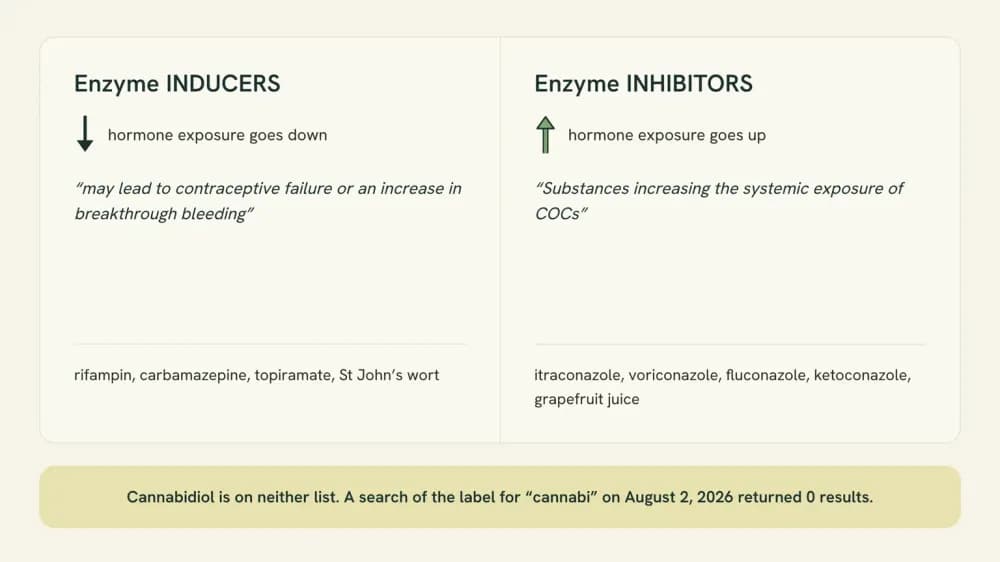
The direction matters more than the enzyme. The interaction that actually causes contraceptive failure is enzyme induction: the FDA-approved label for levonorgestrel and ethinyl estradiol tablets says that metabolic enzyme inducers "may decrease the plasma concentrations of the estrogen and/or progestin component" of combined oral contraceptives and "may lead to contraceptive failure or an increase in breakthrough bleeding", and it names rifampin, carbamazepine, topiramate and St John's wort among the examples. Induction speeds up clearance, so less hormone stays in circulation. That is the failure pathway, and it has a named list attached to it.
Enzyme inhibition is filed on that same label under the opposite heading, "Substances increasing the systemic exposure of COCs", and that is where grapefruit juice actually appears, next to itraconazole, voriconazole, fluconazole and ketoconazole. This is the cleanest correction on the page. A shortcut circulating on this topic tells readers to use the grapefruit test: if your pill's leaflet warns about grapefruit, assume cannabidiol behaves the same way and your contraception is at risk. The label puts grapefruit juice in the list of things that raise hormone exposure, not the list that lowers it, so the test is being quoted backwards. Be careful about what that does and does not establish. It tells you which direction each class pushes. It does not tell you which class, if either, cannabidiol belongs to, and the label answers that question not at all: a full-text search of it for cannabi on August 2, 2026 returned nothing.
There is a second problem with the syllogism, one step earlier than the direction. It assumes the pill's estrogen is a CYP3A4 drug. A 2007 review of ethinyl estradiol interactions, written by pharmacokineticists at Bristol-Myers Squibb, describes it as "extensively metabolised, primarily via intestinal sulfation and hepatic oxidation, glucuronidation and sulfation", with CYP3A4-mediated 2-hydroxylation the major pathway of oxidative metabolism. Oxidation is one arm of that clearance and CYP3A4 is the main route inside that arm, so even a real CYP3A4 effect would be acting on part of the picture. The same review states the direction just as plainly: inducers such as rifampicin "can lead to breakthrough bleeding and contraceptive failure", while inhibitors "can give rise to elevated EE plasma concentrations". It is a review from 2007 by industry scientists, and it says nothing whatsoever about cannabidiol.
The step nobody checks: has CBD been tested against a CYP3A4 drug in people?
The claim that CBD blocks CYP3A4 has been tested in people at pharmaceutical doses, and the FDA-approved label reports the result. Given 750 mg of cannabidiol twice daily with a single 2.5 mg dose of midazolam, the standard sensitive CYP3A4 probe drug, the prescribing information for the approved cannabidiol oral solution states there were no changes in plasma midazolam concentrations compared with midazolam given alone. That is prescription cannabidiol, in healthy adults, in a supervised drug-interaction study. Midazolam is a sedative and not a contraceptive hormone, and ethinyl estradiol is cleared through routes midazolam does not use. Read it as what it is: the probe experiment the popular argument assumes has never been done.
The same label carries a list of drug classes whose dose may need adjusting alongside cannabidiol. It is worth reading for what is on it and for what is not:
- CYP1A2 substrates, where the label calls cannabidiol a weak inhibitor
- CYP2B6 substrates, where cannabidiol is described as both an inducer and an inhibitor
- CYP2C8 substrates
- CYP2C19 substrates, where the label calls cannabidiol a moderate inhibitor
- UGT1A9 substrates
- Orally administered P-glycoprotein substrates, which is a transport pathway rather than a metabolic one
- CYP3A4 substrates are not on the list
The picture is not perfectly clean, and the finding that spoils it sits in the same document. That label reports that cannabidiol at 12.5 mg/kg twice daily, given with 5 mg of everolimus, a drug that is both a P-glycoprotein and a CYP3A4 substrate, led to an approximately 2.5-fold increase in everolimus peak concentration and total exposure in healthy subjects, and it adds that in vivo data show cannabidiol can affect P-glycoprotein efflux activity in the intestine. So a CYP3A4 substrate did move, by a lot, through a route the label files under transport rather than metabolism. Neither drug in either experiment is a contraceptive: a full-text search of that label on August 2, 2026 returned zero occurrences of contracep, levonorgestrel or ethinyl. The tidy version of this section would have stopped one paragraph ago, which is why it does not.
The in vitro literature does not speak with one voice either. A 2021 screen of twelve cannabinoids against six enzymes, from the University of Sydney, concluded that effects on CYP3A4 were limited enough that interactions through that isoform "would not be predicted", flagging CYP2C9 instead with estimated Ki values of 0.2-3.2 micromolar. A 2021 study in microsomes engineered to overexpress single P450 enzymes reported the opposite for that isoform, that CBD "competitively inhibited CYP3A4, CYP2B6, CYP2C9, CYP2D6, and CYP2E1". Both are experiments in glassware, neither used a contraceptive hormone, and a page that cites only the one matching its conclusion is showing you half of what is on the record. For the wider frame beyond contraception, the general picture of CBD and drug interactions is the page that carries the drug list and the enzyme framework.
The 1983 study that keeps getting half-quoted
The receptor claim traces to a single 1983 paper in the Journal of Pharmacology and Experimental Therapeutics, which tested cannabis preparations against estradiol for binding to the estrogen receptor in rat uterine cytosol, a cell-free preparation of soluble protein from ground-up rat uterus. Read past the first line and it says four things at once. Crude marijuana extract and condensed marijuana smoke did compete. Pure delta-9-THC did not interact with the receptor at all, and ten of its metabolites also failed to compete. Of the other cannabinoids tested, only cannabidiol showed any binding, which the authors describe as "evident only at very high concentrations of cannabidiol". Apigenin, a plant flavonoid, showed high affinity. Then they ran the experiment that matters, giving cannabis extract to immature rats in large doses and measuring uterine growth, and found "neither estrogenic nor antiestrogenic effects", concluding that direct estrogenic activity "could not be demonstrated in vivo". We are not printing the concentration the assay used, because the publisher's site refuses automated access and we could not read the full text on August 2, 2026. The phrase "very high concentrations" is the paper's own.
That paper landed in the middle of an argument, which is the context the quoting usually drops. In 1977, a report in Science described THC as a weak but significant competitor with estrogen at the rat uterine estrogen receptor. In 1978, a reply in the same journal, working in mouse mammary and uterine cytosol rather than rat uterus, said its data "strongly refute previous claims that delta-9-THC binds to estrogen receptor". Nearly fifty years later, that unresolved rodent exchange is being cited on shopping pages as though it says something about a person taking a pill. It is rodent tissue in glassware. It is mostly about THC and whole cannabis extract rather than cannabidiol. Its own most complete experiment, the one done in a living animal, came back negative. None of that makes it a claim about hormones in a person, in either direction, and this page does not turn it into one.
The closest thing to human data
The closest thing to human data measures the wrong substance in the wrong place, and is still worth knowing. In a 2024 study in Contraception, 115 contraceptive implant users had their serum etonogestrel measured alongside a survey of what they eat, drink and use. Forty-seven reported using marijuana, 22 of them daily. Using marijuana at least weekly was linked to lower hormone levels in the simple analysis, about 24 pg/mL lower at p = 0.04, and the link disappeared once body mass index and how long the implant had been in place were accounted for, at p = 0.32. The abstract summarizes the whole set as no significant associations. The full text holds both numbers, which is why the full text is the one to read, and why a page quoting either number alone is quoting half of it.
Four limits travel with that study, and none of them is optional. It measured self-reported marijuana, not cannabidiol. It measured an implant, not a swallowed pill. It is cross-sectional, one blood draw per person, so it cannot show change over time. And it had 80% power to detect a difference of 35.3 pg/mL or more, which means a smaller real difference could sit inside it unseen. The authors draw the boundary themselves: they expect the result to generalize to other non-oral steroid hormone formulations, but call for separate research on oral ones "given their first-pass metabolism". The disclosures belong here in full, both halves. The first author is chief medical advisor for Dama Health and sits on a scientific advisory board for 3Daughters; the senior author has served as a scientific consultant for Bayer Healthcare, Merck and Organon; the University of Colorado obstetrics and gynecology department has received research funding from Bayer, Organon, Agile Therapeutics and Medicines360; and the statement closes by saying the authors have no other conflicts of interest to disclose. The funding half runs the same way: the work was supported primarily by the Society of Family Planning Research Fund and the NICHD, and the paper states that none of the funders had any involvement in the study design, the analysis, the writing or the decision to submit.
The dose gap, and why it cuts both ways
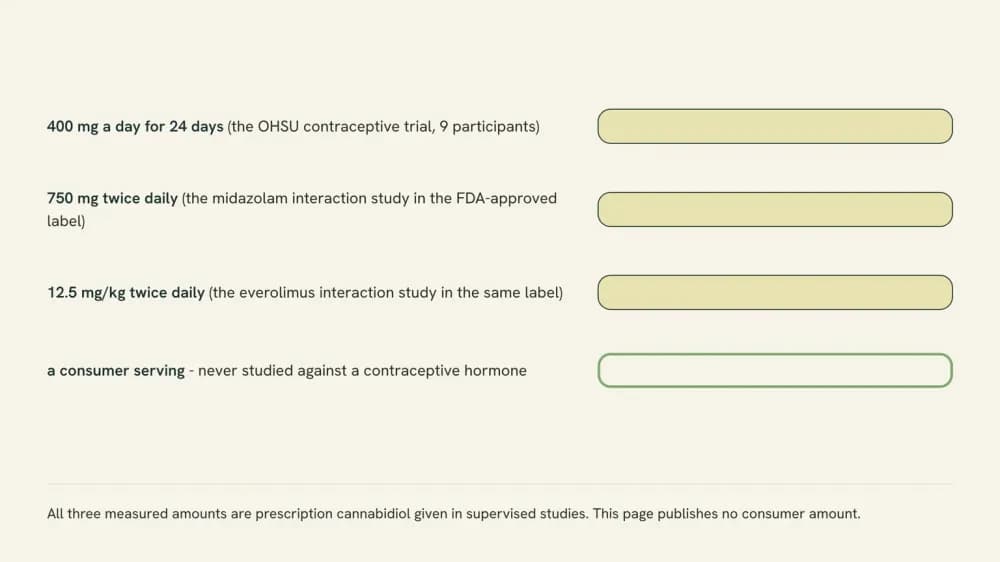
Every figure on this page that involves a human being taking cannabidiol comes from a pharmaceutical exposure. The OHSU trial used 400 mg a day for 24 days. The midazolam experiment used the approved oral solution at 750 mg twice daily, and the everolimus experiment used 12.5 mg/kg twice daily. Those are prescription amounts, given in supervised studies of a drug that is approved for specific seizure disorders. We are not going to convert any of them into drops, milliliters or servings, because on a contraception page a milligram number sitting next to a trial dose reads as an instruction, and this page is in no position to give one. If you want to know what you are actually taking, work out what one drop of your own bottle delivers and check that against how to read what is actually in the bottle.
The gap cuts both ways, and that is the part missed in both directions. A pharmaceutical result showing nothing happening to midazolam does not license a claim about a smaller amount, because a smaller amount was not tested. And a smaller amount is not automatically an amount that does nothing: how much cannabidiol reaches your blood varies with the fat content of the meal you take it with, with the formulation, and with you. The honest reading is that the amount most people actually take has never been studied against a contraceptive hormone at all. The NIH's National Center for Complementary and Integrative Health makes the same general point about this whole category in its summary of what is and is not known about cannabis and cannabinoids, which says in its own words that research on cannabis and cannabinoids for conditions beyond the approved uses is in its early stages.
The direction nobody asks about: what the pill may do to CBD
Every page on this subject asks whether cannabidiol changes the pill. The pharmacology raises a question in the other direction too, and nobody on the results page asks it. That 2007 ethinyl estradiol review notes that in vitro studies have shown ethinyl estradiol inhibits a number of human CYP enzymes, naming CYP2C19, CYP3A4 and CYP2B6. The FDA-approved cannabidiol label states that cannabidiol is metabolized in the liver and the gut, primarily the liver, by CYP2C19 and CYP3A4 enzymes and by the UGT1A7, UGT1A9 and UGT2B7 isoforms. Put those two sentences side by side and the better-documented perpetrator in this pair is the contraceptive rather than the cannabinoid: the pill's estrogen inhibits, in glassware, two of the enzymes that clear cannabidiol.
A 2016 review of pharmacokinetic interactions involving tobacco and cannabinoids approaches the same enzyme from the other side, reporting that CYP3A4 inducers and inhibitors changed exposure to a THC and cannabidiol oromucosal spray, which suggests CYP3A4 is a primary route for those cannabinoids. That review is about a spray rather than a tincture, and it is narrative rather than systematic. What follows from all of it is a question, not a warning: does taking a combined oral contraceptive raise cannabidiol levels? Nobody has measured it. It is not in the three PubMed records above, it is not in the trial registry, and the OHSU study was not built to look, because it measured hormones in blood rather than cannabidiol. We flag it because an unasked question is a more honest thing to hand you than an answer nobody has.
Pills, patches, rings, implants, shots and IUDs
One comparative paragraph, and then this page stops, because the evidence does not support sections. A swallowed pill is absorbed through the gut and passes through the liver before it reaches the rest of the body, which is what first-pass metabolism means, and it is why an enzyme effect would have two chances to matter. A patch, a vaginal ring, an implant, an injection and a hormonal IUD all deliver hormone without that first pass, and a hormonal IUD releases most of its levonorgestrel locally in the uterus. A copper IUD contains no hormone at all, so there is nothing for an enzyme to act on. That difference in route is precisely why the implant study's authors fenced their own result to non-oral formulations and asked for separate research on oral ones. It is a description of how the routes differ. It is not a ranking, it is not a recommendation, and nothing on this page is a reason to switch, add, stop or continue a method. That decision belongs to you and the clinician who prescribed it.
Known, assumed and unmeasured
| Known (measured and published) | Assumed (an argument, not a measurement) | Unmeasured (no published human result) |
|---|---|---|
| Prescription cannabidiol at 750 mg twice daily did not change plasma midazolam in healthy adults (FDA-approved label) | That a midazolam result transfers to ethinyl estradiol, which is also cleared by intestinal sulfation and glucuronidation | Whether cannabidiol changes ethinyl estradiol or levonorgestrel levels in a person |
| The same label reports everolimus, a P-glycoprotein and CYP3A4 substrate, up about 2.5-fold with cannabidiol | That an effect on one transported substrate predicts an effect on a contraceptive hormone | Whether a combined oral contraceptive changes cannabidiol levels, which nobody has looked at |
| Enzyme inducers can lower hormone exposure and carry a contraceptive-failure warning on the label | That cannabidiol belongs to the inducer class, which no label and no human study places it in | What a consumer-scale amount of cannabidiol does to any hormonal method |
| In rat uterine cytosol in 1983, only cannabidiol bound the estrogen receptor, at very high concentrations, and the live-animal test was negative | That a rodent receptor-binding result says anything about a person taking a pill | What the OHSU trial found, four years and five months after it completed |
It helps to see what a documented contraceptive interaction looks like when somebody has actually done the work. A 2022 modelling study of levonorgestrel and ethinyl estradiol combined physiologically based pharmacokinetic simulation with a model-based meta-analysis and predicted that strong CYP3A4 inducers would cut levonorgestrel exposure by roughly 50% to 65% in people with a body mass index under 25, and by 70% to 75% in people with obesity, with a corresponding modelled rise in the Pearl Index. Two things about that. It is a simulation rather than a measurement, and two of its authors are at Bayer AG, a manufacturer of hormonal contraceptives, while the academic authors are at the University of Florida. And it is about inducers, a class nothing has placed cannabidiol in. Still, it shows the shape a real answer takes on this topic: a named class, a percentage, a population, a modelled consequence. Nothing remotely like it exists for cannabidiol. The nearest co-exposure experiment we found gave female rats ethinyl estradiol and levonorgestrel together with WIN 55,212-2, a synthetic cannabinoid receptor agonist that is not cannabidiol, and measured behavior rather than hormone levels.
How to check any of this yourself in about a minute
- 1Open the trial record at clinicaltrials.gov/study/NCT04396730 and check two fields: the overall status, and whether a results section exists at all. On August 2, 2026 it read completed, with no results posted.
- 2Re-run the literature search on PubMed: cannabidiol AND (contracept* OR "ethinyl estradiol" OR levonorgestrel). Then search the registration number itself, on PubMed and again on Europe PMC.
- 3Read the interaction section of the label instead of a summary of it. DailyMed carries the FDA-approved prescribing information for both the contraceptive and the approved cannabidiol solution, and section 7 is where interactions live.
- 4Resolve any PMID a page prints. Paste it after pubmed.ncbi.nlm.nih.gov and read the paper's own conclusion sentence, not the sentence the page wrapped around it.
Step four is the one that changed how we read this topic. We resolved every identifier the top results print. One page supports the sentence that CBD temporarily inhibits certain CYP450 enzymes, particularly CYP3A4, with a PMID that resolves to a real, carefully conducted paper whose own conclusion about CYP3A4 is the opposite: the University of Sydney screen quoted two sections above. Another page supports a claim about estrogen receptor pathways with a 2025 citation that turns out to be a rat chronic-stress study measuring gene expression in brain regions. Nothing was fabricated and both citations resolve. They simply do not say what the sentences beside them say, which is far harder to spot than a broken link, and it is the reason step four exists. An identifier that resolves is not the same as an identifier that supports. We used the same method on how we handled the same evidence problem with alcohol and on the same question asked about melatonin.

What to bring to the person who prescribed your contraceptive
This is the actionable part of the page, and it is short because the honest set of actions is short. Tell the clinician who wrote your contraceptive prescription that you take cannabidiol, tell them how much and how often, and ask a pharmacist to run a formal interaction check against your specific method and your other medicines. A pharmacist can do in two minutes what no article can do at all, which is look at your particular combination. Bring these:
- The name and dose of your contraceptive, and how much cannabidiol you take, in milligrams per serving and servings per day
- The batch certificate of analysis for the bottle you are using, so the conversation is about what an independent lab measured rather than what the label promises
- Every other medicine and supplement you take, because an enzyme conversation is rarely about only two things
- The registration number NCT04396730, if your clinician wants to look at the trial record themselves
- Any breakthrough bleeding, which the contraceptive label already treats as something that can accompany changed hormone exposure and is worth reporting for that reason alone
That last item needs one sentence of care so it is not misread. The label ties breakthrough bleeding to lowered hormone exposure from enzyme inducers, and that is why a prescriber wants to hear about it. No study has shown that cannabidiol causes breakthrough bleeding, and this page is not suggesting it does. It is a signal your clinician already knows how to interpret, and reporting it costs you nothing. If the reason you are reading this is that contraception has already failed, or you think you may be pregnant, that is a different conversation and a separate article on CBD in pregnancy and breastfeeding covers what is known there. And if you are weighing whether to take cannabidiol at all, what CBD's documented side effects are is the page for that question.
Frequently asked questions
No published human study has measured it, in either direction. A randomized, double-blind crossover trial at Oregon Health and Science University, registered as NCT04396730, gave nine healthy volunteers a combined oral contraceptive with either 400 mg of cannabidiol oil daily or a placebo for 24 days and measured ethinyl estradiol and levonorgestrel in their blood. The registry lists it as completed on March 2, 2022, and as of August 2, 2026 it has posted no results and no linked publication. The mechanism argument quoted most often also runs in the wrong direction: contraceptive failure from a drug interaction is classically caused by enzyme induction, while cannabidiol is discussed in the literature as an inhibitor, which sits under the opposite heading of the FDA-approved contraceptive label. That is not a clearance and we are not offering one. It is a reason to be skeptical of confident answers on either side, and a reason to raise the question with the clinician who prescribed your method.
The comparison is usually quoted backwards. On the FDA-approved label for levonorgestrel and ethinyl estradiol tablets, grapefruit juice appears in the list of substances that increase systemic exposure to the pill's hormones, alongside itraconazole, voriconazole, fluconazole and ketoconazole. The list connected to contraceptive failure is a different one: enzyme inducers such as rifampin, carbamazepine, topiramate and St John's wort. So even taken at face value, the grapefruit analogy points toward more hormone exposure rather than less. Separately, cannabidiol appears nowhere on that label. A full-text search of it for cannabi on August 2, 2026 returned nothing at all, so the label is not evidence about CBD in either direction.
Nobody has measured the difference, so any confident answer is invented. What can be said is what was studied. The OHSU trial gave every participant a combined pill and measured both hormones, ethinyl estradiol and levonorgestrel, so its design does not separate the two. The only human measurement anywhere near this subject was made in etonogestrel implant users, and those authors explicitly limited their conclusion to non-oral hormone formulations, asking for separate research on oral ones because a swallowed pill is metabolized on its first pass through the liver. That is a boundary about the route a hormone takes, not a ranking of methods. This page does not recommend one method over another, and no evidence on the record would support it doing so.
Nothing has been measured for either, so the difference between them on this question is unknown. What is knowable is what is in the thing you are holding: how much cannabidiol per serving, whether an independent lab tested that batch, and whether the certificate of analysis matches the label. Formulation genuinely does change how much cannabidiol reaches your blood, which is a real pharmacokinetic fact and one reason a gummy and an oil are not interchangeable. But that fact has never been connected to a contraceptive-hormone measurement in a person. Start with the label and the batch report, because that is the part you can actually verify today.
Different molecule, different evidence, and mostly outside this page. The one human dataset close to the question measured self-reported marijuana use, not cannabidiol, in 115 contraceptive implant users: weekly use was associated with lower serum etonogestrel in the simple analysis at p = 0.04, and the association did not survive adjustment for body mass index and implant duration at p = 0.32. In the 1983 receptor experiment, pure delta-9-THC did not compete with estradiol at all, while crude cannabis extract did. Neither of those is a measurement of what smoking cannabis does to a contraceptive in a person, which nobody has published either.
Tell the clinician who prescribed your contraceptive that you take cannabidiol, say how much and how often, and ask a pharmacist to run a formal interaction check against your specific method and your other medicines. That is the whole answer, and it is deliberately the whole answer. This page does not tell you to switch, add, stop, continue, space out or double up on anything, because no published human measurement exists that would support any of those instructions, and the sites that give them are giving you their confidence rather than their evidence. If you notice breakthrough bleeding, report it, because the contraceptive label already treats changed hormone exposure as something that can show up that way, not because anyone has shown cannabidiol causes it.
Writing about hemp, wellness and the small rituals that keep us balanced.