Does Weed Weaken Your Immune System? What Studies Show
In the lab and in mice, THC turns immune cells down. In people, the clearest measured effect is in smokers' lungs, and for the rest of the body the National Academies found too little evidence to say. Here is each layer, with its limits.
Does weed weaken your immune system? It depends on where you look. In a dish and in mice, THC clearly turns immune cells down. In people, the clearest measured effect is in the lungs of habitual smokers, whose airway immune cells killed bacteria poorly in lab tests. For the rest of the body, the best review of the human evidence found too little to say either way.
The short answer. Those three layers (cells and animals, measurements in people, and real-world illness) give three different answers, and most pages pick one and skip the others. In 2017 the National Academies of Sciences, Engineering, and Medicine reviewed the human evidence on cannabis and immunity in Chapter 8 of its report. It found only limited evidence that smoking cannabis lowers some inflammatory signals in healthy people, and not enough evidence either way on whether it harms immune cells more broadly. Studies since then on COVID and fungal infections have found associations, not causes. Nothing here shows that cannabis boosts immunity or treats any condition, and nothing shows that it wrecks a healthy immune system either. Below is what each layer actually shows, with the numbers and the limits.
Does weed weaken your immune system? The answer in three layers
Research on cannabis and immunity happens at three levels, and each answers a different question. Lab and animal studies ask what THC can do to immune cells under controlled conditions, often at high doses. Studies in people measure something about the immune system (cell counts, signaling proteins, how well cells kill bacteria) without tracking whether anyone actually got sick more often. Outcome studies ask the question you probably care about: do people who use cannabis get more infections, or get sicker when they do? The further down that list you go, the more useful the answer, and the thinner the evidence.
| Layer | What was studied | What it found | What it can tell you |
|---|---|---|---|
| Cells and animals | Human T cells exposed to THC in a dish; mice given THC by injection | Clear dampening of immune cells, mostly through CB2; in animals, some infections got worse and others did not | How THC can act. Not what happens at typical doses in people |
| Measured in people | Lung cells from habitual smokers (UCLA, 2003 and 2004); people with HIV (a 2003 trial and a 2018 snapshot) | Smokers' lung cells killed bacteria poorly; a 21-day trial found no drop in CD4 or CD8 counts; heavy use linked to fewer activated immune cells | That changes can be measured, most clearly in smokers' lungs. Not how often anyone got sick |
| Clinical outcomes | National Academies review (2017); COVID hospital records (2024); insurance claims for fungal infection (2020) | Limited or insufficient evidence of immune harm; higher odds of COVID hospitalization and fungal infection in people with recorded use | Patterns worth knowing, with large confounders. Not proof that cannabis caused them |
Notice what is missing from the bottom row: a study that followed healthy adults who use cannabis and counted how often they caught colds, flu or other infections. When we searched in October 2026, we did not find one. That gap is why the honest answer to "does weed weaken your immune system" is narrower than either side of the debate wants: measurably, in some ways, in some people, with an unknown effect on how often you get sick.
Where cannabinoids touch your immune system
Your body has two main cannabinoid receptors. CB1 sits mostly in the brain and nerves. CB2 was described in a 1993 Nature paper on a cannabinoid receptor found outside the brain, in macrophages in the spleen rather than in brain tissue, and it is the receptor that ties cannabinoids to immunity. In a 1995 study of human immune tissue and blood cells, the genetic message for CB2 ran 10 to 100 times higher than for CB1, and among blood cells the order was B cells, then natural killer cells, then well behind them monocytes, neutrophils and T cells. That study was done by researchers at Sanofi and measured messages, not receptor activity. Your own endocannabinoids use these receptors to fine-tune immune signaling, and the full layout is in our guide to how the endocannabinoid system works. THC binds both CB1 and CB2, which is why it can act on immune cells at all. CBD barely binds either, one reason THC and CBD behave so differently. The wider family of compounds is mapped in our overview of cannabinoids.
What THC does in a dish and in mice
Most of what is known about THC and immunity comes from cells and animals. A 2002 review of human immune-cell research by a UCLA group described human T cells (the white blood cells that coordinate attacks on viruses) exposed to THC in the lab. They divided less and released less interferon-gamma, a signal the body uses against viruses and against bacteria that hide inside cells, and the response tilted toward a so-called type 2 pattern instead. Most of that effect ran through CB2. The same review noted that blood immune cells from marijuana smokers carried more CB1 and CB2 messages than cells from non-smokers. Keep the setting in mind: that is a dish, not a person, and cell studies often use THC concentrations that do not match what reaches your blood.
Animal work points the same way. A 2015 review of mostly animal research concluded that THC and other compounds that act on CB2 dampen immune responses, and that in animals this made some infections worse and left others unaffected. In the authors' words, these cannabinoids "can sensitize to some infections... but not to others." The study behind the 2010 headlines saying pot "suppresses the immune system" was done in mice given THC by injection. It found a "rapid and massive expansion" of myeloid-derived suppressor cells, a type of cell that holds other immune cells back. It measured cells in mice, not infections or cancer in people.
“...a sizable literature... in experimental animals and in cell-based assays... By contrast, the investigations into the effects of cannabis or cannabinoid-based therapeutics on immunity in human subjects are quite limited.”
Why don't the lab results settle the question for people? Three reasons. Dose: animals and cell cultures often get THC amounts that do not match how a person uses it. Species: a mouse immune system is not a human one, and a cell in a dish has none of the backup systems a whole body has. Route: injected THC skips the lungs entirely, while the clearest human finding, below, comes from smoke. The same gap between lab results and people runs through the debate over whether weed kills brain cells.
Your lungs: the clearest human finding
The strongest evidence that cannabis changes immune function in people comes from bronchoscopy studies at UCLA. Researchers rinsed immune cells called alveolar macrophages (the cells that patrol the air sacs and swallow bacteria) out of the lungs of healthy non-smokers, tobacco smokers, habitual marijuana smokers and crack cocaine smokers, then gave the cells Staphylococcus aureus bacteria in the lab. In the 2003 report in the Journal of Infectious Diseases, cells from non-smokers and tobacco smokers showed "potent antibacterial activity" tied to their production of nitric oxide, a chemical they use to kill bacteria. Cells from marijuana and cocaine smokers showed "minimal antibacterial activity" and did not make nitric oxide unless they were primed first. A 2004 follow-up in the Journal of Neuroimmunology found the cells were not damaged beyond repair: adding an immune signaling protein (GM-CSF or interferon-gamma) in the lab "restored the ability of these cells to produce NO and to kill bacteria," which suggests they were missing a "go" signal. The authors concluded that this lung defense is "suppressed by habitual exposure to inhaled marijuana or crack cocaine."
Keep the limits in view. The groups were small (the abstracts do not give counts, so we do not print one), the cells were tested outside the body, everyone in the marijuana group was a habitual smoker, and nobody tracked whether these people actually got more lung infections. One detail is telling, though: tobacco smokers' cells worked normally, so the effect was not simply a matter of breathing smoke. These studies cannot say whether THC reaching the lungs, something else in cannabis smoke, or the way it is inhaled is responsible. What they show is a finding in smokers' lungs, not proof of a body-wide effect, and they say nothing direct about vaping or edibles. Smoking is also what drives the cough and bronchitis symptoms covered in why weed makes you cough, and what changes when you vaporize instead of burning has its own page.

Mold is the other lung question. In a 2020 CDC analysis of 2016 insurance records, 53,217 people whose records were coded for cannabis use were compared with about 21.6 million whose records were not. Fungal infections were rare in both groups (0.08%, or 40 people, versus 0.03%), but after adjusting for age and immune-compromising conditions, the coded users had about 3.5 times the odds (95% confidence interval 2.6 to 4.8). An odds ratio of 3.5 means roughly three and a half times the odds; a confidence interval that stays above 1 means the difference is unlikely to be chance. The most common was aspergillosis (17 of the 40), caused by the common mold Aspergillus. The CDC authors offered several possible explanations and could not choose between them, including mold on the cannabis itself, lungs already damaged by smoking, immune effects, and tobacco, which they could not fully separate. Users with an infection were also sicker to begin with: 43% had an immune-compromising condition, against 21% of non-users with an infection. Billing codes also catch only a sliver of real use (under 0.3% of these records, against roughly 9% in surveys), so the people with a cannabis code may not resemble typical users. Contamination is one of the risks you cannot see in untested cannabis, which is part of why you usually can't tell if weed is laced by looking at it.
The rest of your body: what human studies measured
Beyond the lungs, the best single summary is still the National Academies report. It grades evidence on a five-step scale (conclusive, substantial, moderate, limited, and no or insufficient evidence), and its immunity conclusions all sit in the bottom two steps. In plain terms, the committee found:
- Limited evidence that smoking cannabis is associated with lower production of several inflammatory cytokines (immune signaling proteins) in healthy people.
- Insufficient evidence to support or refute other adverse effects on immune cells in healthy people.
- Insufficient evidence on whether cannabis harms immune status in people with HIV.
- Limited evidence of no link between daily cannabis use and faster liver scarring in people with hepatitis C.
- Insufficient evidence on a link between cannabis and oral HPV infection.
Limited evidence of lower inflammatory signals is neither a finding of harm nor a finding of benefit. It means the human studies are few and small, and nobody has shown what the change means for how often you get sick. One small study the committee cited (20 users, 10 controls, recruited through addiction treatment in Egypt) found that CD4 T cells from cannabis users made about half as much IL-17, an inflammatory signal, and about twice as much IL-10, a calming one, when stimulated in the lab. The hepatitis C conclusion is a liver question with its own page: what the studies show about weed and your liver goes through those data, where the studies disagree.
People with HIV are where the most careful human work has been done, because their immune system is already under strain. In a 2003 randomized trial in the Annals of Internal Medicine, 67 people with HIV were enrolled and 62 analyzed while they lived in a hospital research unit. They smoked cannabis cigarettes (3.95% THC), took a 2.5 mg THC capsule (dronabinol) or took a placebo, three times a day for 21 days. Their CD4 and CD8 counts and viral load did not get worse: compared with placebo, the viral load change in the cannabis group was small enough to be chance (confidence interval -0.30 to 0.13 log10 copies). Three weeks is short, everyone was on protease-inhibitor therapy, and the trial was not designed to show any benefit. Fifteen years later, a 2018 study of people with well-controlled HIV grouped participants by a THC breakdown product in their blood: 128 non-users, 40 moderate users and 14 heavy users. The heavy-use group had fewer "switched-on" (activated) T cells and fewer inflammatory monocytes than non-users. That was a single snapshot of 14 people, some results weakened after adjustment, and the authors describe associations, not causation. It does not show that cannabis helps or harms people with HIV.
Colds, flu, COVID and vaccines
This is the question most people are really asking, and it has the least direct evidence. When we searched in October 2026, we found no human study that counted colds or flu in people who use cannabis compared with people who do not. So no one can tell you from data whether weed makes you catch more colds, or whether using it while sick makes a cold last longer. What is known is narrower. The National Academies found substantial evidence that long-term cannabis smoking is linked to worse respiratory symptoms such as cough and phlegm, and smoke irritates airways that an infection has already inflamed. That is a practical reason many people pause smoking while they have a chest or throat infection. Edibles and tinctures avoid the smoke, but THC is the same cannabinoid studied in the lab work above.
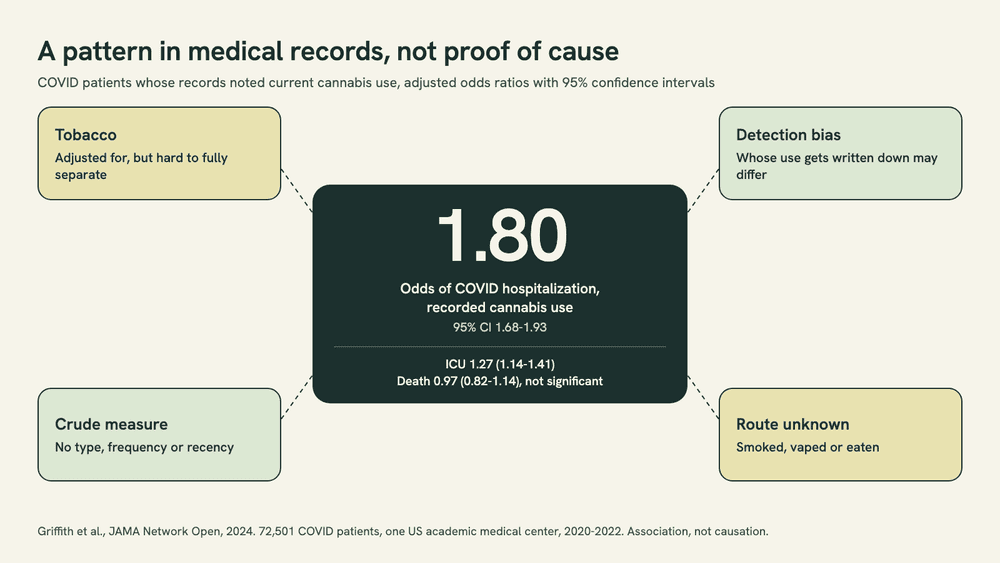
COVID produced the largest data set. A 2024 study in JAMA Network Open looked at 72,501 COVID patients at one Midwest academic medical center between February 2020 and January 2022; 7,060 of them (9.7%) had current cannabis use noted in their records. After accounting for tobacco, vaccination, other illnesses, date and demographics, cannabis use was linked to higher odds of hospitalization and ICU admission, but not of death. The authors called their cannabis measure a "very crude measure without specific details on cannabis type, frequency, or recency," and warned of detection bias: people whose use gets written down may differ from people whose use does not. It shows a pattern, not that cannabis caused worse COVID.
| Outcome | Recorded cannabis use | Recorded tobacco use |
|---|---|---|
| Hospitalization | 1.80 (1.68-1.93) | 1.72 (1.62-1.82) |
| ICU admission | 1.27 (1.14-1.41) | 1.22 (1.10-1.34) |
| Death | 0.97 (0.82-1.14), not significant | 1.37 (1.20-1.57) |
Vaccines have even less data. In a small Israeli study published in 2022, 154 adults had their antibody levels measured 31 to 120 days after a third Pfizer-BioNTech COVID dose. The 46 medical cannabis users among them (25 with cancer and 21 without, using roughly 28 to 32 grams a month) made about the same antibody levels as non-users. That is one small study at one time point, it did not report route or THC-to-CBD ratio, and antibody levels are not the same thing as protection. It does not show that cannabis has no effect on vaccines, and no human study we found shows that it weakens them.
"Calms inflammation" is not "boosts immunity"
Several seller pages take the lab findings and turn them around: if THC dampens immune cells, they say, it must help autoimmune conditions or "support" immunity. Neither follows. Dampening an immune signal in a dish describes a mechanism; by itself it is neither a benefit nor a harm. An immune system that is turned down is not "boosted", and a lower inflammatory marker in a blood test says nothing about whether any disease gets better. A 2021 review in the journal Viruses, by a George Washington University researcher and a scientist at the National Institute on Drug Abuse, reads the same evidence and concludes that cannabis "may impair immune function in many instances," then calls for more research on immune dysfunction and infection risk. It is a review of mixed animal and human studies rather than a new measurement, and it gives no support to using cannabis for immunity.
What about CBD?
Human data on everyday CBD and immune function are thin. The clearest numbers come from the prescription CBD drug. On its FDA-approved prescribing label, infections were reported in about 40% of treated patients (41% and 40% across the treated groups) versus 31% on placebo, in trials in Lennox-Gastaut and Dravet syndromes, two severe forms of epilepsy. Those patients took 10 to 20 mg of CBD per kg of body weight a day, usually alongside other seizure drugs. Pneumonia was also more common (8% and 5% versus 1%), and the label ties that imbalance to clobazam, another seizure drug taken with it. The label does not say CBD caused the infections, and those doses are far above typical consumer use. If you take a steroid, whether CBD counts as an immunosuppressant alongside prednisone is answered on its own page.
Who should talk to a clinician first
For a healthy adult, the human evidence has not shown clear immune harm from cannabis outside the lungs, which is not the same as showing there is none. Some people should not lean on that general picture, because their immune system is already suppressed or their lungs are already vulnerable. If any of the following applies to you, talk to your doctor before using cannabis in any form, and be specific about how much you use and how. Do not stop or change a prescribed medicine on your own.
- You have had an organ or bone marrow transplant, or you take anti-rejection medicine.
- You are having chemotherapy or radiation, or you have a blood cancer.
- You have HIV, or another condition or medicine that lowers your immune defenses.
- You take long-term steroids such as prednisone, or biologic drugs that suppress the immune system.
- You have lung disease such as asthma or COPD, or you keep getting chest infections.
- You have had a fungal lung infection, or your care team has told you mold exposure is a risk for you.
- You have surgery coming up.
What is still unknown
The National Academies closed its immunity chapter with a plain statement of the gap: "Research is needed to determine whether chronic cannabis smoke or cannabinoid treatment alters immune competence in healthy or immunocompromised individuals," measured by how often infections happen and how long they take to clear. That still describes the field. Specifically, nobody yet knows:
- Whether people who use cannabis get more colds, flu or other infections. We found no study that counted them.
- Whether vaping or edibles change the lung findings, which come only from smokers.
- How dose and frequency matter. Most human studies split people into users and non-users, or rely on crude record codes.
- Whether the lower inflammatory signals seen in some studies mean anything for health, good or bad.
- What everyday CBD does to immune function in healthy people.
- Whether the COVID and fungal-infection links hold up with better measures of how much, how often and how people use cannabis.
Frequently asked questions
In cell and animal studies, THC dampens immune cells, mostly through the CB2 receptor. In people, the National Academies found only limited evidence that smoking cannabis lowers some inflammatory signals and insufficient evidence of broader immune harm. Cannabis is not an approved or recommended immunosuppressant, and it is not a substitute for one.
No study we found has counted colds or flu in cannabis users. The clearest human finding is narrower: lung immune cells from habitual marijuana smokers killed bacteria poorly in lab tests (UCLA, 2003). A 2020 CDC analysis found higher odds of fungal infection in people with a cannabis code in their insurance records, but it could not rule out mold on the cannabis, smoke-damaged lungs, tobacco or users already being sicker.
Smoke irritates your airways, and an infection has already inflamed them, so many people pause smoking while they are sick. There is no evidence that cannabis shortens or lengthens a cold. If you have trouble breathing, chest pain or a fever that will not settle, see a clinician.
Very little is known. One small Israeli study found that 46 medical cannabis users made about the same antibody levels after a COVID booster as non-users, measured once, 31 to 120 days after the dose. That is not enough to say cannabis has no effect, and no human study we found shows that it weakens vaccine responses.
A 2024 study of 72,501 COVID patients found higher odds of hospitalization (1.80) and ICU admission (1.27), but not of death, in people with recorded cannabis use, after accounting for tobacco and vaccination. The authors called their cannabis measure very crude and warned of detection bias. It is an association, not proof that cannabis made COVID worse.
No evidence shows that. Lowering some inflammatory signals is a different thing from strengthening your defenses, and it is not a reason to use cannabis for your health. Claims that cannabis supports or balances immunity are not backed by human studies.
Human data on everyday CBD and immunity are thin. In trials of the prescription CBD drug for two severe forms of epilepsy, infections were reported in about 40% of treated patients versus 31% on placebo, at 10 to 20 mg per kg a day alongside other seizure drugs. The label does not say CBD caused them, and those doses are far above typical use.
Where to go next. Every immune effect on this page starts at the CB2 receptor. To see how it fits with CB1 and the endocannabinoids your body makes, read how the endocannabinoid system works, receptor by receptor. If you have an immune condition, bring your questions to your doctor rather than to a search engine.
Writing about hemp, wellness and the small rituals that keep us balanced.