Does Weed Make You Poop? What the Gut Studies Actually Show
Many top search results say weed speeds up your gut. Three placebo-controlled human trials found THC slowed the stomach or relaxed the colon, and none sped it up. Here is what was measured, what the famous survey can't show, and what likely explains the urge.
Does weed make you poop? Plenty of people say a joint sends them straight to the bathroom, and many of the top search results agree, claiming THC speeds up your gut. The controlled human studies say the opposite. In three placebo-controlled trials, THC or its synthetic form slowed the stomach or relaxed the colon, and none sped anything up. So if you need to go after smoking, the likely cause is something that came along with the session. Here is what was measured, and what probably explains the urge.
Does weed make you poop? The short answer
The experience is real. Lots of people notice they need the bathroom soon after smoking, and it is common enough to be a running joke. What many popular pages get wrong is the mechanism. Pages from sellers and medical-card services say cannabinoids "increase motility" or trigger a bowel movement "within 15-30 minutes", but none of them cite a study for it, and we could not find one.
What researchers have actually measured, in healthy volunteers with a placebo comparison, points the other way. THC slows how fast your stomach empties, and a single dose of dronabinol relaxes the colon and quiets its contractions after a meal. A slower stomach and a quieter colon are not what a laxative does. So the honest answer to does weed make you poop is this: THC itself probably does not, but the way people use cannabis often comes packaged with things that do. Below you will find each study with its numbers and limits, then the ordinary explanations, so you can work out which ones apply to you.
What your gut does, and where cannabinoid receptors sit
Moving food through you is a relay with several legs, and a drug can change one leg without touching the others. That matters here, because each study below measured a different leg.
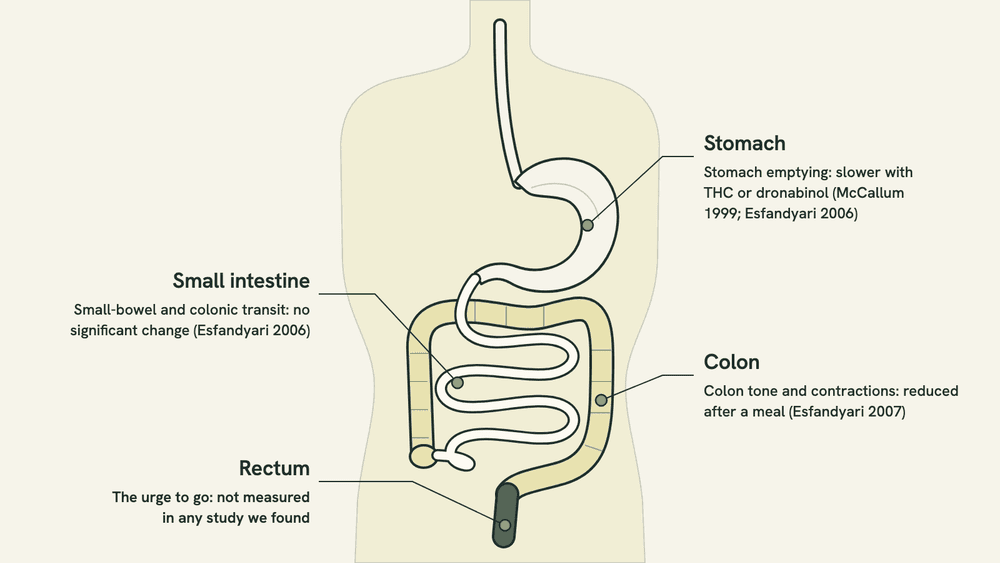
- Stomach emptying: how fast a meal leaves your stomach for the small intestine. Researchers track it by tagging a meal with a tiny amount of radioactive tracer and scanning.
- Small-bowel transit: how long material takes to travel the small intestine, where most nutrients are absorbed.
- Colonic transit: how long material takes to cross the large intestine. This is the leg that most directly shapes how often you go.
- Colonic tone and contractions: how tight the colon wall is and how often it squeezes, measured with a pressure probe. Tone is not the same thing as transit.
- The urge: the signal that it is time to go. We found no cannabis study that measured it.
Your body makes its own cannabinoid-like messengers, part of the endocannabinoid system, and a 2016 review in Gastroenterology describes that system as an important physiological regulator of gut movement. THC acts mainly through one of its receptors, CB1. According to a 2018 review of cannabinoids and gut motility by Michael Camilleri, whose group ran two of the trials below, CB1 receptors sit throughout the digestive tract, mostly on the nerve networks inside the gut wall. In animal and tissue studies, activating CB1 there turns down acetylcholine, the chemical signal that tells gut muscle to contract. That part is animal and lab work, not a human measurement. The human trials below are consistent with it.
Dronabinol, which appears in two of those trials, is a lab-made version of THC used as a medicine. Researchers like it because the dose is exact. If you want the differences between THC, CBD and the other compounds first, start with what cannabinoids are and how they differ. The same receptor system also sits behind other body effects you may have noticed, such as why weed makes your mouth dry.
The three controlled human studies
The earliest is a 1999 double-blind study of 13 healthy volunteers. Each person ate a solid meal on two separate days, once with THC and once with placebo, in random order. The dose was 10 mg of THC per square meter of body surface, which works out to very roughly 17 to 20 mg for an adult with a typical body surface of 1.7 to 2.0 square meters (our arithmetic, not the paper's, and a study condition, not a serving guide). THC slowed stomach emptying in every one of the 13. Thirty minutes after the meal, 94.2% of it was still in the stomach on THC versus 85.5% on placebo. At two hours the gap had widened: 73.9% left on THC versus 45.6% on placebo. Interestingly, how much THC was in someone's blood did not predict how much their stomach slowed.
Next, a 2006 Mayo Clinic trial of dronabinol and gut transit randomly assigned 30 healthy adults to oral dronabinol (5 mg twice a day, three doses in total) or placebo, and tracked the whole relay. Dronabinol slowed stomach emptying overall (P = 0.018). The effect was statistically clear in women (P = 0.011) but not in men (P = 0.184); a P value under 0.05 is the usual bar for a real difference. Here is the part most popular pages miss: dronabinol did not measurably change how fast material moved through the small bowel or the colon. Colonic transit was read at 24 hours. Camilleri's 2018 review notes that a 48-hour reading was not tested, and that men showed a trend toward slower colonic transit that did not reach significance.
The colon finding comes from a separate experiment. In a 2007 trial of 52 healthy adults, researchers placed a pressure-sensing balloon probe in the descending colon, gave a single 7.5 mg dose of dronabinol or placebo, then served a 1,000-calorie meal. Dronabinol made the colon wall more relaxed and stretchy, blunted the rise in colonic tone after the meal, and reduced the colon's squeezing contractions both before and after eating. People on dronabinol also rated the balloon's stretch as more painful. The authors summed it up: dronabinol "relaxes the colon and reduces postprandial colonic motility and tone." Postprandial means after a meal, which is exactly when many people feel the urge to go.
Keep the two colon results apart, because popular pages blend them. The 2006 trial measured transit (how fast things move) and found no change. The 2007 trial measured tone and contractions (how the muscle behaves) and found less activity. Neither measured how often people actually went to the bathroom, and none of the three used smoked cannabis. Together they say one thing clearly: in the lab, THC and dronabinol put the brakes on parts of the gut. Not one of the three found a faster gut.
The survey number everyone quotes
The one human number popular pages do print comes from a 2019 analysis of a US federal health survey by a Massachusetts General Hospital team. It used NHANES, the National Health and Nutrition Examination Survey, across three cycles from 2005 to 2010: 9,645 adults aged 20 to 59. "Recent use" meant any cannabis in the past 30 days. Constipation was judged from stool form on the Bristol Stool Form Scale (a chart of seven stool types) and/or how often people went. Among recent users, 7.5% met the survey's constipation definition, versus 10.2% of people who had used in the past or never.
Popular pages turn that into "30% less likely to be constipated". The paper reports odds, not chance: a crude odds ratio of 0.71, and 0.68 after adjusting for demographics, other illnesses, alcohol, tobacco and other drugs, constipating medicines, general health, physical activity, emotional health and diet. A ratio is relative. In absolute terms the gap is 2.7 percentage points, or roughly 3 fewer people with constipation in every 100. The study found no link with diarrhea at all. In the hospital's own summary of the work, the research team described the absolute difference as modest and noted that the survey left out adults over 60.
“...counter to the known physiologic effects of cannabinoids on colonic motility.”
In other words, the researchers themselves flagged that their result runs against the lab data. Here is what a snapshot survey like this cannot tell you.
- Direction: whether cannabis changed anyone's bowels, or whether people with certain bowel habits are simply more likely to use cannabis.
- Dose, route, product and frequency: one day of use in the past month counted the same as daily use.
- Older adults: people over 60, the age group where constipation is most common, were not included.
- A clinical diagnosis: constipation came from answers on one survey at one point in time, not an exam.
- Everything else: even a long list of adjustments may not capture every way users and non-users differ.
None of this makes the survey wrong. It makes it a clue, not a conclusion, and it is not a reason to use cannabis for constipation. The age gap matters more than it looks: according to the National Institute of Diabetes and Digestive and Kidney Diseases (NIDDK), about 16 in 100 US adults have symptoms of constipation, rising to about 33 in 100 among adults aged 60 and older.
So why do you need to go after smoking? Four ordinary suspects
If THC slows things down, something else is doing the pushing. Three of these four candidates have their own human data, and all of them tend to show up in the same moment as the joint.
1. Tobacco in the roll
Nicotine moves things along. In a 1998 study of nicotine and colonic transit in healthy non-smokers, nicotine patches (17.5 and 35 mg a day) shortened total colonic transit from 42.6 hours to 32.2 and 28.2 hours. Most of the change was in the last stretch before the rectum, where transit fell from 18.6 hours to 9.9 and 7.6 hours. Blunt wraps are made from tobacco leaf, and spliffs mix tobacco in by design (how a blunt differs from a joint covers what is in each). If yours contains tobacco, nicotine is a candidate the cannabis gets blamed for. Three cautions. That study used patches in people who did not smoke. Its comparison point was a baseline X-ray taken before the volunteers' next bowel movement, and the same baseline read after a bowel movement was far shorter (25.1 hours), so the size of the effect depends on the yardstick. And the paper cites earlier work finding that smokers had slower colonic transit than non-smokers. The effect is not simple, and none of this is a reason to add tobacco to anything.
2. Coffee and the morning routine
In a 1998 study of 12 healthy adults with a pressure probe in the colon, a 240 mL cup of caffeinated coffee (about 150 mg of caffeine) stirred the colon about as much as a 1,000-calorie meal: 60% more than water and 23% more than decaf. If your session sits next to your morning coffee, the coffee is a well-documented colon stimulant on its own. If you pair cannabinoids with coffee regularly, our guide to CBD and caffeine looks at that combination.
3. Eating after the munchies
The same coffee study found that a large meal is a strong colon stimulus by itself, the after-meal response many people feel as an urge to go. And cannabis tends to bring on eating. In a 1988 residential lab study of six men, smoking marijuana cigarettes (2.3% THC) in two sessions a day, over 13 days, raised total daily calorie intake by about 40%, almost all of it from extra snacks rather than bigger meals. That study did not measure bowel function, so the next step is our inference, not a finding: more eating means more meal-triggered colon activity, which could plausibly show up as an urge. Appetite itself is covered in our explainer on cannabinoids and hunger.
4. Relaxation and timing
Many people use cannabis to unwind, often at the same time every day, and bowels like routine. It is plausible that a relaxed state and a habitual moment make it easier to go. We found no study that measured this, so treat it as a hypothesis rather than an explanation. How cannabis acts on the nervous system has its own nuances, covered in whether weed is a depressant.
One more variable is route. The two dronabinol trials gave it by mouth, which is the closest lab model to an edible, and they found a slower stomach and a relaxed colon. We found no study comparing smoking and edibles on bowel habits. Edibles also take longer to act, which shifts any effect away from the moment you eat them (why edibles take so long to kick in explains the timing). We found no strain comparison either, so claims that one strain "gets things moving" have no human data behind them.

What was measured vs what people report
Here is every study on this page in one table. Read the last column first: it is what each result can and cannot tell you.
| Study | Who and dose | What was measured | Result | Limit or likely confounder |
|---|---|---|---|---|
| McCallum 1999 | 13 healthy adults; THC 10 mg per square meter of body surface | Stomach emptying of a solid meal | Slower in all 13; 73.9% vs 45.6% left at 2 hours | One dose, one meal; stomach only |
| Esfandyari 2006 | 30 healthy adults; oral dronabinol 5 mg twice daily, 3 doses | Stomach, small-bowel and colonic transit | Slower stomach emptying (clear in women); no change in small-bowel or colonic transit | Low oral dose; colon read at 24 hours only |
| Esfandyari 2007 | 52 healthy adults; one 7.5 mg dronabinol dose | Colonic tone and contractions, with a pressure probe | Relaxed colon; fewer contractions after a 1,000-calorie meal | Tone is not transit; bowel movements not measured |
| Adejumo 2019 | 9,645 US adults aged 20-59 (NHANES 2005-2010) | Self-reported constipation and diarrhea | Constipation 7.5% in past-month users vs 10.2%; adjusted odds ratio 0.68; no link with diarrhea | One-time survey; no dose or route; adults over 60 excluded |
| Rausch 1998 | Healthy non-smokers; nicotine patch, 17.5 or 35 mg a day | Colonic transit | Shorter than a pre-bowel-movement baseline, mostly in the final stretch before the rectum | Tobacco in blunts and spliffs; patch, not smoke |
| Rao 1998 | 12 healthy adults; 240 mL coffee, decaf, water, or a 1,000-calorie meal | Colonic activity, with a pressure probe | Coffee about as strong as a meal; 60% more than water | Morning coffee and meals next to a session |
| Foltin 1988 | 6 men; marijuana cigarettes, 2.3% THC, two sessions a day | Food intake | About 40% more daily calories, mostly from snacks | Eating triggers the colon; bowels not measured |
Can weed cause constipation?
It is plausible, and it fits the pharmacology better than the opposite claim does. A slower stomach and a relaxed colon with fewer contractions are, on paper, a recipe for slower bowels. Camilleri's 2018 review, written for gastroenterologists, says that beyond cannabinoid hyperemesis they "should be aware of less overt manifestations such as chronic constipation or symptoms associated with delayed gastric emptying." That is a note about possible side effects, not a measured rate. But the one large population study found slightly less constipation in past-month users, not more. Both can be true at once. Effects measured at a set dose in healthy volunteers do not have to show up as a measurable difference across a whole population with mixed use, diets and habits. No trial has followed regular users to see what happens to their bowel habits over time.
NIDDK describes constipation as fewer than three bowel movements a week, stools that are hard or lumpy, stools that are difficult to pass, or a feeling that not all stool has passed. It also points out that only you know what is normal for you. If your bowels have changed since you started using cannabis, run this check before you blame the plant.
- 1Timing: did the change start with cannabis, or with something else that changed in the same weeks?
- 2Fiber: has your diet shifted, including what you snack on?
- 3Fluids: are you drinking less water than usual?
- 4Activity: are you moving less?
- 5Medicines and supplements: NIDDK lists opioid pain relievers, iron supplements and some antacids among the medicines that can cause constipation. Ask a pharmacist about anything new.
- 6Routine: travel or a new schedule can throw bowels off on their own.
- 7Red flags: if any item in the list further down applies, skip the self-check and talk to a doctor.
Does CBD make you poop?
CBD is a different question. It is a different molecule that does not activate CB1 receptors the way THC does, so the THC trials above do not tell you what CBD does to your gut. Its digestive side effects come from separate human trials, which we walk through in does CBD cause diarrhea?, including whether CBD makes you poop or causes constipation. If you take CBD and notice a change in your bowels, that page is the right place to start.
When it's not a curiosity: red flags
Needing the bathroom after a joint is usually just timing. Some gut symptoms in cannabis users are not.
Our guide to greening out and cannabinoid hyperemesis explains how the two differ. For the clinical picture, see the StatPearls reference chapter on CHS; the American Gastroenterological Association also published a 2024 clinical practice update on CHS for doctors diagnosing and managing it. For bowel symptoms, NIDDK's guidance on constipation symptoms and diarrhea symptoms lists these as reasons to talk with a doctor right away, whether or not you use cannabis.
- Bleeding from your rectum, or blood in your stool (red blood, or black, tarry stools)
- Constant belly pain, or severe abdominal or rectal pain
- Being unable to pass gas
- Vomiting, especially frequent vomiting
- Fever, or lower back pain alongside constipation
- Losing weight without trying
- Signs of dehydration, or a change in mental state
- For adults with diarrhea: lasting more than 2 days, a high fever, or six or more loose stools in a day
NIDDK also advises seeing a doctor if constipation does not get better with self-care, or if you have a family history of colon or rectal cancer. When you go, describe your cannabis use plainly (how much, how often and how you take it). It changes what your clinician looks for.
What nobody has measured yet
Being clear about the gaps is part of the answer. As of October 2026, we could not find any of the following.
- A controlled trial of smoked cannabis on colonic transit or how often people go.
- Any study of the urge to defecate after cannabis.
- A comparison of strains, or of smoking versus edibles, on bowel habits.
- A study separating tobacco from cannabis in the bowel habits of joint, blunt and spliff smokers.
- A long-term trial in regular users, the group most likely to notice a change.
- A reading of colonic transit beyond 24 hours after dronabinol.
Until those studies exist, the lab data (a slower gut) and the everyday experience (needing to go) are not really in conflict. They measure different things in different settings: a fixed dose of THC in a quiet lab, versus a real session with whatever came with it.
Frequently asked questions
Probably not because of THC. In placebo-controlled trials, THC slowed stomach emptying and dronabinol relaxed the colon. The better-tested candidates are what comes with the session: tobacco in a blunt or spliff (nicotine patches shortened colonic transit in a 1998 study of non-smokers), a cup of coffee (about as stimulating to the colon as a large meal in a 1998 study), eating, and a regular, relaxed routine. Nobody has studied the urge itself, so this is the best reading of the evidence, not a settled answer.
We found no study that measured it. The closest evidence is the two dronabinol trials, which gave synthetic THC by mouth, much like an edible, and found a slower stomach and a relaxed colon rather than a faster gut. If you notice an urge after an edible, look at what else you ate and drank around it. Edibles also take longer to act than smoking, so any effect would not line up neatly with the moment you eat one.
In the lab, the first step slows. In a 1999 study, two hours after a meal 73.9% of it was still in the stomach on THC versus 45.6% on placebo. A 2006 trial found dronabinol slowed stomach emptying, clearly in women, but did not change small-bowel or colonic transit over 24 hours. A 2007 trial found a single dose relaxed the colon after a meal. These were short studies in healthy volunteers, not long-term studies of everyday users.
It is plausible from the pharmacology, and a 2018 review written for gastroenterologists lists chronic constipation among the less obvious effects to be aware of. But the one large US survey found slightly lower constipation in people who had used cannabis in the past month (7.5% versus 10.2%), an association that cannot show cause. If you notice new constipation, check diet, fluids, activity, medicines and routine first, and see a doctor if it does not improve or if any red flag applies. Cannabis is not a treatment for constipation.
In the 2019 NHANES survey analysis, past-month cannabis use was not linked to diarrhea, and the controlled trials point toward a slower gut, not a faster one. Neither finding makes cannabis a treatment for diarrhea, and neither rules out a reaction in an individual person. If you have diarrhea that lasts more than 2 days, a high fever, or six or more loose stools a day, NIDDK advises talking with a doctor. Severe, repeated vomiting after long-term use is a separate pattern, cannabinoid hyperemesis syndrome, and also needs a clinician.
It is common, and on its own it is usually just timing. What is not normal is the red-flag list: blood in your stool, constant belly pain, being unable to pass gas, vomiting, fever, losing weight without trying, or constipation that does not get better with self-care. Repeated vomiting that hot showers ease, after long-term regular use, fits cannabinoid hyperemesis syndrome and needs a clinician.
We found no study comparing them. Blunt wraps are made from tobacco leaf, and nicotine patches shortened colonic transit in a 1998 study of non-smokers, so tobacco is a plausible reason a blunt or spliff could feel different from a pure joint. The same paper cites earlier work finding that smokers had slower colonic transit than non-smokers, so the effect is not straightforward. Treat tobacco as a confounder to be aware of, not something to add.
Where to go next. To see how the CB1 receptors in your gut fit into the wider system THC acts on, read the endocannabinoid system, explained. If vomiting rather than bowels is your concern, start with the greening-out guide linked in the red-flags section above.
Writing about hemp, wellness and the small rituals that keep us balanced.