CBD and Fertility: What Has and Hasn't Been Measured
On August 7, 2026, a PubMed search for cannabidiol and fertility filtered to clinical trials returned zero records. What exists is animal work, cell work and a little human hormone data. Here is what each layer measured, in which species, and what none of it can tell you.

If you are trying to conceive and you want to know whether CBD is making it harder, the honest answer on CBD and fertility is short and unsatisfying: nobody has measured that in a person. On August 7, 2026 we searched PubMed for cannabidiol together with fertility, sperm or semen, and filtered it to clinical trials and randomized controlled trials. It returned zero records. ClinicalTrials.gov listed no registered study of cannabidiol in fertility or infertility, of any design. Anyone can re-run both searches in about a minute. What does exist is animal work, cell work and a small amount of human hormone data, and every one of those layers is answering a narrower question than the one you asked.
That is not the same as saying there is nothing to read. There is one document that a regulator has actually reviewed for reproductive effects, and it contains four separate findings in four different exposure windows: adult animals dosed before and through mating, juvenile animals dosed from four days after birth, juvenile animals dosed with cannabidiol's major metabolite, and offspring exposed in the womb. Almost every page on this topic collapses those four into one scary sentence or one reassuring sentence. Getting them apart is most of the answer, and it is the part nobody on the first page of results has done. This page separates them, prints the exposure margins side by side, and is explicit about the boundary where the evidence stops and guessing starts.
Page one says two opposite things, and both are guesses
Search this question and you will be told, on the same results page, on the same day, that the research does not exist and that the research is encouraging. One fertility company states flatly that no research has been published yet on CBD's effect on fertility. Elsewhere you will read that emerging studies suggest CBD may exert protective and beneficial effects on male reproductive health, possibly through its anti-inflammatory and antioxidant properties. That second sentence is worth tracing, because it is not a finding by anyone. It is lifted almost word for word from the abstract of a 2025 review in Toxicology Letters whose own title is a question: do THC and cannabidiol have opposed effects on male fertility? The other primary paper ranking on that same page, a 2026 review of phytocannabinoids and male fertility, writes the opposite hedge: although CBD exhibits anti-inflammatory and antioxidant properties, its long-term impact on reproductive function remains uncertain. Two narrative reviews, no new data in either, pointing in two directions.
Both of the confident sentences share a defect: they are claims about the size and direction of a literature, made without showing a search. Ours is printed in the lead with its query and its date attached, which is the only form in which a count means anything, and it returned nothing. A broader search, cannabidiol with fertility, sperm, semen or spermatogenesis published between 2023 and 2026, returned 25 records, and the composition of those 25 is more useful than the number. A search is not proof that nothing exists. It is a dated, repeatable description of what a database held on a given morning.
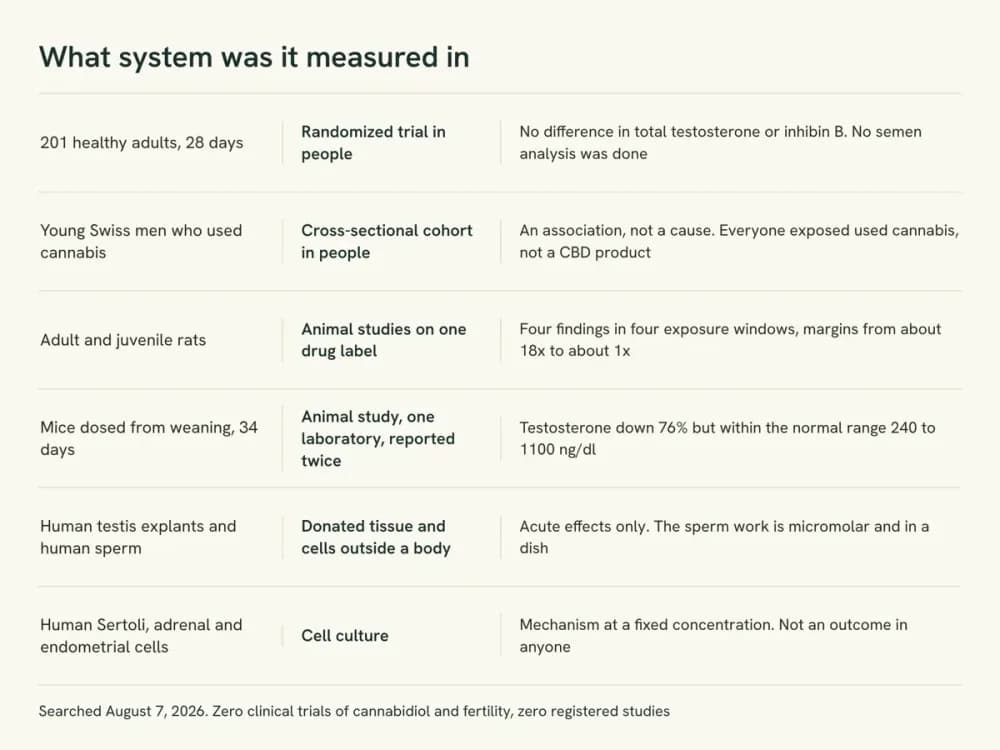
| Layer | Roughly how many of the 25 | What it can answer | What it cannot |
|---|---|---|---|
| Clinical trials in people | 0 | Nothing yet. The filtered query returns no records at all | Everything a trial would answer: whether a person taking CBD conceives more slowly, or at all |
| Narrative reviews | About 9 | What a given set of authors thinks the rows below add up to | Anything new. A review generates no measurement, and two of these reviews disagree with each other |
| Animal studies | About 7 | Whether a reproductive endpoint moved in that species, at that dose, at that stage of life | Anything about a person. The species here include rats, mice, sheep, rams, zebrafish, Nile tilapia and donkeys |
| Cell and tissue experiments | 4 | Mechanism: what a fixed concentration does to cells or tissue in a dish | Consequence. A dish has no bloodstream, no liver and no hypothalamus |
| Surveys | 2 | Who reports using cannabidiol, and whether they tell a clinician | Any biological outcome at all |
| Records that are not about this | 3 | Nothing. They match the query for reasons of indexing | One is a Lancet Global Burden of Disease paper, one is about a hemp russet mite, one is about antiseptic wound dressings |
The 30% you keep reading is a marijuana number, and it is 28%
Almost every page that answers this question reaches for a sperm-count figure within two paragraphs, usually a 30% reduction, and almost none of them name the study. It is a 2015 analysis of 1,215 young Danish men aged 18 to 28, recruited between 2008 and 2012 at their conscription medical examinations, 45% of whom had smoked marijuana in the previous three months. The men who smoked marijuana more than once a week had 28% lower sperm concentration (95% confidence interval from minus 48 to minus 1) and 29% lower total sperm count (minus 46 to minus 1) after adjustment. In the men who combined it with other recreational drugs the figures were 52% and 55%. The number is not 30%, and the largest effect in the paper is entangled with polydrug use rather than with cannabis alone.
Two things follow. First, this is smoked marijuana, self-reported, measured once, in a cross-sectional design that cannot establish which came first. Second, and this is the swap that runs through the whole category, it is being printed under CBD headlines. Cannabidiol is one compound; smoking cannabis delivers THC, everything else in the plant, and everything that comes off it while it burns, and how cannabidiol and THC actually differ is the distinction being erased. One detail from the same paper is almost never quoted and it is inconvenient for the scare version: marijuana smokers in that cohort had higher testosterone, within the same range as cigarette smokers. If you are going to borrow the sperm number, you have to carry that one too.
The only regulator-reviewed fertility dossier, split by exposure window
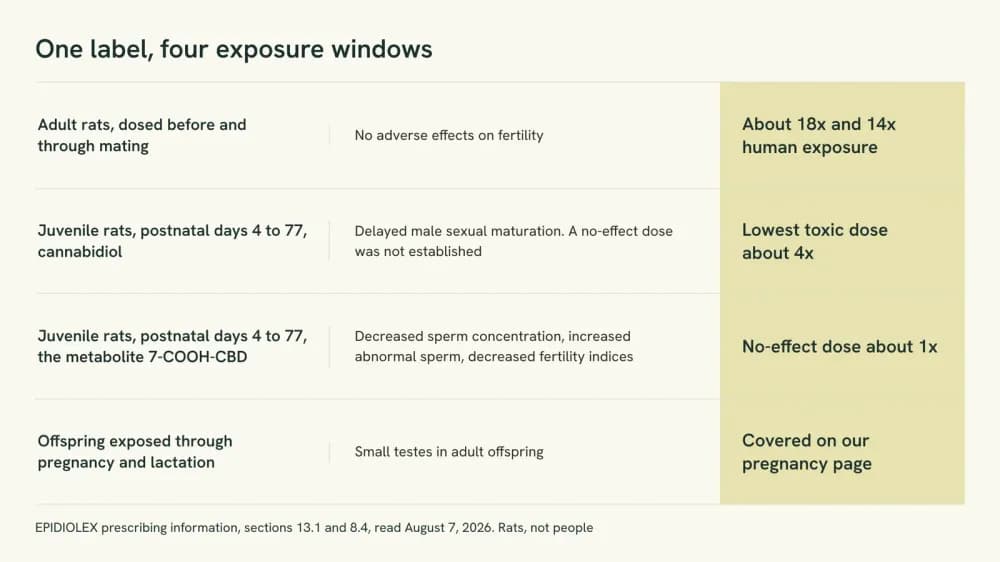
There is exactly one cannabidiol product whose reproductive toxicity package has been reviewed by a regulator, and it is a prescription anti-seizure oral solution. Its prescribing information is public. We read the full structured product label on DailyMed on August 7, 2026 (version 35, effective May 29, 2026, marked revised 7/2025), and the label is free for anyone to open. It carries four reproductive findings, and they sit in two different sections for a reason: section 13.1, Carcinogenesis, Mutagenesis and Impairment of Fertility, holds the adult mating study, while the juvenile studies live in section 8.4, Pediatric Use, under the subheading Juvenile Animal Data. Pages that cite the juvenile findings as though they came from the fertility section are quoting the right document and the wrong part of it.
| Where it sits on the label | Who was dosed, and when in life | What was reported | Exposure margin |
|---|---|---|---|
| 13.1, Impairment of Fertility | Adult male and female rats at 0, 75, 150 or 250 mg/kg/day, dosed prior to and throughout mating and continuing in the females during early gestation | Verbatim: produced no adverse effects on fertility | The highest dose tested ran at plasma exposures approximately 18 and 14 times human exposure at the maximum recommended doses of 20 and 25 mg/kg/day |
| 8.4, Juvenile Animal Data, cannabidiol itself | Juvenile rats, 15 mg/kg under the skin on postnatal days 4 to 6, then 100, 150 or 250 mg/kg by mouth to day 77, ten weeks in total | Increased body weight, delayed male sexual maturation, neurobehavioral effects, increased bone mineral density and liver hepatocyte vacuolation. Verbatim: A no-effect dose was not established | The lowest dose causing developmental toxicity ran at about 4 times human exposure at both maximum recommended doses |
| 8.4, Juvenile Animal Data, the metabolite 7-COOH-CBD | Juvenile rats at 0, 20, 40 or 80 mg/kg/day on the same schedule, days 4 to 77 | At the high dose, verbatim: disrupted estrous cyclicity, decreased sperm concentration and increased abnormal sperm; decreased mating, fertility, and fecundity indices; increased preimplantation loss. Mortality and eye abnormalities at mid and high dose | No-effect dose 20 mg/kg/day, at metabolite exposures the label calls approximately equivalent to human exposure at the maximum recommended doses |
| 8.1, pre- and post-natal study | Rats dosed throughout pregnancy and lactation, offspring assessed as adults | Verbatim: adverse effects on male reproductive organ development (small testes in adult offspring) and fertility were observed in the offspring at the mid and high dose | Covered in full on our pregnancy and breastfeeding page, which owns this window |
Now put the first and third rows next to each other, because that comparison is the single most useful thing on this page. The reassuring finding, no adverse effects on fertility, was obtained at roughly 18 times the plasma exposure a person gets on the prescription drug. The alarming finding, decreased sperm concentration and decreased fertility indices, has a no-effect dose sitting at roughly 1 times that exposure. A margin of 18 and a margin of 1 are not the same kind of statement, and quoting either one alone produces a false page. The second row is the one nobody quotes at all, and it is the most cannabidiol-relevant of the three, because it is cannabidiol itself rather than a metabolite: delayed male sexual maturation in juvenile rats, with the label recording in plain words that a no-effect dose was not established. As for the fourth row, that is the in-womb window and we are not going to re-derive it here beyond the sentence in the table, because our page on CBD in pregnancy and breastfeeding covers the whole developmental package with the rat and rabbit dose tables attached.
What 18 times human exposure is, and what it is not
That 18 is not a dose ratio, it is an exposure ratio. AUC, the area under the concentration-time curve, is the total amount of drug the bloodstream actually sees over a dosing interval, and regulators compare species that way rather than by milligrams because a rat clears cannabidiol differently from a person. So the sentence means: at plasma levels roughly 18 times what a patient on the maximum recommended dose reaches, adult rats dosed before and throughout mating still conceived normally. The human reference point in that comparison is 20 to 25 mg per kilogram per day of a prescription oral solution taken for severe childhood epilepsies, which is a different preparation at a different scale from anything sold as a hemp supplement. We are not going to convert it into any consumer amount in either direction, and neither should anything else you read; the house rule we use for animal-to-human numbers explains why the arithmetic is more misleading than the silence.
The FDA ran its own experiment, on human cells in a dish
Here is a thread that no page-one result mentioned when we read them on August 7, 2026. Scientists at the FDA's National Center for Toxicological Research, in the Division of Biochemical Toxicology at Jefferson, Arkansas, put cannabidiol and two of its metabolites onto Sertoli cells, the cells that nurse developing sperm. Their 2022 paper in Food and Chemical Toxicology used a mouse cell line and, more interestingly, primary human Sertoli cells. Cannabidiol produced concentration-dependent and time-dependent cytotoxicity in both, which the authors attributed mainly to inhibition of the G1 to S phase cell cycle transition. Two details are worth keeping: 7-carboxy-CBD was less cytotoxic than cannabidiol while 7-hydroxy-CBD was comparable, and all three were more cytotoxic in the human cells than in the mouse cells, which is the opposite of the direction people usually assume when they wave animal data away.
The same laboratory followed up in Toxicological Sciences in 2023 with messenger RNA sequencing of primary human Sertoli cells. DNA replication, cell cycle and DNA repair were the most affected pathways, p53 signalling and senescence-associated secretory genes went up, and prolonged treatment with 10 micromolar cannabidiol induced cellular senescence, evidenced by a stable halt to proliferation, activation of senescence-associated beta-galactosidase and increased p16. Now the discipline, because this is exactly the result that gets upgraded into a headline it cannot support. These are cells in a culture dish at micromolar concentrations, not a testis, not a person, and 10 micromolar is not a blood level anyone has been shown to reach from a hemp product. The authors' own framing sentence is careful in the same way: cannabidiol, they write, has been shown to induce male reproductive toxicity in multiple animal models. Animal models is where that sentence stops.
Those animal models are worth naming, because they are more specific than the phrase suggests. One laboratory at the Universidade Federal de Goias has published the same protocol twice, seven years apart: in 2018 and again in 2025, both times giving 21-day-old male Swiss mice cannabidiol at 15 or 30 mg/kg/day by gavage for 34 days against a sunflower-oil control. The 2018 paper reported a 76% decrease in total circulating testosterone at 30 mg/kg and, in the same sentence, that it remained within the physiological normal range of 240 to 1100 ng/dl, alongside a 38% reduction in epididymal sperm number at both doses. The 2025 paper reported fewer Sertoli cells at specific stages of the seminiferous epithelium and reduced percentages of viable and morphologically normal spermatozoa at both doses. Treat those as one research programme reported twice rather than two independent confirmations, and note the life stage: these are mice dosed from weaning, not adults.
CBD and fertility: what has actually been measured in people
The closest thing to a human answer comes from a randomized, double-blind, placebo-controlled trial run by the FDA's own Division of Applied Regulatory Science and published in JAMA Internal Medicine in 2025. It gave 201 healthy adults (median age 36, 89 of them women) 5 mg/kg/day of prescription cannabidiol oral solution, split into two daily doses, for 28 days, with 151 on cannabidiol and 50 on placebo. Its primary endpoint was liver enzymes, but it also ran hormone panels, and there was no difference between the groups in total testosterone or inhibin B in men, nor in thyrotropin, total T3 or free T4. Inhibin B is a Sertoli-cell marker, which makes it the nearest thing to a spermatogenesis proxy any regulator has measured in people on cannabidiol. The limits belong in this same paragraph: 28 days, healthy adults, one dose level, a pharmaceutical solution rather than a hemp extract, and no semen analysis, no time to pregnancy and no fertility outcome of any kind. Hormones are not fertility. For the wider picture of the agency's position, what the FDA has and has not said about CBD is the page that keeps it.
There is a structural reason 28 days cannot settle a sperm question, and it has been measured directly. In a stable-isotope study of 11 men with normal sperm concentrations who drank deuterated water daily for three weeks, labeled sperm first appeared in semen after 64 plus or minus 8 days, with a range of 42 to 76. That is one full cycle of sperm production, measured in people rather than estimated from textbooks. A four-week study therefore ends before a single cohort of newly made sperm has finished the journey. That is not a criticism of the trial, which was designed to look at liver enzymes and did. It is a statement about what a trial of that length is structurally capable of detecting, and it is why the hormone null is reassuring about hormones and about nothing else.
The largest human dataset that touches cannabidiol and the male gonadal axis is a cross-sectional study of young Swiss men published in Andrology, and it is routinely described wrongly, including in our own first outline of this page. It is not a CBD study. Everyone in the exposed group used cannabis; the researchers stratified them by chronicity, recency and whether cannabidiol was detectable, so CBD-positive marks what was in the product they smoked, not a cannabidiol treatment arm. With that established, the direction is worth knowing, because it is the opposite of the scare narrative: androgens, estradiol and sex hormone binding globulin were all higher in cannabis users, particularly in chronic, recent and cannabidiol-positive consumers, while gonadotropin levels were not significantly different. Users also had a more basic semen pH and a higher percentage of progressively motile sperm, and the authors attribute both of those to a shorter period of sexual abstinence in that group rather than to cannabis.
What happened next is the part that changes how the cohort should be read, and no page-one result carried it when we read them on August 7, 2026. The same team went looking for the mechanism behind their own cohort result, and did not find it. Putting THC and cannabidiol on H295R cells, a human adrenocortical carcinoma line used to study steroid production, both compounds significantly reduced production of DHEA, androstenedione and testosterone in a concentration-dependent way, rapidly, by affecting late steps of the pathway, and the effect was not blocked by a CB1 blocker. Cannabidiol, but not THC, appeared to hit the step involving the CYP17A1 enzyme. The authors' conclusion is that these results exclude direct stimulation of steroidogenesis by phytocannabinoids as the explanation for the positive association they themselves had observed. Two caveats, both load-bearing: that is an adrenal cell line, not testis, and it is a dish. Three of the most-cited primary papers in this field come from this one Swiss programme, which is why they should never be counted as three independent results pointing the same way.
“Does CBD cause male reproductive toxicity in humans, as has been reported in studies of animals?”
That sentence is the honest answer to this article's title, and it is the regulator's own. The same FDA consumer update spells out what sits behind it: studies in laboratory animals showed male reproductive toxicity, including in the male offspring of CBD-treated pregnant females, with changes including decrease in testicular size, inhibition of sperm growth and development and decreased circulating testosterone. And then, in the same paragraph, the agency writes the limit itself: because these findings were only seen in animals, it is not yet clear what these findings mean for human patients, and further testing and evaluation are needed to better understand this potential risk. That is a concern a regulator has raised, not a human finding, and anyone quoting the first half without the second half is misrepresenting a federal document.
Sperm in a dish: the CatSper result, read properly
The most mechanistically human result in this whole literature is a 2025 Human Reproduction paper on CatSper calcium channels in human sperm. CatSper is the channel sperm need for hyperactivated motility, the whipping motion that lets them push through cervical mucus and the egg's outer layer. Working with semen from healthy volunteers and, cleverly, from men carrying a homozygous CATSPER2 deletion, the authors showed that both THC and cannabidiol raise intracellular calcium in sperm, with cannabidiol inducing the greater increase, and that the signal disappears in the men whose channel is missing, which proves the route. Cannabidiol suppressed the progesterone-induced calcium response with an IC50 of 2.47 micromolar and the prostaglandin E1 response at 6.14 micromolar, making both compounds genuine CatSper inhibitors rather than simple receptor antagonists.
Then comes the half that never gets quoted: THC, but not cannabidiol, impaired sperm hyperactivation and penetration into viscous media. The molecule that moved the calcium most was not the molecule that moved the function. The authors close with their own limit, and it is the sentence to remember: future studies are needed to assess whether cannabis consumption can affect fertility, since this study was in vitro. A second human-tissue result points the same cautious way. In an organotypic culture of adult human testis, explants from 13 multi-organ donors of mean age 55.15 plus or minus 5.62 years were exposed to cannabidiol, THC or a 1:1 mix at concentrations from a nanomolar to 10 micromolar for up to 9 days: testosterone production and the spatial distribution of Leydig cells did not change, and neither did morphology, apoptosis, proliferation or germ-cell gene expression. The authors call that an absence of acute direct effects and write that further studies are warranted to explore an indirect impact through the hypothalamic-pituitary-testis axis and the effects of long-term exposure. Donated tissue outside a body, acute exposure, donors in their mid-fifties. A null in an explant is not safety in a person. If you arrived here from the contraception side of this topic, the separate question about CBD and hormonal contraception is answered on its own page.
The female side, and exactly how thin it is
Most pages on this topic quietly become pages about sperm, and then say nothing about the other half of conception. We would rather say precisely what is missing. There is no human study of cannabidiol and ovulation. None of cycle length. None of time to pregnancy, egg quality, implantation, IVF or IUI outcomes. Our August 7, 2026 search for cannabidiol with ovulation, oocyte, menstrual, ovarian or endometrial terms returned 80 records, and not one of them reported a fertility outcome in a woman; the bulk are endometriosis and pain work plus cell experiments. Any page that offers you a female fertility verdict, in either direction, is not reading from a document.
Two things do exist, and both belong in the article precisely because they are so small. The first is on the drug label already discussed: disrupted estrous cyclicity in juvenile rats given cannabidiol's major metabolite at the high dose, in the same finding that reported decreased mating and fecundity indices. The second is a 2025 experiment in a human endometrial stromal cell line, St-T1b, exposed to cannabidiol, CBC, CBDV, CBG and CBN at a single concentration of 2 micromolar. Cannabidiol increased transcription of the estrogen receptor gene ESR1, all the cannabinoids inhibited androgen receptor activation, cannabidiol shifted senescence markers, and it upregulated messenger RNA for NAPE-PLD, an enzyme that makes one of the body's own cannabinoids. The authors write that phytocannabinoids may disrupt the interplay between endometrial endocrine signalling and the endocannabinoid system, potentially affecting female fertility. That hedge is theirs and it survives into our sentence, because an immortalized cell line at one fixed concentration is not a menstrual cycle and is not a person. Those two findings are the entire female-side dossier.
What to actually do with this
This page does not tell you to start, to stop, to pause, to taper or to time anything around conception or an IVF cycle, and you should be wary of any page that does, because nobody has run the study that would justify the instruction. There is one action worth taking and it is unglamorous: tell the clinician who is managing your fertility care. That is not a formality. In a survey of 99 young women aged 14 to 25 at a family planning clinic, cannabidiol was the second most commonly used herbal supplement, named by 17 people, behind green tea and ahead of cranberry, and only 29.6% of participants had told their general health care provider about their supplement use at all. That is a different population from a fertility clinic, one site, and a small sample, so read it only for the disclosure point. Non-disclosure is the norm, and it is the one part of this you fully control.
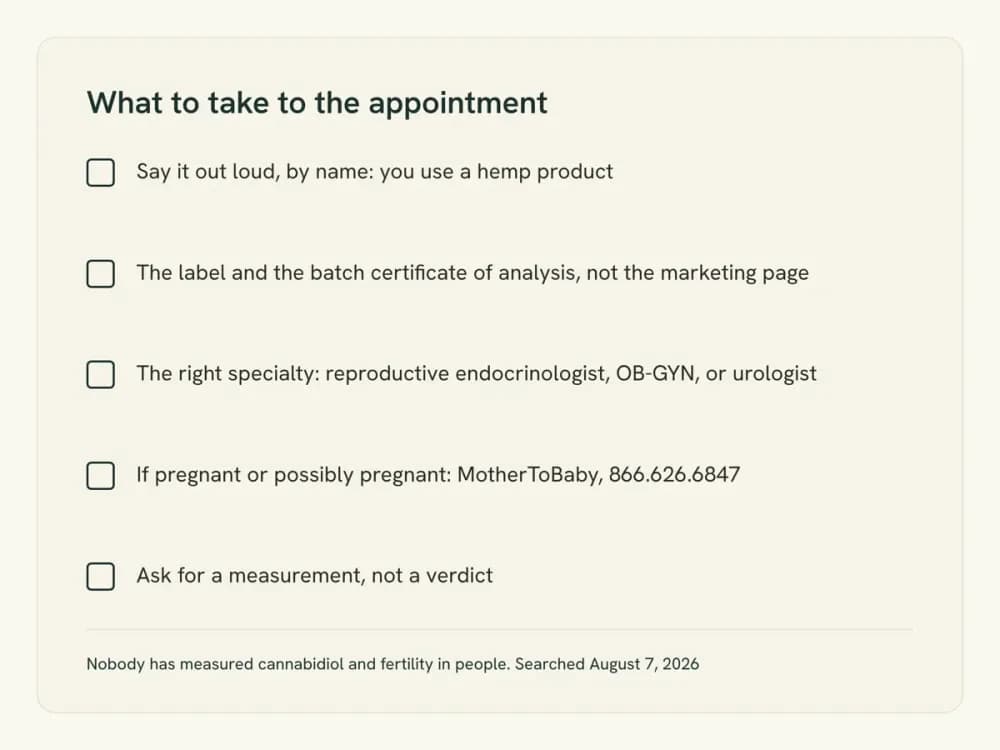
- 1Say it out loud, by name. Tell the clinician managing your fertility care that you use a hemp product. Cannabidiol is not on most intake forms, so it will not come up unless you raise it.
- 2Bring the actual label and the batch certificate of analysis, not the marketing page. The certificate is the only document that states what was measured in what you took, including THC.
- 3Ask the right specialty. For conception questions that is a reproductive endocrinologist, an OB-GYN, or a urologist for male-factor questions. A general appointment tends to rush past this.
- 4If you are or may become pregnant, MotherToBaby answers exposure questions for free at 866.626.6847, by text at 855.999.3525 and by chat, in English and Spanish, Monday to Friday.
- 5Run the 60-second citation check on anything you read, including this. Open the study, read the Methods, and find the species and the system before you believe the headline.
- 6Ask for a measurement instead of a verdict. A semen analysis or a cycle workup ordered by your clinician tells you about you. No article, ours included, can substitute for that.
Where this leaves the question, and what we sell
Put every document on this page in one row and the shape is clear. The confident answers in both directions are unsupported. The animal work is real, and three of its four reproductive findings describe exposure windows that no adult taking a hemp product is in. The human-cell work is real, and it is cells. The one randomized trial in people found no hormone difference over 28 days, which is less than half the time it takes to make a cohort of sperm. The largest human cohort is about cannabis, points upward on androgens, and the same team's follow-up in cells points downward. The regulator that reviewed the drug label lists human male reproductive toxicity among its own open questions. As of the searches printed at the top of this page, nobody has measured whether taking cannabidiol makes it harder for a person to conceive. Not us, not the sellers, not the clinics, not the reviews. If that feels like an unsatisfying place to end, it is the accurate one, and the alternative on offer is somebody's guess wearing a percentage.
Now the part you should weigh when you read the rest. We sell CBD tinctures. The commercially convenient version of this page is the one that leads with the adult rat mating study, says no adverse effects on fertility, and stops. We printed the juvenile finding where the label records that a no-effect dose was not established, the metabolite finding whose no-effect dose sits at roughly human exposure, the FDA laboratory's cytotoxicity and senescence results in human Sertoli cells, and the paper showing cannabidiol reducing androgen output in cells, because leaving them out would have made this page worthless to the person who came here to decide something. There is nothing to buy on this page and no link on it to anything we sell, and that is deliberate rather than an oversight. If you want the neutral background instead, what cannabidiol is covers the compound itself, and reading what is actually on a CBD label explains why a milligram figure on a bottle and a mg/kg figure in a study are not the same kind of number.
Common questions
Nobody has measured that in people. On August 7, 2026, PubMed returned zero clinical trials or randomized trials of cannabidiol with sperm, semen or fertility, and ClinicalTrials.gov listed no registered study. What exists is three animal findings in three different life stages. Juvenile rats given cannabidiol's major metabolite at the high dose had decreased sperm concentration and increased abnormal sperm, per the Epidiolex label, section 8.4. Post-weaning mice given 15 or 30 mg/kg/day for 34 days had a 38% reduction in epididymal sperm number at both doses. And adult rats dosed before and throughout mating showed no adverse effects on fertility, at plasma exposures roughly 18 and 14 times human. Two species, three life stages, and not one of them is an adult person taking a hemp product.
Three sources point three ways, and the honest answer prints all three. In the FDA's randomized, placebo-controlled trial of 201 healthy adults at 5 mg/kg/day for 28 days, there was no difference between groups in total testosterone or inhibin B in men. In a cross-sectional cohort of young Swiss men, androgens were higher in cannabis users, including those whose smoked product contained cannabidiol, though everyone in that exposed group used cannabis, so it is an association and not a cause. And when the same Swiss team put THC and cannabidiol on human adrenal cells, both reduced testosterone output, which is why they concluded that direct stimulation was not the explanation for their own cohort result. Anyone quoting one of those three at you is quoting a third of the evidence.
We cannot tell you that, and neither can any page that does. There is no human study of cannabidiol and conception, no registered trial, and the FDA lists the question of whether CBD causes male reproductive toxicity in humans among its own unanswered questions. What this page recommends is not to start and not to stop, because we have no basis for either instruction. It is to tell the clinician managing your fertility care that you use a hemp product, and to bring the label and the batch certificate of analysis with you so the conversation is about what you actually take rather than about a category.
The female evidence is thinner than the male evidence, and it is worth being exact about how thin. There is no human study of cannabidiol and ovulation, cycle length or time to pregnancy. There are two findings. Juvenile rats given cannabidiol's major metabolite at the highest dose had disrupted estrous cyclicity, on the same drug label discussed above. And a 2025 experiment on a human endometrial stromal cell line at 2 micromolar found changes in estrogen receptor transcription, androgen receptor activation and senescence markers, with the authors writing that phytocannabinoids may disrupt endometrial endocrine signalling, potentially affecting female fertility. A cell line at one concentration is not a cycle. That is the entire dossier.
Nobody has published a clearance window tied to a fertility endpoint, so any number you are given for this was invented. One biological fact is worth knowing, and it is not advice. A stable-isotope study in 11 men measured one full cycle of sperm production directly at 64 plus or minus 8 days, range 42 to 76. That is why a four-week study, including the FDA's, ends before a single cohort of newly made sperm has arrived, and it is why hormone results over 28 days cannot answer a sperm question. What that means for your situation is a question for your clinician, not for a blog, and this page deliberately gives no timing instruction of any kind.
No, and the figure is not 30%. It comes from a 2015 study of 1,215 Danish men aged 18 to 28, in which those who smoked marijuana more than once a week had 28% lower sperm concentration and 29% lower total sperm count after adjustment; combined with other recreational drugs the figures were 52% and 55%. That is smoked cannabis, self-reported on a questionnaire, measured once, and none of those men were taking a CBD product. The same paper also found that marijuana smokers had higher testosterone, within the same range as cigarette smokers, which is the half that never gets carried across when the number is borrowed for a CBD headline.
Writing about hemp, wellness and the small rituals that keep us balanced.