CBD and Antibiotics: The Interaction Runs the Other Way
Page one asks what CBD does to your antibiotic. The only interaction measured in people runs the other way: an antibiotic cut cannabidiol exposure by about a third on the FDA-approved label, and by about half in a separate human trial. What the labels say, drug by drug.
You have a ten-day prescription in one hand and a dropper bottle in the other, and you want to know whether they belong in the same day. Search CBD and antibiotics and almost every result answers one question: what does the CBD do to the antibiotic? The only interaction anyone has actually measured in people runs the other way. An antibiotic changed the cannabidiol, and it made the cannabidiol weaker.
What follows is a map of that question rather than a verdict on it: what has been measured, in which direction, in whom, in which form of cannabidiol, and at what dose, alongside the parts nobody has measured at all. It is not a ruling that the two are safe together, and it is not a ruling that they are dangerous together, because no study exists that could support either one. It contains no instruction to change any medication, and the single action it ends on is a conversation.
Why "CBD and antibiotics" is usually asked backwards
Every consumer page on this topic starts from the same assumption: CBD is the thing that interferes. That assumption grows out of a real fact. Cannabidiol is cleared by liver enzymes, and the FDA-approved cannabidiol label states it plainly: cannabidiol is metabolized in the liver and the gut (primarily in the liver) by CYP2C19 and CYP3A4 enzymes, and UGT1A7, UGT1A9, and UGT2B7 isoforms. Those enzymes handle a large share of prescription medicine, so "CBD is cleared by CYP3A4" gets converted into "CBD will change your prescription" without anyone checking whether it was measured. If the general framework is what you came for, our page on how CBD interacts with other medications keeps the broad drug list and the enzyme primer, and the plain chemistry of cannabidiol sits one level above that. This page takes one class of drug and goes deep.
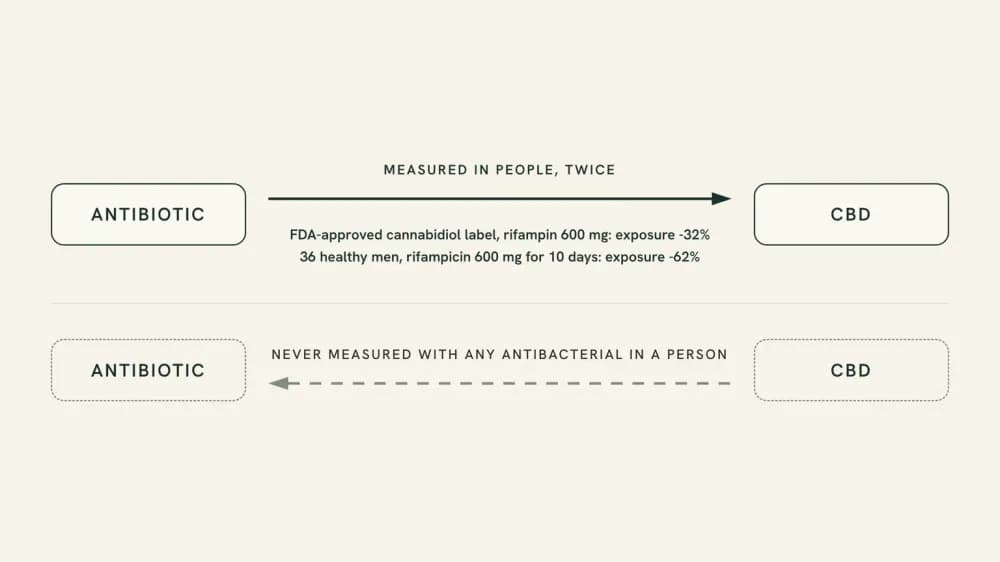
An interaction has a direction, and the two directions have wildly different amounts of evidence behind them. Direction one, the antibiotic changes the CBD, has been measured twice in humans, both times with the same antibiotic, and both times the CBD went down. Direction two, the CBD changes the antibiotic, has no published human measurement behind it at all: the PubMed searches at the end of this article, run on August 4, 2026 and reproducible from the queries printed there, return no study that gave CBD with an antibacterial and then measured the antibacterial. Everything written about that second direction is inferred from probe drugs and enzyme lists, and as you will see, the probe drugs disagree with each other. Keeping the two directions apart is most of the work on this page, and it is the thing page one does not do.
The one antibiotic that has been measured with CBD in people: rifampin
Rifampin is an antibiotic. On its own FDA-approved label its indications are tuberculosis and asymptomatic carriers of Neisseria meningitidis, with the label adding that it is not indicated for the treatment of meningococcal infection. It is also, in pharmacology, the reference example of a strong enzyme inducer, meaning a drug that makes the liver produce more clearing enzyme than usual. That same label lists what it affects: drug metabolizing enzymes and transporters affected by rifampin include cytochromes P450 1A2, 2B6, 2C8, 2C9, 2C19, and 3A4, UDP-glucuronyltransferases, sulfotransferases, carboxylesterases, and transporters including P-glycoprotein. Set that list beside the enzymes that clear cannabidiol and the overlap is hard to miss: rifampin induces both of the two largest ones.
That overlap was not left as a theory. The prescribing information for EPIDIOLEX, the FDA-approved cannabidiol oral solution, reports in section 12.3 that coadministration with rifampin, a strong CYP3A4 and CYP2C19 inducer, caused a decrease in cannabidiol exposure of 32% and 34% for AUC and Cmax. The active metabolite fell much further: 7-OH-CBD decreased by 63% and 67% for AUC and Cmax. The people in that arm were healthy volunteers given pharmaceutical cannabidiol oral solution, the FDA-approved prescription form, alongside rifampin 600 mg once daily. The label prints the rifampin dose and does not print the cannabidiol dose for that arm, so no cannabidiol amount is quoted here for it. What is certain either way is that none of it was a hemp tincture.
“Concomitant use with a strong CYP3A4 and CYP2C19 inducer (rifampin 600 mg once daily) decreased cannabidiol and 7-hydroxy-cannabidiol (7-OH-CBD) plasma concentrations by approximately 32% and 63%. The impact of such changes on efficacy of EPIDIOLEX is not known. Consider an increase in EPIDIOLEX dosage (based on clinical response and tolerability) up to 2-fold, when concomitantly used with a strong CYP3A4 and/or CYP2C19 inducer.”
Two things about that quote matter more than the percentages. The first is who it is written to. It is an instruction to a prescriber about a prescription medicine in a monitored patient, and it says in its own words that the impact of such changes on efficacy is not known. It is not advice to anybody holding a dropper bottle, and this article is not restating it as such. The second is what it says about direction. The concern the regulator recorded is that the antibiotic makes the cannabidiol do less, not that the cannabidiol makes the antibiotic do less. Rifampin is also not the prescription most readers are holding: it belongs to tuberculosis regimens and meningococcal carriage, plus some off-label use in staphylococcal and prosthetic-joint regimens, which is a different world from a five-day course for a sinus infection.
A second human trial found the same direction, and a bigger effect
The label is not the only human measurement, and the second one is almost never quoted. A 2013 open-label randomized crossover trial published in SpringerPlus enrolled 36 healthy male volunteers, 12 per group, and gave each of them a single dose of four sprays of a THC/CBD oromucosal spray delivering 10.8 mg of THC and 10 mg of CBD, once on its own and once after ten days of rifampicin 600 mg daily. After the rifampicin, the peak CBD concentration fell by about 52% (geometric mean ratio 0.480, 90% confidence interval 0.420 to 0.550) and CBD exposure over the measured period fell by about 62% (ratio 0.381, 90% confidence interval 0.274 to 0.529). Same antibiotic, same direction as the label, roughly twice the size.
Read the design before carrying that number anywhere. This was an oromucosal spray absorbed through the lining of the mouth rather than a swallowed oil, and it contained THC alongside the CBD, so it is not a clean test of oral cannabidiol on its own. It was 12 men per arm and no women. The CBD concentrations being measured sat near the bottom of the assay, with peaks around 1 ng/mL, and for several CBD profiles more than 20% of the total exposure had to be extrapolated rather than measured, which is the point at which pharmacokineticists start handling a number carefully. The authors are identified with the manufacturer of the spray. So it is a small, sponsored, early-phase study, and it is also the only other time anyone has done this in people. It agrees with the regulator-reviewed result, which is worth more than either number on its own.
The neat mirror image, and the result on the same label that spoils it
If an enzyme inducer lowers cannabidiol, the obvious next thought is that an enzyme blocker must raise it, and therefore that a macrolide antibiotic like clarithromycin, which its own label calls a strong CYP3A4 inhibitor, will push your CBD up. The same label section that produced the rifampin number tested exactly that idea, using two strong blockers that are both antifungals rather than antibacterials, which matters for how far the result travels. Itraconazole, a strong CYP3A4 inhibitor and an antifungal, increased exposure by less than 10% for cannabidiol. Fluconazole, a strong CYP2C19 inhibitor and also an antifungal, moved cannabidiol by 22% and 24% for AUC and Cmax, and the label's own verdict on that deserves quoting whole: although the effects of a strong CYP2C19 inhibitor fluconazole were slightly more marked, they are still considered not to be clinically meaningful. Blocking either enzyme did far less to cannabidiol than inducing both.
That is not unanimous, and printing only the tidy half would be dishonest. The same 2013 trial that produced the larger rifampicin effect also ran an arm with ketoconazole, another antifungal and a strong CYP3A4 blocker, at 400 mg. In that group of 12 healthy men, the trial's abstract reports peak CBD concentration rising from 0.66 to 1.25 ng/mL, an increase of 89%, and its tables put the geometric mean ratio for CBD exposure over the measured period at 2.715 (90% confidence interval 2.047 to 3.601), close to a tripling. So two human datasets disagree about what blocking CYP3A4 does to cannabidiol: almost nothing on the label, close to a tripling in the trial. Different formulation, different route of absorption, very small numbers on both sides. What survives the disagreement intact is the antibacterial conclusion, because neither dataset used an antibacterial as the blocker. The inhibitor half of this story is unsettled, and anyone telling you confidently that a Z-Pak will raise your CBD levels has not read either dataset.
There is a mechanistic reason induction and blocking are not symmetric here, and it comes from a 2023 physiologically based pharmacokinetic model published in CPT: Pharmacometrics and Systems Pharmacology, built from laboratory enzyme data and then checked against the observed clinical ratios. That model partitions cannabidiol's clearance across six routes: CYP3A4 38%, CYP2C19 21%, UGT1A9 16%, CYP2C9 11%, UGT2B7 10% and UGT1A7 4%. Block one enzyme and roughly four fifths of the machinery keeps working. Induce CYP3A4 and CYP2C19 at the same time, which is what rifampin does, and you have accelerated the two largest contributors at once. This is a model rather than a trial, and its simulated numbers do not land exactly on the observed ones (it predicted a rifampicin exposure ratio of 0.49 against an observed 0.69), but it explains the asymmetry that both human datasets show.
Does CBD change the antibiotic? What the probe studies show
Now the direction everybody actually asks about, where the evidence is thinner and stranger than the confident sentences on page one suggest. No published trial has given CBD with an antibacterial and then measured the antibacterial. What exists is probe-drug work, in which researchers give a standard test drug whose clearance route is already known and watch what happens to it. For CYP3A4 the standard probe is midazolam, and the FDA-approved cannabidiol label reports that coadministration of EPIDIOLEX (750 mg twice daily) with a single dose of midazolam (2.5 mg), a sensitive CYP3A4 substrate, did not result in changes in plasma concentrations of midazolam compared to midazolam administered alone. That is 1,500 mg a day of pharmaceutical cannabidiol oral solution failing to move a drug chosen precisely because it is easy to move. The same label's list of substrate classes prescribers should consider a dose change for names CYP1A2, CYP2B6, CYP2C8, CYP2C19, UGT1A9 and orally administered P-glycoprotein substrates. CYP3A4 substrates are not on that list.
Left there, that reads like reassurance, so here is the study that stops it doing that. A 2023 randomized crossover trial in Clinical Pharmacology and Therapeutics gave 18 healthy adults a single 640 mg dose of CBD, delivered in a cannabis-extract brownie that also contained 20 mg of THC, followed by a cocktail of probe drugs designed to interrogate several enzymes at once. There, midazolam exposure rose 56%. So one human study says a large steady dose of pharmaceutical cannabidiol did nothing to the CYP3A4 probe, and another says a single large dose of a CBD-dominant extract raised the same probe by more than half. Both were done in people. Neither was done with an antibiotic.
The authors of the second study offer a reconciliation, and it is worth knowing because it changes what "CBD blocks CYP3A4" even means. The proposal is that a single dose of CBD blocks CYP3A4 while repeated dosing induces it, so the acute and the chronic answers point in opposite directions. The support for that comes from work in human liver cells published in Drug Metabolism and Disposition in 2025, where CBD at 420 nanomolar raised CYP3A4 messenger RNA 3.3-fold to 11.1-fold in three of four donor cell lots over 72 hours, and CYP3A activity 2.3-fold to 3.4-fold in two lots. Those are cells in a plate rather than people, and the donor lots disagreed with each other. It is an explanation on offer, not a finding about anybody's prescription.
Keep the scale attached to all of it. The 750 mg twice daily in the label is 1,500 mg of pharmaceutical cannabidiol a day. At 250 mg/mL, the concentration of a Planntz tincture, that would be 6 mL a day, roughly 120 drops at about 0.05 mL per drop, or about a tenth of a 60 mL bottle every single day. That arithmetic is here to show the distance between these published figures and a bottle on a kitchen shelf, not to suggest anyone close it. Amounts belong to our guide to working out a CBD serving, not to a page about prescriptions. And if AUC and Cmax are unfamiliar terms, the caffeine page works through what AUC and Cmax actually mean and why a metabolite moving is the signature of a blocked enzyme. The bottom line for this section is narrow and firm: "CBD slows your antibiotic down" is printed across the search results with no study behind it, not for clarithromycin, not for erythromycin, not for anything else you are likely to be handed.
Route by route: what your prescription is actually cleared by
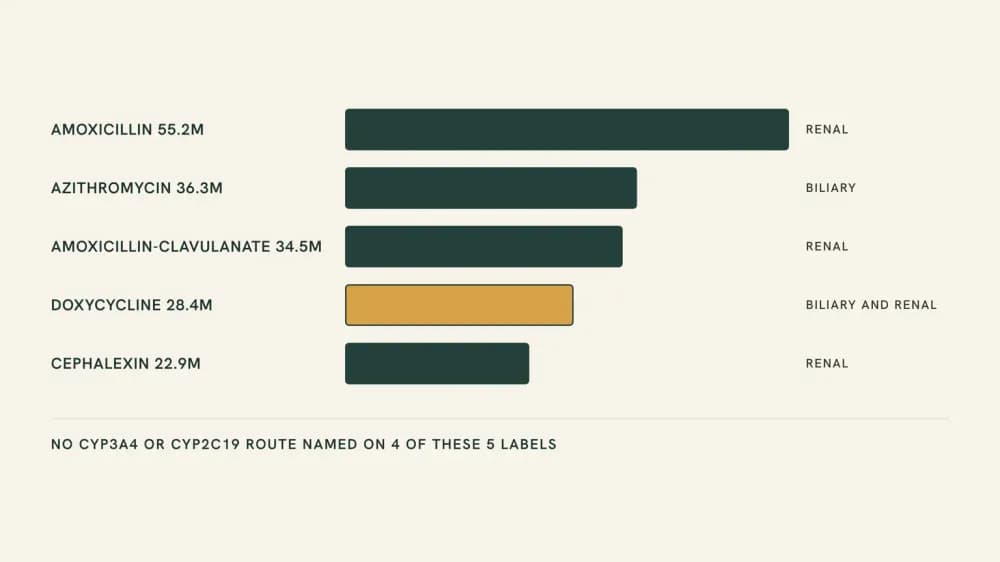
This is the part page one never does. Antibiotics are not one thing, and the ones Americans are actually handed are mostly not cytochrome P450 drugs at all. The CDC's outpatient antibiotic prescribing report for 2024 counts 255.9 million oral antibiotic prescriptions dispensed in US outpatient pharmacies that year. The five most-dispensed agents were amoxicillin at 55.2 million, azithromycin at 36.3 million, amoxicillin-clavulanate at 34.5 million, doxycycline at 28.4 million and cephalexin at 22.9 million. Every row in the table below was read from that drug's own FDA-approved label. None of those labels mentions cannabidiol anywhere. They establish the route, not an interaction.
| Antibiotic | What its own FDA label says about clearance | CYP3A4 or CYP2C19 named? | What that means here |
|---|---|---|---|
| Amoxicillin (55.2M prescriptions in 2024) | "Primarily eliminated by the kidney." A whole-document search returns zero hits for CYP, cytochrome or P450 | No | No shared route on the two labels. That is not the same as a study showing nothing happens |
| Amoxicillin-clavulanate (34.5M) | "Substantially excreted by the kidney." The only metabolic interaction named is probenecid, which slows amoxicillin's renal secretion | No | Same position as amoxicillin |
| Cephalexin (22.9M) | "Excreted in the urine by glomerular filtration and tubular secretion"; over 90% excreted unchanged in the urine within 8 hours | No | Same position again, and it leaves the body fast |
| Azithromycin (36.3M) | Metabolism studies "have not been performed"; biliary excretion of predominantly unchanged drug is a major route; about 6% appears unchanged in urine; terminal half-life 68 hours | No | The macrolide most people are actually prescribed is not a labeled CYP drug |
| Doxycycline (28.4M) | Concentrated by the liver in the bile and excreted in urine and feces in a biologically active form; about 40% renal over 72 hours; barbiturates, carbamazepine and phenytoin shorten its half-life | Not named | No CYP isoform on the label, but three named enzyme inducers shorten it, so not a clean no-route case |
| Clarithromycin | "Clarithromycin is a strong CYP3A4 inhibitor"; about 20-30% excreted in urine as clarithromycin, with 14-OH clarithromycin the principal metabolite | Yes, CYP3A4 | The real macrolide CYP story. Never co-administered with CBD in a published human study |
| Erythromycin | "A substrate and inhibitor of the 3A isoform subfamily of the cytochrome p450 enzyme system"; concentrated in the liver and excreted in the bile | Yes, CYP3A | Mechanism only. Same absence of human co-administration data |
| Clindamycin | "Predominantly metabolized by Cytochrome P450 3A4 (CYP3A4)", with a minor contribution from CYP3A5; inducers may reduce and inhibitors may increase its concentrations. Carries a boxed warning for C. difficile-associated diarrhea | Yes, CYP3A4 | The common oral antibacterial that genuinely is a CYP3A4 substrate |
| Ciprofloxacin | "Eliminated primarily by renal excretion", partly cleared through the biliary system and the intestine; "an inhibitor of human cytochrome P450 1A2" | No. It touches CYP1A2 | Not the enzyme pair that clears cannabidiol. Summaries calling cipro a CYP-cleared drug have it backwards |
| Levofloxacin | "Limited metabolism in humans"; about 87% of an oral dose recovered as unchanged drug in urine within 48 hours | No | No shared route on the labels |
| Nitrofurantoin | About 20-25% of a single dose recovered unchanged in urine within 24 hours; plasma levels usually under 1 mcg/mL; "bactericidal in urine" | No | It barely leaves the urinary tract in the first place |
| Sulfamethoxazole/trimethoprim | Excretion "primarily by the kidneys"; one metabolite formed via CYP2C9; trimethoprim inhibits CYP2C8 and sulfamethoxazole inhibits CYP2C9 | No. It touches CYP2C8 and CYP2C9 | Different enzymes from the pair that does most of the cannabidiol clearance |
| Metronidazole | 60% to 80% of the dose eliminated via the urine; metabolites from side-chain oxidation and glucuronide conjugation; no isoform named | Not specified | No isoform on the label to compare against |
| Rifampin | Induces "cytochromes P450 (CYP) 1A2, 2B6, 2C8, 2C9, 2C19, and 3A4, UDP-glucuronyltransferases (UGT), sulfotransferases, carboxylesterases, and transporters including P-glycoprotein (P-gp)". Labeled for tuberculosis and asymptomatic meningococcal carriers | Yes, it induces both | The documented case. Measured twice in humans, and both times the cannabidiol went down |
Two conclusions come out of that table. The first is arithmetic. Those five most-dispensed agents account for 177.3 million of 255.9 million prescriptions, about 69% of the US outpatient total, and four of the five name no CYP3A4 or CYP2C19 route on their own labels at all. The fifth, doxycycline, is not a labeled CYP drug either, though its label does say that barbiturates, carbamazepine and phenytoin, all enzyme inducers, shorten its half-life, which stops it being a clean no-route case. The second conclusion is a correction. The most repeated claim in this search-result set is that macrolides such as azithromycin, erythromycin and clarithromycin are the antibiotics to worry about with CBD. Azithromycin's own label says that in vitro and in vivo studies to assess the metabolism of azithromycin have not been performed, describes biliary excretion of predominantly unchanged drug as a major route of elimination, and names no CYP enzyme anywhere in the document. Clarithromycin and erythromycin genuinely do have CYP3A stories on their labels. Azithromycin, the macrolide most people are actually handed, does not.
One more thing the table settles, because a widely circulated AI summary of this query gets it backwards. Ciprofloxacin is not a CYP3A4 or CYP2C19 drug. Its label says it is eliminated primarily by renal excretion and that ciprofloxacin is an inhibitor of human cytochrome P450 1A2. Cannabidiol is described in its own label as a weak inhibitor of CYP1A2 as well, which is an observation about the same enzyme rather than a measured interaction between the two drugs, and CYP1A2 is not the route that carries this topic. The general lesson is duller and more useful than the SERP version: the class name on the box tells you almost nothing, and the label tells you nearly everything.
Is CBD itself an antibiotic?
There is a real literature behind this question, and it is being read badly. A 2021 paper in Communications Biology tested purified cannabidiol against bacteria in culture and reported what the authors called a strikingly consistent minimum inhibitory concentration of 1-4 μg/mL across more than 20 Gram-positive species, including methicillin-resistant Staphylococcus aureus and Clostridioides difficile, along with what the authors called excellent potency against four Gram-negative species, among them Neisseria gonorrhoeae at 1-2 μg/mL. That is a genuine microbiology result and it was published in a serious journal. It is also a result about bacteria in a dish and about mouse skin and thigh infection models, which is where the consumer version of the story usually stops reading.
The same paper contains the sentences that end it. When the researchers added 50% human serum to the assay, the antibacterial activity was abrogated, with the MRSA minimum inhibitory concentration rising above 256 μg/mL, which the authors attribute to how tightly cannabidiol binds to proteins in blood. And in the mouse thigh-infection model, CBD was ineffective when it was dosed into the body rather than onto the skin: subcutaneously at 100 mg/kg, intraperitoneally at 200 mg/kg, or orally at 250 mg/kg. Those are the authors' own findings in their own paper, not a hostile reading of it. Cannabidiol inhibiting bacteria on a plate and cannabidiol doing something about an infection inside a living animal are two different results, and in this work only the first one happened.
The paper currently sitting at the top of these search results is a 2022 study in Microorganisms reporting that a crude winterized CBD oil made from the hemp variety Suver Haze lowered the concentration of ampicillin, kanamycin or polymyxin B needed to inhibit Salmonella Typhimurium in culture, at CBD concentrations of 0.001 to 1 μg/mL, measured by fractional inhibitory concentration index and membrane-integrity assays. Read the design rather than the abstract's last line: bacterial culture only, no animals and no people anywhere in it. Two of its three partner drugs, kanamycin and polymyxin B, are not oral outpatient antibiotics at all. A synergy number from a plate is a lead for a drug-development program. It is not information about a course of tablets, and it is certainly not a reason to change one.
There is one place where the regulator-reviewed record mentions infections at all, and it points away from benefit rather than toward it: in the controlled trials pooled in the FDA-approved cannabidiol label, adverse events grouped as "Infection, all" were reported in 41% of patients at 10 mg/kg/day and 40% at 20 mg/kg/day against 31% on placebo, in children and adults with severe epilepsy who were taking several other antiseizure medicines. The label does not claim that cannabidiol caused those events, and it attributes a separate imbalance in reported pneumonia to concomitant clobazam rather than to cannabidiol.
The side effects that overlap, and the one not to blame on your CBD
For most people the practical reason this pairing matters has nothing to do with enzymes. It is that both things on the counter can upset your stomach, which makes it easy to blame the wrong one. On the cannabidiol side, the pooled controlled trials in the FDA-approved label report diarrhea in 9% of patients at 10 mg/kg/day and 20% at 20 mg/kg/day against 9% on placebo, and decreased appetite in 16% and 22% against 5%. In the tuberous sclerosis complex trial, diarrhea was reported by 31% against 25% on placebo. That is the adverse-event record that exists, and it comes from children and adults with severe epilepsy taking 10-25 mg/kg/day of a pharmaceutical oral solution alongside other antiseizure medicines, not from anyone using a consumer oil.
On the antibiotic side the same complaint is one of the most common labeled effects in medicine. The amoxicillin-clavulanate label reports diarrhea or loose stools in 9% of patients. Azithromycin's label reports diarrhea or loose stools in 4% to 5% of adults on its multiple-dose regimens, rising to 14% after a single 2-gram dose. And clindamycin carries a boxed warning for Clostridioides difficile-associated diarrhea, which the label says may range in severity from mild diarrhea to fatal colitis and has been reported to occur over two months after the administration of antibacterial agents. That last clause is the reason this section exists. The misattribution that actually hurts people is not blaming the antibiotic for something the CBD did. It is deciding that new diarrhea must be the tincture, and waiting.
Any of the following belongs to the prescriber, or to an urgent care service, whether or not a CBD oil is anywhere in the picture.
- Watery diarrhea, especially if it is frequent or getting worse rather than settling
- Diarrhea with a fever, or with abdominal pain or cramping
- Blood or mucus in the stool
- Diarrhea that starts after the course has finished, or that persists after it, which the clindamycin label notes can begin more than two months later
- Signs of dehydration: dizziness on standing, dark urine, passing very little urine
- A rash, facial swelling or difficulty breathing, which are antibiotic allergy signs rather than anything to do with enzymes, and which are an emergency rather than a phone call
None of that is a reason to stop, skip or shorten a prescribed course on your own. It is a reason to describe what is happening to the person who prescribed it, who can tell the difference between a nuisance and a complication. One boundary while we are on adverse effects: this page treats the liver as a route, the place where drugs are broken down, and whether cannabidiol can injure the liver is a separate subject with its own literature. The documented adverse effects, including the liver-enzyme ones, are collected in our review of what CBD's reported side effects actually are.
What has never been studied, and what to do about it
The honest headline of this whole topic is an absence, and it should be dated so you can re-run it yourself. As of a PubMed search run on August 4, 2026, no published study has given a consumer-sized dose of a hemp CBD oil together with an ordinary oral antibacterial such as amoxicillin, azithromycin, doxycycline or cephalexin and measured the concentration of either drug in people. The searches were cannabidiol paired with rifampicin, rifampin, clarithromycin, erythromycin or ketoconazole and with pharmacokinetics or interaction, which returned 13 records, and cannabidiol paired with the common antibacterial names above, which returned 15 records, 9 of them in humans. Resolving all of them one at a time produces reviews, a transplant case report, an everolimus phase 1 study, a pediatric antimicrobial review that predicts an effect rather than measuring one, an in vitro paper, and the two rifampicin studies already described. The entire human record on antibiotics and cannabidiol is one antibiotic, twice, both times in a pharmaceutical cannabidiol preparation, and both times measuring what the antibiotic did to the CBD.
Which brings up the single most repeated piece of advice on this subject, and the one that does not match the mechanism it claims to be about. Several pages tell you to space your CBD and your antibiotic a few hours apart so they do not overlap in the liver. The effect that has actually been measured here is induction, and induction is not an overlap in the moment. It is the liver building extra enzyme over days and then unwinding it over days. You can see that timescale written into other FDA labels: the labeling for levonorgestrel and ethinyl estradiol tablets instructs patients to continue backup contraception for 28 days after discontinuing the enzyme inducer. Twenty-eight days, not four hours. That particular instruction is about contraception, which has its own page here, and it is quoted only to show how long induction lasts. Spacing does not address it, and inventing a schedule for yourself is not a substitute for asking the pharmacist who filled the prescription.
So the genuinely useful list is short, and none of it involves changing a medication on your own.
- 1Tell the prescriber, or the pharmacist who filled the prescription, that a CBD oil is in the picture. Pharmacists run interaction checks all day, the conversation is free, and the question will not surprise them.
- 2Name the specific item rather than saying "CBD oil": the milligrams per milliliter, the size of the bottle, whether it is full spectrum, broad spectrum or isolate, and how often you take it.
- 3Bring the rest of the list too. Interactions are rarely about two things, and the pharmacy already holds the medication record.
- 4Take the course exactly as it was written, for exactly as long as it was written. Nothing on this page is a reason to change that.
- 5Write down anything new that starts and the date it started, so the follow-up conversation runs on dates rather than impressions.
- 6If the prescription is rifampin or another rifamycin, say so explicitly. It is the one antibiotic with measured human data here, and it is the one a prescriber will want to know about.
That is a question for the prescriber, and here is what is actually on the record. Amoxicillin is the most-prescribed oral antibiotic in the United States, with 55.2 million prescriptions dispensed in 2024 according to CDC, and its FDA label says it is primarily eliminated by the kidney, with no cytochrome P450 enzyme named anywhere in the document. Cannabidiol is cleared mainly by liver enzymes. So there is no shared metabolic route on the two labels, which is a different statement from a study showing the combination is fine. Nobody has run that study. Name the CBD oil to whoever wrote the prescription, and let them make the call.
No study has measured an antibacterial's blood levels in a person taking CBD, so nobody can answer that from data. The closest human evidence uses probe drugs and it disagrees with itself. The FDA-approved cannabidiol label reports that 750 mg of pharmaceutical cannabidiol oral solution twice daily did not change midazolam concentrations, midazolam being the standard sensitive CYP3A4 test drug. A separate 2023 trial in 18 healthy adults gave a single 640 mg dose of CBD in a cannabis-extract brownie containing 20 mg of THC and found midazolam exposure rose 56%. Two measurements, two answers, and neither of them involved an antibiotic.
That advice is everywhere in the search results and it does not match the mechanism it claims to describe. The one measured antibiotic effect on this page is enzyme induction, which is the liver making more clearing enzyme over a period of days and then unwinding it over a period of days. It is why a different FDA label tells patients to continue backup contraception for 28 days after stopping an enzyme inducer. A few hours does not touch a process on that timescale. Rather than invent a schedule, ask the pharmacist who filled the prescription, and take the course exactly as written.
In a dish, purified cannabidiol inhibits many Gram-positive bacteria at 1-4 μg/mL, and a 2022 paper found that a crude hemp CBD oil lowered the concentration of ampicillin, kanamycin and polymyxin B needed against Salmonella Typhimurium in culture. In the same 2021 paper that produced the inhibitory concentration data, adding 50% human serum abolished the activity, and cannabidiol dosed orally at 250 mg/kg failed to treat infection in mice. None of that transfers to swallowing a tincture, nothing in it says CBD helps a prescribed antibiotic work, and nothing here is a reason to change how a course is taken.
On their own FDA labels, the ones with real CYP3A4 involvement are clarithromycin (a strong CYP3A4 inhibitor), erythromycin (a CYP3A substrate and inhibitor), clindamycin (predominantly metabolized by CYP3A4) and the rifamycins, which induce CYP3A4 and CYP2C19. Amoxicillin, amoxicillin-clavulanate, cephalexin, azithromycin, levofloxacin and nitrofurantoin name no CYP3A4 or CYP2C19 route at all. Sharing a route on paper is a reason for a pharmacist to look, not a finding. Only the rifamycin case has ever been measured in people.
Both are on the list, which is exactly why guessing is the wrong move. Diarrhea was reported by up to 20% of patients on 20 mg/kg/day of pharmaceutical cannabidiol against 9% on placebo in the pivotal epilepsy trials, and it is also among the most common labeled effects of several antibiotics, at 9% for amoxicillin-clavulanate and, depending on the regimen, 4% to 14% for azithromycin. The reason to ask rather than guess is that antibiotic-associated Clostridioides difficile diarrhea is a medical problem in its own right, it carries a boxed warning on the clindamycin label, and it can begin more than two months after a course ends. Watery, bloody or feverish diarrhea is a call to the prescriber, not a reason to assume it was the tincture.
Writing about hemp, wellness and the small rituals that keep us balanced.