CBD and Alcohol: What Three Human Studies Actually Found
Researchers have given people CBD and a measured dose of alcohol in three published studies: two in 1979 and one in June 2026. Here is what each one measured, why a lower breathalyzer reading is not less impairment, and what no study has tested yet.
As of July 2026, three published studies have given people CBD and alcohol together at measured doses: two in 1979 and one in June 2026. One of the 1979 studies reported lower blood alcohol readings when CBD was added, which is where the internet's idea that CBD helps you handle a drink comes from. That same study reported that the impairment did not change. This page describes all three studies, translates their doses into something you can hold next to a dropper, and says plainly what the evidence does not cover.
Here it is in one paragraph, before the detail. There is no established waiting time between CBD and alcohol, no evidence that CBD reduces what alcohol does to you, and one thing regulators state plainly: combining CBD with alcohol raises the risk of sedation and drowsiness. Nothing in the human literature supports CBD as a hangover remedy, a liver protector or a way to drink more safely. If you use both, the supportable moves are small and unglamorous. Keep the amounts modest, do not drive, do not add other sedating substances, and tell a clinician you use both. If you are new to the compound itself, what cannabidiol actually is covers the ground this page assumes.
The short answer, and the one sentence most pages get backwards
Start with the only sentence a federal agency has written about this combination. The FDA's consumer update on products containing cannabis or cannabis-derived compounds says that using CBD with alcohol or other drugs that slow brain activity 'increases the risk of sedation and drowsiness, which can lead to injuries.' Read the verb. That is a risk statement, not a measured amplification: the agency gives no dose, no population and no magnitude, and it does not claim anyone has measured how much worse the combination is. It is still the clearest thing any regulator says here, and it is the sentence to plan around.
The sentence most pages get backwards is about blood alcohol. Several CBD sites and a few health sites report that a 1979 study found lower blood alcohol levels when CBD was taken with alcohol, and then treat that as good news, as though CBD had absorbed part of the drink. The same paper reported that the people in the lower-reading condition were just as impaired. A number that no longer tracks impairment is not protection. It is a broken gauge, and the rest of this page is mostly about why that distinction matters more than anything else on the topic.
What 200 mg of CBD actually is
Study doses only mean something once you can put them next to what you actually use. On the alcohol side, the NIAAA defines a US standard drink as about 14 grams of pure alcohol, which is a 12 oz beer at 5% ABV, a 5 oz glass of wine at 12%, or a 1.5 oz shot of spirits at 40%. On the CBD side, a 250 mg/mL tincture (the concentration Planntz bottles) delivers roughly 12.5 mg per drop at the usual 0.05 mL drop, so the 200 mg used in 1979 is 200 divided by 12.5, or 16 drops taken at once. The alcohol dose in that study, 1 g/kg, works out to 70 g for a 70 kg adult, and 70 divided by 14 is five standard drinks in one sitting. The other 1979 study used 320 micrograms per kilogram, which is 0.32 mg times 70, or about 22 mg: closer to two drops.
| Study | CBD dose as published | In drops of a 250 mg/mL tincture | Alcohol dose as published | In US standard drinks (14 g each) |
|---|---|---|---|---|
| Belgrave 1979 | 320 micrograms/kg, about 22 mg for a 70 kg (154 lb) adult | About 2 drops | 0.54 g/kg, about 38 g for 70 kg | About 2.7 drinks |
| Consroe 1979 | 200 mg, single oral capsule | 16 drops | 1 g/kg, 70 g for 70 kg | 5 drinks |
| Wolinsky 2026 | 50 mg and 100 mg, CBD isolate softgels | 4 drops and 8 drops | Vodka dosed by weight and sex to a target peak blood alcohol of 0.06 g/100 mL | A target, not a fixed amount |
| Crockett 2020 | 750 mg, prescription CBD oral solution | 60 drops | 40 g in 500 mL of lemonade, drunk within 5 minutes | About 2.9 drinks |
| Bogenschutz 2026 | 600 mg/day, then 1,200 mg/day | 48 and 96 drops a day | Not administered (outpatient alcohol use disorder trial) | Not applicable |
Two things fall out of that table. The first is that most of this research does not describe what most people are doing: 16 drops at once, or 60, is not a label serving. The second is the trap in the opposite direction. A smaller amount is not therefore safe with alcohol; it is untested with alcohol. The only study in the group that used an amount close to a normal serving is Belgrave's roughly 22 mg, and it was 15 people in 1979.
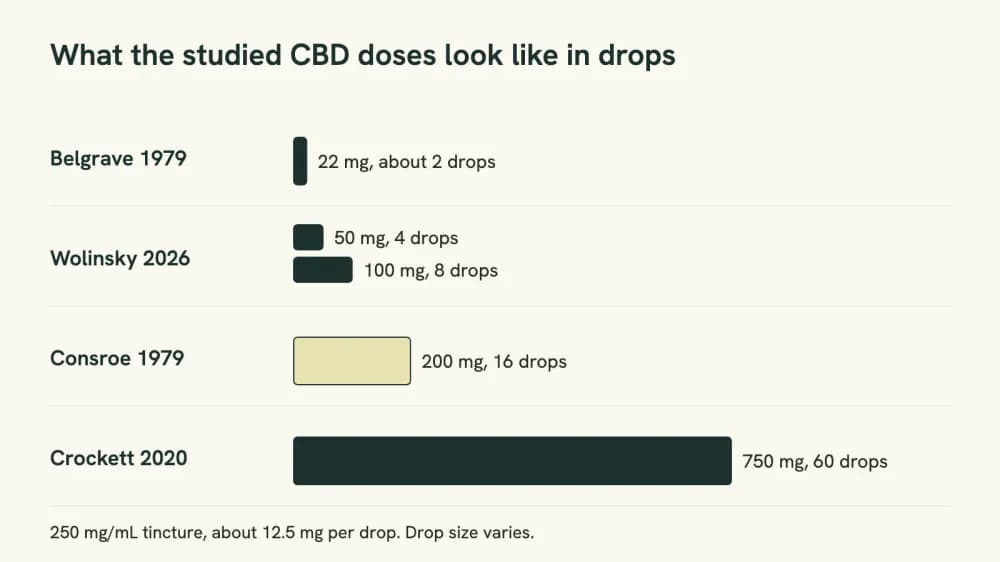
The three times researchers gave people CBD and alcohol together
The 1979 crossover study by Consroe and colleagues, published in Psychopharmacology, is the one everybody cites. Ten healthy volunteers, six men and four women, went through four conditions a week apart in a double-blind randomized design: placebo, 200 mg of CBD in a capsule, alcohol at 1 g/kg in orange juice, and both together. The measures were a finger tap test, cancellation and aptitude tests, a one-minute time production task, a 66-item adjective-pair rating scale, and breathalyzer estimations of blood alcohol. Alcohol alone and alcohol plus CBD both produced significant impairment of motor and psychomotor performance, overestimation of time, and subjective ratings the authors described as an accurate self-perception of intoxication. CBD alone produced none of that. And the combination produced significantly lower blood alcohol readings than alcohol alone. The abstract gives no figure for how much lower and the full text sits behind a paywall, so 'significantly lower' is as precise as anyone can honestly be. Note also that the measurement was a breathalyzer estimate, not a blood draw.
The second 1979 study, by Belgrave and colleagues, is usually described on the same page as though it were a replication at the same dose. It was not, and this is the factual error the whole search results page repeats. Fifteen volunteers took CBD at 320 micrograms per kilogram or placebo, then 60 minutes later an ethanolic drink at 0.54 g/kg or placebo, with testing at 100, 160 and 220 minutes. That is about 22 mg of CBD for a 70 kg adult, roughly one-ninth of Consroe's amount, and an alcohol dose about half as large. Factor analysis produced three factors: reaction speed, standing steadiness, and psychomotor coordination with cognitive performance. Ethanol significantly worsened the third one. On CBD the authors wrote: 'There was no demonstrable effect of CBD, either alone or in combination with ethanol.' They also reported that prior administration of CBD did not significantly affect blood ethanol levels, and that subjects correctly identified the ethanol but did not report any subjective effects of CBD at all.
The third study is the newest human data anybody has, and it appears on none of the pages currently ranking for this question. In a Phase I trial published in June 2026, 19 healthy adults who drink moderately took 50 mg or 100 mg of CBD isolate with vodka dosed to a target peak blood alcohol of 0.06, and peak breath alcohol came out at 0.074 and 0.072 against 0.071 on placebo, with no significant difference in subjective effects or on a psychomotor battery four hours later. That is reassuring and it is narrow: 19 people, one laboratory, CBD isolate rather than a full-spectrum product, healthy moderate drinkers, and authors affiliated with CBD companies. The trial's own conclusion asks for the safety in people with more severe alcohol use to be examined in future studies.
Some detail worth having on that one, because it is the best data anybody has. It ran at Johns Hopkins and Auburn. Twenty-nine people enrolled and 19 completed, against 30 planned. Each attended three blinded acute sessions in random order: placebo, 50 mg or 100 mg, given as softgels of CBD isolate in MCT oil with an MCT-oil placebo, followed immediately by 80 proof vodka mixed with Crystal Light and dosed by body weight and biological sex. The omnibus test on peak breath alcohol returned p = 0.89. No global score on the DRUID psychomotor battery exceeded 57 four hours after dosing, and no adverse event occurred in any acute session. Participants then took 50 mg twice daily for four weeks with no placebo comparison in that phase, where two adverse events appeared, somnolence and headache. On the conflicts, which are substantial: one author is an employee of Charlotte's Web, another held Canopy Growth stock options while the trial ran, a third is a former Canopy employee, and Canopy Growth both funded the trial and supplied the CBD given to participants. The paper also describes its mitigations, a conflict-free Auburn investigator overseeing administration, independent data curation at Johns Hopkins, and no Canopy rights over interpretation. Both facts belong in view at once.
| Study | People and design | What it measured | What it found |
|---|---|---|---|
| Consroe 1979 (PMID 120541) | 10 healthy volunteers, double-blind randomized crossover, 4 conditions a week apart | Motor and psychomotor tests, time production, a 66-item subjective scale, breathalyzer estimations | Alcohol and alcohol plus CBD both impaired performance, CBD alone did not, and blood alcohol readings were significantly lower with CBD, with few differences between the two alcohol conditions |
| Belgrave 1979 (PMID 115049) | 15 volunteers, placebo-controlled, CBD 60 minutes before the drink, tested at 100, 160 and 220 minutes | Reaction speed, standing steadiness, psychomotor and cognitive performance, blood ethanol, subjective effects | Ethanol worsened the psychomotor and cognitive factor. No demonstrable effect of CBD alone or in combination, and no significant effect on blood ethanol levels |
| Wolinsky 2026 (PMID 42288934) | 19 completers of 29 enrolled, healthy adults 21 to 65 who drink moderately, 3 blinded acute sessions plus 4 weeks outpatient | Peak and time course of breath alcohol, subjective effects, the DRUID psychomotor battery, labs, craving, drinks per day | Peak breath alcohol 0.071 on placebo, 0.074 at 50 mg, 0.072 at 100 mg, omnibus p = 0.89. No significant difference in subjective effects or psychomotor performance. No acute adverse events |
One note on that count, because 'three studies' is doing real work here and other pages still say two. On July 30, 2026, a PubMed search for cannabidiol and alcohol filtered to randomized controlled trials returned 37 records, a title search pairing CBD or cannabidiol with alcohol or ethanol returned 52, and a search pairing cannabidiol with breath or blood alcohol measurement returned 9. Reading every title in those sets, only the three above actually gave people CBD together with a measured dose of alcohol. Database counts move, so that is where this one stood on that date.
Why a lower blood alcohol number is not less impairment
A lower number on a breathalyzer is not less impairment. In the 1979 study that reported lower blood alcohol readings with CBD, the researchers also reported that 'there were few differences observed between the pharmacological effects of the two alcohol conditions', and their own conclusion was that CBD's inactivity on motor and mental performance 'also extends to its interaction with alcohol.' In other words, the authors did not read their own result as CBD blunting alcohol. They read it as CBD doing nothing much, including in combination.
“there were few differences observed between the pharmacological effects of the two alcohol conditions”
The 2026 team looked at the same finding and did not inherit it. They note that their results contrast with Consroe's on peak breath alcohol, and they attribute the difference to dose: 200 mg in 1979 against 50 and 100 mg in theirs. That is their interpretation and not a demonstrated mechanism. What can be said without interpretation is narrower and more useful. The lower-reading result has stood unreplicated for 47 years. The other 1979 study, at a much smaller dose, found no significant effect on blood ethanol. And the newest and best-controlled measurement found peak breath alcohol essentially identical across placebo, 50 mg and 100 mg. One result, three studies, no replication.
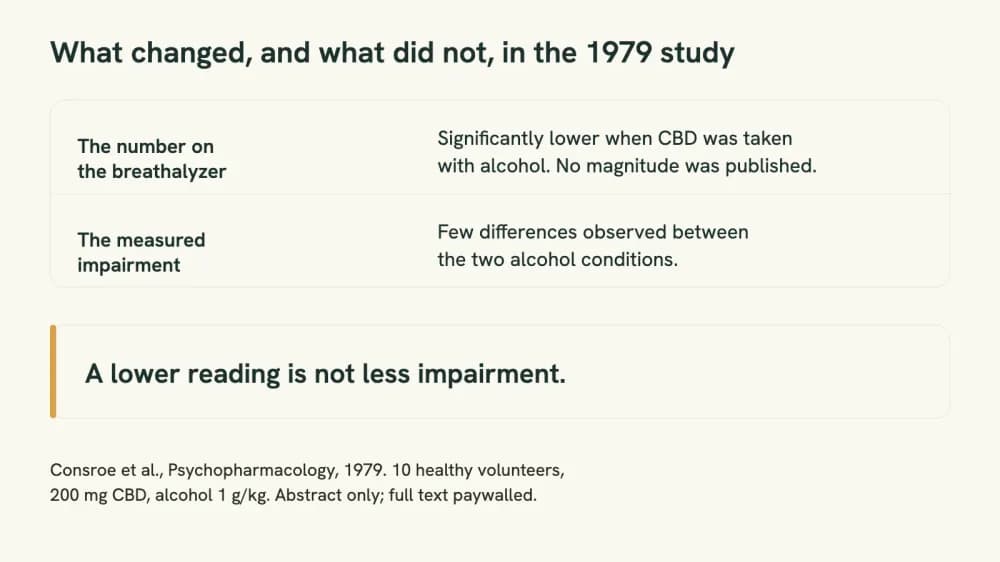
What is actually documented: sedation, and an interaction that runs the other way
The FDA-approved CBD medicine has a section on this, and it is worth reading over the vendor pages. The prescribing information for Epidiolex, a cannabidiol oral solution, contains a subsection literally titled 'CNS Depressants and Alcohol'. It says concomitant use with other CNS depressants including alcohol 'may increase the risk of sedation and somnolence', and elsewhere that other CNS depressants including alcohol 'could potentiate the somnolence and sedation effect'. Again, read the verbs: may increase, could potentiate. In the controlled trials behind that label, in patients with Lennox-Gastaut syndrome or Dravet syndrome taking prescription CBD at 10 or 20 mg/kg/day, somnolence and sedation were reported by 32% of treated patients against 11% on placebo, and the label calls the effect generally dose-related.
The same label also shows what adding a second depressant looked like in that population, and the second depressant was not alcohol. Among those same patients with severe epilepsy taking prescription CBD, somnolence and sedation ran 46% in the ones also taking clobazam, a benzodiazepine, against 16% in the ones not taking it. That is a benzodiazepine in a severe epilepsy population, not a glass of wine, and nobody has produced the equivalent figure for alcohol. Two more numbers keep the scale honest: the label's recommended maintenance dose runs from 10 mg/kg/day up to 25 mg/kg/day depending on the syndrome, roughly 700 to 1,750 mg a day for a 70 kg adult, and the Epidiolex solution itself contains 7.9% w/v dehydrated alcohol. The direction of effect transfers to a tincture serving. The percentages do not.
Now the interaction that has actually been measured, which runs in the direction almost nobody asks about. A GW Research phase 1 trial published in Epilepsia in 2020 gave 14 healthy adults 40 g of alcohol in 500 mL of still lemonade within five minutes before a single 750 mg dose of the prescription CBD solution. Against the fasted condition, peak CBD exposure rose 1.93-fold (90% confidence interval 1.57 to 2.38) and total exposure rose 1.57-fold (1.32 to 1.87). For scale, in the same trial a high-fat, high-calorie meal raised peak exposure 5.2-fold, which is why whether to take CBD with food changes more than the drink does. All five authors were employees of GW Research, three held GW Pharmaceuticals share options, and GW sponsored the trial. Crucially, it never measured blood alcohol, so it says nothing about the reverse direction. What it documents is alcohol raising CBD levels, not CBD lowering alcohol's.
The metabolism correction: alcohol is not cleared the way your medications are
The enzyme story that drives most CBD interaction articles does not transfer cleanly to alcohol, and almost every page transplants it anyway. A 2006 review of alcohol metabolism in Alcohol Research and Health puts the main route elsewhere: ethanol is oxidized mainly by alcohol dehydrogenase, with the P450 enzyme CYP2E1 as a secondary route and catalase a minor one. A 2012 review in Clinics in Liver Disease attaches numbers. About 90% of the alcohol you drink is removed by oxidation and under 10% leaves in breath, sweat and urine. CYP2E1 accounts for roughly a tenth of the liver's alcohol-oxidizing capacity at low blood alcohol and matters more as concentrations rise. Average capacity for a 70 kg person is about 7 g an hour, which is roughly one standard drink an hour. That last figure is a population average across people, not a schedule to plan an evening around.
CBD is cleared somewhere else. According to the FDA-approved CBD drug's label, cannabidiol is metabolized in the liver and the gut, primarily the liver, by CYP2C19 and CYP3A4 along with the UGT1A7, UGT1A9 and UGT2B7 isoforms. CYP3A4 and CYP2C19 are where the real prescription and over-the-counter interaction story lives, and that story matters a great deal; it is simply a different story from this one. How CBD interacts with prescription and over-the-counter medications handles it properly, including the grapefruit comparison people keep asking about.
The picture is not perfectly clean, and the honest version says so out loud. A 2021 study in Drug Metabolism and Disposition, using microsomes from P450-overexpressing cells, reported that CBD competitively inhibited CYP2E1 along with CYP3A4, CYP2B6, CYP2C9 and CYP2D6. That is a test tube, not a person: no dose a human would take, no blood alcohol measured, and the authors' own static modelling flagged CYP2B6, CYP2C9 and CYP2D6 rather than CYP2E1 as the realistic interaction candidates. So the reasoning ends here rather than in a mechanism. No human study has shown CBD slowing alcohol clearance, and the three trials that gave people both either found no change in blood or breath alcohol or found it lower, which is the opposite of what blocking a clearance enzyme would predict. Anyone telling you CBD changes how your body handles alcohol is reading past the evidence, in one direction or the other.
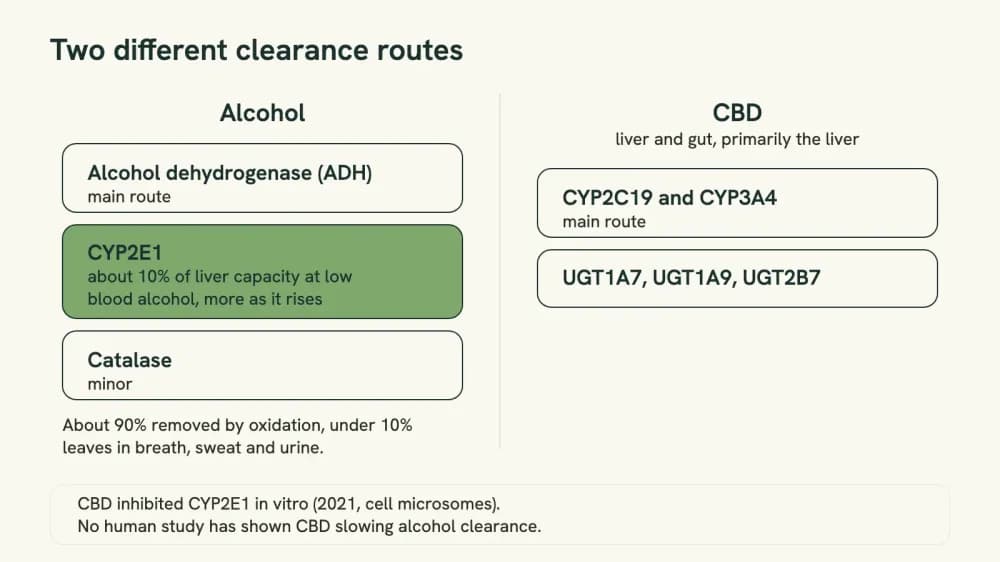
The wait four hours rule nobody sourced
There is no established interval. No trial, no regulator and no drug label sets a number of hours between CBD and alcohol. The four-hour figure that appears on most CBD websites has no published source behind it. We went looking for one: there is no trial that tested an interval in either direction, no agency guidance that names a number of hours, and nothing in the FDA-approved CBD label. It is a number that got copied from page to page until repetition made it look like a rule, and it now appears in the same confident tone as facts that do have papers behind them.
It also does not survive contact with the pharmacology. The FDA-approved CBD drug's label reports a plasma half-life of 56 to 61 hours after twice-daily dosing for seven days in healthy subjects, at prescription doses. Whatever four hours is, it is not a washout of anything, and how long CBD stays in your system works through what those timelines mean at consumer amounts. We are not replacing the four-hour rule with a number of our own, because there is no honest number to give. If you have taken CBD and you are deciding whether to drink, the useful question is how you feel right now, not how many hours have passed since the dropper.
Full spectrum, trace THC, and the gap nobody has tested
The spectrum choice is part of the honest answer, and the honest answer is that nobody has tested it. The 2026 trial used CBD isolate. The pharmacokinetic and epilepsy work used purified pharmaceutical CBD. As of July 2026, no study has given a person a full-spectrum product together with a measured dose of alcohol. That matters because the better-studied combination in the wider literature is THC plus alcohol, not CBD plus alcohol, and full-spectrum hemp products carry trace THC by definition.
The arithmetic is worth seeing as measurement rather than as advice. On current Planntz certificates of analysis a full-spectrum tincture carries roughly 0.11 to 0.12 mg of THC per drop, with batch totals from 0.129% to 0.251%, always under the 0.3% federal figure: non-intoxicating at label use, but not zero. Across the visible full-spectrum line the per-drop range runs about 0.06 to 0.12 mg, and broad spectrum reports THC as non-detected on two flavors and 0.019% on the third. What none of that licenses is a claim about what trace THC does, or does not do, alongside alcohol, because no trial has combined them. It is an open question, and pages that answer it confidently are inventing the answer. If the labels themselves are the confusing part, what full spectrum, broad spectrum and isolate actually mean is the place to start.
Is CBD a treatment for drinking? What the newest trials found
The optimism you meet online about CBD and drinking comes almost entirely from rodents. A 2018 study in Neuropsychopharmacology gave rats with alcohol and cocaine self-administration histories transdermal CBD once a day for seven days, and reported that context- and stress-induced drug seeking remained attenuated for something close to five months even though CBD stayed detectable in plasma and brain for only three days. Those are rats, dosed through the skin, and one author was at a transdermal cannabinoid company. A 2014 study in Free Radical Biology and Medicine is the one behind every headline about CBD and the liver: it reported that cannabidiol prevented acute alcohol-induced fatty liver in mice, with supporting work in a liver cell line. Mice and a cell line. Nobody has tested that finding in a person taking a CBD product with alcohol, and the FDA's own consumer page points the other way when it says CBD can cause liver injury, a risk identified through blood tests during the review of the prescription drug.
The human trials are newer and far less exciting. Two randomized proof-of-concept trials published in 2026 tested CBD in adults with alcohol use disorder: 27 people at 600 mg/day for four weeks and then 1,200 mg/day for four more, and 30 people with alcohol use disorder plus PTSD symptoms at 600 mg/day for six weeks. The authors' own summary is one sentence: 'Neither trial demonstrated superiority of CBD over placebo for drinking outcomes, craving, mood, anxiety, or PTSD symptoms.' Both arms improved substantially, which is what a large participation effect looks like, and 7 of 31 people on CBD had dose-limiting side effects. A 2025 randomized trial in Neuropsychopharmacology, which its authors describe as the first adequately powered medication screening study of CBD in youth with alcohol use disorder, gave 36 non-treatment-seeking people aged 17 to 22 a single 600 mg dose and found 'no effects of acute CBD administration, compared to placebo, on any outcomes of interest', across brain imaging, alcohol cue reactivity, craving, heart-rate variability and drinking itself.
One smaller result gets quoted a lot without its size attached. A 2025 pilot randomized trial in Frontiers in Psychiatry followed 44 participants with moderate-to-severe alcohol use disorder for eight weeks across three arms: 13 people on full-spectrum hemp-derived CBD, 15 on broad spectrum and 16 on placebo. Both preparations were well tolerated, with no significant difference in attrition or side effects. The reported outcome, in the authors' words, is that individuals receiving full-spectrum CBD 'demonstrated reductions in craving but no reduction in drinks per drinking day'. Craving is a self-reported intermediate measure and the drinking itself did not move, in a feasibility study with 13 people in the arm that produced the signal. The authors raise a possible role for THC as a question they want larger trials to answer, not as something they found.
Set beside a 2019 review of the preclinical and human literature, which concluded that 'the paucity of such studies precludes any definitive conclusions relating to CBD-alcohol interactions', the position is not complicated. CBD is being studied for alcohol use disorder and the recent human results have not been encouraging. That research is not a reason to buy anything. If drinking is a problem, the NIAAA's guide to finding and getting help for alcohol problems and SAMHSA's national helpline at 1-800-662-HELP (4357) are the place to start, along with a clinician who knows your history.
What is actually supportable to do
There is no protocol here, because a protocol would imply a tested procedure and there is not one. What follows is the short list of things the evidence and the labels actually support, which is deliberately duller than the advice you will find elsewhere.
- Tell a clinician or pharmacist that you use both, especially if you also take something sedating: sleep medication, benzodiazepines, opioids, antihistamines or muscle relaxants.
- Do not drive or operate machinery. The FDA-approved CBD label tells prescribers to advise patients not to drive until they know how the drug affects them, and alcohol makes that judgement harder, not easier.
- Do not stack. Alcohol plus CBD plus any other substance that slows brain activity is the exact combination the FDA singles out, and the risk it names is drowsiness leading to injury.
- Watch for drowsiness instead of watching the clock. If it turns up, that is the signal to stop for the night, whatever the label serving says.
- Know your own milligrams. At 250 mg/mL a drop is about 12.5 mg, so a few drops can be 25 mg or 50 mg depending on the day. Drop size varies with the dropper and with technique.
- Do not treat an invented waiting time as permission. Four hours is not a safety threshold, and using it as one is how people end up driving when they should not.
Those signs are not folklore. The National Library of Medicine's MedlinePlus entry on ethanol poisoning lists confusion and slurred speech, slowed breathing, vomiting and decreasing alertness among the reasons to call an emergency number or the Poison Help line at 1-800-222-1222, and the cold or bluish skin sign comes from the NIAAA's alcohol overdose guidance. If the worry is the CBD rather than the drinking, what happens when you take too much CBD covers the acute picture and where the real limits are, and the side effects people actually report covers the ordinary ones, with drowsiness at the top of the list.
What is still unknown
This is a small literature and naming its edges is more useful than smoothing them over. As of July 2026, nobody has given a person a full-spectrum or broad-spectrum product together with a measured dose of alcohol. Nobody has studied heavy drinkers: the 2026 trial's own closing line asks for the safety of CBD in people with more severe alcohol use to be examined in future studies, which means it has not been. No study has established a safe interval in either direction. No mechanism has been demonstrated for the 1979 lower-reading result, and no one has replicated it. And no trial has measured what happens at the amounts people actually take, day after day, alongside the drinking they actually do.
There are also unknowns the federal label states about itself. It notes that food, certain concomitant medicines and alcohol may increase exposure to cannabidiol, and that the potential effect on QTc prolongation in that scenario is not known. An explicit unknown on a drug label is not a hidden danger, and it is not reassurance either. It is what the honest state of a file looks like. Everything on this page reflects sources read on July 30, 2026, at doses that are mostly far above a tincture serving, in trials that mostly did not test the thing you are asking about. If that changes, the change will come from a trial, not from a blog post.
No law or label stops you, and there is a documented risk to weigh. The FDA says using CBD with alcohol or other drugs that slow brain activity increases the risk of sedation and drowsiness, which can lead to injuries. The three trials that gave people both together did not measure extra impairment, but they enrolled 10, 15 and 19 people, all healthy volunteers, and none of them included heavy drinkers. If you do both, keep the amounts modest, do not drive, do not add other sedating substances, and tell a clinician you use both.
No trial, agency or drug label has established a safe interval, in either direction. The four-hour figure that appears on most CBD websites has no published source behind it. For scale, the FDA-approved CBD drug's label reports a plasma half-life of 56 to 61 hours after a week of twice-daily dosing in healthy subjects at prescription doses, so four hours is not a washout of anything. Judge how you feel rather than counting hours, and if you feel drowsy, that answers the question.
One 1979 crossover study in 10 people reported significantly lower breathalyzer readings when 200 mg of CBD was taken with alcohol, and it has never been replicated. A second 1979 study, at about 22 mg, found no significant effect on blood ethanol. A Phase I trial published in June 2026 measured peak breath alcohol at 0.071, 0.074 and 0.072 g/100 mL for placebo, 50 mg and 100 mg of CBD isolate, with an omnibus p value of 0.89. And in the one study that did find lower readings, the impairment was not reduced, which is the part that decides what to do with the information.
There is no human research on CBD and hangovers. A PubMed search on July 30, 2026 for cannabidiol and hangover returned no records at all. Anyone selling it as a hangover remedy is selling ahead of the evidence.
No study has measured extra intoxication from the combination. What is documented is a shared direction of effect. Both can cause drowsiness, and the label of the FDA-approved CBD drug says other CNS depressants including alcohol could potentiate its somnolence and sedation. In the controlled epilepsy trials behind that label, patients taking prescription CBD at 10 or 20 mg/kg a day reported somnolence and sedation 32% of the time against 11% on placebo, and the effect was dose-related. Those are prescription doses in patients with severe epilepsy rather than a tincture serving, but the direction is what to plan around.
It is being studied and the recent human results have not been encouraging. Two randomized proof-of-concept trials published in 2026, at 600 mg and then 1,200 mg a day, showed no superiority over placebo on drinking, craving, mood, anxiety or PTSD symptoms in 27 and 30 adults with alcohol use disorder. A 36-person trial in youth with alcohol use disorder, using a single 600 mg dose, found no effect on any outcome measured. None of that is a treatment recommendation, and this page is not making one. If drinking is a problem, the route is a clinician plus the NIAAA and SAMHSA resources, including the national helpline at 1-800-662-HELP (4357).
No study has measured what the combination does to a person's liver, so any number you see for that risk is invented. The claim that CBD protects the liver from alcohol traces to a 2014 study in mice with supporting work in a liver cell line, and it has never been tested in a person taking a CBD product with alcohol. The FDA's consumer page points in the other direction: it says CBD can cause liver injury, a risk identified through blood tests during the review of the prescription CBD drug, at doses far above a tincture serving. Alcohol's own effects on the liver are a separate subject, and nothing you add to a drink improves them.
Where to go from here
Two next steps, depending on which question actually brought you here. If it was CBD itself, what CBD actually feels like sets honest expectations for the drowsiness this page keeps returning to. If it was your drinking, the NIAAA's Alcohol Treatment Navigator states on its own pages that it has no commercial sponsors and points only to evidence-based treatment, and SAMHSA's treatment locator will find services near you. There is nothing to buy on either of those, and there is nothing to buy on this page.
Writing about hemp, wellness and the small rituals that keep us balanced.