CBD and Melatonin: What Happens When You Take Both
The honest safety answer takes one paragraph: no dangerous interaction between CBD and melatonin is documented, and additive drowsiness is the real caution. The rest of this page covers what nobody checks, starting with what is actually in each bottle.
CBD and melatonin end up in the same nightstand drawer more often than any other pair in this category, and they are sold together in a single gummy. The honest safety answer is short: no dangerous interaction between the two has been documented, and the caution that is actually on record is additive drowsiness. The longer answer is more interesting, because the trial everyone cites found no measured difference when cannabinoids were added to melatonin, and because two published analyses suggest the melatonin bottle may not contain what its label says.
Here is the practical answer in one paragraph, before the detail. Both substances are separately associated with drowsiness, so the realistic risk of taking them on the same night is that you end up more sedated than you planned. That makes the useful rules unglamorous: do not drive after taking both, do not stack them with alcohol or a sedating prescription, and tell a clinician who knows your medication list that you use both. This page gives no amount for either substance, on purpose. If you are new to the compound itself, a plain primer on what CBD is covers the ground the rest of this assumes.
Can you take CBD and melatonin together?
No dangerous interaction between CBD and melatonin has been documented, and the two are sold together in a single gummy in most drugstores. That is not the same as a clean bill of health. It mostly reflects how little of this pair has ever been measured in people. The caution that is genuinely on record is additive drowsiness. The FDA's consumer page on cannabis-derived compounds, which we reread on August 1, 2026, states that using CBD with alcohol or other drugs that slow brain activity increases the risk of sedation and drowsiness, which can lead to injuries. That page does not name melatonin. We searched its full text the same day and got zero hits for the word, so the sentence covers drugs that slow brain activity, and applying it to melatonin is our inference rather than the agency's.
The other half of the question is about benefit, not risk, and there is one good piece of evidence on it. A double-blind randomized trial of 1,793 US adults, published in 2024, ran six capsule arms for four weeks. Two of those arms are the ones that matter here: one took 5 mg melatonin alone, and another took 5 mg melatonin plus 15 mg CBD and 15 mg CBN. The prespecified comparison between melatonin alone and melatonin plus cannabinoids came back flat: a coefficient of -0.07 on the change in overall sleep disturbance score, 95% CI -0.48 to 0.34, p = 0.734. A null result in one four-week self-report trial is the absence of a detected difference, not proof that nothing happens. It is still the most direct answer anyone has published, and there is a great deal more to say about that trial further down.
You have only checked one of the two bottles
You would not buy a CBD oil without looking at its batch lab report. Almost nobody applies that habit to the melatonin sitting next to it. Every page on this search result treats melatonin as a known quantity, a fixed number of milligrams that behaves the same way every night. Two published analyses have actually measured that assumption, and neither is cited by any of the consumer pages currently ranking for this question.
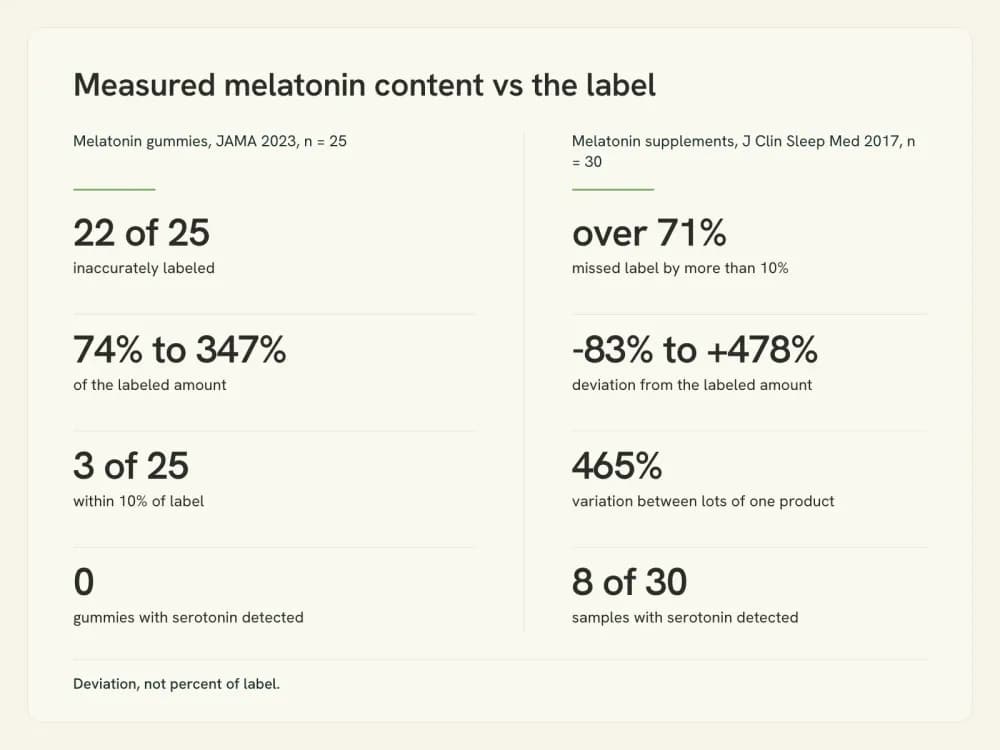
The first started from 30 melatonin gummy brands listed in the NIH Dietary Supplement Label Database, bought them online in September 2022, and was able to analyze 25 of them by liquid chromatography. The results, published in JAMA in 2023, were that 22 of the 25 (88%) were inaccurately labeled and only 3 (12%) came within 10% of the declared quantity. Measured melatonin ran from 74% to 347% of the label, which worked out to between 1.3 mg and 13.1 mg of actual melatonin per serving. One item, labeled as 5 mg melatonin plus 30 mg CBD, contained no detectable melatonin at all. The authors also screened for serotonin, because a Canadian team had previously found it in this category, and detected none. The limits matter: 25 brands, one sample each, gummies only, bought in a single month. The authors say themselves that it is not known whether the finding extends to tablets and capsules, or how much a single brand varies from batch to batch.
The second analysis is older and, in one respect, more useful, because it opened more than one bottle of the same thing. Erland and Saxena tested 30 supplements across 16 brands bought in grocery stores and pharmacies in Guelph, Ontario, in liquid, capsule, tablet, sublingual and chewable form. Their abstract counts 31 analyzed and their results section counts 30, and every figure here uses the results section's own denominator. Their measured melatonin content deviated from the label by -83% to +478%, and more than 71% of the samples missed their label by more than 10%. The worst overdelivery was a chewable claiming 1.5 mg that measured almost 9 mg. Read that range carefully, because it is routinely compressed: +478% is a deviation, an increase of 478% over the printed figure, not 478% of it. Some secondary renderings, including the discussion section of the JAMA paper above, restate the same range as running to 478% of the declared quantity, which is a different and smaller claim. The finding with no equivalent anywhere else is the batch-to-batch one: within a single product, from one lot to the next, melatonin content varied by as much as 465%. And serotonin, which no melatonin label declares, was detected in 8 of the 30 samples. If any of that vocabulary is unfamiliar, reading a certificate of analysis line by line is the same skill applied to a hemp extract.
| What was measured | Melatonin gummies (JAMA, 2023, n = 25) | Melatonin supplements (J Clin Sleep Med, 2017, n = 30) |
|---|---|---|
| Items within 10% of the label | 3 of 25 (12%) | Fewer than 29%: over 71% missed by more than 10% |
| Range of measured content | 74% to 347% of the labeled amount | -83% to +478% deviation from the labeled amount |
| Worst single result | An item labeled 5 mg melatonin contained no detectable melatonin | A chewable labeled 1.5 mg measured almost 9 mg |
| Batch-to-batch variation | Not assessed: one sample per brand | Within a single product, as much as 465% |
| Serotonin detected | None of the 25 | 8 of the 30 samples |
| CBD content, where declared | 5 items declared CBD, measured at 104% to 118% of label | Not applicable |
| Where and when | Bought online in the US, September 2022 | Bought in stores in Guelph, Ontario, published 2017 |
One sentence of context on why chemists went looking at gummies in the first place: a national poison-center analysis published by the CDC counted 260,435 pediatric melatonin ingestions reported between 2012 and 2021, with the annual number rising 530% over that decade, though call volume is not a rate of harm per user and there is no denominator of users behind it.
Now the uncomfortable half, because a CBD company writing this section has an obvious temptation. In those same 25 gummies, the CBD content was the more accurate of the two: the 5 items that declared CBD measured 10.6 mg to 31.3 mg per serving, or 104% to 118% of the labeled amount, against melatonin's 74% to 347% in the same bottles. That is five gummies with one sample each, and it is not a statement about CBD as a category. When the same test has been pointed at the category, it has come back worse. An analysis of 84 CBD extracts bought online, published in JAMA in 2017, found roughly 31% labeled within 10% of their actual content. A 2024 review of 202 CBD samples sold in the US, sponsored by Jazz Pharmaceuticals, which makes the prescription CBD drug, found 149 of them (74%) off their CBD label claim by at least 10%. That is our own shelf, not somebody else's, and it is why independent batch testing is a requirement rather than a badge.
The enzyme that actually connects them is CYP1A2
Most CBD interaction writing, including our own page on CBD and other medications, is built on CYP3A4 and CYP2C19. That is correct for the drugs it covers. The label for the only FDA-approved CBD drug states that cannabidiol is metabolized in the liver and the gut, primarily in the liver, by CYP2C19 and CYP3A4 enzymes plus three UGT isoforms. Melatonin is not on that list. Melatonin leaves the body mainly through 6-hydroxylation, and a 2001 study in human liver microsomes found that step is mediated 'mainly, but not exclusively, by CYP1A2'. Hold on to the qualifier. In the same paper, yeast-expressed CYP2C19 and CYP2C9 also produced the metabolite, and CYP2C19 is one of CBD's own enzymes, so the neat version of this correction, different enzyme therefore no interaction, is not available. Those authors did assume the two CYP2C enzymes to be less important than CYP1A2, which is the honest weight to give them: a smaller second door, not a closed one. What is available is more interesting than the neat version.
You can watch CYP1A2 move melatonin in actual people, using a substance most readers already take. In a crossover study of 12 healthy adults published in 2003, 200 mg of caffeine taken in the evening raised overnight serum melatonin exposure by 32% compared with placebo (area under the curve 3.16 versus 2.39 nmol/L per hour, p < 0.02), with the 4 a.m. peak rising from 0.35 to 0.48 nmol/L. Caffeine competes for CYP1A2, melatonin clears more slowly, and more melatonin is in the blood. That is a human result about caffeine and not about CBD. It is here only to establish that the enzyme is real in living people and that competing for it moves the number in a direction you can measure.
Now the cannabinoid work, and every sentence of it carries a species. A 2025 study gave oral melatonin, alone or with CBD, to 12 male beagles and measured a 4.2-fold rise in melatonin exposure in the combination group (AUC 601.9 to 2,536 h.ng/mL, p < 0.01), with the ratio of the 6-hydroxy metabolite to melatonin falling from 0.32 to 0.07, which is the signature of a blocked CYP1A2 step. In human liver microsomes in the same paper, CBD inhibited melatonin metabolism with an IC50 of 16.47 micromolar. The authors then fed those inputs into a static interaction model and projected a worst-case human melatonin exposure increase in the range of 8.10-fold to 12.48-fold. The 12.48 is the top of that modelled range, it is built on dog and rat data, and it has never been measured in a person. The authors add their own limitation, which is that the doses used in the animal experiments may not cover the clinically relevant range.
A mouse study a year earlier shows the direction is not a simple increase. In 30 male ICR mice, oral CBD at 40 mg/kg given with oral melatonin at 10 mg/kg cut melatonin's peak concentration to 57% of control while raising total exposure to 2.85-fold. The authors read that as high oral CBD slowing both the intestinal absorption and the metabolic clearance of melatonin, producing a flatter, longer curve rather than a bigger spike. Those are milligram-per-kilogram doses in a rodent, far above anything a person takes, and they are reported here for one reason: the popular intuition on this topic is that the two might cancel each other out. Nothing in the literature supports that. What the preclinical work points to, in animals only, is melatonin hanging around longer when a cannabinoid is present.
Which brings us to the study we have the most reason to leave out. Planntz's night-time tincture pairs CBD with CBN, and in 2025 a group led from the University of Sydney's Lambert Initiative, with collaborators at Northwestern University, published preclinical evidence of a drug interaction between cannabinol and melatonin: CBN potently inhibited CYP1A2-mediated metabolism of melatonin in vitro and produced a four-fold increase in plasma melatonin exposure in mice. The authors' own framing is that this is an additional example of a potential interaction, which is the right weight for microsomes and mice. We are not going to attach a reassurance the evidence cannot support, and we are not going to imply a risk it cannot support either. It is a cell and mouse finding about a cannabinoid we sell, and you should know it exists. If you have not met the compound, what CBN actually is covers the identity question without the marketing.
Does CBD raise your own melatonin?
Several pages on this search result say that CBD increases your natural melatonin production by acting on CB1 receptors in the pineal gland. It is a satisfying sentence with a real-looking mechanism attached, which is exactly why it travels. The primary literature says close to the opposite. In 2006, researchers treated cultured rat pineal glands with cannabidiol, cannabinol and a THC metabolite, and found that all three significantly reduced norepinephrine-induced arylalkylamine N-acetyltransferase activity and melatonin biosynthesis. Reduced, not raised. And the effects were not mimicked by the cannabinoid receptor agonist WIN55,212-2 and were not blocked by CB1 or CB2 antagonists, so whatever was happening in that tissue was not running through cannabinoid receptors at all.
The anatomical half of the claim is not invented, which is part of why the story is sticky. A 2008 paper from the same group detected CB1 and CB2 receptor proteins, along with the enzymes that build and break down endocannabinoids, in rat pinealocytes, with the CB1 signal falling significantly at the end of the light phase. So the rat pineal gland does contain an endocannabinoid system. A receptor being present is not a mechanism, and what CB1 receptors do and do not do is worth understanding before accepting any sentence built on them. As for the human version of the question, here is a search you can repeat: on August 1, 2026 we queried PubMed for cannabidiol and melatonin with the human filter applied and got 20 records, none of which measured endogenous melatonin levels after CBD in people. So the popular claim has the direction wrong, has the receptor wrong, and has no human measurement behind it in either direction. That last part cuts both ways, and we are not going to claim CBD lowers your melatonin either.

What the trial everyone cites actually measured
Trade coverage of this topic is dominated by one study, usually described as a landmark trial of around 1,800 people showing that cannabinoids and melatonin improve sleep, and usually described with no journal, no authors and no funding line. It is a real, peer-reviewed trial, and reading it is more interesting than the summary. Saleska and colleagues published it in the Journal of the American Nutrition Association in 2024. Screening ran from March 23 to April 8, 2022. A total of 1,793 US adults with self-reported sleep disturbance were randomized evenly into six capsule arms, two of them single ingredients and four of them combinations. After 495 people completed no sleep surveys at all and were classified as no-shows, 1,298 were analyzed. The outcome was the PROMIS Sleep Disturbance short form, collected weekly across five weeks around four weeks of use. Mean age was 46.5, 57% were female and 83% were White.
Two facts change how you read every number in it. First, the funding. The paper states that the research was supported by Radicle Science's partner Open Book Extracts, and that Open Book Extracts provided direction into the study design through development of the study arms and the primary objective of the study. The methods call it the partnering manufacturer and say it supplied all six study products, so the party that sells the class of product tested both made it and helped choose what was tested. Now read the rest of that same funding statement, because half a disclosure is worse than none: it also says the sponsor had no role in the conduct of the study, in the collection, management, analysis or interpretation of the data, or in the preparation, review or approval of the manuscript. Three of the authors are employed by Radicle Science, a contract research organization that the paper says receives funding from partnering brands and manufacturers, and the remaining five have been paid for consultancy by Radicle. All of that is disclosed in the paper itself, which is what disclosure is for. In the trial's favor, and worth stating: the study capsules were analyzed at an independent laboratory to confirm ingredient identity, safety and potency. Second, and larger than the funding: there was no placebo arm.
“As this comparative effectiveness study used an active control, we cannot determine if and how much the observed effects may be due to participant expectations/placebo.”
Every arm improved over the four weeks, with p values below 0.001, and that is the sentence the coverage is built on. With no placebo group, those within-group improvements cannot be read as evidence that any ingredient did anything, because there is nothing to subtract expectation against. The comparisons that survive the problem are the ones between arms, and the one this page exists for is melatonin alone versus melatonin plus cannabinoids: a coefficient of -0.07 on the change in sleep disturbance score, 95% CI -0.48 to 0.34, p = 0.734, and for the odds of reaching a clinically important improvement, a coefficient of 0.06, 95% CI -0.49 to 0.60, p = 0.837. Descriptively, 71.0% of the melatonin-alone arm and 75.3% of the melatonin-plus-cannabinoids arm crossed the clinically important threshold. The authors' own conclusion is that chronic use of a low dose of CBD 'could improve sleep quality, though these effects do not exceed that of 5 mg melatonin', a sentence that carries the same missing-placebo caveat as everything else in the trial. Human evidence on CBD and sleep is limited and mixed in general, and what the sleep research on CBD does and does not show is where we treat it properly.
One more thing about the widely repeated write-up. The number that travels with it is 34 to 76 additional minutes of sleep per night. That figure is reported in the same article as carrying no statistical significance, and a between-arm minutes-of-sleep outcome does not appear among the peer-reviewed paper's reported results at all, which are sleep disturbance scores and the odds of a clinically important difference. So a number can be non-significant in the very article that publishes it, and still become the fact everybody repeats. That is not a story about one outlet. It is a story about how a result travels once it leaves the paper, and it is the reason for the next section.
How to check a trial like that yourself in three minutes
You do not need a statistics background to do most of what we just did. Six steps, in order, using this trial as the worked example. It works on any supplement study you meet, and it is faster than reading the abstract.
- 1Find the registry number. This one is NCT05552898 on ClinicalTrials.gov. If a write-up names no journal and no registration, you are reading a press release, not a result.
- 2Read the funding and disclosure statements in full, both halves. Here: funded by a cannabinoid ingredient manufacturer that helped develop the study arms, and that same statement says the sponsor had no role in the analysis.
- 3Check the comparator. An improvement means nothing until you know what it was measured against. This trial used an active control and had no placebo group, which the authors state plainly in their own limitations.
- 4Check the dates. The registry shows the study completed on August 26, 2022 and was first submitted to ClinicalTrials.gov on September 20, 2022, about a month afterward.
- 5Compare the registry with the paper. The registry says arms would be compared to the melatonin isolate and lists a placebo comparator; the published paper describes six active arms and compares each to the CBD isolate arm.
- 6Find the number the coverage is quoting, then locate it in the paper. If the outcome the headline rests on is not among the reported results, the headline is not reporting the trial.
The registry record for this trial is public and takes about ninety seconds to read: lead sponsor Radicle Science, listed as industry, actual start March 1, 2022, primary completion May 31, 2022, study completion August 26, 2022, first posted September 23, 2022. We are printing dates and comparator statements, all of them checkable, and leaving the inference to you. Registry entries get edited over the life of a study, and a mismatch between a registry and a published paper has ordinary explanations at least as often as interesting ones. The point of the exercise is not suspicion. It is that three minutes of checking turns a landmark trial into a specific, four-week, industry-funded, placebo-free comparison, which is a much more useful object to reason with.
Additive drowsiness is the caution that is documented
The realistic risk of taking both is not an exotic interaction. It is that you took two things associated with drowsiness and then did something that needed you alert. The FDA sentence quoted at the top of this page is the regulatory version of that caution. The clinical version sits on the label of the only FDA-approved CBD drug, which has a section on CNS depressants stating that concomitant use with other CNS depressants, including alcohol, may increase the risk of sedation and somnolence. That same label reports somnolence and sedation in 32% of patients on the drug versus 11% on placebo in its Lennox-Gastaut and Dravet syndrome trials. Read the dose before transferring that number anywhere: the approved drug is prescription CBD at 10 to 25 mg per kilogram of body weight per day depending on the condition being treated, which is a different order of magnitude from a consumer tincture. The signal is real enough to sit on an approved federal label. The size of it is not yours to borrow.
The combination trial reported side effects in 11.9% of participants (n = 199), around 85% of them mild, none severe or life-threatening, at similar rates across all six arms. The most common was fatigue or grogginess at 2.7% (n = 49), then sleep disturbance at 1.4%, headache at 1.1%, upset stomach at 1.0%, and dry mouth and vivid dreams or nightmares at 0.8% each. Two limits travel with that: it is spontaneous self-report over four weeks with no placebo arm to subtract, and the trial excluded people taking medications with which cannabinoids could interfere as well as anyone pregnant or breastfeeding, so it describes tolerability in a screened sample rather than safety in everyone. On the other side, the NCCIH summary of melatonin lists headache, dizziness, nausea and sleepiness among the mild side effects reported in studies, which is the same column CBD's occupies. The side effects most often reported with CBD has the fuller list, and we asked the same question about alcohol on a companion page built around the same FDA sentence.
- You take a prescription sedative, sleep medication, benzodiazepine, opioid or muscle relaxant. Additive sedation is the documented caution here and it belongs to a prescriber, not to a blog post.
- You will drive, ride, operate machinery or be on call within the next several hours. This is the failure mode the FDA names, and it is the one that actually sends people to an emergency room.
- You are drinking alcohol the same evening. That adds a third thing that slows brain activity to a stack that already has two.
- You take any medication with a narrow margin between a working amount and a problem amount, including blood thinners and anti-seizure drugs. A pharmacist can check the whole list in one call.
- You are pregnant, breastfeeding, or considering either substance for a child. Those are clinician questions, not internet questions, and nothing on this page is written for them.
- You wake up more groggy than the night was worth. Fatigue was the single most reported side effect in the trial above, and it is a reason to stop and reassess rather than to adjust anything upward.

Where melatonin's evidence is stronger than any cannabinoid's
This is the part a hemp company has every incentive to leave out, which is why it is here. Melatonin has evidence for a specific job that no cannabinoid can match: shifting the timing of the body clock. The same NCCIH page records that melatonin supplements may help with jet lag, and that in a 2018 trial in people with delayed sleep-wake phase disorder, taking melatonin an hour before the desired bedtime along with keeping a set bedtime produced several improvements, including falling asleep 34 minutes earlier. That same page also states that under practice guidelines from the American Academy of Sleep Medicine in 2017 and the American College of Physicians in 2016, there is not enough strong evidence on the effectiveness or safety of melatonin supplementation for chronic insomnia to recommend its use. Both sentences are true at the same time, and neither of them is about CBD.
On regulation, the asymmetry runs against us rather than for us, and it is worth saying out loud on a page like this. Melatonin is a legal dietary supplement in the United States, regulated less strictly than a prescription or over-the-counter drug per the same NCCIH page, and it is not approved to treat anything. CBD is in the worse position of the two: the FDA states that it is currently illegal to market CBD by adding it to a food or labeling it as a dietary supplement. Long-term data is missing on both sides. NCCIH says outright that information on the long-term safety of melatonin supplementation is lacking, and the equivalent data for consumer CBD does not exist either. The trial described above ran four weeks, and in the literature we searched on August 1, 2026 we did not find a longer study of the two taken together. So if you want the fair summary: the melatonin bottle has the better evidence for one narrow job, the cannabinoid bottle has no evidence of adding anything measurable to it, and both of them have a labeling problem you can do something about.
CBD and melatonin: frequently asked questions
No dangerous interaction between the two has been documented, and they are widely sold in the same gummy. The caution that is actually on record is additive drowsiness: both are separately associated with it, and the FDA warns that combining CBD with other things that slow brain activity increases the risk of sedation and drowsiness, which can lead to injuries. On the benefit side, a 1,793-person trial found no measured difference between melatonin alone and melatonin plus cannabinoids over four weeks. If you take a sedating prescription, or you need to drive, that is a question for your prescriber or pharmacist rather than for a search result.
There is a real point of contact and it is CYP1A2, the enzyme that handles most of melatonin's breakdown. In human liver microsomes, in mice and in 12 male beagles, CBD and CBN both slowed melatonin's metabolism, and in the animals melatonin exposure went up rather than down. Not one of those results is a human measurement. The enzyme story is not clean either: a 2001 study found melatonin's main pathway is mediated mainly, but not exclusively, by CYP1A2, and CYP2C19, one of CBD's own enzymes, contributes to it as well, though the same authors assumed it to be less important than CYP1A2. So the honest answer is that a plausible pharmacokinetic contact point exists, its predicted direction is more melatonin exposure rather than less, and nobody has measured it in people.
The claim circulating online says yes, through CB1 receptors in the pineal gland. The only primary work behind it is a 2006 study on cultured rat pineal glands, and it found the opposite direction: cannabidiol and cannabinol reduced norepinephrine-induced melatonin biosynthesis. The same study reported that the effect was not mimicked by a cannabinoid receptor agonist and not blocked by CB1 or CB2 antagonists, so it did not run through cannabinoid receptors at all. A 2008 paper from the same group did find CB1 and CB2 receptors present in rat pinealocytes, which is probably why the story sticks, but a receptor being present is not a mechanism. We searched PubMed on August 1, 2026 and found no human study measuring melatonin levels after CBD, in either direction.
Nobody has published a long-term study of the combination. NCCIH says information on the long-term safety of melatonin supplementation is lacking, and the equivalent data for consumer CBD does not exist. The four-week trial that tested the pair reported side effects in 11.9% of participants, none of them severe, most commonly next-day fatigue or grogginess at 2.7%, in a sample that had been screened to exclude people on medications cannabinoids could interfere with. Nightly use of anything sedating is a conversation to have with a clinician who can see your full medication list, and it is one of the few questions on this topic where a two-minute phone call genuinely outperforms research.
Fatigue or grogginess was the single most reported side effect in the four-week trial, at 2.7% of participants, and drowsiness is separately listed as a side effect of each substance on its own. There is also a pharmacokinetic reason worth knowing about, with the caveat that it has only been shown in animals: when CBD was present, melatonin cleared more slowly and stayed in circulation longer in mice and in beagles, and a mouse study found a lower peak with a longer tail rather than a bigger spike. Nobody has measured that in a person, so treat it as a hypothesis about why, not an explanation of your morning. If it keeps happening, that is a reason to stop and reassess.
No. Planntz sells four tinctures, all of them full spectrum or broad spectrum hemp extract in coconut MCT oil, and one of them pairs CBD with CBN at 133 mg/mL and 67 mg/mL. No Planntz product contains melatonin, and we do not sell melatonin separately. That is also why this page says out loud where melatonin's evidence beats any cannabinoid's, and why it prints the mouse study showing CBN slowed melatonin metabolism: we have nothing to sell you on that side of the comparison, so there is no reason to shade it.
Writing about hemp, wellness and the small rituals that keep us balanced.