CBD and Breastfeeding or Pregnancy: What the Evidence Says
Every US authority that has published a position advises against CBD during pregnancy and breastfeeding, and the reason is missing research, not demonstrated injury. Here is what the FDA, the NIH's LactMed database, the Epidiolex label and the milk studies actually measured.

If you are pregnant, trying to conceive, or breastfeeding and you want to know whether CBD is an option, the honest answer is short. Every United States authority that has published a position on CBD and breastfeeding, or on CBD in pregnancy, advises against it, and not one of them says so because cannabidiol has been shown to injure a human pregnancy. They say so because almost nothing has been measured. This page quotes the two documents that define what is actually known, the FDA's consumer update and the NIH's LactMed monograph on cannabidiol, and shows you precisely where the evidence stops.
Here is the whole position in one paragraph, before the detail. The FDA states that it "strongly advises against the use of cannabidiol (CBD), tetrahydrocannabinol (THC), and marijuana in any form during pregnancy or while breastfeeding." LactMed, the federal database clinicians check for drugs in lactation, carries the same eleven words under three consecutive headings: relevant published information was not found as of the revision date. There is no controlled trial of cannabidiol in pregnancy, no cohort study of people who used a CBD product rather than cannabis, and no published measurement of how long cannabidiol lingers in human milk. If the compound itself is new to you, what cannabidiol actually is covers the ground this page assumes. What follows is what has been measured, in whom, and what each measurement can and cannot tell you.
What the FDA, LactMed, ACOG and the AAP actually say
Start with the sentence of record. The FDA's consumer update, What You Should Know About Using Cannabis, Including CBD, When Pregnant or Breastfeeding, opens with this: "FDA strongly advises against the use of cannabidiol (CBD), tetrahydrocannabinol (THC), and marijuana in any form during pregnancy or while breastfeeding." We reread that page on July 31, 2026 and the sentence was still there, unchanged. The reason it gives is not a finding. It is an absence. "There is no comprehensive research studying the effects of CBD on the developing fetus, pregnant mother, or breastfed baby." The agency then names two specific concerns: "High doses of CBD in pregnant test animals have caused problems with the reproductive system of developing male fetuses," and "based on what we already know about CBD, we expect that some amount of CBD will be transferred to babies through breast milk."
| Authority | Document and date | What exposure it covers | What it says |
|---|---|---|---|
| FDA | Consumer update on cannabis and CBD, live and unchanged when reread July 31, 2026 | CBD, THC and marijuana | Strongly advises against use in any form during pregnancy or while breastfeeding |
| NIH LactMed | Cannabidiol monograph, revised May 15, 2025 | Cannabidiol | Not studied in nursing women taking the prescription product; detected in the milk of some mothers who used cannabis |
| FDA drug label | EPIDIOLEX prescribing information, sections 8.1 and 8.2, label revised 07/2025 | Prescription cannabidiol at 10 to 25 mg/kg/day | No adequate human data in pregnancy, no data on cannabidiol in human milk, developmental toxicity in two animal species |
| ACOG | Committee Opinion No. 722, 2017, reaffirmed 2021 | Marijuana, not cannabidiol | Women pregnant or contemplating pregnancy should be encouraged to discontinue; data on lactation are insufficient |
| AAP | Clinical report, Pediatrics, 2018 | Marijuana, not cannabidiol | MotherToBaby records the AAP recommendation as avoiding marijuana when pregnant or breastfeeding |
| MotherToBaby (OTIS) | Cannabis fact sheet, published May 2025 | Marijuana and CBD | States the AAP, ACOG and FDA positions side by side, and notes that a THC free label can still carry measurable THC |
The document that matters most here is the one nothing on the first page of results quotes. LactMed, the NIH's Drugs and Lactation Database, is what a pediatrician or a lactation consultant opens when a nursing parent asks about a drug. Its cannabidiol monograph was last revised on May 15, 2025, it is free, and anyone can read it. Its summary sentence is the most precise statement anybody has written about this question.
“Cannabidiol has not been studied in nursing women taking the pharmaceutical product (Epidiolex), but it has been detected in the breastmilk of some mothers who used cannabis products.”
Then read the rest of the entry, because its structure is the answer. Under Infant Levels, under Effects in Breastfed Infants, and under Effects on Lactation and Breastmilk, the monograph carries an identical line: "Relevant published information was not found as of the revision date." Three consecutive headings in the database clinicians actually use, and the same eleven words under each one. LactMed adds one more sentence, about cannabidiol taken as an antiepileptic medicine: "Because no published information is available with cannabidiol use as an antiepileptic during breastfeeding, an alternate drug may be preferred, especially while nursing a newborn or preterm infant."
The two professional societies people quote most are talking about a different exposure. ACOG's Committee Opinion No. 722, published in 2017 and reaffirmed in 2021, says that "women who are pregnant or contemplating pregnancy should be encouraged to discontinue marijuana use" and that "there are insufficient data to evaluate the effects of marijuana use on infants during lactation and breastfeeding, and in the absence of such data, marijuana use is discouraged." The American Academy of Pediatrics reached a similar position in its 2018 clinical report. Both are real positions, and neither is a position on cannabidiol: anyone writing that ACOG or the AAP has ruled on CBD in pregnancy is putting words in their mouth. The MotherToBaby fact sheet on cannabis, published in May 2025, sets all three statements out side by side and keeps them distinct, which is the correct way to read them.
Why "not studied" does not turn into "probably fine"
Three sentences are true at the same time, and holding all three at once is the whole skill on this topic. No published human study has shown that cannabidiol damages a pregnancy. No published human study has shown that it does not. A recommendation to avoid is exactly what a regulator issues when the second sentence is true and the person who would carry the risk is a fetus or a newborn who cannot agree to the experiment. The recommendation is not a verdict on the molecule. It is a verdict on the state of the evidence, and it is what a careful institution does with a blank page.
That blank page is checkable, and you should check it rather than take our word for it. On July 31, 2026 we ran a PubMed search for cannabidiol and pregnancy in title or abstract, filtered to clinical trials and randomized controlled trials. It returned zero records. A ClinicalTrials.gov search the same day returned no interventional study administering cannabidiol to pregnant participants: the fourteen records that match the terms are trials in endometriosis, kidney stones, transplantation and spinal cord injury, plus two observational registries. A third search, for topical or transdermal cannabidiol together with pregnancy or lactation, returned three records, none of them a human study. Anyone can re-run all three in under a minute, and we would like the answer to change.
- Nobody has established a level of cannabidiol exposure in a human pregnancy at which nothing happens, so "a small amount" is not a measured category here. It is a guess with a comforting shape.
- No trimester has been studied separately in people, so a first-trimester question has no first-trimester answer, only the same blank page.
- No study has followed children exposed to a CBD product in the womb or through milk, so nothing is known about outcomes at 6 months, 2 years or 10 years.
- The absence is not evenly spread. Transfer into milk has been measured a little. Effects on the infant have been measured not at all.
- Absence of evidence is the reason for the recommendation, which means new evidence could move it in either direction. Nobody gets to assume which direction.
What the evidence base actually contains, layer by layer
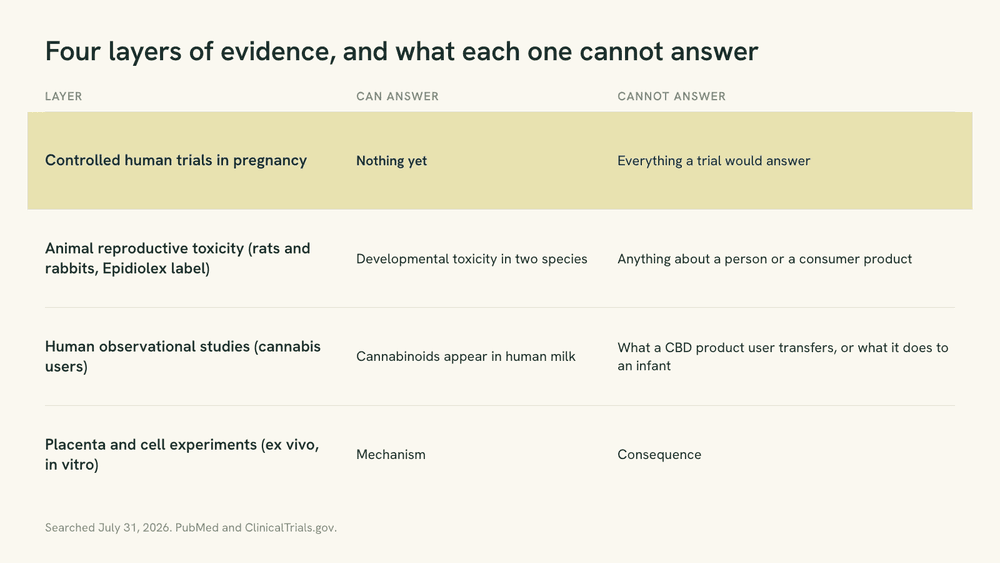
When a page tells you the research here is limited, that is true and it is useless, because "limited" hides four completely different kinds of limitation. One layer is empty. One is animal. One is human but measures the wrong exposure. One is laboratory tissue and cannot speak to outcomes at all. Here is the actual stack, with what each layer can and cannot answer.
| Layer | What exists | What it can tell you | What it cannot |
|---|---|---|---|
| Controlled human trials in pregnancy | None. PubMed returns zero records for cannabidiol plus pregnancy filtered to trials, searched July 31, 2026 | Nothing yet | Everything a trial would answer: timing, outcomes, and a level at which no effect appears |
| Animal reproductive toxicity | The EPIDIOLEX label, section 8.1: rats at 0, 75, 150 or 250 mg/kg/day and rabbits at 0, 50, 80 or 125 mg/kg/day | That pharmaceutical cannabidiol produced developmental toxicity in two species at maternal exposures similar to (rabbit) or greater than (rat) human therapeutic exposure | Anything about a person, or about a hemp extract at the amounts people actually take |
| Human observational studies | Milk measurements in cannabis users (54 samples in 2018, 20 participants in 2021, 200 samples in a 2023 model) and prevalence surveys | That cannabinoids including cannabidiol appear in human milk after cannabis use, and roughly at what concentrations | What a CBD product user transfers, and what any of it does to an infant |
| Placenta and cell experiments | One ex vivo perfusion study in donated term placentas (2026) and trophoblast cell-line work (2024) | Mechanism: that cannabidiol can cross perfused placental tissue, and that it changes cell behavior in a dish | Consequence. A perfused placenta is not a pregnancy and a cell line is not a baby |
The animal row deserves its own paragraph, because it is the only reproductive-toxicity dossier for cannabidiol that a regulator has ever reviewed, and because it is the row most often misquoted in both directions. The EPIDIOLEX prescribing information states in section 8.1 that "there are no adequate data on the developmental risks associated with the use of EPIDIOLEX in pregnant women." It then reports that administration to pregnant animals "produced evidence of developmental toxicity (increased embryofetal mortality in rats and decreased fetal body weights in rabbits; decreased growth, delayed sexual maturation, long-term neurobehavioral changes, and adverse effects on the reproductive system in rat offspring) at maternal plasma exposures similar to (rabbit) or greater than (rat) that in humans at therapeutic doses." In the study that dosed rats through pregnancy and lactation together, the effects at the mid and high dose included "small testes in adult offspring," and the no-effect dose in that study corresponded to roughly 9 and 7 times human exposure at the maximum recommended human doses of 20 and 25 mg/kg/day.
Now the sentence that has to travel with those findings every time they are quoted, including when somebody quotes them back at us. Those are rats and rabbits, dosed at 50 to 250 mg per kilogram per day of pharmaceutical cannabidiol. That is a prescription anti-seizure medicine studied for a regulatory dossier, not a hemp tincture, and none of those numbers transfer to a consumer product or to a person. The label's own framing is the useful part: the rabbit no-effect exposure sat below human therapeutic exposure, which is why the finding is on the label at all, and the label still records that there are no adequate human data. Animal reproductive toxicity is a reason a regulator writes a caution. It is not a measurement of what happens to anyone.
CBD and breastfeeding: does cannabidiol reach the baby, in milk or across the placenta?
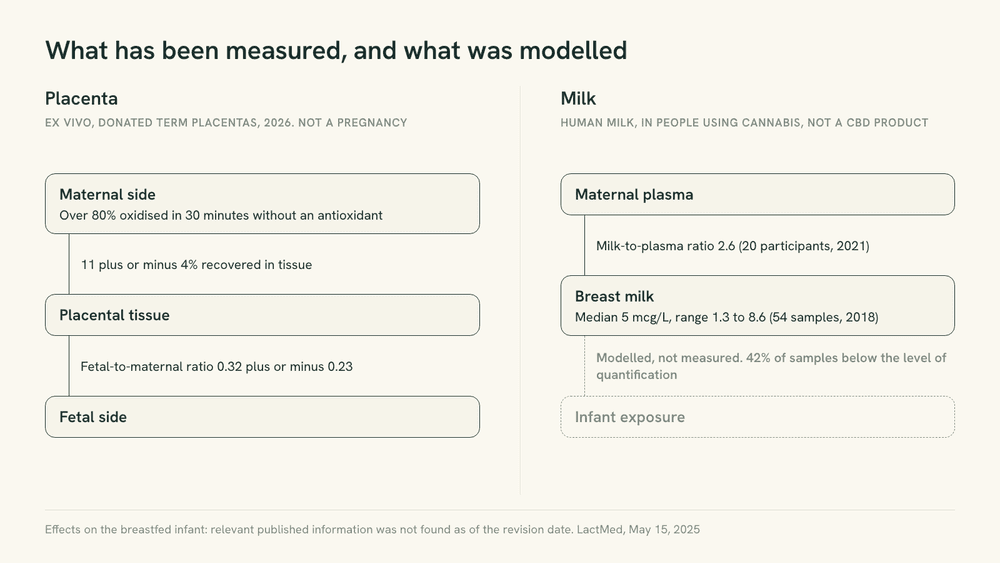
Whether cannabidiol crosses the human placenta was tested in 2026 in donated term placentas perfused outside the body, and the result arrived with a warning about itself. Without an antioxidant present, more than 80% of the cannabidiol disappeared from the maternal side within 30 minutes through oxidation, and none of it reached the fetal side at all. With albumin and an antioxidant added to the buffer, it did cross, reaching a fetal-to-maternal ratio of 0.32 plus or minus 0.23, with 11 plus or minus 4% recovered in the tissue. In the same preparation, cannabidiol dilated healthy placental arteries by 36 plus or minus 4%. That is an ex vivo experiment in donated tissue, not a pregnancy, and the fact that the answer flipped completely on what was added to the perfusion buffer is a fair summary of how young this field is.
One layer below that sits a 2024 experiment in a placental cell line called BeWo b30, where 20 micromolar cannabidiol reduced markers of trophoblast fusion and lowered mitochondrial membrane potential, basal respiration and ATP production. Trophoblasts are the cells that build the placenta, so the finding is mechanistically interesting. It is also a dish of cells held at one fixed concentration. It is a reason to run the studies. It is not a finding about anybody.
Milk is where the real numbers live, and where they get compressed into something the paper never said. The study every page on this topic cites is Bertrand and colleagues in Pediatrics in 2018: fifty breastfeeding women who reported using marijuana donated 54 milk samples between 2014 and 2017. THC was detectable in 34 of the 54 samples (63%) up to about 6 days after last reported use, at a median of 9.47 ng/mL with a range of 1.01 to 323.00. Then comes the sentence people flatten: five samples had detectable levels of 11-hydroxy-THC or cannabidiol, with cannabidiol ranging from 1.32 to 8.56 ng/mL. The paper pools those two analytes in that one count, so nobody can honestly write that cannabidiol was found in five samples. The sample with the highest cannabidiol concentration, 8.56 ng/mL, had no measurable THC at all. Cannabinol was not detected in any sample. And the exposure that produced all of it was marijuana use, not use of a CBD product.
LactMed renders the cannabidiol result from that dataset as a median milk concentration of 5 mcg/L with a range of 1.3 to 8.6 mcg/L, which is the same unit as ng/mL. A second dataset, Moss and colleagues in Pediatric Research in 2021, followed 20 breastfeeding women who used cannabis at a single university hospital and measured a median cannabidiol concentration of 1.2 ng/mL in milk against 0.6 ng/mL in plasma: a milk-to-plasma ratio of 2.6, with THC at 7.0. Their stated conclusion is that THC and cannabidiol accumulate in breast milk and that research on the effects of infant exposure "is urgently needed." People usually ask next how long it lingers. Nobody has published an elimination half-life for cannabidiol in human milk; how long CBD stays in an adult body covers the plasma half-life figures, and those describe an adult's bloodstream, not a nursing infant's supply. One more detail decides what any of these numbers mean: a large share of samples sit below the concentration at which a lab will put a number on them at all. If limit of detection and limit of quantification are unfamiliar terms, reading a batch lab report explains them in a context you can hold in your hand.
Which brings us to the one figure on this page that can be read into the opposite of what it says. LactMed also carries a physiologically based pharmacokinetic model published by Yeung and colleagues in 2023, built from 200 milk samples from 181 mothers who used cannabis, 42% of which had cannabidiol below the level of quantification. The crisp number people quote from it is LactMed's rendering rather than the paper's own: LactMed states that the projected exposure of a fully breastfed infant was less than 1% of that in children aged 4 to 10 who were receiving the drug therapeutically for seizures, while the paper's abstract says only that infant exposures were magnitudes lower than in children aged 4 to 11 on the lowest approved therapeutic dose. Read that carefully: it is a projection, not a measurement; the mothers were using cannabis, not CBD products; and the same database says that for effects in breastfed infants, "relevant published information was not found as of the revision date." The authors' own closing line is that studies examining adverse reactions will provide further insight into potential risk. A small modelled dose and a known-harmless dose are different claims, and only the first one has been made.
There is an apparent contradiction sitting in the middle of all this, and a careful reader will spot it, so here it is deliberately. The Epidiolex label, section 8.2, says: "There are no data on the presence of cannabidiol or its metabolites in human milk, the effects on the breastfed infant, or the effects on milk production." LactMed says cannabidiol has been detected in human milk. Both are true. The label is describing its own drug in its own population, women taking prescription cannabidiol, where nobody has run the study. LactMed is reporting detections in a different population, women using cannabis, measured by researchers who were mostly looking for THC. Neither document describes the person this page is written for.
CBD while pregnant or nursing: the workarounds, one honest sentence each
Every version of this question eventually arrives at a workaround, and all of them are reasonable instincts rather than bad faith. None of them changes the analysis, and each deserves a straight sentence rather than a wave of the hand. The MotherToBaby fact sheet disposes of the first one in a line: "CBD products labeled as 'THC free' might still contain a measurable amount of THC." If full spectrum, broad spectrum and isolate are doing work in your head here, what broad spectrum actually means is the definition to read first, and the legal line between hemp and marijuana covers the second instinct on this list.
- Broad spectrum, or a THC free label. The label describes an intention, not a guarantee. In an independent analysis of 202 items bought online, only 68% of the 28 broad-spectrum ones matched the spectrum type printed on the package.
- Topicals, creams and bath bombs. A documented PubMed search on July 31, 2026 found no human study of topical cannabidiol in pregnancy or lactation. Skin absorbs at a rate that varies by formulation, and nobody has measured it here.
- Hemp, not marijuana. The FDA's own explanation says cannabidiol can be derived from either plant, and its advice covers CBD in any form. The plant of origin changes the law, not the molecule.
- Just one drop. No exposure level has been shown to produce no effect in a human pregnancy, so "small" is not a measured category here. Untested at a low amount is still untested.
- It is a supplement, not a drug. The FDA's position is that CBD is not a lawful dietary supplement, so no supplement framework has reviewed it for this population either.
The other half of the question: what is actually in the bottle
Suppose you had settled the question about the molecule. You would still be holding a bottle, and the bottle is a second question that almost nothing on this results page raises. In 2024, an analytical survey of 202 CBD product samples bought online in the United States reported that three broad-spectrum samples contained THC, two of them above 0.3%, and that only 68% of the 28 broad-spectrum samples met the definition of the spectrum type claimed on the package. Heavy metals were detected 52 times across 44 samples, and five samples, 3% of the 202 tested, exceeded a regulatory threshold, every one of them for lead. That study was sponsored by Jazz Pharmaceuticals, which sells the prescription cannabidiol drug, and you should weigh that when you read it. It is also one of the very few systematic looks at what is actually inside this category. For the general version of the problem, what third-party testing does and does not prove is the page to read.
The FDA names the same problem in its pregnancy update, and the verb it chooses matters. "We also know that there is a potential for CBD products to be contaminated with substances that may pose a risk to the fetus or breastfed baby, including THC. We have also heard reports of CBD potentially containing other contaminants (e.g., pesticides, heavy metals, bacteria, and fungus); we are investigating this." That is an agency describing reports it is investigating, not test results it has published, and preserving the difference is part of reading this topic accurately. The same update lists the general risks identified in the clinical studies supporting the one approved CBD drug: liver toxicity, extreme sleepiness, and harmful interactions with other drugs. Both of those have their own pages here, the side effects that are actually documented and how CBD interacts with other medications, and the second one matters more than usual if you are already taking something prescribed.
Why so many people ask, and where the confident answers come from
You are not unusual for asking. In the International Cannabis Policy Study, a survey of 66,457 women in the United States and Canada between 2019 and 2021 that included 1,096 pregnant respondents, 20.4% of the pregnant group reported CBD-only use, against 11.3% of the non-pregnant group. The commonest reasons given were anxiety (58.4%) and pain (52.3%), with nausea or vomiting at 31.9%. Those are self-reports from a non-probability sample, but one in five is not a fringe number. A nationally weighted estimate from the National Survey on Drug Use and Health is lower and much wider: in its 2023 wave, past-30-day CBD use ran at 39.3 per 1,000 pregnant women, with a 95% confidence interval of 16.2 to 62.4, against 113.2 per 1,000 reproductive-aged women overall. Its authors' recommendation is that clinicians screen for CBD use so they can counsel patients against use in pregnancy and while breastfeeding.
The confident answers, meanwhile, often come from the counter. In a 2025 study in the Journal of Obstetric, Gynecologic and Neonatal Nursing, researchers mystery-called 104 Arizona dispensary staff about morning sickness. 71.2% recommended a cannabis product, cannabidiol and edibles most often, and 18.9% recommended tinctures; 85.6% suggested a medical consultation, but only 34.6% did so without being prompted. That is one state and 104 phone calls, not an indictment of an industry, and dispensaries are a different retail channel from hemp sellers. It is still what the retail layer of this market told pregnant callers, and it is a useful reminder that the person recommending something is rarely the person who has read the literature.
What would have to exist for the answer to change
This page has an expiry date, and it is worth being specific about what would move it. Not a better opinion and not a louder disclaimer: four measurements that do not currently exist. One of them is being taken right now. NCT06589258, "Cannabidiol Into Breastmilk", run by the regional hospital in Orleans, France, plans to enroll 60 breastfeeding women who use CBD and to measure cannabidiol in their blood, their milk and their infants' urine. It began recruiting in October 2025, with primary completion estimated for October 2027. We have no idea what it will find, and neither does anyone else. Separately, pregnancy outcomes on prescription cannabidiol are being collected in the Epidiolex Pregnancy Surveillance Program (NCT06113237, around 50 participants, estimated primary completion 2033) and in the North American Antiepileptic Drug Pregnancy Registry at 1-888-233-2334, both named on the drug's label, and both open only to people taking the prescription medicine.
- 1A measured concentration-time profile for cannabidiol in human milk, in people using a CBD product rather than cannabis. That is exactly what the Orleans study is collecting.
- 2Infant outcome data rather than exposure estimates. The authors of the modelling study say so themselves: studies of adverse reactions are what would provide further insight into potential risk.
- 3A prospective pregnancy cohort in which the product was verified in a laboratory rather than reported on a questionnaire, so that what was taken is known instead of assumed.
- 4A human exposure level at which no effect is observed. Until one exists, no amount can be called small in any sense that means anything.
Where to actually get an answer today
"Ask your doctor" is the standard ending here, and on its own it is not enough, because most people leave that appointment holding the same three sentences they walked in with. There is a better first call, it is free, and it is not us. MotherToBaby is the public service of the Organization of Teratology Information Specialists. Its specialists answer questions about exposures in pregnancy and breastfeeding for free, by phone at 866.626.6847, by text at 855.999.3525, and by live chat and email, in English and Spanish, Monday to Friday from 8am to 7pm Eastern, for residents of the United States and its territories. Answering this exact question is their entire job. Yours is not an unusual call to them.
Two other doors are worth knowing about. LactMed is public, so you can open the cannabidiol monograph yourself, at no cost, and read precisely what your pediatrician reads, which is a strange and useful experience. And an IBCLC, an international board certified lactation consultant, is the right person for milk supply and feeding questions that a short general appointment tends to rush past. If you have already used CBD, before you knew you were pregnant or since, the useful move is to say so out loud rather than sit with it. A past exposure is information for a clinician, not a verdict, and this page cannot tell you what it means for you, because nobody has published the study that would.
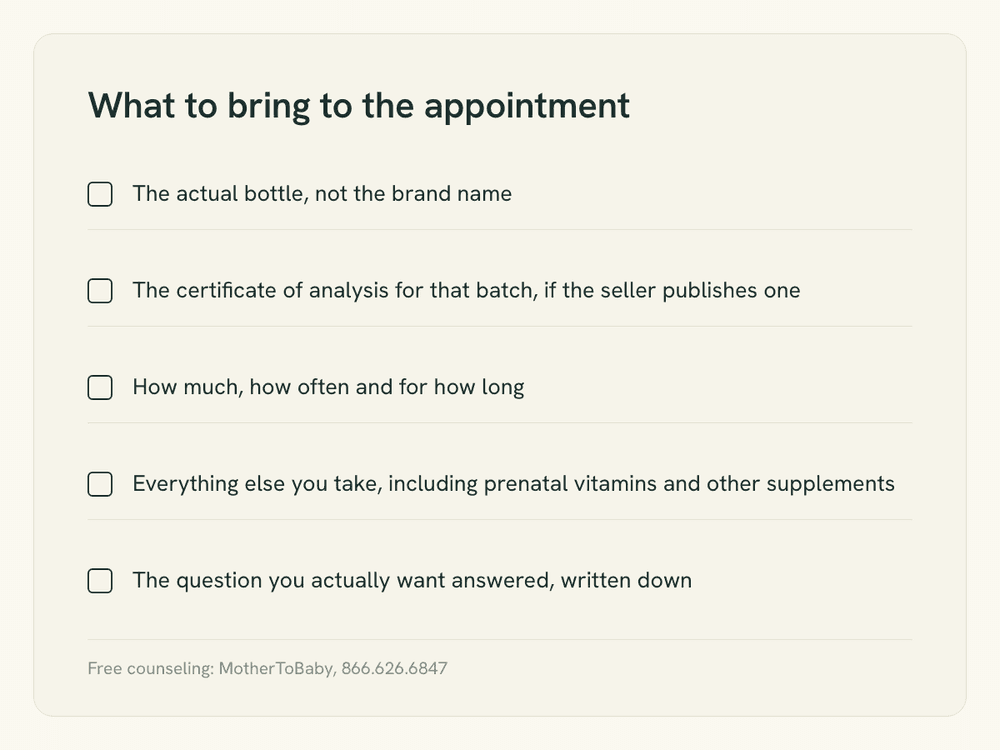
- 1The actual bottle, not the brand name. The label carries the concentration, the batch number and the spectrum, and a clear photograph of it is enough if you would rather not carry it in.
- 2The certificate of analysis for that batch, if the seller publishes one. It is the only document that states what was measured in what you took, including THC.
- 3How much, how often and for how long, in the plainest terms you can manage, including the weeks you would rather not mention.
- 4Everything else you take: prescriptions, over-the-counter medicines, prenatal vitamins and other supplements, because interactions are the part a clinician can act on immediately.
- 5The question you actually want answered, written down before you go in. Appointments are short, and this is a question that gets deflected easily.
Our position, stated plainly
We sell CBD tinctures. Our full-spectrum bottles carry trace THC, roughly 0.13% to 0.25% on the batch certificates of analysis, and our broad-spectrum batches report THC as non-detected or, on one flavor, 0.019%. Those are small numbers and they are still not zero, and none of them have been studied in a pregnancy or in a nursing infant. We do not recommend our products for anyone who is pregnant, trying to conceive, or breastfeeding, and that is why there is no link to them anywhere on this page.
And the limits of this page itself, which are real. It is a summary of published evidence as of July 31, 2026, written by an editorial team rather than by a clinician, and it is not medical advice. It does not tell you what to do. It tells you what has been measured and by whom, so that the decision you make with a clinician is made on the actual state of the record. If the Orleans study reports in 2027 and the picture changes, this page will be out of date until we update it, and the date at the top is how you check. Anything you read on this topic that sounds more certain than this, in either direction, was written by someone who has not opened the sources.
Common questions
Every US authority that has published a position advises against it. The FDA strongly advises against CBD, THC and marijuana in any form during pregnancy or while breastfeeding, and LactMed, the federal database on drugs in lactation, records that cannabidiol has not been studied in nursing women taking the prescription product, with no published information found on infant levels, on effects in breastfed infants, or on effects on lactation and breastmilk. The reason is the missing research, not a demonstrated injury. That distinction does not make the recommendation weaker. It is the reason the recommendation exists.
It has been detected there, in the milk of people using cannabis rather than a CBD product. In 54 samples from 50 women who reported marijuana use, five samples had detectable 11-hydroxy-THC or cannabidiol, with cannabidiol ranging from 1.32 to 8.56 ng/mL, and LactMed summarizes the cannabidiol result as a median of 5 mcg/L (range 1.3 to 8.6). In a separate group of 20 women using cannabis, median cannabidiol was 1.2 ng/mL in milk against 0.6 ng/mL in plasma, a milk-to-plasma ratio of 2.6. In the largest modelling dataset, 42% of samples had cannabidiol below the level at which the laboratory could quantify it. No study has measured what any of that does to an infant.
Nobody has published an elimination half-life for cannabidiol in human milk. The figures people quote belong to a different molecule: the roughly 6-day detection window comes from the 2018 study of cannabis users and describes THC, and the modelled 12 to 39 hour half-life in LactMed's cannabis monograph is also THC. Plasma half-life figures for adults are a different question with different data, and they do not answer this one. Whether to pump and discard is a question for your clinician or a lactation consultant, not for a page that cannot tell you what is being cleared or how quickly.
There is no trimester-specific human data, because there is no human trial at all: a PubMed search on July 31, 2026 filtered to clinical trials returned zero records. The animal studies on the Epidiolex label dosed rats through organogenesis and dosed a separate group through pregnancy and lactation together, so the concern recorded on that label is not confined to one window. Those are rats and rabbits at 50 to 250 mg per kilogram per day of pharmaceutical cannabidiol, and they do not translate into an amount or a timing for a person. There is no window this page can endorse, and anyone offering you one is inventing it.
Not in any way that has been measured. A documented PubMed search on July 31, 2026 for topical or transdermal cannabidiol together with pregnancy or lactation returned three records, none of them a human study in this population. Skin is not a firewall: absorption varies with the formulation, the site and the amount applied, and nobody has quantified it in a pregnant or nursing person. Applying rather than swallowing changes the pharmacokinetics. It does not change the fact that nothing here has been studied.
No. The FDA's own explanation of the terms states that CBD, which does not produce a high, can be derived from either marijuana or hemp, and its advice covers CBD in any form. Hemp and marijuana are legal categories defined by THC content, not two different cannabidiol molecules. What the plant of origin does change is what else may travel in the extract, which is an argument for more attention to the contents of the bottle, not less.
Tell your obstetrician, and bring the actual product and its certificate of analysis so the conversation is about what you took rather than about a category. Then call MotherToBaby at 866.626.6847: free, confidential, and staffed by people whose entire job is answering this question. What we will not do is estimate your risk, in either direction. A past exposure is information for a clinician, and no published study allows anyone to put a number on it. The only choice here that reliably makes things worse is not mentioning it.
Writing about hemp, wellness and the small rituals that keep us balanced.