Does CBD Make You Hungry? The Evidence Points Both Ways
The munchies belong to THC. The CBD evidence is stranger: in one randomized trial, 15 healthy adults ate 193 kcal more at lunch after CBD isolate without feeling hungrier, while the only CBD product the FDA has approved lists decreased appetite as a common adverse reaction.
Does CBD make you hungry? The folk version of that question borrows its premise from THC, and the two pieces of real evidence on CBD itself point in opposite directions. One randomized trial found that healthy adults ate more after CBD and did not feel any hungrier. The only CBD product the FDA has approved lists decreased appetite as a common side effect. Neither of those describes a hemp tincture.
That contradiction is the article. Page one of the search results answers "no, CBD does not give you the munchies" and stops there, usually on the strength of a receptor sentence that turns out to be wrong in a checkable way. What follows is both findings printed whole, with the arms, the sample sizes and the placebo columns beside them, plus a dated literature count you can re-run yourself, plus the ordinary confounders that make appetite one of the least reliable things a person can observe about themselves. This page recommends nothing and publishes no serving amounts.
Does CBD make you hungry? The short answer has two halves
Take the question literally and it has two honest answers, from two very different kinds of study, pointing in two different directions. The first comes from a laboratory. In 2026, researchers published a randomized crossover trial in which 15 healthy adults were given either 298 mg of CBD isolate or a placebo, fed a standard breakfast half an hour later, and then sat in front of an unlimited lunch three hours after the dose. They ate 193 kcal more on the CBD day. The second comes from a drug label. Cannabidiol has been approved by the FDA in exactly one form, a prescription oral solution for rare seizure disorders, and decreased appetite is printed on that label as a common adverse reaction for both of its indication groups.
The instinct is to decide which one is right. Neither is, in the sense the question wants. One is a single meal in 15 people after a single dose of a purified isolate. The other is a count of what patients, caregivers and clinicians reported over 14 to 16 weeks in children and adults with severe epilepsy, taking a drug dosed by body weight alongside other antiseizure medicines. They are not measuring the same thing, in the same people, at anything close to the same amount. What they do together is dismantle the confident answer page one gives, which is that CBD has no appetite effect at all because it does not touch the receptor THC uses. If you want the plain chemistry underneath all of this first, start with what cannabidiol actually is.
Does CBD increase appetite? The one trial that measured real eating
A randomized crossover trial published in the journal *Appetite* in 2026 is the closest thing that exists to a direct test of the question. Fifteen healthy adults, four of them women, came into the lab twice. On each visit they swallowed either 298 mg of CBD or a matched placebo, double-blind, ate a mixed-macronutrient breakfast 30 minutes later, and were then given an ad libitum lunch at 180 minutes, meaning as much as they wanted with no portion limit. Subjective ratings were collected every hour, and blood was sampled and metabolic measurements taken throughout.
Energy intake was 193 kcal greater after CBD (95% confidence interval 80 to 306 kcal; 979 kcal on CBD against 786 kcal on placebo; p = 0.003). That is the headline, and the next result is the one that changes what the headline means: there were no between-condition differences in any subjective outcome. Not hunger, not fullness, not desire to eat. Ghrelin, the hormone usually invoked whenever anyone explains appetite on the internet, was lower after CBD, by 93 pg/mL at 120 minutes and 107 pg/mL at 180 minutes. Lower ghrelin, unchanged hunger ratings, more food eaten. The authors describe their result as the first evidence that CBD isolate can increase energy intake in humans, and that superlative is theirs, not ours.
It is worth being precise about what this trial does not say. It does not say CBD makes you hungry, because the people in it did not report feeling hungrier. It does not say CBD makes you eat more in your own kitchen, because a laboratory buffet at a fixed hour is not your own kitchen. And the amount involved was chosen by researchers to test a hypothesis. This page publishes no serving sizes at all: how CBD amounts actually work is a separate article and it owns that question.
Does CBD suppress appetite? What the FDA-reviewed label reports
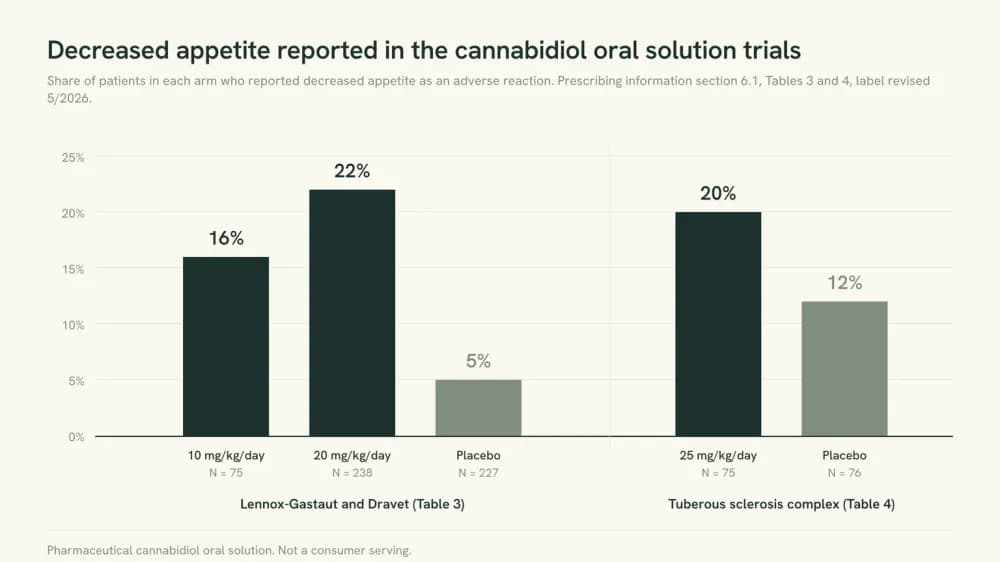
Here is where the evidence turns around, and it is the half of the answer almost nobody quotes. The honest version is narrow: decreased appetite was reported more often than on placebo in trials of a prescription drug, at doses no consumer takes, in patients no consumer resembles, and that is not the same statement as "CBD suppresses appetite". The prescribing information for EPIDIOLEX, the FDA-approved cannabidiol oral solution, label revised 5/2026 and read on August 5, 2026, names decreased appetite in its Highlights section twice, once for each indication group. For patients with Lennox-Gastaut syndrome or Dravet syndrome, and again for patients with tuberous sclerosis complex, decreased appetite is listed among the most common adverse reactions, which the label defines as occurring in 10% or more of patients on the drug and more often than on placebo. Several pages in the search results read on that date mentioned that this line exists. None of them printed the tables underneath it, which is where the interesting part lives.
| Trial program (label table) | Arm | N | Decreased appetite |
|---|---|---|---|
| Lennox-Gastaut and Dravet, Studies 1-3 (Table 3) | 10 mg/kg/day | 75 | 16% |
| Lennox-Gastaut and Dravet, Studies 1-3 (Table 3) | 20 mg/kg/day | 238 | 22% |
| Lennox-Gastaut and Dravet, Studies 1-3 (Table 3) | Placebo | 227 | 5% |
| Tuberous sclerosis complex, Study 4 (Table 4) | 25 mg/kg/day | 75 | 20% |
| Tuberous sclerosis complex, Study 4 (Table 4) | Placebo | 76 | 12% |
Two things jump out. The first is a dose relationship inside the same trial program: 16% at 10 mg per kilogram per day, 22% at 20, against 5% on placebo. The second is stranger and more useful. The two placebo columns disagree with each other. Five percent of placebo patients in the Lennox-Gastaut and Dravet trials reported decreased appetite; 12% did in the tuberous sclerosis trial. Same adverse reaction, same drug, same sponsor, and the background rate more than doubles between trial populations. That is the single best argument on this page against reading any one appetite percentage as a fact about appetite.
Now the constraints, which travel with those numbers every time they are quoted. This is pharmaceutical cannabidiol oral solution, dosed by body weight at 10 to 25 milligrams per kilogram per day, in children and adults with Lennox-Gastaut syndrome, Dravet syndrome or tuberous sclerosis complex. In the Lennox-Gastaut and Dravet trials the label reports a mean age of 14 years and states that all patients were taking other antiseizure drugs; in the tuberous sclerosis trial the mean age was also 14 and all patients but one were on other antiseizure drugs. An adverse-reaction rate is a count of what somebody reported to an investigator. It is not a demonstration that cannabidiol suppresses appetite in a healthy adult, and it is not a reason to take or avoid anything. It is also worth saying plainly what these rows are: a side effect that the prescribers of a childhood epilepsy medicine are told to watch for, not an effect anybody set out to produce.
A dose-ranging safety trial in 34 children with Dravet syndrome shows the same gradient more sharply, with the percentages as they were tabulated inside a later systematic review: decreased appetite in 0% on placebo, 0% at 5 mg/kg/day, 13% at 10 mg/kg/day and 44% at 20 mg/kg/day. The arms were tiny, no more than ten children each, so those percentages are a handful of children apiece and should be read as a direction rather than a rate. That review also notes it was the only outcome in the trial where a dose relationship was observed at all.
Does CBD give you the munchies? What the THC half rests on
The munchies question is not really a question about CBD. It is a question about THC that got attached to CBD because both come from the same plant, so it is worth checking the THC half before assuming it transfers. It holds up in one narrow and very specific place. The FDA-approved label for MARINOL (dronabinol) capsules carries an indication for anorexia associated with weight loss in patients with acquired immune deficiency syndrome. So the FDA has approved a THC molecule where appetite is the point, and has approved nothing at all in the CBD direction for appetite.
Then read what that approval actually covers. Dronabinol is synthetic THC in a capsule, at 2.5, 5 or 10 mg, a Schedule III prescription medicine first approved in the United States in 1985. The starting dosage for that indication is 2.5 mg orally twice daily, one hour before lunch and dinner. Section 14.1 of the label reports that the appetite effect was studied in a randomized, double-blind, placebo-controlled study involving 139 patients. Add that up: a purified THC molecule, at a prescription dose, in adults with a specific clinical diagnosis. A full-spectrum hemp tincture carries trace THC below the 0.3% federal limit, and nothing about that comparison transfers. Our page on whether CBD can get you high covers the intoxication side of the same distinction, and the difference between full spectrum, broad spectrum and isolate covers what is actually in the bottle.
The folk premise then fails on its own terms, before CBD is even discussed. A comparative systematic review of the approved cannabinoid medicines, registered at PROSPERO and pooling 15 randomized controlled trials with 1,974 participants for the appetite outcome, concluded that pharmaceutical THC (nabilone and dronabinol) "does not affect sleep or appetite", while reporting moderate evidence that CBD decreases appetite (odds ratio 2.46, confidence interval 1.74 to 4.01). Read that slowly: in pooled trial data of the very medicines that carry an appetite indication, appetite did not move. Both halves of that review are adverse-event and secondary-outcome signals extracted from trials designed to measure other things, in patient populations, at prescription doses, which is a real limitation on both. But the chain of reasoning that runs "THC causes the munchies, so CBD might too" breaks at the first link, not the second.
"CBD has no affinity for CB1 or CB2": the sentence page one repeats
Search this question and you will meet some version of the same sentence on nearly every result: CBD does not cause the munchies because it has no affinity for CB1 or CB2 receptors. The conclusion is right. The reason given for it is not, and the difference matters, because the wrong reason is the one people then use to predict other things.
The IUPHAR/BPS Guide to PHARMACOLOGY, the expert-curated database pharmacologists use for ligand and receptor data, lists cannabidiol's curated interactions across TRPV2, TRPV3, TRPA1 and TRPM8, GPR18 and GPR55, and a run of voltage-gated sodium channels. Exactly one entry in that list is a cannabinoid receptor: the human CB1 receptor, recorded as an allosteric modulator with the action "negative". There is no CB2 entry for cannabidiol in that dataset, which is the absence of a curated entry rather than proof of no interaction. The primary paper behind the CB1 entry, a 2015 study in the *British Journal of Pharmacology*, concluded that cannabidiol behaves as a non-competitive negative allosteric modulator of CB1 receptors, having tested it in HEK 293A cells engineered to express CB1 and in a striatal-neuron cell model that expresses CB1 naturally. In plain terms: cannabidiol does occupy a site on CB1, a different site from the one THC uses, and it turns the receptor's response down rather than switching it on.
So the honest version of the sentence is not "CBD is absent from CB1". It is "CBD is not a CB1 agonist". That is why it does not do what THC does. Both halves of the correction are cell-culture pharmacology, and a receptor label has never predicted a feeling in a person, which is why this page states the point once and moves on: how the endocannabinoid system is put together is where the receptor anatomy lives. It is also worth noticing how much more carefully the two drug labels hedge than the blog posts do.
“The precise mechanisms by which EPIDIOLEX exerts its anticonvulsant effect in humans are unknown. Cannabidiol does not appear to exert its anticonvulsant effects through interaction with cannabinoid receptors.”
Read the object of that verb. The label says cannabidiol does not appear to exert its anticonvulsant effects through cannabinoid receptors. It does not say cannabidiol has nothing to do with cannabinoid receptors, which is the much broader claim the search results make. The dronabinol label hedges in the same direction from the other side, saying only that cannabinoid receptors "may play a role in mediating the effects of dronabinol". Two FDA-reviewed documents, both careful about what is known. A page of search results full of confident mechanism sentences that neither document supports.
What the literature actually contains, counted on August 5, 2026
It is easy to write "studies show" about this topic. It is more useful to count. Here are four searches run against PubMed on August 5, 2026, with the query strings printed exactly as they were entered so you can re-run them and see whether the numbers have moved. Indexing changes, so the counts will drift; the shape of the answer is unlikely to.
| Query, verbatim | Records |
|---|---|
| (cannabidiol) AND (appetite OR ghrelin OR "food intake") | 213 |
| the same query AND humans[MeSH] | 133 |
| the same query AND randomized controlled trial[pt] | 19 |
| (cannabidiol) AND (ghrelin) | 10 |
Nineteen randomized-controlled-trial records is not 19 answers. Resolving each of those records one at a time gives a much smaller number: exactly two distinct trials gave a CBD-containing product and measured what people actually ate as a prespecified outcome, and only one of the two used CBD on its own. That one is the Appetite trial above. The other gave a THC-containing oromucosal prescription medicine rather than CBD alone, to 17 older patients, and found no significant difference in caloric intake against placebo (10 kcal, confidence interval -55 to 75). Eleven of the remaining records captured appetite the way a trial captures a side effect: whoever happened to mention it, in a study designed to count seizures. Four were noise, including a trial of a different drug entirely and an alcohol cue-reactivity brain scan.
The ghrelin query is the shortest and the most instructive. Ten records for cannabidiol and ghrelin, of which one is a completed human trial reporting ghrelin after CBD, one is a secondary analysis of another, one is a rat study, one is an analytical-chemistry paper about a different receptor, and the rest are reviews and conference index entries. There is essentially no human literature on CBD and ghrelin at all. The one trial that measured it found ghrelin lower while eating went up, which is the opposite of the mechanism story the search results tell.
Which raises a question about where those confident citations come from. One of the most heavily referenced results on this search prints nine numbered academic references beneath its claims about human appetite. Resolving the identifiers on August 5, 2026 turned up a cell-culture study of cannabidiol and calcium handling in neurons, a study of CB1 and glucose handling in mice, a review about endocannabinoids rather than CBD, a study of marijuana users and reward anticipation, and a narrative review. Not one of them is a human trial of CBD and appetite, and neither of the two human trials that do exist appears on that list. This is a check anyone can run in about a minute: take the numbered reference, search its title on PubMed, then ask whether the species and the outcome in the paper match the sentence it is attached to. It is more or less the method behind how we read evidence on this blog, and it is not being used here to accuse anyone of anything. Citations are simply easier to add than to check.
Why appetite is the hardest side effect to read honestly
Suppose you take CBD for two weeks and notice you are less hungry. Before that becomes a fact about CBD, it has to survive a queue of duller explanations. The published literature has exactly the same problem at a larger scale, and reading how researchers handle it is the fastest way to learn how to handle your own two weeks.
A 2022 systematic review in *Clinical Drug Investigation* searched for every randomized placebo-controlled trial of CBD in humans reporting appetite data, either as a measured outcome or as a safety observation, and found 11. Its tally: seven reported decreased appetite in a higher share of the CBD arm, an eighth reported increased fullness, one reported an increase in appetite, and two found no significant difference in either direction. The authors' own conclusion carries the qualifier the search results usually drop, that most of the studies included in the review raised some concerns in terms of risk of bias. And in five of the eleven trials, participants were also taking topiramate, which the review describes as "a drug that is known to decrease appetite and body weight". Five of eleven is not a footnote. It is most of the evidence base sharing a confounder.
The rest of that review reads like a list of reasons to be careful. Only three of the eleven trials measured body weight at all. It was not always clear whether appetite in the pediatric trials was reported by the children or by their caregivers, which are different measurements wearing the same label. And the detail the search results repeat most often, about the effect being larger at higher body mass index, is attached to two different references in two different places inside the review itself, and the trial it actually comes from used a cannabinoid extract containing THC in a different population. That claim is not being restated here in either direction.
A meta-analysis of adverse effects across 12 randomized CBD trials with 803 participants sharpens the same picture and then complicates it usefully. Decreased appetite was more likely on CBD overall (odds ratio 3.56, 95% confidence interval 1.94 to 6.53), and more so in the epilepsy trials specifically (odds ratio 4.12, 2.16 to 7.85). Then comes the sentence that decides how much any of this means for a healthy adult: in the non-epilepsy studies, the only event that was more frequent with CBD was diarrhea (odds ratio 5.03, 1.44 to 17.61). The appetite signal, in other words, lives almost entirely in the epilepsy trials. The same paper notes in its discussion that across the trials it identified, "weight was monitored too infrequently to be evaluated", and its authors close by asking for safety data from studies of over-the-counter CBD products, which is a polite way of saying that this literature is not about the products people actually buy.
One trial in that group deserves its own sentence, because it is the only adult, non-epilepsy, multi-week CBD trial in the set. A randomized, double-blind, placebo-controlled pilot in 62 adults with non-insulin-treated type 2 diabetes split them across five treatment arms, one of which took 100 mg of CBD twice daily for 13 weeks, with appetite and body measurements among the prespecified secondary and tertiary endpoints. It found no effect on appetite, and, in the detail tabulated inside the 2022 review, no change in BMI, waist circumference, visceral adiposity, waist-to-hip ratio, neck circumference or skinfold thickness. Read the arithmetic before the conclusion: five arms out of 62 people is roughly a dozen each, and the trial was built around glycemic and lipid endpoints rather than appetite, so it was never designed to detect a small appetite effect. But it is the closest thing in the set to adults living ordinary lives over several weeks, and its appetite result is null.
Then there are the confounders nobody writes about because they are boring. Every Planntz tincture uses a coconut MCT oil carrier, and whether you take CBD with food changes both how it is absorbed and what your stomach was doing at the time. Starting anything new also resets your attention, and attention is not a neutral instrument. What CBD actually feels like is largely a question about expectation, and appetite is among the most expectation-sensitive things a person can report.
- The carrier. A tincture in coconut MCT oil taken on an empty stomach behaves differently from the same tincture taken after a meal, and a fatty carrier is itself a small amount of food.
- The hour. A serving taken close to bedtime removes an eating window. A serving taken at 4 p.m. sits on top of one.
- What changed alongside it. Most people start CBD in a week when something else also changed: a new routine, a new schedule, a new reason to be paying attention to how they feel.
- Expectation. You read a page about CBD and appetite before you started. That is an input, not a control condition.
- Ordinary variation. Appetite swings across a week for reasons nobody tracks, and the day you decide to start noticing is rarely an average day.
- Regression to the mean. People start supplements when something already feels off, and "off" tends to drift back toward normal on its own, with or without the supplement.
There is one number that puts a floor under all of this. In a 2006 phase III oncology trial of cannabis extract and THC, not CBD, increased appetite was reported by 73%, 58% and 69% of patients in the extract, THC and placebo arms respectively, and an independent data review board recommended stopping recruitment early because the differences between the arms were insufficient. Sixty-nine percent of people on a placebo reported that their appetite had increased. That trial says nothing whatsoever about CBD, and it is cited here for one purpose only: it is the strongest available evidence that the sentence "I felt hungrier" is not a measurement. The Appetite trial makes the same point from the other direction, where the eating changed and the reported feeling did not.
A 14-day method for telling whether it is happening to you
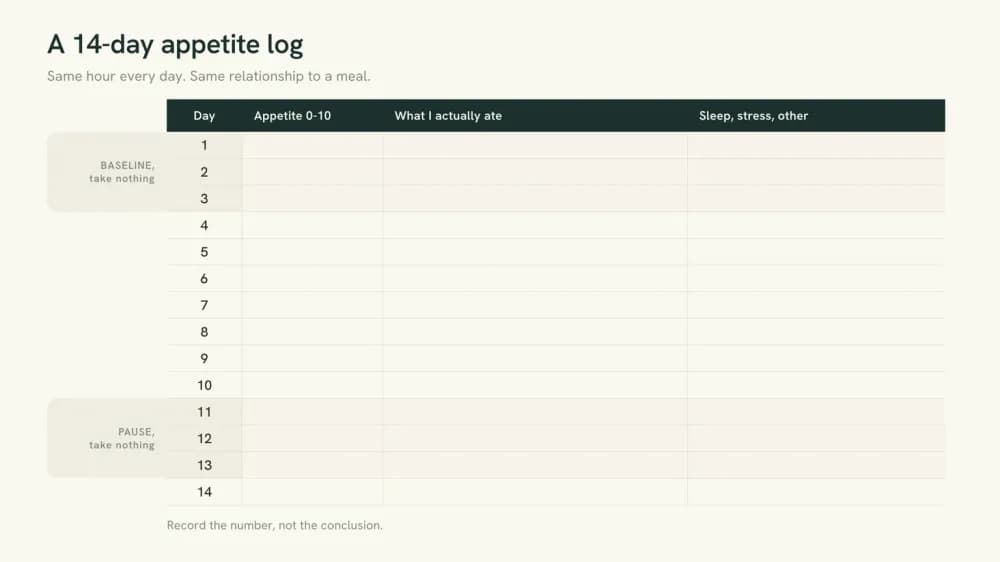
None of the evidence above tells you what happens in your kitchen. That question is answerable, but only with a method, because the thing being measured is noisy and you are the instrument. Here is a version that takes two weeks, costs nothing and is honest about what it can and cannot establish.
- 1Change one thing. For that fortnight, start nothing else: no new supplement, no new eating plan, no new training block, no new schedule. One variable, or the exercise is worthless.
- 2Fix the window. Take it at the same time each day and in the same relationship to a meal, always with breakfast or always two hours after dinner. A moving target cannot be measured.
- 3Record three days before you start. At a fixed hour, rate your appetite from 0 to 10 and note roughly what you ate, without taking anything. That is your baseline, and skipping it is the most common mistake people make.
- 4Record the thing, not the story. "Appetite 7, skipped the afternoon snack" is data. "CBD killed my appetite" is a conclusion dressed as data. Write the first kind.
- 5Keep the confounders in the same column. Sleep, stress, illness, a late night, a heavy lunch, a day off work. Write them next to the number, because at the end you will need them to explain the outliers.
- 6Pause for three days at day 10. If the effect is real and reversible, this is where you see it move back. This step is what separates an observation from a belief.
- 7Read the whole two weeks, not the days that agree with you. Look at the full column, including the entries that contradict your conclusion, and count them.
When an appetite change is a reason to call a clinician
There is a version of this question that a blog should not be answering, and it is worth being direct about where that line sits. If your appetite has changed enough to worry you, the useful next step is a clinician, not a search result, and that is true whether or not CBD is anywhere in the picture. Any of the following belongs in a conversation with a professional.
- Appetite loss that persists for more than a couple of weeks, or that arrived with no obvious change in your routine.
- Appetite change alongside nausea, vomiting, abdominal pain, unusual tiredness or yellowing of the skin or the whites of the eyes. Those combinations belong in front of a doctor the same week.
- Appetite change in an older adult, where the consequences arrive faster and matter more, and where several common prescriptions list appetite effects of their own.
- Appetite change in a child, or in anyone whose intake is already something a clinician is monitoring.
- Any appetite change in someone taking prescription medication. A great many medicines list appetite effects, and untangling which one is responsible is a pharmacist's job rather than yours.
- Any eating pattern that is causing you distress. That is a clinical conversation, and it has nothing to do with a hemp product.
Appetite change also sits on the general side-effect list for CBD, alongside diarrhea, drowsiness and changes in liver enzyme readings. The full picture of CBD side effects is a separate page, what happens at large amounts is another, and what older adults should check first covers why the same event carries more consequence later in life. This page is one line of that side-effect list, expanded until it is useful.
What this page is not saying
So: does CBD make you hungry? On the evidence that exists, the fair answer is that one small, carefully run trial found healthy adults ate more after a single research dose without reporting that they felt any hungrier, and that the only cannabidiol product the FDA has approved lists decreased appetite as a common adverse reaction, at doses no consumer takes, in a population no consumer belongs to. Two real findings, pointing opposite ways, neither of them describing you. That is a less satisfying answer than the one on page one, and it is the one the evidence supports. If your appetite changes after you start something new, the honest response is not a theory. It is two weeks of notes.
No. The munchies reputation belongs to THC, and even that reputation is shakier than it sounds. A comparative systematic review pooling 15 randomized controlled trials with 1,974 participants found that the approved pharmaceutical THC medicines, nabilone and dronabinol, did not affect appetite. CBD is not an agonist at the CB1 receptor, so it does not do what THC does there. Across the trials counted on this page the CBD appetite signal mostly runs the other way, and the one trial that measured real eating found people ate more without reporting that they felt any hungrier, which is not what the munchies means.
In the one randomized crossover trial that measured what people actually ate, 15 healthy adults ate 193 kcal more at an unlimited lunch after a single 298 mg dose of CBD isolate than after placebo (95% CI 80 to 306 kcal, p = 0.003). In the same trial they reported no difference in hunger, fullness or desire to eat. That is one trial, one dose, one meal, 15 people and a laboratory, which makes it a finding worth knowing and not a rule about your week.
Decreased appetite is listed as a common adverse reaction on the FDA-approved cannabidiol label, reported by 16% of patients at 10 mg per kilogram per day and 22% at 20 mg per kilogram per day against 5% on placebo in the Lennox-Gastaut and Dravet trials, and by 20% against 12% on placebo in the tuberous sclerosis trial. Those are prescription doses of an oral solution in people with severe epilepsy, almost all of whom were taking other antiseizure drugs. A pooled analysis of 12 CBD trials found that signal concentrated in the epilepsy studies: in the non-epilepsy studies, the only adverse event more frequent with CBD was diarrhea.
Possibly because of the CBD, and possibly for one of a dozen duller reasons. Appetite is among the least reliable things to self-observe. In a 2006 oncology trial of cannabis extract and THC, 69% of patients on placebo reported increased appetite. The placebo arms of the CBD epilepsy trials reported decreased appetite at 5% in one trial program and 12% in another, for the same drug. And the one trial that measured real eating found the eating changed while the reported feeling did not. Carrier oil, timing relative to meals, sleep, stress and expectation all move the needle before CBD gets a turn.
Appetite change is on the side-effect list, it tends to show up early, and the practical response is to change one thing at a time, keep the timing fixed and write it down for two weeks. It becomes a clinician's question rather than a blog's when it persists, when it is significant, or when it arrives with nausea, vomiting, unusual tiredness or yellowing of the skin. Anyone taking prescription medication should raise it with a pharmacist or prescriber, since a great many medicines list appetite effects of their own.
None of the trials counted on this page tested that specific question, and the arithmetic is against it. Full-spectrum hemp extract carries trace THC below the 0.3% federal limit, and on Planntz full-spectrum certificates of analysis that lands around 0.13% to 0.25%. The approved THC capsule that carries an appetite indication starts at 2.5 mg of pure synthetic THC twice daily, by prescription. Broad-spectrum products have the THC removed, and Planntz broad-spectrum COAs report non-detected THC on the mango and natural batches and a 0.019% trace on lemon. Check the certificate for the batch you actually have rather than the claim on the front of the box.
Read the batch, not the marketing
Every Planntz tincture ships with a per-batch third-party certificate of analysis, so the cannabinoid breakdown for the bottle in your hand is published rather than promised.
See the Planntz tincturesWriting about hemp, wellness and the small rituals that keep us balanced.