Does CBD Cause Diarrhea? The Label Data and the Carrier Oil
Yes, it can: the FDA names gastrointestinal distress as a CBD side effect. But the reason page one gives has no source, and the two animal papers cited underneath it report the opposite. Here is what the trials, the registry and the approved label actually show.

Yes, CBD can cause diarrhea. It is one of the effects the FDA names by name when it lists what CBD can do to you, and in the one randomized dataset with per-arm numbers it turned up far more often on cannabidiol than on placebo. The interesting part is that almost nothing page one tells you about why it happens has a source behind it.
So the useful question is not whether it can happen. It is which thing did it: the cannabidiol itself, the oil it is dissolved in, the amount, the time of day, or something you ate that afternoon. Reaching an answer is mostly a matter of changing one variable at a time and writing down what happens. This page stays on one side effect of CBD oil, diarrhea and the looser stools around it, and takes it from the evidence down to a method you can run this week. The wider list of what CBD does to people lives in our roundup of CBD side effects, and if you are still working out what cannabidiol actually is, start there and come back.
What the FDA actually says, in its own words
The plainest statement on this comes from a federal consumer page, and it is worth quoting rather than paraphrasing. In the FDA's consumer update on products containing cannabis or cannabis-derived compounds, the agency writes that CBD "can cause" side effects "that you might notice", and then names them. One of the items on that list reads: "Gastrointestinal distress, most commonly experienced as diarrhea and/or decreased appetite." A longer version of the same sentence on the same page adds that it "could also include abdominal pain or upset stomach". The agency also says what happens next: these side effects "should improve when CBD is stopped or when the amount used is reduced." The page footer reads "Content current as of: 03/05/2020", and we re-read the page on August 6, 2026 with both a plain fetch and a browser user agent. Those sentences were still there.
Read it twice, because the value is in what is missing. The FDA gives no duration and no milligram threshold. It is a consumer summary rather than a trial report, so it cannot tell you how often this happens or to whom. But it is the document the whole category leans on, and the two figures that circulate hardest online are not in it: not the claim that the risk begins somewhere above 300 mg, and not the claim that the effect clears in 24 to 72 hours. Neither figure is in the FDA-approved cannabidiol label either, and neither is in either randomized trial that measured gastrointestinal outcomes under CBD. That absence is the real finding of this section, and everything below is what you can put in its place.
The mechanism everybody prints, and the two mouse papers underneath it
Almost every page on this search result offers the same explanation in almost the same words: CBD stimulates cannabinoid receptors in the intestine, which accelerates digestive motility, which shortens transit time, which gives you diarrhea. It reads like textbook physiology. Of the nine results we read on August 6, 2026, eight were CBD sellers, affiliates or marketplaces and one was a clinical case report. Among the seller pages, exactly one printed identifiers beside its motility claim, which made it the only version of the sentence on the page that could be checked at all. So we checked it.
Both identifiers resolve to real papers. Both papers are mice, and both report the opposite direction. The first is a 2008 paper in the British Journal of Pharmacology on cannabidiol and inflammatory hypermotility in mice, whose in vivo result reads: cannabidiol "did not affect motility in control mice, but normalized croton oil-induced hypermotility". In animals whose guts had been chemically irritated into running fast, it brought motility back toward normal; in healthy animals it did nothing measurable. The second, a 2016 study in Frontiers in Pharmacology using an orally active cannabidiol-rich extract in mice, found the same shape: it reduced intestinal hypermotility "at doses lower than those required to affect transit in healthy mice". These are preclinical studies, in rodents, in chemical irritant models. They say nothing directly about a person and nothing at all about a hemp tincture, in either direction. What they do settle is narrower and more useful: they are not evidence for the sentence they are being cited for.
“In vivo, cannabidiol did not affect motility in control mice, but normalized croton oil-induced hypermotility.”
The two randomized trials that measured a human gut
As of a PubMed search run on August 6, 2026, exactly two randomized controlled trials in humans connect cannabidiol to a gastric-emptying or gut-motility term, and both come out of the same Mayo Clinic program. The query was: cannabidiol AND ("gastrointestinal transit" OR "gut motility" OR "colonic transit" OR "gastric emptying") AND humans[MeSH] AND randomized controlled trial[pt]. Run it yourself and the count should reproduce. The first of the two is a 2022 randomized, double-blind, placebo-controlled trial in the American Journal of Gastroenterology. It gave pharmaceutical-grade cannabidiol twice daily at 20 mg per kilogram of body weight per day for four weeks, then measured gastric emptying of solids, gastric volumes and a nutrient satiation test. Its Results section reports: "CBD and placebo effects on physiological functions and patient response outcomes were not significantly different." Its Discussion goes further, stating that approved doses of CBD used off-label "do not ... alter gastric motor functions and satiation".
Do not turn that into "CBD does not affect your gut". It is one population, one dose level, four weeks, and upper-digestive measurements. Gastric emptying is how fast a meal leaves the stomach; it is not stool frequency, and this trial did not measure colonic transit at all. The only other signals in it were two borderline gene-interaction terms at P = 0.06 and P = 0.12, neither statistically significant. What the trial does do is remove the physiology page one asserts: when researchers actually pointed instruments at gut motor function under cannabidiol, nothing moved.
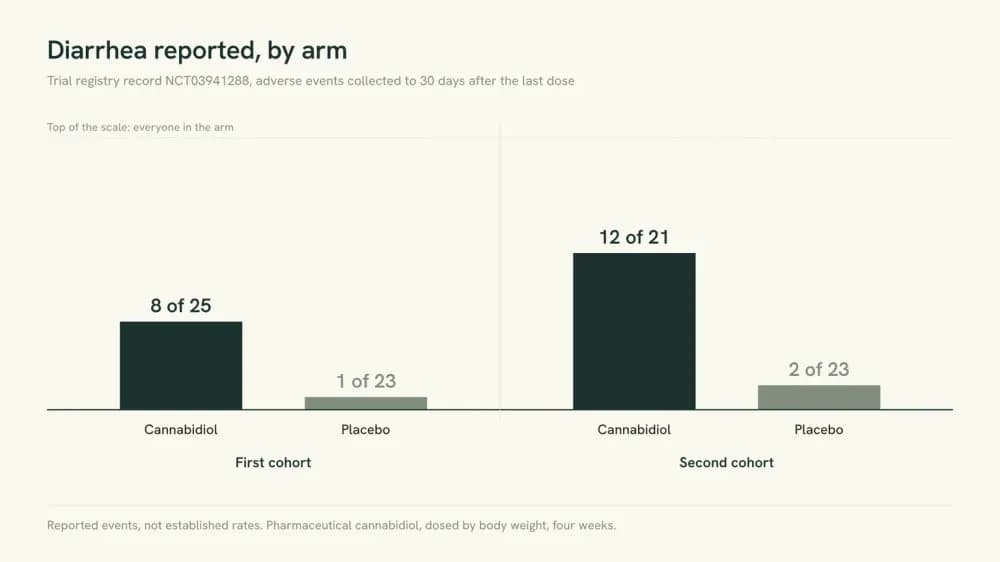
The trial's abstract does not tell you how many people in it got diarrhea. The results record for the same trial on ClinicalTrials.gov does, and it is the clearest human number on this entire topic. In the first cohort, diarrhea was reported by 8 of 25 adults taking cannabidiol against 1 of 23 taking placebo. In the second cohort, 12 of 21 against 2 of 23. Exactly three non-serious adverse-event terms cleared the registry's 5% reporting threshold in the whole study, and the other two did not separate at all: in the first cohort nausea was 8 and 8, and fatigue was 8 and 8, identical on cannabidiol and on placebo. Events were collected, in the registry's words, "from baseline until 30 days after the last day of study medication". There were no deaths in any arm.
Here is the habit worth stealing from this section. The published paper from the second cohort, a 2023 randomized controlled trial in Clinical Gastroenterology and Hepatology, reports the safety data in its abstract like this: "The most common adverse events reported were diarrhea (14 patients), fatigue (8 patients), headache (8 patients), and nausea (7 patients)." Fourteen patients. The registry shows those 14 are 12 on cannabidiol and 2 on placebo, and the other two terms it publishes reconcile the same way: fatigue is 4 and 4, nausea is 3 and 4. A pooled adverse-event count in an abstract hides the arm split, and the arm split is the whole answer. Whenever you meet a side-effect count with no placebo column beside it, what you are reading is not yet a finding.
The limits travel with all of it, and they are not small. Both cohorts were adults recruited at one academic center because they already had a diagnosed digestive condition, which is not who is reading this page. Both took pharmaceutical cannabidiol dosed by body weight for four weeks, which is not comparable to a tincture serving. The arms are small, and an adverse event in a registry is a reported event rather than a demonstrated rate: nobody randomized these people to find out how often diarrhea happens. What survives all of that is the shape of the table. Diarrhea separated from placebo, and the two symptoms sitting beside it did not.
What the FDA-approved cannabidiol label reports
There is exactly one cannabidiol product the FDA has approved: a prescription oral solution for rare, severe seizure disorders. Its prescribing information is public, and unlike almost everything else in this category it carries adverse-reaction tables with a placebo column beside every rate. Diarrhea is in them. The label, hosted on the National Library of Medicine's DailyMed, is the document this section reads. Read across the rows before you read down them.
| Label table | Dose | Patients on cannabidiol | Diarrhea on cannabidiol | Diarrhea on placebo | Patients on placebo |
|---|---|---|---|---|---|
| Table 3 (Studies 1, 2, 3) | 10 mg/kg/day | 75 | 9% | 9% | 227 |
| Table 3 (Studies 1, 2, 3) | 20 mg/kg/day | 238 | 20% | 9% | 227 |
| Table 4 (Study 4) | 25 mg/kg/day | 75 | 31% | 25% | 76 |
Two things in that table do more work than the headline number. At the lower dose the diarrhea rate is 9% and the placebo rate is also 9%: the same figure. And in the fourth study, the one in Table 4, a quarter of the placebo group, 25%, reported diarrhea as well. There is a genuine dose-related pattern between the two lower dose levels, 9% rising to 20%, and that qualitative pattern is one of the few real things anyone can say about amount and digestive upset. What is not in the label anywhere is a milligram threshold. The number circulating online has no home in this document.
Then the three reasons none of those percentages transfers to a bottle on a shelf, all of them in the label's own words. The dosing is per kilogram of body weight per day, in trials of severe childhood-onset epilepsy syndromes where the mean age was 14 years (range 2 to 48 in the first three studies) and treatment ran up to 14 to 16 weeks. Everyone was on other medicines: "All patients were taking other AEDs" in the first three studies, and all but one patient in the fourth. The vehicle is not our vehicle: the label's inactive ingredients are "dehydrated alcohol (7.9% w/v), sesame seed oil, strawberry flavor, and sucralose", which is a sesame-oil-and-alcohol solution, not coconut MCT. Be precise about that second point, because it is easy to overreach. The label attributes transaminase elevations to concomitant valproate and clobazam, and it attributes the diarrhea to nothing at all. Neither do we: every patient producing these figures was taking other drugs, which is not the same as saying the other drugs produced the figures. The same tables carry the decreased-appetite rows, which we read separately in the appetite question.
Is it the CBD or the oil? We ran the numbers on our own bottle
The carrier oil is the one thing page one mentions and then drops after a single sentence. A seller page put it this way: "MCT oil (derived from coconut) is a common carrier in CBD oils. However, it is known to have a mild laxative effect." No study is cited for it, there or anywhere else on that page. It is a convenient sentence for a company that sells cannabinoids dissolved in oil, because it moves the blame off the cannabinoid and onto something that sounds like a neutral ingredient. Our tinctures use coconut MCT oil, so rather than repeat the sentence we ran the arithmetic in public, using the density printed on our own batch certificate of analysis. If you have never opened one, how to read a COA shows you where a density figure sits on the page, and the difference between CBD oil and a tincture covers what else is in the bottle.
| Step | Calculation | Result |
|---|---|---|
| Mass of everything in the bottle | 60 mL x 0.934 g/mL (COA-measured density) | 56.04 g |
| Subtract the labeled cannabinoids | 56.04 g - 15 g | 41.04 g of carrier |
| Carrier per milliliter | 41.04 g / 60 mL | 0.684 g/mL |
| Carrier in one drop of about 0.05 mL | 0.684 g/mL x 0.05 mL | about 34 mg |
| Benchmark | MCT amount | Drops of this tincture to reach it |
|---|---|---|
| Day 1 of a ketogenic-diet introduction protocol, titrated to avoid intolerance | 12.5 g | about 366 |
| Days 2 to 10 of the same protocol | 25 g per day | about 731 |
| Human dietary level called confirmed safe in a toxicology review, 1 g/kg, for a 70 kg adult | 70 g | more than the whole bottle holds |
| The entire 60 mL bottle | about 41 g | 1,200, which is all of them |
The benchmarks are not ours. A toxicology review in Food and Chemical Toxicology closes its abstract with this: "The safety of human dietary consumption of MCTs, up to levels of 1 g/kg, has been confirmed in several clinical trials." It is a review, and most of it is animal toxicology, so that single human dietary sentence is the only part we are using. The lowest well-characterized human exposure where digestive symptoms actually show up is a 2021 study in Nutrients of 16 women, 13 of whom completed it, already following a ketogenic diet. Its protocol titrated MCT deliberately "to avoid intolerance": 12.5 g on the first day, 25 g a day for the following nine. Its abstract reports that "abdominal pain, diarrhea, and nausea were reported after adding betaquik". Single arm, no placebo, all with drug-resistant epilepsy. Its value here is the number of grams, not the outcome.
So: about 34 mg of carrier oil per drop, and about 41 g in an entire 60 mL bottle. Running the same arithmetic against the COA-measured cannabinoid content rather than the label figure gives 33 mg per drop, and across all four of our tinctures the range comes out at 33 to 37 mg. To reach even the introductory first-day amount in that ketogenic protocol you would have to swallow roughly 366 drops at once, and the whole bottle is less than two days of it. At ordinary tincture use, the carrier-oil explanation does not survive its own arithmetic. That is a finding against the explanation that would have flattered us, which is exactly why it is here.
Three counterweights, and none of them is optional. First, this is arithmetic about amounts, not proof that carrier oil never matters to any individual. Nobody has published a study of digestive symptoms at tens of milligrams of MCT, so "far below the studied amounts" is not the same claim as "cannot possibly matter for one person". Second, a tincture is not only cannabinoids and carrier: flavor systems are unstudied here, and in other formats so are the sweeteners, gelling agents and sugar alcohols. Third, the one published clinical report on this topic involved an olive-oil soft gel rather than an MCT tincture. And every drop figure above assumes a drop of about 0.05 mL, which varies with the dropper and with your technique. Our per-drop calculator walks through why that assumption is the weakest link in any per-drop number, including this one.

Does CBD make you poop?
Asked in the words people actually use: some people do report looser and more frequent stools, and in the one randomized dataset that publishes per-arm numbers, diarrhea separated clearly from placebo. What does not exist is a trial built to answer this. A PubMed search run on August 6, 2026 for cannabidiol together with defecation, stool frequency, bowel movement or stool consistency terms returns 12 records, and not one is a trial that set out to measure a stool outcome. Widen it to cannabidiol and diarrhea restricted to human randomized trials and you get 20 records: 12 belong to the childhood epilepsy program, 3 are phase 1 pharmacology studies, 1 is query noise, and the remaining 4 are trials in single unrelated conditions. None is a trial of a consumer hemp CBD product with a stool outcome specified in advance. "People report it" and "it has been measured" are two different claims, and only the first is available here.
The opposite question comes up almost as often, and there is even less to go on. A search restricted to human randomized trials of cannabidiol and constipation returns a single record, and that record is not a study of the question. The pattern that shows up in adverse-event reporting runs the other way, toward looser rather than firmer stools. One odd detail from the case report below: that patient had constipation, managed with a fiber supplement, before her diarrhea ever began. One patient is not a pattern, but it is a reminder that a change in either direction is worth writing down rather than explaining away.
The one clinical report on record, and exactly how much it weighs
Search the indexed literature for cannabidiol alongside microscopic, collagenous or lymphocytic colitis and you get one record in total. It is a 2020 case report in Cureus describing a 75-year-old woman who had been taking CBD oil for about a year for lower back pain. Her stools went from two loose bowel movements a day to five a day plus three or four at night, with urgency, left-sided abdominal pain, an unintentional weight loss of eight pounds and a small amount of blood on wiping. She was not taking NSAIDs or any other agent associated with the diagnosis at the time, and a stool PCR panel came back negative for enteric pathogens. A repeat colonoscopy with random biopsies found collagenous colitis; an earlier scope had looked normal to the eye, because random biopsies had not been taken. Then the part that gives the report its weight: CBD was stopped and the diarrhea improved, she restarted it at home and it returned, she stopped and it resolved, and a week later she restarted and it returned again. Two rechallenges, and the authors grade the link "probable or likely" on the World Health Organization causality scale.
Now the weight of it, honestly. n = 1. A case report can generate a hypothesis; it cannot produce an incidence, a risk or a threshold, and anyone quoting it as evidence of how common this is has misread what a case report is. The product was a soft gel made with hemp oil and extra virgin olive oil, not an MCT tincture, which is the second reason not to hang the whole answer on the carrier. The journal prints its own standing disclaimer that it "is not responsible for the scientific accuracy or reliability of data or conclusions published herein", and the National Library of Medicine's catalog record for that journal states that it is not currently indexed for MEDLINE, with the article reaching PubMed by way of PubMed Central deposit. None of that is a criticism of the authors, whose dechallenge and rechallenge sequence is the most careful piece of observation in this literature.
What the case is really for is a different question: what does "go and get evaluated" look like, and why is it worth the trouble? Watery night-time diarrhea, weight loss and blood are the features that got this patient scoped, and the scope is what found the answer. Diarrhea that does not stop deserves an evaluation, and the evaluation may well turn up something that has nothing to do with what you took.
How to find out which variable it is: a seven-day sequence
This page publishes no amounts. Our dosage guide owns those, and amount is the wrong lever to pull first anyway, because it is the one that changes everything else about your routine at the same time. The first lever is food: taking CBD with a meal changes more than comfort, since a fatty meal changes how much cannabidiol is absorbed in the first place. The second is technique and format, which our guide to taking CBD oil covers in detail. And if the change in your digestion arrived in the same week as a new prescription, that is a question for the prescriber rather than for the bottle: CBD and medications explains why the overlap matters. Here is the sequence, and it is deliberately slow.
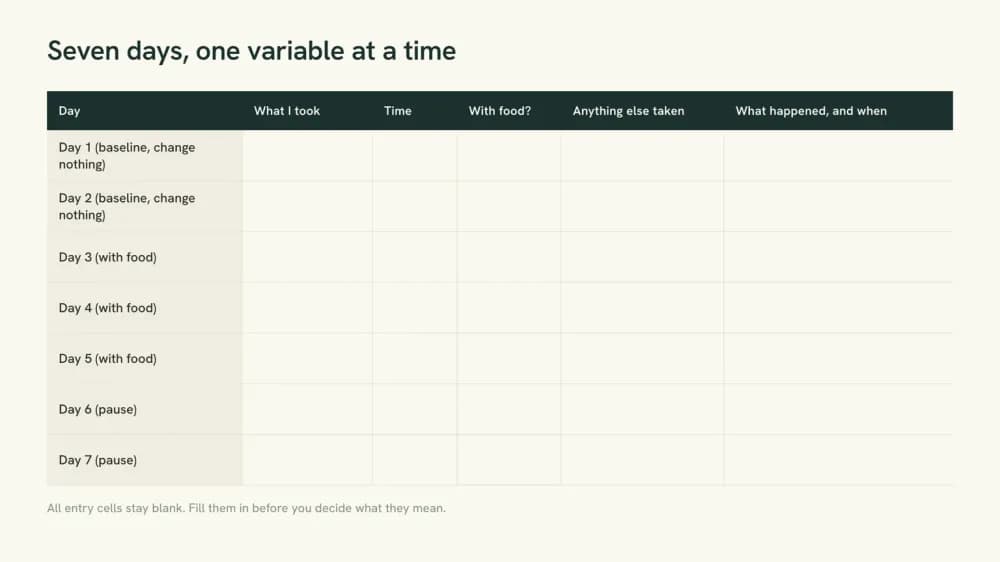
- 1Write it down first. Two days of notes before you change anything: what you took, when, with or without food, what else you took that day, and what happened and when. Without a baseline you are guessing.
- 2Change one variable, not three. The most common mistake is switching product, timing and amount at the same time, which guarantees you learn nothing from the result.
- 3Variable one: food. Take it with a meal instead of on an empty stomach, at the same time of day, for three days before you judge it.
- 4Variable two: the format. Changing format changes the carrier, the flavor system and any sweeteners all at once. That is a blunt test, but it is a useful one when food changes nothing.
- 5Variable three: the time of day. Same product, same food context, moved to the other end of the day.
- 6Then pause entirely for three days. If it settles on the pause and comes back when you restart, you have run your own dechallenge and rechallenge, which is the pattern the one published clinical report rests on.
- 7Check what else changed. A new medicine, a course of antibiotics, a new sweetener, travel, or a stomach bug in the house. A digestive change that lands in the same week as a new prescription is a question for the prescriber.
Most digestive upset is neither dramatic nor lasting, and the practical difference between a tolerability problem and something that needs a clinician is usually whether it stops when you stop. If your question is closer to how much is too much than to what caused this, how much CBD is too much carries the US poison-control route and what an accidental overconsumption actually looks like. And if you are trying to work out what is normal for you in the first place, what CBD feels like is about the self-observation habit rather than the symptom.
What is still unknown
The honest limits of this page are larger than its findings, so state them plainly. Nobody has measured stool frequency or stool consistency under cannabidiol in a trial designed to do it. Every human diarrhea number above describes pharmaceutical cannabidiol, dosed by body weight, in people enrolled for a diagnosed condition and taking other medicines: not one of them describes a healthy adult taking a hemp tincture. Nobody has studied carrier oil at the scale a tincture delivers, which is why our own arithmetic can tell you about amounts and not about your individual sensitivity. The case literature is one patient, on a different product, in a different format. And the mechanism question is genuinely open: the preclinical work points one way, the randomized trial that measured gastric motor function in people found nothing moving, and the confident sentence circulating online is supported by neither.
No trial and no regulator publishes a duration. The figures circulating online, usually 24 to 72 hours, have no citation attached to them anywhere we could find. What the FDA does say is that these side effects should improve when CBD is stopped or when the amount used is reduced, which is a description of what happens on a pause rather than a clock. If it is not improving after about 48 hours, or if any of the red flags above appear, that is a reason to be evaluated rather than to wait it out.
No published trial has measured stool frequency or stool consistency as an outcome under cannabidiol. A PubMed search run on August 6, 2026 for cannabidiol together with defecation, stool frequency, bowel movement or stool consistency terms returns 12 records, and none of them is that study. What does exist is adverse-event reporting, where diarrhea separated from placebo in one randomized dataset. That is not the same claim as a laxative effect, and treating it as one skips over the study nobody has run.
There is essentially nothing to go on. A search restricted to human randomized trials of cannabidiol and constipation returns one record, and that record is not a study of the question. The pattern that shows up in adverse-event reporting runs the other way, toward looser rather than firmer stools. If your own experience runs in the opposite direction, it is still worth writing down, because nobody has measured either direction properly.
On the arithmetic, the carrier is an unlikely culprit at ordinary tincture use. One drop of a Planntz tincture carries about 34 mg of coconut MCT oil, and the whole 60 mL bottle about 41 g, which is less than two days of the smallest MCT amount at which the nutrition literature reports digestive symptoms. That is not a proof about any one person: amounts are not the same thing as individual sensitivity. The way to find out is to change one variable at a time, and the first two worth changing are food and format.
No threshold exists in any document we could check. It is not in the FDA-approved cannabidiol label, not in the FDA consumer update, and not in either randomized trial that measured gastrointestinal outcomes. The trials where diarrhea separated from placebo used pharmaceutical cannabidiol dosed by kilogram of body weight per day, which is not comparable to a tincture serving. The 300 mg and 500 mg figures circulating online arrive with no source attached, and we could not find one for them.
Pausing is the cheapest test available to you, and if the cannabidiol is the cause, stopping is also the FDA's own description of what makes it improve. Give the pause long enough to mean something, then decide. Blood in the stool, fever, severe pain, diarrhea that wakes you at night, unintentional weight loss or anything lasting past about 48 hours is a call to a clinician instead of a home experiment.
Writing about hemp, wellness and the small rituals that keep us balanced.