CBD Oil vs Tincture: What the Word Actually Means Now
In practice, CBD oil and CBD tincture name the same thing on a US shelf. But the word tincture did not lose its meaning, it lost its jurisdiction. Here is what it officially means, what it used to guarantee, what is actually in 437 bottles, and how to tell in 30 seconds.
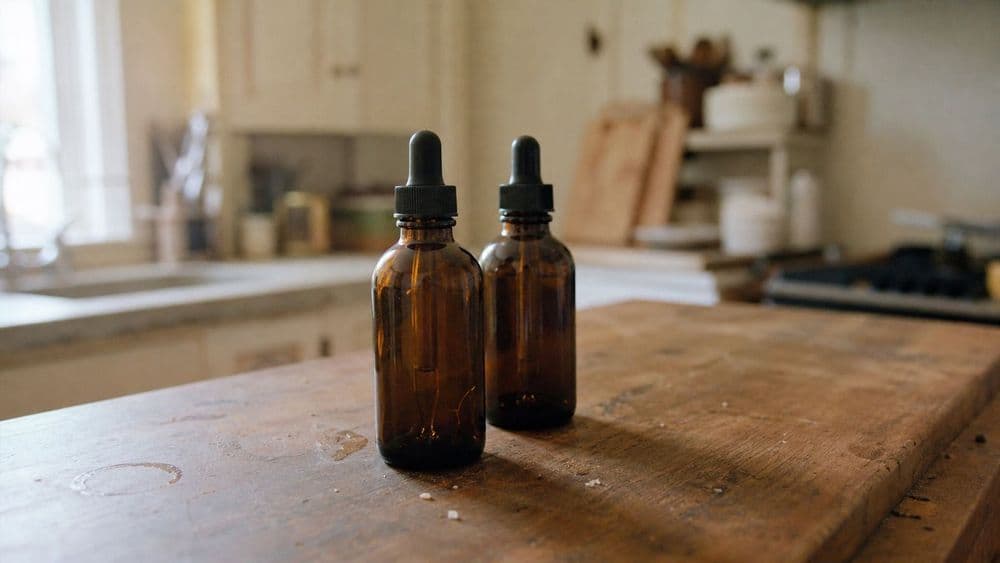
You are holding two bottles. One says CBD oil, the other says CBD tincture. Same volume, same dropper, similar price, and the ingredient lines look close to identical. Almost every page on CBD oil vs tincture either tells you the words are interchangeable or tells you a tincture is the one made with alcohol. Both answers are half right, and neither one helps you at the shelf. Here is the fuller version: the word tincture did not lose its meaning. It lost its jurisdiction.
The short answer first. On a US shelf in 2026, CBD oil and CBD tincture describe the same category of product: a hemp extract suspended in a liquid you measure with a dropper. The word tincture does still carry a precise definition in the vocabulary the FDA uses on drug labels, where it means an alcoholic or hydroalcoholic solution. That vocabulary governs drugs, and a hemp product sold as a supplement is not one, so nothing stops a company from printing the word tincture on a bottle of oil. What actually decides your purchase is the concentration in mg/mL, the spectrum, and a batch lab report you can match to your bottle, which is the same short list as the buyer's checklist we use for everything else.
CBD oil vs tincture: are they the same thing?
Yes, almost always. The reason the internet cannot agree is that two different sources of truth are talking past each other. One camp is quoting a pharmacy definition, in which a tincture is a specific preparation with a named solvent and a fixed strength. The other camp is describing a shelf, on which tincture is just what dropper bottles get called. Both are accurate about their own world. Neither one tells you what is in the bottle in your hand, because the pharmacy definition has no authority over a hemp product and the shelf convention has no rules at all.
So instead of arguing about vocabulary, this page answers three checkable questions. What does the word officially mean, and to whom? What did it used to guarantee, back when it guaranteed something? And what is actually in the bottles being sold right now? At the end you get a 30-second test that makes the whole argument moot. If you landed here from the wider format question, the same comparison asked about gummies covers two genuinely different products. Oil versus tincture is not that.
Tincture is not a vibe. It is a defined dosage form.
Every drug marketed in the United States has to declare a dosage form from a controlled list, and the FDA publishes that list of acceptable dosage-form terms with a code for each entry. TINCTURE is on it, code C43000, sitting alongside OIL (C42965), SOLUTION (C42986), EXTRACT (C42929) and FLUID EXTRACT (C68991). These are not loose synonyms for one another. The record behind C43000 carries two definitions, and alcohol sits in the middle of both: "an alcoholic or hydroalcoholic solution prepared from vegetable materials or from chemical substances", and "a solution composed of an alcoholic extract or solution of nonvolatile active and/or inert ingredient(s)". Read those as a labeling standard for drugs, though, not as a law about your dropper bottle. Nothing in this vocabulary reaches a hemp extract sold as a supplement.
| Dosage form (code) | Definition in the FDA labeling vocabulary | What actually carries it |
|---|---|---|
| TINCTURE (C43000) | An alcoholic or hydroalcoholic solution prepared from vegetable materials or from chemical substances. | Iodine, gentian violet, deodorized opium tincture, homeopathic mother tinctures. No CBD product. |
| EXTRACT (C42929) | A distillate composed of active and/or inert ingredient(s) extracted from plant or animal matter, and represented in concentrated form. | The form cannabis first entered the US Pharmacopoeia in, as Extractum Cannabis in 1850. |
| FLUID EXTRACT (C68991) | Alcohol as the solvent and/or preservative, prepared so that the ingredient in each milliliter is equivalent to 1 gram of the dried plant. | A 1:1 ratio of liquid to dried plant, which is where the old strength standards lived. |
| OIL (C42965) | A solution or suspension that is hydrophobic, soluble in organic solvents, and liquid at ambient temperature. | The category almost every CBD dropper bottle on the market actually belongs to. |
| SOLUTION (C42986) | A clear, homogeneous liquid composed of one or more chemical substances dissolved in a solvent or mixture of mutually miscible solvents. | Epidiolex, the only FDA-approved CBD medicine, is registered as an oral solution. |
Here is the part nobody in the search results has bothered to count. The FDA's National Drug Code Directory lists every drug product currently marketed in the US along with its declared dosage form. Query the openFDA drug NDC endpoint for dosage_form:"TINCTURE" and you get 31 products, on data last updated July 29, 2026. Not one of them is a CBD product. They are iodine, gentian violet, benzalkonium, miconazole nitrate, podophyllum resin, deodorized opium tincture and a set of homeopathic mother tinctures. That is not a rejection of CBD. The directory covers drug listings, and CBD tinctures are absent because they are not marketed as drugs, so nobody ever filed them. The word kept its meaning inside the drug system and got borrowed by a market that system does not govern.
If you want to see what the word still means where it has legal force, the clearest live example is Opium Tincture, USP (Deodorized). Its FDA-approved label on DailyMed describes "a clear, reddish-brown hydroalcoholic solution" in which "each 100 mL contains 1 g of anhydrous morphine (represents the equivalent of 10 g of Powdered Opium, USP), alcohol, 19%, and water." It is a Schedule II prescription medicine and it is quoted here purely as a vocabulary specimen, so nothing about how it is used has any bearing on a hemp product. Look at the composition instead: a named solvent, a stated alcohol percentage, and a fixed ratio of 10 grams of crude drug per 100 mL. That ratio is not a coincidence. It is the same 10% standard the US Pharmacopoeia wrote down for tinctures in 1916.
What the word used to guarantee, from 1850 to 1942
Cannabis entered the United States Pharmacopoeia in the 1850 revision. The entry reads "Extractum Cannabis. Extract of Hemp. An alcoholic extract of the dried tops of Cannabis sativa, variety Indica", and it appears in that edition's table of substances newly introduced to the materia medica. You can page through the scan of the 1850 Pharmacopoeia on the Internet Archive and find it on page 50. Two details are worth noticing. The solvent is named inside the definition itself, and the preparation is called an extract rather than a tincture, because in that system those were different products at different strengths.
By the Ninth Decennial Revision, official from September 1, 1916, the standard was explicit. The USP IX text, also scanned on the Internet Archive, states on page 444 that "tinctures are alcoholic preparations made by extracting the valuable principles from drugs by the use of appropriate menstrua or solvents", and then fixes the strength: "tinctures of potent drugs are made of the strength of ten grammes of drug in one hundred mils of tincture." Ten grams per hundred milliliters, written into the word itself. The same page names the two exceptions that prove the rule, tincture of ferric chloride and tincture of iodine, which are "alcoholic solutions of chemical substances" rather than extractions.
Cannabis had three separate preparations in that edition, at three different concentrations. Tinctura Cannabis started from "CANNABIS, in No. 40 powder, one hundred grammes", which at the tincture rule of ten grammes per hundred mils works out to about a liter of finished tincture, at an average dose of 0.75 mil (12 minims). Fluidextractum Cannabis was ten times stronger, because the USP defined fluidextracts so that "one mil of the fluidextract closely represents the activity of one gramme of the air-dried and powdered drug of standard quality". Extractum Cannabis sat at the top of that ladder as the concentrated solid. The three names were not branding. They encoded three ratios, and a pharmacist reading the label knew which of the three was in the bottle.
The strangest detail is how they verified it. USP IX standardized Tincture of Cannabis biologically: "When assayed biologically Tincture of Cannabis produces incoordination when administered to dogs in a dose of not more than 0.3 mil per kilogramme of body weight." All three preparations carried their own dog dose, and the doses track the ratios: 0.3 mil per kilogramme for the tincture, 0.03 mil for the fluidextract, 0.004 gramme for the extract. There was no chemical assay for cannabinoids in 1916, so potency was measured in dogs. That is also exactly why none of these historical numbers translate into a modern figure. Nobody knew, and nobody could know, how much cannabidiol or THC was in the herb, so a nineteenth-century ratio of plant to liquid says nothing about milligrams of anything. A 2017 review of medical cannabis in the journal P T records the two ends of the story: the 1850 listing, and the removal of cannabis from the Pharmacopoeia in 1942, five years after the Marihuana Tax Act.
What is actually in the bottles today
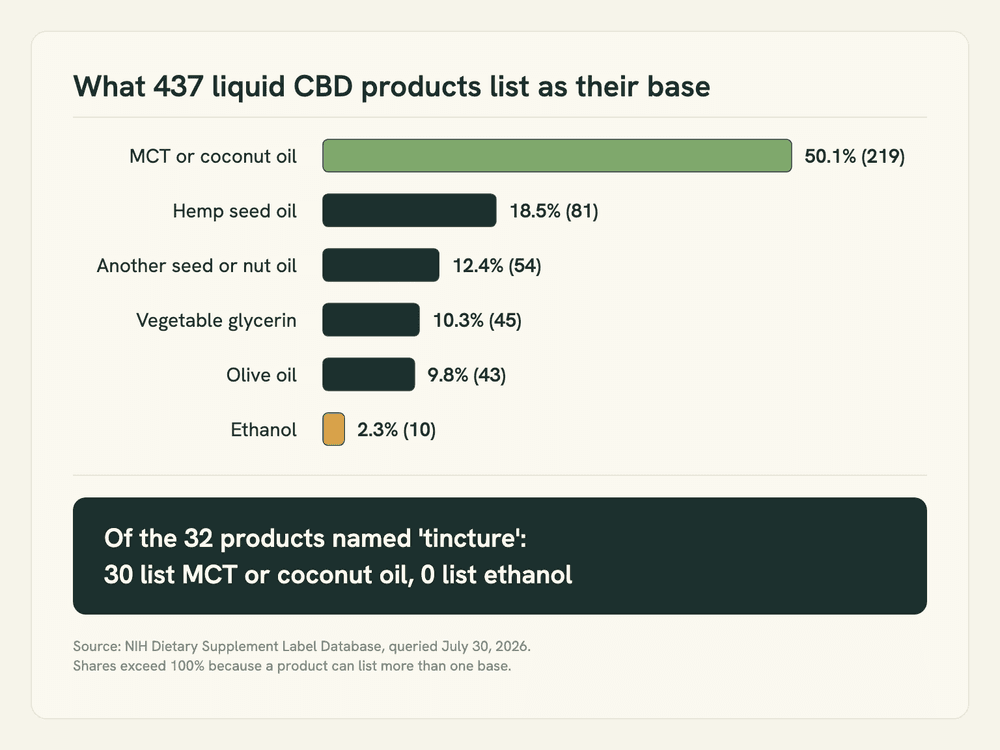
Definitions and history are interesting, but the useful question is empirical. When a US company sells you a liquid CBD product, what is the hemp extract actually suspended in? NIH runs a Dietary Supplement Label Database that archives the labels of supplement products, hemp and CBD items included. We queried it on July 30, 2026 and tabulated the declared bases of 437 unique liquid products whose labels list cannabidiol or a hemp extract. The result is lopsided.
Those figures add up to more than 100% because one product can list more than one base. The headline is in the subset. Of the 32 unique products whose name contains the word tincture, 30 of them (93.8%) list MCT or coconut oil, and zero list ethanol. In the same archive, oil outnumbers tincture in product names by roughly five to one. So the most common thing sold in the United States as a CBD tincture is an oil suspension with no alcohol in it at all: not a tincture by the 1916 definition, and something the FDA's own drug vocabulary would file under OIL.
Here is exactly how that was produced, because a number without a method is a rumor. We ran three searches against the DSLD API (cannabidiol, hemp extract, and CBD), up to 1,500 records each, deduplicated by record id to 2,111 records, kept the 1,049 whose ingredient list or product name contained a cannabidiol or hemp-extract term, kept the 579 label records marked as liquids, then deduplicated by brand plus product name down to 437 unique products and classified the ingredient names by keyword. The endpoint is api.ods.od.nih.gov/dsld/v9/search-filter. Now the limits, which matter as much as the numbers. DSLD is a label archive, not a market census: entries run from 2015 to 2025 and cluster in 2020, 2021 and 2024, and 113 of the 579 label records are flagged off-market. The FDA's position is that CBD is excluded from the dietary supplement definition, so these labels sit in the archive regardless of that dispute. The ethanol group is also concentrated in three brands (nine records from one, six from another, two from a third), so 2.3% is a count of products in this archive rather than a market share, and it will drift as the archive updates. Alcohol-based hemp drops do exist and are sold. What the data supports is narrow and still useful: in this archive, the products that call themselves tinctures are overwhelmingly oils, and none of those 32 listed ethanol.
The same data points at something else about the noun: it is the least load-bearing word on the package. A 2025 analysis in Cannabis and Cannabinoid Research bought 18 commercial CBD tinctures online and measured them by RP-HPLC-UV, and 12 of the 18 were more than 10% away from the labeled CBD concentration. That is one university lab, one time point, 18 products, and the brands are not identified. A larger 2024 survey of 202 US CBD products, 100 of them tinctures, sponsored by Jazz Pharmaceuticals found 149 of the 202 (74%) more than 10% off label, with about a quarter failing to match the spectrum type printed on the package. Neither study tested a Planntz batch. The lesson is about the category rather than any one brand: whatever the front of the bottle calls itself, the number that matters is the one a lab measured.
Our own bottles say Tincture, and by that definition they are not
We should be straight about our own shelf before we ask anything of yours. Every product Planntz sells carries that word in its name: Broad Spectrum Tincture, Full Spectrum CBD Tincture, Full Spectrum CBD + CBG Tincture and Full Spectrum CBD + CBN Tincture. The ingredient line is hemp extract and organic coconut MCT oil, plus a natural fruit flavor in the two fruit flavors and none at all in the unflavored one. No alcohol, no glycerin, no preservative. By the 1916 USP definition, none of them is a tincture. By 2026 shelf convention, all of them are. We use the word because it is the word people type into a search bar, and the honest move is to say that out loud rather than pretend the label is a technical claim.
So here is what is in the bottle instead of the noun. 60 mL, a dropper, and 250 mg/mL of CBD on the two flagship products, which is 15,000 mg in the bottle. At the usual convention of about 0.05 mL per drop, that works out to roughly 12.5 mg of CBD per drop and about 1,200 drops per bottle, with the standing caveat that drop size varies with the dropper and with how you squeeze it. The CBD + CBG version splits the same bottle differently, at 150 mg/mL CBD and 100 mg/mL CBG; the CBD + CBN version is 133 mg/mL CBD and 67 mg/mL CBN. Each batch has a third-party lab report you can match to the batch code printed on your bottle. Those are the numbers worth comparing against anyone else's bottle, whatever either of you calls it.
Four different things get sold as a CBD tincture
The category is not one product wearing two names. It is at least four different liquids, and only one of them fits the historical definition. What follows is shelf reality, not a ranking: the base a company picks changes taste, mixability and how the label reads, and which base oil is better in its own right is a separate question that deserves its own page rather than a paragraph here. If your interest in the alcohol column is about drinking rather than about labels, CBD and alcohol taken together is where that question is answered properly.
| Format | What the ingredient line says | How it behaves | What to check |
|---|---|---|---|
| Oil suspension (the default) | Hemp extract plus MCT or coconut oil (50.1% of the sample), hemp seed oil (18.5%), another seed or nut oil (12.4%) or olive oil (9.8%). | Oily mouthfeel, beads and floats on water, carries the highest concentrations on the shelf. | mg/mL, spectrum and the batch lab report. The base oil is mostly a taste and texture choice. |
| True hydroalcoholic tincture (rare) | Names an alcohol outright: grain alcohol, cane alcohol or ethanol, sometimes with a percentage or a proof. | Sharper, warming taste. Disperses into water instead of floating on it. | The declared alcohol percentage, since no federal alcohol cap applies to a hemp product. |
| Glycerin drops | Vegetable glycerin, sometimes with water. 10.3% of the sample listed it. | Sweet and noticeably thicker. Usually lower in mg/mL than an oil of the same size. | The strength line, because sweetness can disguise a weak product. |
| Nanoemulsion or water-soluble | Emulsifiers and surfactants, often with ethanol. Sold on mixability rather than on strength. | Mixes into a drink without separating out. | The full ingredient list, and whether the mg figure is per bottle or per serving. |
Does the base change how it works? The honest answer
Nearly every page on this topic states that tinctures absorb faster, because alcohol carries cannabinoids into the bloodstream more efficiently than oil does. None of them cites anything for it, and the human evidence that does exist points the other way. The closest thing to a direct test is a randomized, participant-blinded crossover trial that gave the same CBD oil as sublingual drops or as swallowed capsules, in eight healthy men (n = 8). Peak plasma CBD was 24.0 ng/mL for the drops against 28.0 for the capsules, time to peak was 4 hours in both arms, and total exposure over 6 hours was 41.8 against 45.3 ng/mL per 6 hours, with every comparison at p of 0.25 or higher. The authors concluded that this "implies that CBD oil delivered sublingually is swallowed before oral mucosal CBD absorption occurs."
That trial had no alcohol-based arm, so it cannot settle the tincture question by itself. The wider picture runs in the same direction. A 2024 systematic review and meta-regression of 112 trial arms from 39 studies in healthy adults sorted the formulations into nanotech, oil-based, alcohol-based (10 arms), water-based, Sativex and Epidiolex, and reported that compared with oral administration, oromucosal administration was associated with lower peak concentration and lower total exposure. That is an association across heterogeneous studies, not a randomized head-to-head, and most of the oromucosal arms were a pharmaceutical spray rather than a consumer dropper. Further back, a 2018 systematic review of CBD pharmacokinetics in humans, whose co-author A.S. Yates was at Artelo Biosciences, found absolute bioavailability reported only for smoking (31%) and for no other route, and called the field a paucity of data.
The direct comparison has simply never been run. As of July 30, 2026, a PubMed search for cannabidiol AND tincture[tiab] returns 15 records and not one is a head-to-head trial of an alcohol-based CBD product against an oil-based one; three further searches, one for hydroalcoholic or alcohol-based cannabidiol, one for tincture in the title, and one for cannabidiol pharmacokinetics with an alcohol vehicle or carrier, return six more records between them, and none of those is a comparison either. So when a page tells you tinctures absorb faster, it is not summarizing a study. It is repeating another page.
For the technique itself, how to actually take it covers hold time, food timing and what to do when the taste is the problem, and this page will not repeat any of it. Read that page knowing the sublingual advantage for an oil-based product is a sensible habit with thin evidence behind it, not a measured fact.
The one CBD medicine the FDA approved is neither, and both
There is exactly one CBD product with FDA approval, and its formulation quietly ends the vocabulary argument. Epidiolex is registered as an oral solution, not an oil and not a tincture. Its label describes a "clear, colorless to yellow liquid containing cannabidiol at a concentration of 100 mg/mL", and lists its inactive ingredients as "dehydrated alcohol (7.9% w/v), sesame seed oil, strawberry flavor, and sucralose." An oil and an alcohol, in the same bottle, filed under a third name entirely. The label also states that "oral administration is recommended", so it is swallowed rather than held under the tongue, and it is measured by volume with calibrated 1 mL and 5 mL oral syringes because, in the label's own words, "a household teaspoon or tablespoon is not an adequate measuring device."
Now the sentence that has to sit immediately beside that one. Epidiolex is a prescription medicine for three seizure disorders, prescribed and monitored by a doctor. Nothing about its dose, its results or its risk profile transfers to a consumer hemp product, and it is cited here for exactly two reasons: what it is made of, and how it is measured. The second one is worth borrowing as a principle. A graduated dropper you can read beats counting drops, and a volume is a more repeatable unit than a squeeze.
How to tell what you actually bought, in 30 seconds
You do not need any of the history to answer the practical question. Under the US food labeling rules at 21 CFR 101.4, ingredients run in descending order of weight, so whatever sits next to the hemp extract is the base, and it is usually first or second on the line. One thing to know before you start: 21 CFR 328.10 caps inactive alcohol in over-the-counter drugs at 10% for ages 12 and over, 5% for ages 6 to under 12, and 0.5% for under 6. A hemp tincture is not an over-the-counter drug, so that cap does not reach it. There is no federal alcohol ceiling on the bottle in your hand, which is precisely why the ingredient line is your only instrument.
- 1Find the ingredient line. Whatever is listed beside the hemp extract is your base: MCT or coconut oil, hemp seed oil, olive oil, glycerin or alcohol.
- 2Scan for the words alcohol, ethanol, ethyl alcohol, grain alcohol or cane alcohol. If none of them appears, there is none in it, whatever the front of the bottle says.
- 3Check that the strength is given in mg/mL and not only as a total for the bottle. A 3,000 mg bottle tells you nothing until you know its volume.
- 4Look at the dropper. Graduated markings let you measure a volume; an unmarked pipette leaves you counting drops, which is the less repeatable unit.
- 5Find the batch code and the lab report that matches it. A report for a different batch is a brochure, not a test.
- 6Check the spectrum, because full spectrum, broad spectrum and isolate are a real difference between two bottles in a way the noun on the front is not.
Three of those steps have a page of their own, because each is deeper than a bullet. For step 3, what each number on the panel actually means walks through mg, mg/mL and per serving. For step 4, turning drops into milligrams does the arithmetic with the 0.05 mL convention. For step 5, matching the batch on the bottle to the lab report shows what a real certificate of analysis looks like. And if you are wondering why so many bottles say hemp extract instead of CBD, that traces back to the agency itself: the FDA states that it is currently illegal to market CBD by adding it to a food or labeling it as a dietary supplement. The phrase is a labeling decision, and it tells you nothing at all about strength.
There is also a physical hint, offered as a hint and not as a test. Ethanol mixes with water and cannabidiol does not; the Epidiolex label notes that CBD "is insoluble in water and is soluble in organic solvents". So a drop of a genuinely hydroalcoholic product will disperse in a glass of water, while a drop of an oil-based one beads and floats. Glycerin and nanoemulsions both muddy that result, which is why the ingredient line stays the real answer.
So which one should you buy?
The noun is not a decision variable, so stop treating it as one. Three things on a dropper bottle actually change the product you end up with: the concentration in mg/mL, the spectrum, and whether there is a batch lab report you can match to the bottle. Of those, full spectrum, broad spectrum or isolate is the one that most changes what is in the liquid, and it is printed on the same label that carries the word you came here to decode. There are, however, three real cases where the base itself matters to a person.
- You avoid alcohol, for any reason at all. Read the ingredient line, and that is the entire test. Most CBD dropper bottles on the US market do not contain any.
- You want to stir it into a cold drink. A hydroalcoholic or glycerin product will disperse; an oil will separate and cling to the side of the glass.
- You want the most milligrams per drop. The highest concentrations on the shelf sit in oil bases, because that is what carries the load.
One claim we are deliberately not making: that alcohol makes a tincture last longer on the shelf. Every brand blog on this subject asserts it and none of them cites anything, and we could not find CBD-specific evidence for it in either direction, so we are not going to assert it or deny it here. Shelf life is a real question with a real answer about oxidation, light and heat, and how long an opened bottle really lasts is where we have written that one out.
Questions people ask about CBD oil and tinctures
On a US shelf in 2026, almost always yes. Both are a hemp extract in a liquid you measure with a dropper, and the same formulation is routinely sold under one word by one brand and the other word by the next. The terms only come apart if you go back to the pharmacy definition, where a tincture is an alcoholic or hydroalcoholic solution and an oil is not. Nothing obliges a hemp company to respect that distinction, so treat the noun as a marketing choice and read the ingredient line instead.
Because the word outlived the recipe. It kept its precise meaning inside the vocabulary the FDA uses on drug labels, where 31 products are currently marketed in the TINCTURE dosage form and not one of them is CBD, and it got borrowed as a shelf category for dropper bottles that the same vocabulary does not govern. Companies also keep using it because shoppers search for it, which is a circular but honest reason.
Usually not. In NIH's label archive, 10 of 437 liquid CBD products listed ethanol, and none of the 32 products actually named tincture did. Genuinely hydroalcoholic hemp drops do exist and are sold, and they say so on the ingredient line, so the check takes seconds. If you are asking because of a breathalyzer, no page can promise you a device reading, and the honest first step is to find out whether your product lists any alcohol at all. Anything about drinking alcohol and CBD together is covered on our page about CBD and alcohol rather than here.
There is no human trial comparing the two. The nearest evidence is a randomized crossover in 8 healthy men that gave the same CBD oil as sublingual drops or as swallowed capsules and found no meaningful difference in peak level, time to peak or total exposure, plus a 2024 meta-regression of 112 trial arms in which oromucosal delivery was associated with lower exposure than oral, not higher. Both have real limits, and neither supports the faster-absorption claim that the rest of the internet repeats.
It is a labeling decision driven by the FDA's stated position that CBD may not be added to a food or labeled as a dietary supplement. Plenty of companies write hemp extract to stay clear of that line. It tells you nothing about strength or quality; the mg/mL figure and the batch lab report do.
Not by any pharmacy definition, because glycerin is not alcohol. It is a genuine fourth format with its own trade-offs: sweeter, noticeably thicker, usually lower in mg/mL than an oil of the same size, and it will mix into a drink where an oil will not. About 10% of the liquid CBD products in the NIH label archive listed vegetable glycerin.
The blanket rule you will read everywhere, that you must never use a tincture topically, is stated without a source in every place we found it. The honest answer is that it depends on what is in it. An alcohol-based liquid feels very different on skin than an oil-based one, and neither is formulated for that use, so if you want a topical the sensible move is to buy something made as a topical.
If you want to see how we answer our own checklist, the details are all published: hemp extract in organic coconut MCT oil, 250 mg/mL on the flagship bottles, and a third-party report for the batch in your hand. Every product page and lab report is open to read without an email address.
A short ingredient line, 250 mg/mL, a published batch report
Planntz sells one format: a 60 mL dropper bottle of hemp extract in organic coconut MCT oil, with the concentration printed in mg/mL and a third-party lab report for the batch you receive. Call it an oil or call it a tincture. The numbers are the same either way.
See the tincturesWriting about hemp, wellness and the small rituals that keep us balanced.