Hemp Seed Oil vs CBD Oil: The Thousandfold Difference
The internet says hemp seed oil has zero cannabinoids. Measured, thirty commercial oils carried 9 to 279 mg of total cannabinoids per kilogram. The real gap is about a thousandfold, and the ingredient line is where you settle it before you pay.
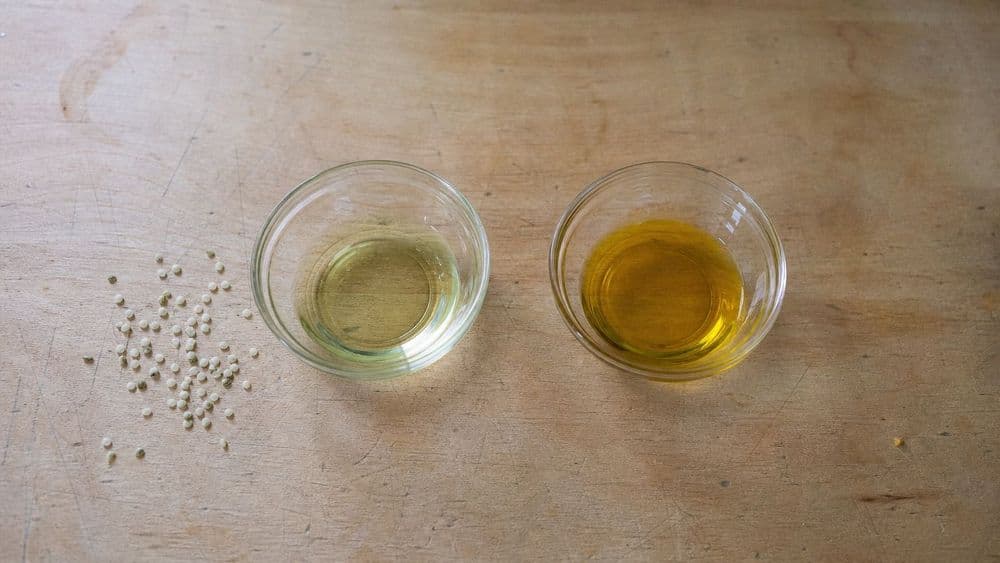
Two bottles, both with the word hemp on the front. One is on a grocery shelf next to the olive oil. The other is on a wellness site, with a dropper and a milligram figure. Almost every page about hemp seed oil vs CBD oil resolves this the same way: seeds have no cannabinoids, flowers do, done. That answer is close enough to be useful and wrong enough to be worth fixing. Hemp seed oil is not cannabinoid-free. Somebody measured it, more than once, and the real numbers are more useful than the myth.
The short version first. Hemp seed oil is pressed from the seed and sold as a food. CBD oil is extracted from the flower and leaf and sold for its cannabinoids. Both come from Cannabis sativa. The difference is not that one has cannabinoids and the other has none: it is that one has roughly a thousand times more of them than the other. And because nothing forces a seller to print a cannabinoid milligram figure on the front of a box, the only reliable way to tell which one you are holding is the ingredient list plus a batch lab report. That is the same short discipline behind the wider checklist for choosing a CBD oil.
Same plant, different press: what actually goes into each bottle
Start where the confusion starts, with the seed. The FDA states it plainly on its own cannabis page, and this is the sentence every comparison article quotes.
“Hemp seeds are the seeds of the Cannabis sativa plant. The seeds of the plant do not naturally contain THC or CBD.”
The same paragraph keeps going, and the next part is the one that gets dropped. Hemp seed derived ingredients, the agency writes, "contain only trace amounts of THC and CBD, which the seeds may pick up during harvesting and processing when they are in contact with other parts of the plant." Read those two sentences together and you get the accurate picture. The seed is not a cannabinoid crop. The oil pressed out of it is not a cannabinoid-free product either. FDA uses the word trace and attaches no number to it, which is why the rest of this article goes looking for the numbers.
Everything else follows from which part of the plant went into the press. Hemp seed oil is made by cold pressing whole seeds, and it has been a legal grocery item far longer than CBD has been anything: the Controlled Substances Act's definition of marihuana carves out oil or cake made from the seeds of the plant, along with the mature stalks and the sterilized seed. CBD oil takes the opposite route through the plant and a different route through the law. It is a solvent extraction of the flower, leaf and resinous trim, where the cannabinoids actually are, and it is federally legal through the 2018 Farm Bill's definition of hemp, which turns on a delta-9 THC concentration at or below 0.3%. That is where the federal line sits as this is published in August 2026, and how that line between hemp and marijuana is actually drawn is a subject of its own. If cannabidiol itself is still fuzzy, start with what cannabidiol actually is and come back to this.
| Hemp seed oil | CBD oil (a cannabinoid extract) | |
|---|---|---|
| Part of the plant | The seed, hulled or whole | Flower, leaf and resinous trim |
| How it is made | Cold pressing. The GRAS notice FDA reviewed describes whole seeds cold pressed to extract the oil, with no solvent step | Solvent extraction, usually CO2 or ethanol, then winterization and often distillation |
| What it is sold as | A food. A culinary oil, and a cosmetic ingredient | A cannabinoid product, generally marketed as a supplement |
| Cannabinoids present | Trace, picked up from contact with the rest of the plant. Measured at 9 to 279 mg/kg total across 30 European retail oils | The entire point of the product. One 60 mL tincture's batch report works out to roughly 296,000 mg/kg of total cannabinoids |
| Route through federal law | Excluded from the Controlled Substances Act's definition of marihuana as oil or cake made from the seeds | Legal through the 2018 Farm Bill definition of hemp, at or below 0.3% delta-9 THC |
| What the label must show | The seed derived ingredient declared by name on the ingredient list | No federal rule forces a cannabinoid milligram figure onto the front of the box |
"Zero cannabinoids" is the wrong answer, and the real number is the point
The most repeated sentence on this topic is that hemp seed oil contains zero cannabinoids. It is in brand blogs, in comparison tables, and in results currently ranking for this exact query. It is also checkable, and somebody checked. Germany's federal risk assessment institute quantified sixteen cannabinoids in thirty commercial hemp seed edible oils by liquid chromatography and tandem mass spectrometry, and published the result in 2024. Total cannabinoid content ran from 9 to 279 milligrams per kilogram of oil. Delta-9 THC ran from 0.2 to 6.7 milligrams per kilogram. Three of the thirty came in above the European maximum for hemp seed oil sold as food, a ceiling set on delta-9 THC equivalents rather than on delta-9 THC alone, which is the next paragraph's business. That is a European retail sample of thirty bottles and it says nothing about any American brand, but it settles one thing: zero is not the right number.
That European ceiling deserves a sentence of its own, because it is easy to misread. Commission Regulation (EU) 2023/915 sets 7.5 milligrams per kilogram for hemp seed oil sold as food, alongside 3.0 mg/kg for hemp seeds themselves and 3.0 mg/kg for other processed hemp seed products. The metric is not a raw THC reading. The regulation defines the limit as the sum of delta-9 THC and delta-9 THCA, the acid form the living plant actually makes, expressed as delta-9 THC with a factor of 0.877 applied to the THCA. That is how three oils can breach a 7.5 ceiling when the highest raw delta-9 reading in the whole study was 6.7: the acid counts too. Note also that this is European law. The United States has no equivalent numeric THC limit for a finished hemp seed food.
Widen the sample and the range widens with it. An earlier analysis published in Food Chemistry in 2015 measured THC from 3.23 to 69.5 milligrams per kilogram in hempseed oils bought on the Croatian market, an order of magnitude above the German ceiling nine years later. The authors' own reading of that spread is worth having verbatim: the differences in phenotype ratio were large enough to suggest "that not all of analysed hempseed oils were produced from industrial hemp." Two small national samples nine years apart are not a picture of the world market, and neither one is American. What they are is evidence that the cannabinoid content of hemp seed oil is a variable rather than a constant, and that nobody printing "zero" on a comparison chart has measured anything.
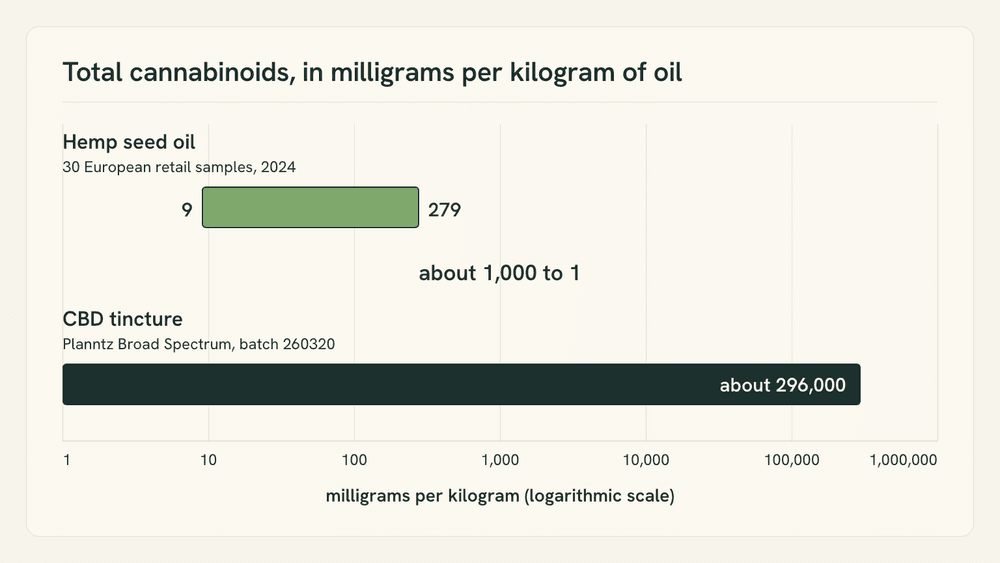
Now put the two on the same scale, because that is the number nobody prints. The richest hemp seed oil in the German survey carried 279 milligrams of all sixteen cannabinoids per kilogram of oil, which is 0.0279% by weight. A Planntz Broad Spectrum bottle, batch 260320, reports 16,600 milligrams of total cannabinoids in a nominal 60 milliliters at a measured density of 0.934 grams per milliliter. Sixty milliliters at that density weighs 56.04 grams, so 16,600 milligrams works out to roughly 296,000 milligrams per kilogram, about 29.6% of the bottle by weight. Set 296,000 beside 279 and the ratio is about a thousand to one. Both sides of that comparison are total cannabinoids, which is the only reason it is a fair one, and 60 milliliters is the nominal fill printed on the bottle rather than a weighed volume.
Another way to feel the same gap. One 0.05 milliliter drop of a 250 mg/mL tincture carries about 12.5 milligrams of CBD. Collecting 12.5 milligrams of every cannabinoid combined out of that richest hemp seed oil would take about 45 grams of the oil, a little over three tablespoons, in one sitting. That is a statement about category, not about quality. It is the difference between a bottle of olive oil and a bottle of vitamin E, not the difference between a good product and a bad one, and a hemp seed oil is not failing at anything by being a hemp seed oil.
The obvious follow-up is whether trace amounts at that scale can matter for a drug test. A 2026 systematic review in the International Journal of Legal Medicine screened 477 records and included twelve studies; of the eight that looked at cannabinoid positivity in people using CBD or hemp oils, five reported nothing above the cut-off, while still detecting trace levels near the limit of detection. The review pools CBD oils and hemp oils together, so it cannot produce a hemp-seed-oil-only answer, and its authors put positive results down mainly to what is in the product: undeclared or excessive THC, mislabeling and contamination. No product and no article can guarantee a test result. If that is the actual question that brought you here, what does and does not show up on a drug test goes through the cut-offs properly.
Four phrases on a label, and what each one actually guarantees
There is one rule working in your favor here, and it is a food rule rather than a CBD rule. FDA's guidance on the hemp seed ingredients it reviewed is that products containing them "must declare them by name on the ingredient list." Nothing compels a seller to print a cannabinoid amount on the front of a box. Something does compel the seed oil onto the ingredient line. So the ingredient line is where you look, and the front of the package is where you stop believing things.
| What the package says | What it guarantees | What it does not guarantee |
|---|---|---|
| Hemp seed oil, or Cannabis sativa seed oil | Oil pressed from the seed. A food ingredient, and one that has to be declared by name on the ingredient list | Any particular cannabinoid content. Trace amounts are normal, but nobody measured the bottle in your hand |
| Hemp oil | Nothing at all. The phrase is used both as everyday shorthand for seed oil and as a cautious stand-in for a cannabinoid extract | Which of the two you are holding. This is the single most ambiguous phrase in the category |
| Hemp extract, aerial parts, whole plant hemp | That something was extracted from the above-ground plant rather than pressed from the seed | How many milligrams of any cannabinoid you get. Extract names a process, not a dose |
| Full spectrum hemp extract, 75 mg per 0.5 oz | 75 milligrams of extract in a half-ounce bottle | 75 milligrams of CBD. Extract weight and cannabinoid weight are different quantities |
| Cannabidiol (CBD), 1,500 mg | A named cannabinoid with a number attached, which is the only version of this that is checkable at all | That the number is accurate. Only a batch report matched to your bottle does that |
Row four generates the most email, and it is the query that brought a lot of people to this page. "Full spectrum hemp extract, 75 mg per 0.5 oz" is real packaging copy and it is not lying to you: there really are 75 milligrams of extract in that bottle. Extract weight and cannabinoid weight are simply different quantities, and the label is quoting the first while most readers assume the second. Turning one into the other is arithmetic that needs a batch report, and it lives, along with every other figure on the panel, in our guide to decoding every figure on a CBD label. The word spectrum in that same phrase is doing separate work: it describes which cannabinoids survived the extraction, and full spectrum, broad spectrum and isolate are three different answers to that question.
What the milligram number on the front is actually counting
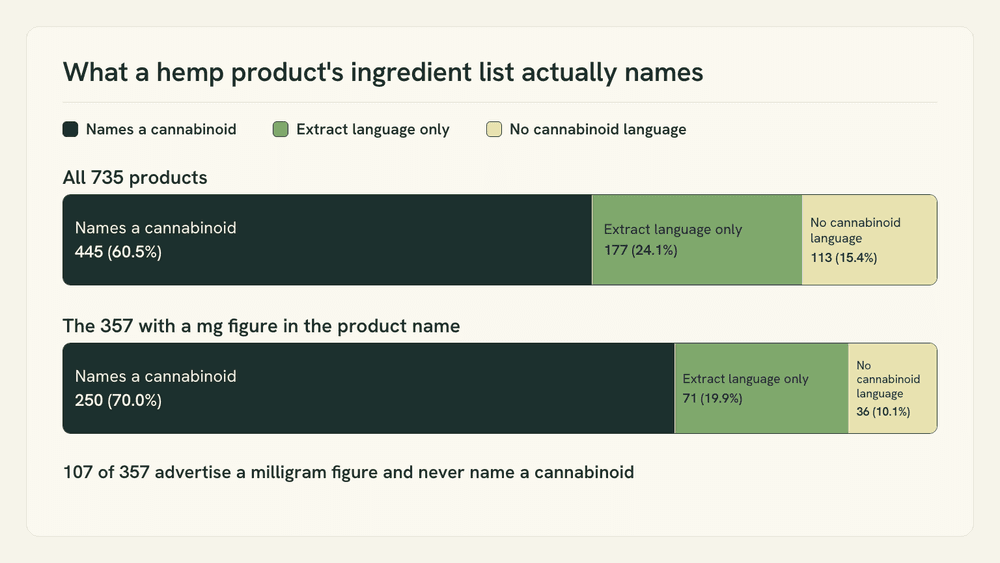
So we went and counted. The National Institutes of Health maintains the Dietary Supplement Label Database, a public archive of label images and transcribed ingredient lists for supplements sold in the United States. On August 1, 2026 we queried it through its open API for hemp, hemp seed oil, hempseed, cannabidiol and hemp extract, kept every record whose product name contains hemp, CBD or cannabid, and deduplicated by brand and product name. That leaves 735 unique products, and they sort into three tiers.
445 of the 735, just over 60%, name an actual cannabinoid on the ingredient list: cannabidiol, CBG, CBN, CBDV, THCV. Another 177, about 24%, use hemp extract, aerial parts, whole plant or the bare word cannabinoid without ever naming one. And 113, about 15%, carry no cannabinoid language anywhere, with 53 of those listing a hemp seed or hemp oil ingredient instead. Now narrow to the 357 products that put a milligram figure in the product name itself, which is the number a shopper reads as the dose. 250 of those name a cannabinoid. 71 use extract language only. 36 name no cannabinoid at all. That is 107 of 357, close to three in ten, advertising a number in milligrams while never telling you the milligrams of any cannabinoid on the ingredient list.
Read those figures for exactly what they are. The database is a label archive, not a market census: 125 of the 735 are flagged off market, entries run from 2012 to 2025 and cluster in 2020, 2021 and 2024, and this classification is keyword matching over label text, which makes it a floor on both sides rather than a precise count. The middle tier is not an accusation either. A product that says hemp extract may well contain plenty of cannabinoids; the finding is only that its label does not tell you how much. No brand from that dataset is named here, because the pattern is the story and singling out sellers is not. Rerun the query and the counts will drift, which is why the date is printed beside them.
Label numbers are not self-verifying even when a cannabinoid is named. A 2024 analysis of 202 US CBD products bought in 2021, sponsored by Jazz Pharmaceuticals, found 149 of them, 74%, outside a 10% band around their labeled CBD content, and about a quarter did not meet the definition of the spectrum type they claimed. Neither that study nor any other tested a Planntz batch, so read it as a statement about the market rather than about any one brand. The practical consequence is the same either way. A milligram figure becomes information when a cannabinoid is named beside it, and becomes evidence when a batch report says the same thing.
The 60-second check before you pay
None of the above requires you to become an analytical chemist. It requires you to turn the package over and read six things in order. This works in a store, on a phone in a store, and on a product page, and it is the same check whether you are trying to buy CBD or trying to avoid paying CBD prices for a cooking oil.
- 1Turn the package over and find the ingredient list. The front is marketing. The ingredient line is the regulated part, and it is the only place a hemp seed ingredient has to appear by name.
- 2Look for a named cannabinoid: cannabidiol, CBD, CBG, CBN. If the only hemp words on the list are hemp seed oil or Cannabis sativa seed oil, you are holding a food oil, whatever the front says.
- 3If the list says hemp extract, hemp aerial parts or whole plant hemp with no cannabinoid named, treat the milligram number on the front as a weight of extract until something tells you otherwise.
- 4Check that the milligram figure is attached to both a cannabinoid and a volume or serving. A number floating on its own, with no cannabinoid and no denominator, tells you nothing you can act on.
- 5Find the batch code and the certificate of analysis, then check that the batch on the report is the batch on your bottle. A report for a different batch is a brochure, not a test.
- 6Confirm the lab is independent of the seller, and that the report is recent enough to plausibly be about the bottle you are about to buy.
Here is what passing that check looks like on a real bottle, using ours, because those are the numbers we can print. A Planntz Broad Spectrum tincture says 15,000 mg of CBD in 60 mL, which is 250 mg per milliliter, or roughly 12.5 mg of CBD in a 0.05 mL drop. Its ingredient line names a hemp extract as the active and coconut MCT oil as the carrier, so a genuine CBD oil can have a coconut base and no hemp seed oil in it at all. And batch 260320's third-party report, produced April 1, 2026, covering potency, heavy metals and microbials, puts total CBD at 16,300 mg and total cannabinoids at 16,600 mg, with THC non-detected on that batch. That is three separate places where a cannabinoid is named with a number, and one of them is a laboratory. You can open the batch reports for every flavor and match the batch code on the bottle to the one on the report yourself. A hemp seed oil has none of those three, because it has no cannabinoid worth naming.
Why the wording exists: one plant, two regulatory worlds
None of this vocabulary is an accident, and it is more useful to understand it than to resent it. Two things happened in the same month. In December 2018, the FDA closed out three GRAS notices for hemp seed derived ingredients and said it had no questions about hulled hemp seed, hemp seed protein powder and hemp seed oil being used in human food. That is the moment hemp seed oil became an unremarkable grocery ingredient in the eyes of the agency that polices grocery ingredients.
In the same breath, on the same subject, the agency stated that "these GRAS conclusions do not affect the FDA's position on the addition of CBD and THC to food." That position, which the agency summarizes in its consumer guidance, is that "it is currently illegal to market CBD by adding it to a food or labeling it as a dietary supplement." One hemp ingredient walked through the food door in 2018. The other did not, and as of this writing still has not. That asymmetry is most of the reason a general retail shelf is thick with the word hemp and thin on the word cannabidiol.
It also explains why the ingredient line is more honest than the front panel. A hemp seed ingredient has a settled place in food labeling and a rule requiring it to be declared by name. A cannabinoid has a contested one, so the safest thing a cautious seller can print is a word that suggests everything and guarantees nothing. Two legal routes, two vocabularies, one plant, and a shopper left to work out for themselves which world a given bottle belongs to. That is a description of an incentive, not an allegation against anyone in particular.
What hemp seed oil actually is, and what nobody should promise you
Set the cannabinoid question aside and hemp seed oil is a perfectly good culinary oil with an unusually well documented composition. The GRAS notice the FDA reviewed in 2018 describes it in detail, and the attribution matters more than the figures do. The description belongs to the notifier, Fresh Hemp Foods, Ltd., not to the agency. FDA's own contribution is the sentence "we have no questions at this time," plus an explicit note that the letter "is not an affirmation that hemp seed oil is GRAS under 21 CFR 170.35." With that in place, here is what the notice says the oil is.
- On average 77% polyunsaturated fat, 13% monounsaturated and 9.8% saturated.
- Made up mostly of linoleic acid at 50.9% and alpha-linolenic acid at 16.7%, an omega-6 to omega-3 ratio of roughly three to one.
- With gamma-linolenic acid at 3.6% and stearidonic acid at 1.2%.
- Produced by cold pressing whole seeds, with no solvent step in the process.
- Held to a company specification of no more than 10 mg/kg of combined THC and THCA, plus limits on lead, cadmium, mercury, arsenic and aflatoxin. That is one firm's specification, not a federal limit.
A second federal record lands in the same place independently. USDA's FoodData Central entry for hulled hemp seed reports 48.75 grams of total fat per 100 grams, of which 38.1 grams are polyunsaturated, with linoleic acid at 27.358 grams and alpha-linolenic at 8.684. That is a ratio of about 3.15 to 1, against the 3.05 to 1 you get from the notice's 50.9% and 16.7%. Two independent federal records agreeing on roughly three to one is about as solid as food composition data gets. The caveat is that the USDA entry is for the seed rather than the pressed oil, so the proportions transfer and the absolute per-100-gram values do not.
One more line travels across almost every article on this comparison: that hemp seed oil is high in B vitamins and vitamin D. It does not come from the composition records. USDA's entry for hulled hemp seed carries no vitamin D value at all, and the B vitamins it does list, thiamin at 1.275 mg and niacin at 9.2 mg per 100 grams among them, are measured in the seed rather than in the pressed oil. The federal description of the oil itself is a fatty acid profile and nothing else. A missing value in a database is not a measured zero, so treat this as a sourcing correction rather than a nutrition verdict: the claim is repeated more confidently than the records support.
And none of that is a health benefit, which is where this page parts company with most of the results around it. A fatty acid profile is a composition, not an outcome. Hemp seed oil is a culinary oil with a well documented fat profile, and what eating it does for a person is a nutrition question this article does not answer, and neither does the label on the bottle. The same restraint applies to the other side of the comparison. Nothing here claims that any oil, ours included, treats, prevents or improves anything.
One practical consequence of that fat profile is worth carrying home, because it changes how you store the bottle. It is a food fat and it ages like one. A 2024 storage study cold pressed hempseed oil and kept it for 270 days in four packaging materials, at 25 degrees Celsius under diffused light and at 10 degrees in the dark, tracking peroxides throughout. The authors describe the oil as "extremely rich in unsaturated fatty acids" and therefore highly sensitive to oxidative and photo-oxidative degradation, and amber glass wrapped in aluminum foil at refrigerated temperature protected it best. That was one cultivar in 20 mL vials with no CBD product anywhere in the design, so read it as food science. If shelf life is your real question, how long an opened bottle really lasts is the page for it.
What these numbers do not tell you
Three honest limits, because the numbers on this page are load bearing. The cannabinoid measurements are European: thirty bottles in Germany published in 2024, and a smaller Croatian sample from 2015. We could not find an equivalent published survey of American hemp seed oils, so treat the 9 to 279 mg/kg range as evidence that the content is measurable and variable rather than as a figure for the bottle in your kitchen. The label counts come from an archive of label transcriptions queried on a single day, and they describe what labels say rather than what bottles contain. And the thousandfold ratio compares one survey's richest sample against one Planntz batch report; change either bottle and the ratio moves, though not by an order of magnitude, which is the only part of it that carries any weight.
There is also a finding inside the German study that cuts against the intuitive fix. When the researchers heated hemp seed oil to 200 degrees Celsius for an hour, total cannabinoids fell by 38% and the cannabinoid acids by 99%, but delta-9 THC rose by 22%, because heat converts the acid form into the neutral one. Cooking with the oil does not simply burn the cannabinoids off. It reshuffles them, and it moves the one number a regulator cares about in the wrong direction. That is a result from a laboratory heating protocol rather than a recipe, and it is one more reason "hemp seed oil has no cannabinoids" is a sentence worth retiring.
Common questions about hemp seed oil vs CBD oil
Practically none, and not literally zero. The FDA's position is that the seeds do not naturally contain THC or CBD, and that the trace amounts found in hemp seed ingredients arrive from contact with the rest of the plant during harvesting and processing. Measured, thirty commercial hemp seed oils in a 2024 German survey carried 9 to 279 milligrams of total cannabinoids per kilogram of oil. One Planntz 60 mL bottle's batch report works out to roughly 296,000 milligrams per kilogram. So the accurate answer is that hemp seed oil contains cannabinoids at roughly one thousandth the concentration: close enough to none for any practical purpose, and far enough from none that zero is the wrong word to print.
Sometimes, which is exactly the problem. The phrase hemp oil is used two ways: as everyday shorthand for hemp seed oil, the food product, and as a cautious substitute for CBD oil on packaging where the word cannabidiol is legally awkward. The phrase itself settles nothing. The ingredient list does. Hemp seed oil or Cannabis sativa seed oil is the food oil. A named cannabinoid with a milligram figure and a batch report behind it is the extract. If the label uses only the ambiguous phrase and never names a cannabinoid, assume the food oil until proven otherwise.
It means there are 75 milligrams of extract, not 75 milligrams of CBD, in a half-ounce bottle. Extract weight and cannabinoid weight are different numbers, and only a batch report tells you how the first converts into the second. It is not a dishonest phrase on its own; it just answers a different question from the one most shoppers think they are asking. The arithmetic, including how to compare that figure against a bottle labeled in mg per mL, is worked through step by step in our guide to reading a CBD label.
It is unlikely, and it is not a guarantee, and nobody honest will give you one. A 2026 systematic review in the International Journal of Legal Medicine screened 477 records and included twelve studies; of the eight that examined cannabinoid positivity in people using CBD or hemp oils, five reported nothing above the cut-off, while still detecting trace levels near the limit of detection. The review pools CBD oils and hemp oils together, so it does not produce a hemp-seed-oil-only answer, and its authors attribute positive results mainly to product content, including undeclared THC and mislabeling. Our article on CBD and drug tests covers the cut-offs and the residual risk in detail.
Yes, and faster than most kitchen oils. The composition described in the GRAS notice the FDA reviewed is, in the notifying company's own figures, on average 77% polyunsaturated fat, and polyunsaturated fats oxidize. A 2024 storage study tracked cold pressed hempseed oil over 270 days in four packaging materials and found it highly sensitive to oxidative and photo-oxidative degradation, with amber glass wrapped in foil at refrigerated temperature offering the most protection. That was one cultivar in 20 mL vials, so read it as food science rather than as a use-by date for your bottle. Shelf life for a CBD tincture is a separate question, and our article on whether CBD oil expires handles it.
Because the two ingredients took different routes through federal law. In December 2018 the FDA responded to three GRAS notices for hemp seed derived ingredients and said it had no questions about their use in human food, while stating in the same breath that those conclusions do not affect its position on adding CBD and THC to food. The agency's stated position is that it is currently illegal to market CBD by adding it to a food or labeling it as a dietary supplement. So a hemp seed ingredient has a settled place in food labeling and a cannabinoid does not, and hemp is the word that carries the least regulatory risk. That is an explanation of the vocabulary, not an accusation about any particular seller.
The whole comparison collapses into one habit. Read the ingredient line before you read the front of the box, then ask for the batch report. Everything else, the plant part, the press, the two legal routes, the two vocabularies, is background for why that habit is necessary. Every product page and its lab results on this site prints the cannabinoid, the milligram figure, the volume and the batch code, which is the least a bottle should be willing to tell you.
See what a named cannabinoid looks like on a real label
Every Planntz tincture names its hemp extract and its carrier oil on the ingredient line, prints its concentration in mg per mL, and publishes a third-party batch report you can match to the code on your bottle.
See the products and lab resultsWriting about hemp, wellness and the small rituals that keep us balanced.