What Is Hemp Extract? What the Words Actually Guarantee
Hemp extract is a phrase about origin, not contents. No federal rule gives it a consumer definition, and in Virginia and Florida the milligram number is only required if the seller claims a cannabinoid. Here is what three states wrote, and what to check instead.
You picked up a bottle and the front of it says hemp extract. Maybe with the words full spectrum in front, maybe with a milligram number beside it. So what is hemp extract, and what does that phrase actually commit anyone to? The short answer is that it describes where the material in the bottle came from. It does not tell you what is in it. Those are two different claims, and only the weaker one is being made.
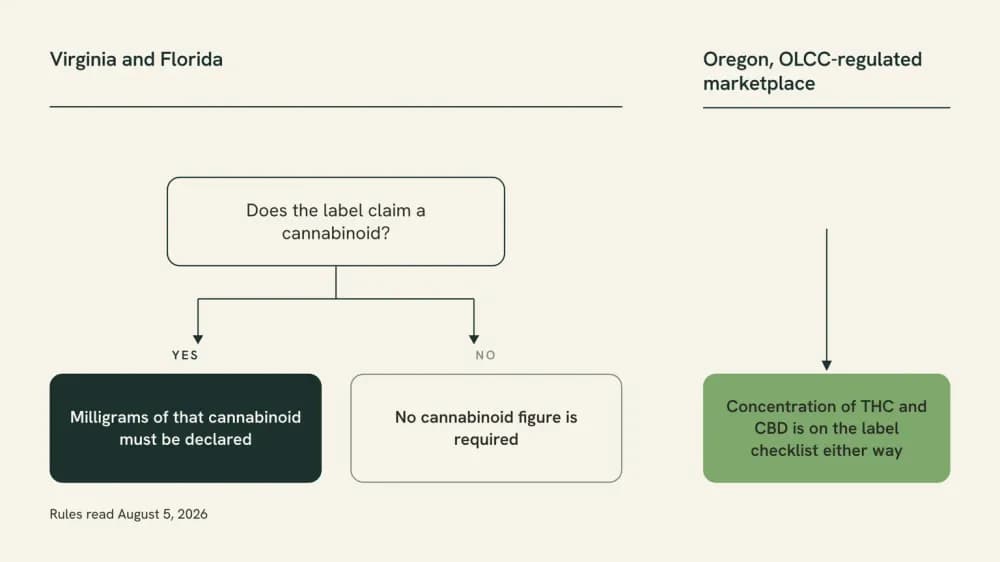
Here is the rest of the short answer, up front. There is no federal common-or-usual name for hemp extract, so the phrase means whatever a seller means by it unless a state has written it down. Three states have, and they do not agree. In two of them, Virginia and Florida, a cannabinoid milligram figure is only required on the label if the seller claims a cannabinoid in the first place, which means a package that claims nothing discloses nothing. Oregon, working through a licensed marketplace, is the counterexample: the concentration of THC and CBD is on the label checklist regardless. Everything below is quoted from the rules themselves, all read on August 5, 2026, and it is the missing half of the checklist for choosing a CBD oil.
What hemp extract actually is
Extract is a process word, not a composition word. It says that something was taken out of plant material and the structural plant matter was left behind. Virginia put the cleanest version of that into a rulebook, in the definitions section of its industrial hemp extract chapter.
“"Extract" means a naturally occurring phytochemical produced by the industrial hemp plant that has been removed from the inert structural material of the plant.”
Read it again and notice what is not there. No cannabinoid is named. No amount is set. No test is required by the definition itself. The same section defines an industrial hemp extract as an extract of a Cannabis sativa plant with a tetrahydrocannabinol concentration no greater than federal law allows for hemp, intended for human consumption. That is the whole of it: a source, a ceiling on one compound, and an intended use. A phytochemical is simply a chemical the plant made, and calling it naturally occurring rules out a synthetic one, which is a claim about origin again.
This is also where hemp extract parts company with hemp seed oil, which is pressed from the seed rather than separated from the leaf and flower, and that comparison has its own page. What matters here is the grammar of the phrase. Hemp names the plant. Extract names what was done to it. Neither word is doing any work on the question you actually have, which is how much of which cannabinoid is in the bottle in your hand.
There is no federal definition of hemp extract for a consumer label
Federal law defines hemp. The statutory definition at 7 U.S.C. 1639o covers the plant Cannabis sativa L. and all of its derivatives, extracts, cannabinoids, isomers, acids and salts, at a delta-9 tetrahydrocannabinol concentration of not more than 0.3 percent on a dry weight basis. That is a definition of a plant category, not of a product name on a shelf, and how the line between hemp and marijuana is drawn is a subject of its own. One dating note belongs with it: that text is in force through November 11, 2026, and a replacement enacted as Public Law 119-37 takes effect the following day.
For the name on the front of a food, the federal reference point is a different one. Most foods have no standard of identity, so there is a general rule for naming them, and 21 CFR 102.5 states the principle plainly: "The common or usual name of a food, which may be a coined term, shall accurately identify or describe, in as simple and direct terms as possible, the basic nature of the food or its characterizing properties or ingredients." The same subsection adds that the name "shall be uniform among all identical or similar products". That is the standard the naming of a food is measured against. It is a general principle rather than a hemp rule, and nothing on this page says that any particular label meets it or fails it. That judgement belongs to a regulator, not to an article.
What can be checked is the list. Subpart B of 21 CFR Part 102 is where the federal government writes those names down one food at a time, and it currently runs to sixteen entries. Hemp extract is not one of them. That is a fact about the list, not a verdict about any product, and it is worth reading the list in full because it shows how specific the government gets when it decides a name needs pinning down.
What the three states that defined it actually wrote
State rules are where the phrase gets a legal shape, and the shapes do not match. Virginia regulates industrial hemp extract as a food ingredient category and defines it by origin and process, as quoted above. Florida wrote a definition into statute at 581.217 that has something Virginia's does not, a composition floor: hemp extract there means "a substance or compound intended for ingestion, containing more than trace amounts of a cannabinoid, or for inhalation which is derived from or contains hemp and which does not contain controlled substances", and the term "does not include synthetic cannabidiol or seeds or seed-derived ingredients that are generally recognized as safe by the United States Food and Drug Administration". Notice that the floor has no number attached to it, which is itself informative. Oregon takes a third route. Rather than defining the phrase for every package sold in the state, the OLCC's Packaging and Labeling Guide, Version 6.2 of December 2025, sets out what a hemp item must carry inside the licensed marketplace the agency regulates, implementing rules at OAR 845-025-7000 to 845-025-7190.
| Jurisdiction | How it defines the term | What the label must carry | What it leaves optional |
|---|---|---|---|
| Virginia (2VAC5-595) | An extract of Cannabis sativa at or below the federal THC limit, intended for human consumption. A phytochemical removed from the inert structural material of the plant. No quantity of any cannabinoid appears in the definition. | A unique batch code that is legible on the label, plus extra statements if the product contains THC, including that it may not be sold to anyone under 21 and the total percentage and milligrams of THC. Labeling reaches the website and the advertising too. | Any cannabinoid milligram figure, unless the label itself claims a specific cannabinoid or a concentration of one. |
| Florida (Fla. Stat. 581.217 and Fla. Admin. Code 5K-4.034) | A substance or compound intended for ingestion or inhalation, derived from hemp, containing more than trace amounts of a cannabinoid, and containing no controlled substances. Synthetic cannabidiol and GRAS seed ingredients are excluded by name. | A scannable barcode or QR code linking to that batch's certificate of analysis, the batch number, an internet address for batch information, and an expiration date. The QR must reach the report in three or fewer steps and stay live at least 90 days past expiration. | The milligram figure attaches to each marketed cannabinoid per serving, so a package that markets none declares none. |
| Oregon, OLCC-regulated marketplace (Packaging and Labeling Guide v6.2, December 2025) | Handled as a hemp item inside a licensed marketplace rather than through a standalone definition of the phrase, under OAR 845-025-7140. | The concentration of THC and CBD, the hemp symbol in place of the universal symbol, and the warning: This product is derived from hemp and could contain THC. Keep out of reach of children. Extracts and concentrates that are not edibles, tinctures or capsules also carry DO NOT EAT in bold capitals. | Very little on this point. The CBD figure is on the label checklist whether or not the seller advertises it, and it must be the value calculated by the laboratory that did the testing. |
Line the three up and a structural finding falls out that no consumer page has published: in Virginia and Florida the cannabinoid milligram figure is conditional, and in Oregon's regulated marketplace it is not. Two caveats travel with that. The Oregon requirements apply to items handled through OLCC licensees and hemp certificate holders, not to every hemp product a person can buy in Oregon. And three jurisdictions are three jurisdictions: the accurate claim from this evidence is that the rules vary a great deal, never that any one of them is the national rule. If you sell, ask a lawyer in your state. If you buy, keep reading, because the variation is the practical part.
The trigger nobody explains: why the milligram number is optional
Here is the sentence that does most of the work on this page. Virginia's labeling section puts the milligram requirement behind a condition, at subsection (D).
“If a manufacturer labels an industrial hemp extract or food containing an industrial hemp extract as containing a specific cannabinoid or concentration thereof, the number of milligrams of such cannabinoid must be declared on the product label. The manufacturer must make and maintain records verifying the declared amount of cannabinoid.”
Read the first six words again: if a manufacturer labels. The disclosure is switched on by the seller's own claim. A package that says only hemp extract has not claimed a specific cannabinoid, so no milligram figure is owed, and no record verifying an amount is owed either. That second sentence matters as much as the first: the obligation to hold evidence for the number arrives with the number, not with the product.
Florida writes the same conditional twice. Its statute requires the container to state "the number of milligrams of each marketed cannabinoid per serving", and the department's rule for hemp extract for human consumption, amended effective November 2, 2025, puts it in plainer words still: "If cannabinoids are marketed, the number of milligrams of each cannabinoid per serving and the serving size must be declared on the label." Marketed is the trigger word. Two states, three separate provisions, one design: the label describes what the seller chose to assert.
One arithmetic point, once, because another page owns it in full. A milligram figure attached to the word extract is a weight of extract, not a weight of any cannabinoid: 75 mg of full spectrum hemp extract is 75 mg of extract, and how much CBD sits inside that is a separate question the phrase does not answer. If you want that decoded properly, panel by panel, with where each printed number comes from, our guide to reading a CBD label does the whole walkthrough and this page deliberately does not repeat it.
Hemp extract vs CBD: a source description and a molecule
CBD is a single compound, cannabidiol, with one chemical identity. Hemp extract is a description of a source material that may contain that compound along with dozens of others: CBG, CBN, CBDV, THCV, terpenes, waxes and chlorophyll all ride along depending on the plant and the process, and what else counts as a cannabinoid is its own subject. So a product can be a hemp extract and be rich in CBD. It can be a hemp extract built around a different cannabinoid. Under Virginia's definition it can be a hemp extract with no cannabinoid quantity claimed at all, while Florida's definition would require more than trace amounts of one before the term applies there. The two phrases are not competitors and they are not synonyms. One answers where from, the other answers which molecule, and a package can answer either question without answering the other.
The ingredient line is the more regulated part of the package, and it is worth knowing exactly how much it tells you. Federal food labeling requires ingredients to be listed by common or usual name in descending order of predominance. That gives you the ordering and not the amounts. An ingredient line that names a carrier oil first and a hemp extract second tells you the carrier outweighs the extract, which is normal for a tincture. It does not tell you how many milligrams of any cannabinoid that extract carries, and no rearrangement of the ingredient line ever will.
What full spectrum hemp extract adds, and what it still does not
Full spectrum is the most common thing added to the phrase, and it describes the range of compounds kept during processing rather than any quantity of them. It says the extract was not stripped down to a single molecule. It does not say which cannabinoids survived, in what proportion, or in what amount, and it does not distinguish an extract that is mostly CBD by weight from one that is mostly something else. Full spectrum, broad spectrum and isolate are worth understanding as categories and that page handles them. What matters for the words on the front is that adding full spectrum to hemp extract narrows the description and still leaves the number unwritten. It was also the single most common variant in the label archive below, appearing on 59 of the 489 products counted there.
Why the bottle says hemp extract instead of CBD
The vocabulary did not appear from nowhere, and the pressure on the alternative word is documented. Start federal. The FDA's consumer update on cannabis-derived products states the agency's position in one sentence: "It is currently illegal to market CBD by adding it to a food or labeling it as a dietary supplement." That is an agency position rather than a court holding, and it is covered in full in our summary of what the FDA says about CBD. What matters here is narrower: three of the words a seller would reach for, CBD, food and dietary supplement, all appear inside a sentence the regulator has written that way.
The advertising layer is documented too, and it is more specific than most people assume. Google's advertising policy, read on August 5, 2026, says: "Ads for topical, hemp-derived cannabidiol (CBD) products with THC content of 0.3% or less are allowed." Advertisers have to apply before running those ads, and the policy limits their targeting to California, Colorado and Puerto Rico. A tincture is not a topical, so it falls outside that allowance entirely. Meta's advertising standards, read the same day, say that ads promoting or offering the sale of cannabidiol "are only allowed with prior written authorisation", conditioned on an active LegitScript certification, United States targeting only, and no audience under 18.
The payment layer is narrower than the folklore. Stripe's restricted-business list, read August 5, 2026, does not ban CBD outright. Under its marijuana heading it restricts "CBD products with THC levels greater than the applicable local jurisdiction's legal limit, including CBD edibles". Worth reading exactly, because the sentence people repeat is considerably broader than the sentence that is actually written down. The four documents summarized below were all read on the same day.
- FDA, consumer update: its stated position is that it is currently illegal to market CBD by adding it to a food or labeling it as a dietary supplement.
- Google Ads: CBD advertising is accepted only for topical products at or below 0.3% THC, only by application, and only targeted to California, Colorado and Puerto Rico.
- Meta: CBD ads are allowed only with prior written authorisation, an active LegitScript certification, United States targeting and no audience under 18.
- Stripe: the restricted-business schedule lists CBD products above the local legal THC limit, and CBD edibles. It is a narrower restriction than the one people describe.
Now the honest limit, because it is the part most pages skip. Everything above is documented: a federal position and three commercial policies that treat the word CBD as restricted inventory. What is not documented, and what this article will not assert, is that any particular company chose the phrase hemp extract because of any of it. A labeling decision's motive cannot be read off a package, so no brand is named here and no motive is assigned. The two sets of facts sit side by side and you can draw your own line between them.
Seventy-nine ways to write two words
To see how unstandardized the phrase really is, we queried the National Institutes of Health Dietary Supplement Label Database, the federal archive of supplement labels, on August 5, 2026. The method is reproducible if you want to run it yourself: four searches (hemp extract, hemp, cannabidiol, aerial parts), up to 1,500 records each, deduplicated by record id to 3,863 records, then filtered to every record whose ingredient list contains a string carrying both hemp and extract, then deduplicated by brand plus product name. That leaves 489 unique products. The database is cited here in plain text rather than as a link because its public pages block automated requests, which is also why nobody seems to have counted this.
After the bare phrase, the list fragments quickly: full spectrum hemp extract (59 products), hemp flower and leaf extract (39), broad spectrum hemp extract blend (29), broad spectrum hemp extract (26), full spectrum hemp aerial parts extract (25), hemp aerial parts extract (23), hemp oil extract (22), organic hemp extract (11), phytocannabinoid-rich hemp extract (11), CBD-rich whole hemp extract (9), and hemp decarboxylated flowering top extract (7). Counted by keyword across the whole set, the word aerial appears on 79 products, full spectrum on 95, broad spectrum on 73, flower on 62, organic on 45, and phytocannabinoid on 13. None of those words is defined by a federal labeling rule for this ingredient, which is exactly why there are 79 of them.
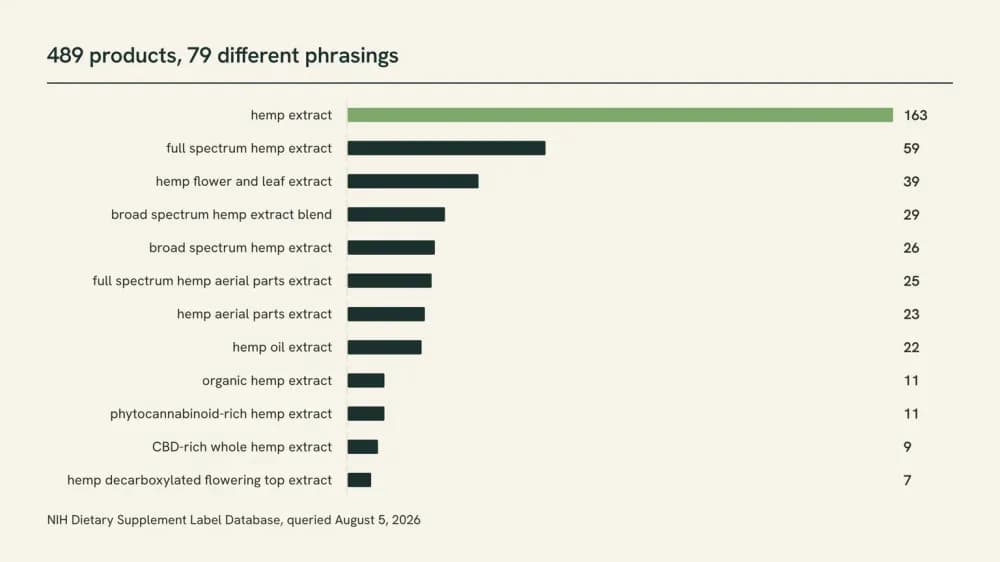
What that count is and is not. The label database is an archive, not a market census: 94 of the 489 products are flagged off market, and the entry dates run from 2015 to 2025 with clusters in 2020 (156 products) and 2024 (115). The classification is keyword matching over label text, so 79 is a floor on the number of spellings rather than a ceiling. No brand from the dataset is named here, no product in it is being criticized, and the counts will drift if you re-run the query, which you can, because the search terms and the date are printed above.
What the phrase does not guarantee: five questions to ask instead
None of this makes hemp extract a bad phrase to see on a package. A product is not worse because its front panel uses it, and it is not better because the front panel says cannabidiol. The phrase is simply uninformative, and the fix is not a better word on the front. It is a batch report. It is also worth seeing what a state requires when it does require testing: Virginia's testing section has a manufacturer submit a sample from each batch for analysis, forbids selling from a batch "whose sample does not contain the cannabinoid or phytochemical concentration claimed on the label", requires a laboratory with "no direct or indirect financial interest in a manufacturer of an industrial hemp extract", and sets residual solvent ceilings including benzene at 2 parts per million, hexane at 290, methanol at 3,000 and ethanol at 5,000. Florida's rule sets benzene at 1 part per million. Whether anything comparable applies to the bottle in front of you depends on where it was made and sold, which is the variation this whole page is about.
- 1Which cannabinoid, and how many milligrams of it? A number sitting next to the word extract is a weight of extract. Until a cannabinoid is named beside a number, no cannabinoid has been quantified.
- 2Which part of the plant? Aerial parts, meaning leaf and flower, and seed are different starting materials with completely different cannabinoid content, and only one of the two is a cannabinoid source.
- 3Which batch, and does the code printed on the package match the code printed on the report? A report for a different batch is a report about a different product.
- 4Who ran the test, and are they independent of the manufacturer? Virginia requires a laboratory with no direct or indirect financial interest in the manufacturer. Not every jurisdiction says anything on the subject.
- 5What did the report measure besides potency? Residual solvents, pesticides, heavy metals and microbials are separate panels, and a potency-only report answers only the potency question.
Each of those questions has an answer somewhere, and none of the answers is on the front panel. How to read a certificate of analysis covers what a batch report contains and how to match it to the bottle in your hand. What third-party tested actually means covers laboratory independence, which is the part the phrase third party is doing all of the work on. And if you want to turn a milligram figure into an actual serving, the per-drop calculator does that arithmetic for you.
We print the phrase too
It would be strange to write all of this and not say the obvious thing. Planntz uses the phrase. Our Full Spectrum CBD product copy reads, in its own words, "Our whole-plant full spectrum hemp extract in coconut MCT oil." That sentence is doing exactly what this article says the phrase does: naming a source and a process and nothing else. We are describing a convention we take part in, not one we stand outside of, and a page that criticized the convention without saying so would not be worth much.
So here is how to resolve it on our own bottle, using the same method you would use on anyone's. The label does not stop at the phrase: it names the cannabinoid and the amount, 15,000 mg of CBD in 60 mL. Then the batch report closes the loop. Batch 260310 of Full Spectrum CBD in Mango and Peach, produced March 23, 2026, reports 15,900 mg of total CBD, 16,300 mg of total cannabinoids, 136 mg of delta-9 THC (0.238 percent, below the 0.3 percent federal limit) and 75.4 mg of CBDV. The printed figure is a floor and that batch measured above it, which is precisely the kind of thing only a batch report can tell you and no phrase on a front panel ever could. Every batch report we publish is there for that reason.
What this page cannot tell you
This is a description of published rules, not legal advice, and not advice for a seller either. It quotes three jurisdictions because three is what could be opened, read and verified in one sitting, and three is not a national picture: the finding here is that the definitions vary, not that any one of them reaches where you live. Whether a given hemp product is legal where you are is largely a state question with a moving answer, and every rule quoted above can be amended by the same body that wrote it. A phrase on a package also tells you nothing about quality in either direction. Hemp extract on the front is not a warning sign, and cannabidiol on the front is not a guarantee. Both are words. The report is the evidence.
Common questions about hemp extract
No. CBD is one molecule, cannabidiol. Hemp extract describes where a material came from and how it was separated from the plant. An extract can be rich in CBD, poor in it, or built around a different cannabinoid entirely, and the phrase alone does not tell you which. The cannabinoid name plus a milligram figure is what settles it, and our guide to reading a CBD label walks through where each number on a panel comes from.
Usually there is some, but the phrase carries no guarantee, and the two states that defined it disagree about whether it should. Florida's statute writes a floor into the definition, requiring more than trace amounts of a cannabinoid, with no number attached to the word trace. Virginia's definition sets no quantity of anything at all. For the bottle in your hand, only a batch report answers the question, and our guide to reading a certificate of analysis explains what to look for on it.
It means 75 milligrams of extract in a half-ounce bottle. Extract weight and cannabinoid weight are different quantities, and the phrase does not convert one into the other. If the label names a cannabinoid anywhere, that is the number to look for. If it does not, the batch report is the only place the answer exists. The full decode of a label panel lives on our how to read a CBD label page, which owns that arithmetic.
There is documented pressure on the word CBD. The FDA's stated position, quoted above, is that it is currently illegal to market CBD by adding it to a food or labeling it as a dietary supplement. As of August 5, 2026, Google accepted CBD advertising only for topical products, only by application, and only targeted to California, Colorado and Puerto Rico. Meta required prior written authorisation and a LegitScript certification, and Stripe restricted CBD products above the local THC limit along with CBD edibles. What none of that establishes is any individual company's reason for its own wording, and we do not claim to know it.
Federal law defines hemp and its derivatives, extracts and cannabinoids at or below 0.3 percent delta-9 THC on a dry weight basis, and that definition is in force through November 11, 2026 before a replacement takes effect. What may be sold, and how it must be labeled, is largely a state question that changes often. This page describes rules as they were written on August 5, 2026 and does not advise anyone on what is permitted where they live. Treat anyone who tells you a hemp product is legal in all 50 states as a source to double-check.
No. Hemp seed oil is pressed from the seed. A hemp extract is separated from the aerial parts of the plant, the leaf and flower, where the cannabinoids concentrate. They are different starting materials sold for different reasons, and the comparison has its own page on this site.
If you take one thing from this page, take the order of operations. The phrase on the front tells you the source. The ingredient line tells you the order. The cannabinoid name and its milligram figure, when they are there, tell you the amount. The batch report is the only one of the four that had to be measured by somebody. Every Planntz product page prints the second and the third, and every batch has a report behind it.
Match the words to the numbers
Every Planntz tincture names its cannabinoids and their milligram amounts, and every batch has a public third-party report you can match to the code on your bottle.
See our lab resultsWriting about hemp, wellness and the small rituals that keep us balanced.