Water-Soluble CBD and Nano CBD: What the Label Actually Means
Cannabidiol does not dissolve in water. Water-soluble and nano CBD are emulsions, and the whole human evidence base is six crossover trials in 76 people. Here is what they measured, what the multipliers actually mean, and how to check any absorption claim in 60 seconds.
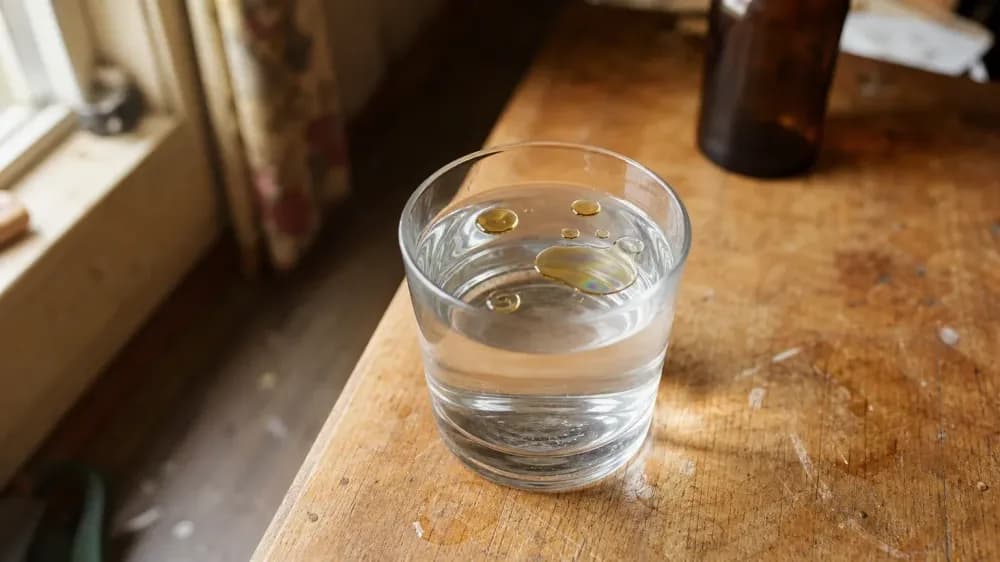
A bottle labeled water soluble CBD usually costs more than the oil sitting next to it, and the reason given is always the same: your body absorbs more of it. That claim has a number attached. The number has a source. The source is smaller and stranger than the packaging suggests. Start with the chemistry, because it settles the name: cannabidiol does not dissolve in water. What is sold under that label is an oil-in-water dispersion held apart by surfactants. It is a delivery format, not a new molecule.
Planntz sells MCT-oil tinctures and does not sell a water-soluble or nano CBD product, so read what follows knowing which side of the argument we are standing on. We are going to give the format its real wins anyway, because they exist. Here is the short version before the detail. Four human crossover trials have compared a nanoemulsified CBD against an oil, and their total-exposure multipliers were 1.0x, 1.48x, 1.70x and 2.3x. The 4.4x you see quoted everywhere is a peak-concentration figure from a single 16-person study whose own 24-hour exposure number, in the same people, was 1.70x. Seventy-six volunteers have taken part in the entire human literature on this format, across six trials, every one of them linked to a formulation company, and not one of them measured whether anybody felt anything.
Water soluble CBD describes the packaging, not the molecule
Cannabidiol does not dissolve in water, and the one CBD medicine the FDA has approved says so on its own label. Section 11 of the prescribing information describes the active ingredient as insoluble in water and soluble in organic solvents. We are quoting that document for its formulation vocabulary and for nothing else. It is a prescription anti-seizure medicine, and nothing about its dose, its results or its risk profile transfers to a hemp supplement.
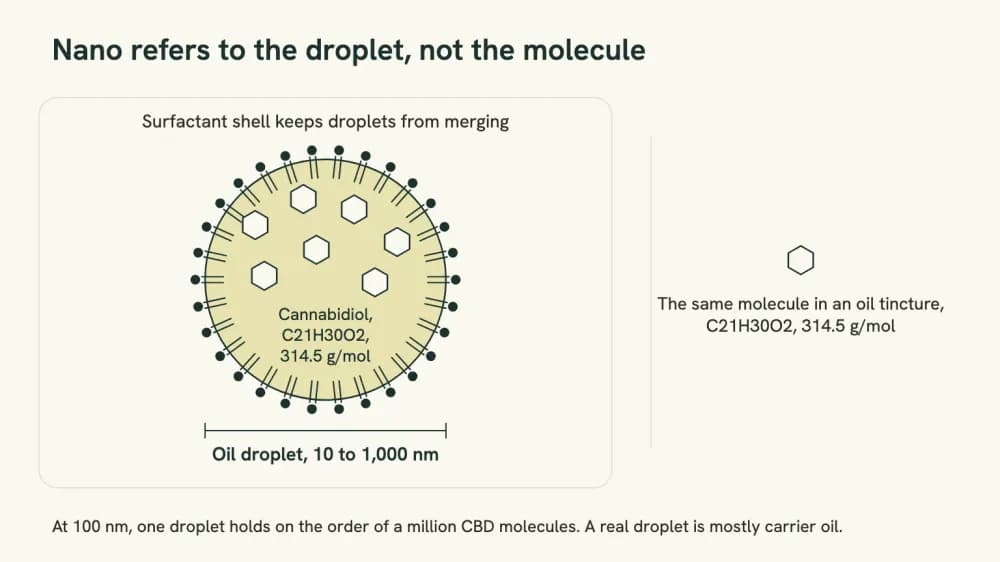
How strongly does CBD prefer fat? The NIH chemical database lists cannabidiol as C21H30O2, 314.5 grams per mole, with a computed XLogP of 6.5. XLogP is a fat-versus-water partition coefficient on a log scale, so 6.5 puts the ratio on the order of a million to one. That is a computed descriptor rather than a measured solubility in a finished product, but the direction is not in dispute. To get CBD into a glass of water you do not dissolve it. You chop the oil into droplets small enough to stay suspended, then coat each droplet in a surfactant so the droplets cannot find each other and merge back into a slick.
That is why the word soluble is doing marketing work rather than chemistry work. The accurate words are emulsion, dispersion or suspension, and which one you have depends on the manufacturing process rather than the label. A water-soluble product is also, strictly, neither an oil nor a tincture in the old pharmacy sense, and if the vocabulary on the shelf is the part bothering you, we took the word tincture apart in its own article.
What nano CBD actually is: nanoemulsion, liposome, dry powder
Nano CBD is not one technology, and the word appears on at least four different things. The most common by far is a nanoemulsion. A 2025 review in Pharmaceuticals puts nanoemulsion particle sizes at 10 to 1,000 nanometers, typically spherical, which is a range wide enough that two products both calling themselves nano can differ by two orders of magnitude in droplet size. Almost nobody prints the droplet size on the label, and there is no rule that says they have to.
- Nanoemulsion: oil droplets roughly 10 to 1,000 nanometers across, kept apart by surfactants. This is what most products labeled water soluble or nano actually are.
- Self-emulsifying delivery system (SEDDS or SNEDDS): a concentrate of oil, surfactant and co-solvent that forms the emulsion when it meets the water in your gut. Four of the six human trials tested this design.
- Liposome: cannabinoid carried inside a lipid bilayer vesicle. Small unilamellar vesicles run 20 to 100 nanometers, large unilamellar vesicles above 100.
- Dry powder: an emulsion spray-dried onto a carrier such as gum acacia or maltodextrin, sold as a stick pack, a capsule or a drink mix.
Liposomal claims deserve their own sentence, because the evidence behind them is not the evidence behind nanoemulsions. A PubMed search for cannabidiol and liposomes, run on July 31, 2026, returns 53 records, and none of them is a human oral pharmacokinetic trial. The only in vivo crossover in that set is a subcutaneous study in dogs (PMID 41635790). Liposomal CBD may be a perfectly good product. It is not a studied one in people who swallow it, and a page that puts liposomal and nanoemulsion in the same sentence about human absorption is stretching one body of evidence over two formats.
The number everyone multiplies has never been measured
Before you can multiply a number, you have to have one. In a 2020 critical appraisal in CNS Drugs, Perucca and Bialer write that although detailed studies have not been published, the available data suggest that the absolute bioavailability of CBD after oral dosing under fasting conditions is approximately 6%, and that it increases roughly fourfold when the dose is taken with a high-fat meal. Read the first half of that sentence again. The 6% is an inference two experts drew from published exposure data, offered in the same breath as the admission that the studies which would establish it have not been done.
The systematic review of human CBD pharmacokinetics is blunter. Pooling 24 human studies, it reports that bioavailability following smoking was 31% however no other studies attempted to report the absolute bioavailability of CBD following other routes in humans, and describes the field as having a paucity of data. One of its co-authors, A. S. Yates, was at Artelo Biosciences. So the only absolute bioavailability figure ever reported for CBD in a person is for smoking it, and every 2x, 4x and 10x printed on a package is being applied to a number nobody has directly measured.
You will also read that water-soluble CBD bypasses the liver. A swallowed product cannot. Blood leaving the gut goes to the liver before it goes anywhere else, and that first pass is where an estimated 70 to 75% of an absorbed CBD dose is removed. The one route that partly avoids it is intestinal lymphatic transport, and the only study we could find that measured lymph routing for an oil against a nanoemulsion did it in three conscious pigs with a cannulated thoracic lymph duct. In those three animals the nanoemulsion sent less of what it delivered through the lymph (11% ± 13) than the oil did (20% ± 10), and absolute bioavailability came out at 6.1% ± 0.9 for the oil against 9.2% ± 6.6 for the nanoemulsion, a difference smaller than its own standard deviation. Three pigs is a preclinical result and does not transfer to you or to any product on a shelf. It is enough to say the liver-bypass story is unsupported. It is not enough to claim the opposite.
Every human trial of nano or water-soluble CBD, in one table
The entire human evidence base fits on one screen, which is itself the most useful fact on this page. On July 31, 2026 we ran this PubMed query: cannabidiol AND (nanoemulsion OR self-nanoemulsifying OR self-emulsifying OR SNEDDS OR SEDDS) AND (crossover OR healthy volunteers OR healthy subjects). It returned seven records. Six are human crossover pharmacokinetic trials and the seventh is the pig study above. Between them the six trials enrolled 76 people. If you re-run that search after this date, expect the count to move, and check the new records rather than trusting ours.
| Study | n and design | Comparator | Cmax | AUC | Funding or affiliation |
|---|---|---|---|---|---|
| Cherniakov 2017 | 9 fasted volunteers, 2-way crossover, 10 mg CBD | Oromucosal spray, not an oil | 4x | 2.2x | Hebrew University formulation. The capsule also contains 20 mg piperine, a metabolism inhibitor, so part of the gain is a drug interaction |
| Atsmon 2018 | 14 healthy males, crossover | Oromucosal spray, not an oil | 1.6x | Relative bioavailability 131% | Authors employed by PhytoTech Therapeutics |
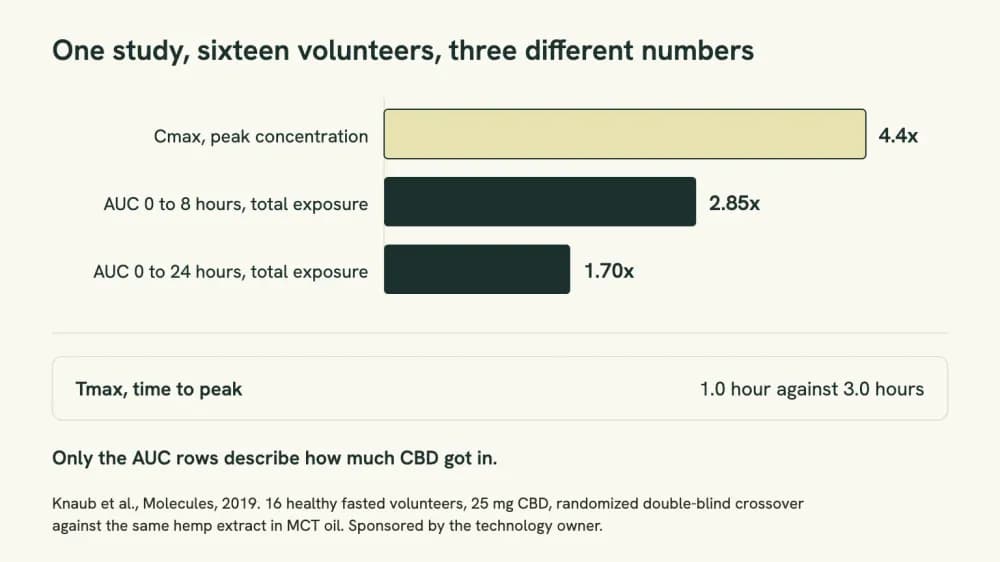
| Knaub 2019 | 16, randomized double-blind crossover, 25 mg, fasted | The same hemp extract in MCT oil | 4.4x | 2.85x over 8 h, 1.70x over 24 h | Sponsored by Vesifact AG, which owns the delivery technology |
| Izgelov 2020 | 12 healthy males, 3-way blinded crossover | Sesame oil, and raw powder | Higher than powder | No difference against sesame oil | One author at PureForm Biosciences; competing interests declared none |
| De Pra 2021 | 11, single-dose open-label crossover | MCT oil, and glyceryl monolinoleate | Not reported in the abstract | 1.48x against MCT, 1.12x against GML | All authors at Entourage Phytolab |
| Hermush 2025 | 14 adults, crossover, 30-day washout, 8 mg CBD with 8 mg THC | Oil drops | 2.2x, not statistically significant (p = 0.121) | 2.3x (p = 0.018) | Funded by Capsoil Technologies; the company CEO is an author |
Read the comparator column first, because it decides what each row is worth to you. Two of the six compared their formulation against an oromucosal spray rather than an oil, which answers a question you were not asking. Only four compared a nanoformulation against the thing you actually own. Across those four, total exposure ran from no difference at all up to 2.85x. Nothing in the human record reaches 4x on an exposure basis, let alone the 10x that circulates on category pages. And none of the six measured an outcome. They measured blood.
The single most quoted result in this category belongs to a randomized, double-blind crossover in 16 healthy fasted volunteers given 25 mg of CBD, published in Molecules in 2019 and sponsored by the company that owns the delivery technology. Its peak concentration was 4.4 times that of the same hemp extract in MCT oil, and its peak arrived at 1.0 hour instead of 3.0. In the same sixteen people, in the same study, total exposure over 24 hours was 1.70x. Both numbers are real and both are correctly reported in the paper. Only one of them is about how much CBD got in.
The most tightly designed of the four is a three-way blinded crossover in 12 healthy men that gave the same synthetic CBD three ways: as a raw powder, in sesame oil, and in a self-nanoemulsifying system. Its conclusion runs one sentence: overall plasma exposure of CBD did not differ between the sesame oil vehicle and the SNEDDS formulation. What did differ was consistency. In the oil arm some subjects absorbed early and some absorbed late, while the nanoemulsion produced one uniform early profile in everybody. That is a genuine advantage, and it is not the advantage printed on the box.
The newest is a 2025 crossover in 14 adults with a 30-day washout, funded by Capsoil Technologies with the company's chief executive as an author. Parent-CBD exposure was 2.3 times higher from a self-nanoemulsifying powder than from oil drops and that difference reached statistical significance (p = 0.018), while the peak concentration difference (p = 0.121) and the time to peak (p = 0.175) did not. Fourteen people, one dose, blood levels only. That is the state of the art, and it is worth knowing how small the state of the art is before paying a premium for it.
Cmax, Tmax and AUC are three different claims
Almost every misleading absorption claim in this category is one of three numbers wearing another one's clothes. They come from the same blood samples and they answer completely different questions. Tmax is the closest thing to an onset number that a blood draw can give you, and the wider question of when people actually notice anything is onset and duration, which is a different measurement entirely.
- Cmax is the highest concentration your blood reached. It tells you how tall the peak was, not how much arrived in total.
- Tmax is when that peak happened. It is a timing measurement, and a faster peak in plasma is not the same thing as a faster effect.
- AUC, the area under the concentration-time curve, is total exposure across a window such as 0 to 24 hours. This is the number that means more CBD got in.
Pooling the whole literature does not settle the question either, and the review that tried says so in its own limitations. A 2024 systematic review with meta-regression pooled 112 trial arms from 39 studies and sorted their formulations into nanotech, oil-based, alcohol-based, water-based, Sativex and Epidiolex groups. Formulation type could only be modeled for one parameter, Tmax, where nanotech and oil-based formulations landed in the same bucket, both faster than the Epidiolex formulation. The authors write that they could not explore other formulations or other pharmacokinetic parameters, which limits interpretation of different formulations on their comparable bioavailability for CBD. If you want the wider version of how a swallowed format meets first-pass metabolism, that lives in oil against gummies.
One more comparison puts every multiplier on this page in scale. In a Phase I trial, a high-fat meal raised CBD peak concentration 4.85-fold and total exposure 4.2-fold against the fasted state, in a 12-person food-effect arm. Two caveats travel with that: the trial used a single 1,500 mg dose of pharmaceutical-grade CBD oral solution, roughly a hundred times a typical consumer serving, and its authors were GW Research employees and shareholders. Read it as direction rather than as a dose to copy, and read the practical details in taking it with food, which is where we keep that topic. The direction is still striking: the largest exposure multiplier in this whole literature is free and comes with dinner.
What is on the ingredient line, and what regulators actually say about it
Emulsification is not free. Holding oil droplets apart in water takes surfactants and co-solvents, and those appear on the ingredient line of a water-soluble product and not on a two-ingredient tincture. Knowing what they are is part of reading a label, and the rest of that skill is in what each line on the label means. Below is what the US and EU regulatory record actually says about the five you will see most often. None of it is a safety allegation, and none of these ingredients is unusual in food. It is simply the information a longer label asks you to look up.
| Ingredient | What it does | US status | Published intake ceiling |
|---|---|---|---|
| Polysorbate 80 | Synthetic surfactant that forms and stabilizes fine droplets | Food additive with an enumerated list of permitted uses, 21 CFR 172.840 | EFSA group ADI for the polysorbates, 25 mg per kg body weight per day (2015). The CFR listing caps special dietary foods at 360 mg per day |
| Quillaja saponin extract | Plant surfactant from soapbark, common in beverage emulsions | Listed as a natural flavoring substance, 21 CFR 172.510 | EFSA ADI 3 mg saponins per kg body weight per day (2019). JECFA group ADI 0-1 mg per kg |
| Lecithin | Phospholipid emulsifier, usually from soy or sunflower | GRAS, 21 CFR 184.1400, used with no limitation other than current good manufacturing practice | None set |
| Gum acacia (gum arabic) | Emulsifier and stabilizer, also the carrier in many dry powders | GRAS, 21 CFR 184.1330 | Up to 2.0% in beverages as an emulsifier or stabilizer |
| Glycerin | Co-solvent, humectant and sweetener | GRAS under good manufacturing practice, 21 CFR 182.1320 | None set |
Take polysorbate 80 as the example, because it attracts the most drama and deserves the least. 21 CFR 172.840 lists the foods it is permitted in, one by one: ice cream and frozen desserts at up to 0.1%, yeast defoamers, pickles at up to 500 ppm, vitamin and mineral preparations with per-dose intake caps, shortenings and edible oils at up to 1%, canned spiced green beans, special dietary foods at up to 360 mg per day. A hemp extract is not among the listed uses. That is a fact about the list, not an accusation about any product. In 2015 Europe's food safety authority set a group acceptable daily intake for the polysorbates of 25 mg per kilogram of body weight per day, identified no concern for genotoxicity, carcinogenicity or developmental toxicity, and noted in the same opinion that estimated toddler exposure at the top of the range already sits at 24.5 (PMID 42109790). None of that is a warning about a CBD product, from us or from anybody else. It is homework, and the length of an ingredient line decides how much of it there is.
FDA has one position that lands directly on this category, and it is a question rather than a verdict. A 2014 guidance filed under docket FDA-2011-D-0490 sets out the agency's thinking on whether the intentional reduction in particle size to the nanoscale for a food substance already on the market affects the identity of that substance, the safety of its use, or its regulatory status. In plain terms: an ingredient's status at conventional particle size does not automatically carry over to the nanoscale, and the manufacturer is the one who should be asking. The guidance is non-binding, and it does not say that anything is unsafe. It says the question exists, which is more than most category pages will tell you.
A dispersion is a suspension problem: what to ask about the COA
An oil solution is thermodynamically boring, which is a compliment. An emulsion is a physical structure that can come apart, and when it comes apart the number on the label stops describing what is in the bottle. In one published stress test of a quillaja-stabilized CBD nanoemulsion, droplets of roughly 120 nanometers with a zeta potential near -30 mV stayed stable for six weeks at room temperature and shrugged off heat, cold, dilution and carbonation, but broke at pH at or below 2 and at salt concentrations above 100 millimolar. The authors report that cannabis potency measured by HPLC was detrimentally affected by any change in the nanoemulsion phase stability. That is one laboratory formulation rather than a retail product, six weeks is not a shelf life, and the work was funded through a fellowship whose industrial partner was a processing company with one of its scientists as a co-author.
The obvious follow-up question has no published answer. As of July 31, 2026, a PubMed search for cannabinoid emulsions together with dose uniformity or content uniformity returns zero records, and a wider search for cannabidiol with water-soluble or nanoemulsion plus label, homogeneity or potency returns 11, none of which is a survey of retail products. Nobody has published what emulsion stability does to the dose in an actual bottle on an actual shelf. Meanwhile label accuracy in this market is already documented: a 2024 analytical survey of 202 US CBD products, sponsored by Jazz Pharmaceuticals, found 149 of them, 74%, outside 10% of the CBD content claimed on the label (PMID 38562466). That survey bought one unit per product in 2021 and did not test water-soluble products as a category, so it is context rather than a verdict on this format.
- Was the sample the finished emulsion, or the isolate that went into it? A certificate on the input ingredient tells you nothing about what is in the bottle.
- Does the batch number on the report match the batch number on the bottle? A report for a different batch is a brochure, not a test.
- Is the result reported per milliliter or per serving, and does the serving on the report match the serving on the label?
- Does the report cover anything besides cannabinoids? Most do not list the emulsifier system. That is a gap worth noticing rather than a violation.
- Is there a date, a named third-party lab and a method? Potency by HPLC on a dated report from a lab you can look up is the minimum.
None of that is specific to emulsions, and the general skill transfers to every product you will ever buy in this category. We walk through the whole document, panel by panel, in how to read the batch report.

Where the format genuinely wins, and we do not sell it
Here is the part that costs us something. Four things the water-soluble format really does better, drawn from the same evidence we just used to shrink its headline claim. We are the last people who benefit from writing them down, which is precisely why they belong here rather than in a footnote. One of them also explains why sublingual technique matters less for this format than for an oil, and if you use an oil, holding an oil under your tongue is its own small topic.
- It disperses in a drink. Put an oil tincture in coffee and you get a slick on top. This is the format's clearest advantage and you do not need a study to see it.
- It reached its peak sooner. In the trial with the largest measured difference, peak blood concentration arrived at 1.0 hour instead of 3.0.
- It absorbed the same way in everyone. In the blinded three-way crossover, plain oil produced early and late absorbers while the nanoemulsion gave one uniform early profile.
- It may lean less on you eating first. That is a mechanistic rationale rather than a measured result: no trial has run fed against fasted for a nanoemulsion versus an oil.
There is also one difference nobody on this search page mentions. Forensic scientists from RTI International, Johns Hopkins and the SAMHSA Division of Workplace Programs incubated three THC-free CBD products in synthetic gastric fluid for three hours. The oil converted less than 0.0006% of its CBD to delta-9 THC. The water-soluble product converted up to 0.063%, at least a hundredfold more, because that conversion needs a surfactant and this format brings its own. Their own conclusion is the reassuring half, and it ships in the same breath: at a daily CBD dose of around 30 mg they judged a positive urinary drug test unlikely at the 15 ng/mL cutoff, and the amounts stayed below the THC already reported in products labeled THC-free. That is a beaker, not a stomach, and no product in any format can guarantee a test result. If that is your live question, we handle it properly in whether CBD shows up on a drug test.
What we are not going to do is turn any of this into dollars per milligram of absorbed CBD. The temptation is obvious: take a price, take a multiplier, divide, publish a table. But the multiplier runs from 1.0x to 2.85x across four small industry-linked trials with different comparators, and you cannot divide money by a number with that much air in it. A cost comparison that hides that range is arithmetic dressed up as analysis.
How to check a bioavailability claim in 60 seconds
The defense here is not skepticism, it is a habit, and it takes about a minute. Most absorption claims in this category either cite nothing at all or cite something that does not say what the page says it says. On July 31, 2026 we ran the check below across the pages currently ranking for these terms. On one of them, four PubMed IDs were printed beside four claims about CBD absorption, and the four papers that came back were about a virus in rainbow trout, sorption behavior in mesoporous silica films, a dental trial in children, and a real chemistry review credited to the wrong author. The citations looked like evidence. They were not. We are not naming the page, because the lesson is the method rather than the brand.
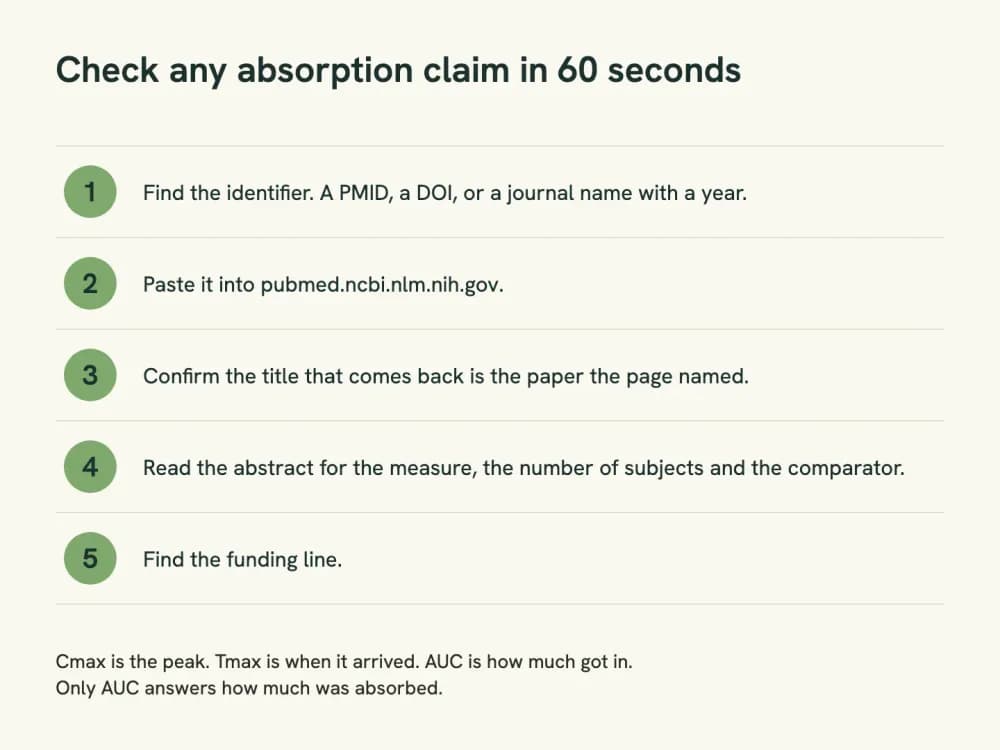
- 1Find the identifier. Look for a PMID, a DOI, or a journal name with a year. If there is no identifier anywhere on the page, you are reading an assertion and you can stop.
- 2Paste it into pubmed.ncbi.nlm.nih.gov. A PMID resolves in one search. A DOI usually resolves there too, or through doi.org.
- 3Check that the title coming back is the paper the page named. A wrong title means the citation is decorative, and everything built on it is unsupported.
- 4Read the abstract for three things: the measure (Cmax, Tmax or AUC), how many subjects, and what the comparator was. An oil comparator and a spray comparator answer different questions.
- 5Find the funding line. In this category it is nearly always the company that owns the formulation. That is not disqualifying, but it is context you are entitled to.
Run that check on this page too. Every number here carries its measure, its sample size and its funder, and where the evidence is three pigs or a beaker of synthetic gastric fluid we said so in the same sentence rather than in a footnote. Absorption is one criterion among several and it is rarely the deciding one; the rest of the shortlist, from spectrum to concentration to what the batch report has to show, is in our buyer's checklist for choosing CBD oil.
No. Cannabidiol is one of the most fat-loving molecules on a supplement shelf, with a computed XLogP of 6.5, and the label of the one FDA-approved CBD medicine describes it as insoluble in water. A product sold as water-soluble is an emulsion or dispersion: oil droplets suspended in water and kept from merging by surfactants. The molecule inside those droplets has not changed at all.
It depends what better means, and the honest answer is measured in blood rather than in how you feel. Across four human crossover trials that used an oil as the comparator, total exposure ran from no difference at all up to 2.85x, in 11 to 16 people each, and every trial was linked to a formulation company. Peak levels usually arrived sooner. No trial measured whether anybody felt more of anything, so nobody can tell you the format works better. They can only tell you what the plasma curves did.
Nobody has measured working. What has been measured is Tmax, the time to peak blood concentration. In the trial with the largest gap it moved from 3.0 hours to 1.0 hour against the same extract in MCT oil. In a 2025 crossover, parent-CBD Tmax moved from 4.57 hours to 2.57 hours and that difference was not statistically significant (p = 0.175). Faster into the bloodstream is not the same as faster to an effect.
Yes, and dispersing into a beverage is the format's clearest genuine advantage. In one published stress test, a quillaja-stabilized CBD nanoemulsion survived heat, cold, dilution and carbonation, but broke at pH at or below 2 and at salt above 100 millimolar, and the measured potency tracked the physical stability. Very acidic mixers and very salty ones are the two conditions that took it apart in the lab. That was a laboratory formulation, not a retail bottle.
They are the reason the ingredient line is longer. Lecithin, gum acacia and glycerin are generally recognized as safe with specific CFR citations. Polysorbate 80 is an approved food additive with an enumerated list of permitted uses that does not include hemp extract. Quillaja saponin extract is listed as a natural flavoring substance. European regulators have published acceptable daily intakes for two of them and found no concern for genotoxicity, carcinogenicity or developmental toxicity. None of that is a safety warning. It is what a label lets you check, and a longer ingredient line simply gives you more to look up.
No product in any format can guarantee a drug-test outcome. One in vitro study found the water-soluble format converted CBD to delta-9 THC at least a hundredfold more than an oil in synthetic gastric fluid, and the same authors, who include scientists at the SAMHSA Division of Workplace Programs, concluded that at around 30 mg of CBD a day it is unlikely to produce a positive urine screen at the 15 ng/mL cutoff. A beaker of synthetic gastric fluid is not a stomach. Separately, full-spectrum products of any format carry trace THC by definition, which is the more common reason people ask this question.
Take it with food, ideally something fatty. In a Phase I trial, a high-fat meal raised CBD peak concentration 4.85-fold and total exposure 4.2-fold against the fasted state, which is larger than any multiplier measured for a nanoemulsion against an oil. That trial used 1,500 mg of pharmaceutical-grade CBD, roughly a hundred times a typical consumer serving, and its authors worked for the company that makes it, so treat the result as direction rather than as a dose or a promise.
If you want to see what the other end of that ingredient line looks like on paper, our tinctures are whole-plant hemp extract in organic coconut MCT oil at 250 mg/mL in a 60 mL bottle, with a third-party certificate of analysis published with the lab results for every batch. We are not claiming MCT delivers CBD better than an emulsion does. The human evidence above does not support that claim in either direction, and we are not going to make it. What a short ingredient line does buy you is a shorter list of things to verify.
Two ingredients, 250 mg/mL, a published batch report
Planntz sells one format: a 60 mL dropper bottle of whole-plant hemp extract in organic coconut MCT oil, with the concentration printed in mg/mL and a third-party lab report for the batch you receive. That works out to about 12.5 mg of CBD per drop on the 250 mg/mL bottles, though drop size varies with the dropper and your technique.
See the tincturesWriting about hemp, wellness and the small rituals that keep us balanced.