CBD and Ashwagandha: What Is Actually Known About Taking Them Together
Nobody has published a study of a person taking both CBD and ashwagandha. This page prints the search that shows it, the dated case record behind ashwagandha's liver signal, the causality grade the NIH gives each substance, and a five-question checklist for the other bottle.
Can you take CBD and ashwagandha together? The honest answer is neither yes nor no, because nobody has published a study of a person taking both. Search the medical literature for the pair and you get eleven records, and not one of them is a trial of the combination. What does exist is a separate safety record for each substance, and one of them has its own named chapter in the federal reference work on drug-induced liver injury.
Here is the short version, with the search you can rerun yourself. On August 7, 2026 we ran this PubMed query: (cannabidiol) AND (ashwagandha OR "Withania somnifera"). It returns 11 records. Filtered to clinical trials, it returns zero. Eight of the eleven are review articles that mention the two substances in separate paragraphs of a longer list, one is an analysis of health messaging in the media, and the closest thing to an experiment is a 2023 study in rats that gave hemp extract to one group and ashwagandha to a different group and then compared them. So when a page tells you the pair is generally safe, or that the two amplify each other, it is not reporting a result. It is filling a gap. If you want the plain chemistry of the ingredient we do sell, our hub on what cannabidiol is covers it, and the way we handle evidence on this kind of topic is set out in our page on CBD and stress.
What the first page of results says, and what it leaves out
We read the first page of search results for this question on August 7, 2026. All eight results were commercial: five CBD brands, one supplement brand, and a marketplace running two product-collection pages. There was no government page, no university, no pharmacy and no medical publisher anywhere on it. That composition is worth naming out loud, because it explains why the same four sentences turn up on nearly every one of them. When every writer on a topic sells the topic, the sentences converge.
Those four sentences are: that it is generally safe to take the two together; that they work through different pathways, the endocannabinoid system on one side and the hypothalamic-pituitary-adrenal axis on the other, so they complement each other; that together they amplify each other's effects; and that both can cause drowsiness, so start low. One page did note that there is very little research on the combination, then spent the rest of the page describing what the combination does. Now the omission, counted rather than asserted: of the five pages we could open and read in full, not one mentions ashwagandha and the liver in the same sentence, and not one mentions the thyroid at all. Both subjects have a documented, citable record. The rest of this page is that record.
Nobody has studied CBD and ashwagandha together in people
A negative claim is a claim about an entire literature, so it needs its own search rather than somebody's impression of one. Here is ours in full, so it can be checked. Database: PubMed. Date: August 7, 2026. Query: (cannabidiol) AND (ashwagandha OR "Withania somnifera"). Records returned: 11. The same query filtered to the publication types randomized controlled trial or clinical trial: 0. Restricting the terms to title and abstract only returns 10. There is no version of that search that produces a human study of the two taken together, because no such study has been published.
The eleven records deserve describing rather than rounding down to zero. Eight are narrative or systematic reviews, covering topics from Parkinson's disease and epilepsy to acne, in which CBD and ashwagandha each appear in a separate section of a longer list of substances. One is a content analysis of health messaging in the media. One is indexed for withanolides, the molecule class in ashwagandha. And one is an actual experiment: a 2023 study in Sprague Dawley rats using an immobilization-stress model, which gave broad-spectrum hemp extract at 28 mg/kg of body weight to one group and ashwagandha root extract at 300 mg/kg to a separate comparison group, then measured lipid peroxidation, 2-AG, FAAH, catalase and glutathione. The two were compared, never combined, and the subjects were rats. Its authors are affiliated with a contract research organization in Mumbai and a hemp-ingredient company in Indiana, and the paper declares that there are no conflicts of interest. Both halves of that belong in the same sentence.
Ashwagandha has its own chapter in the federal liver-injury reference work
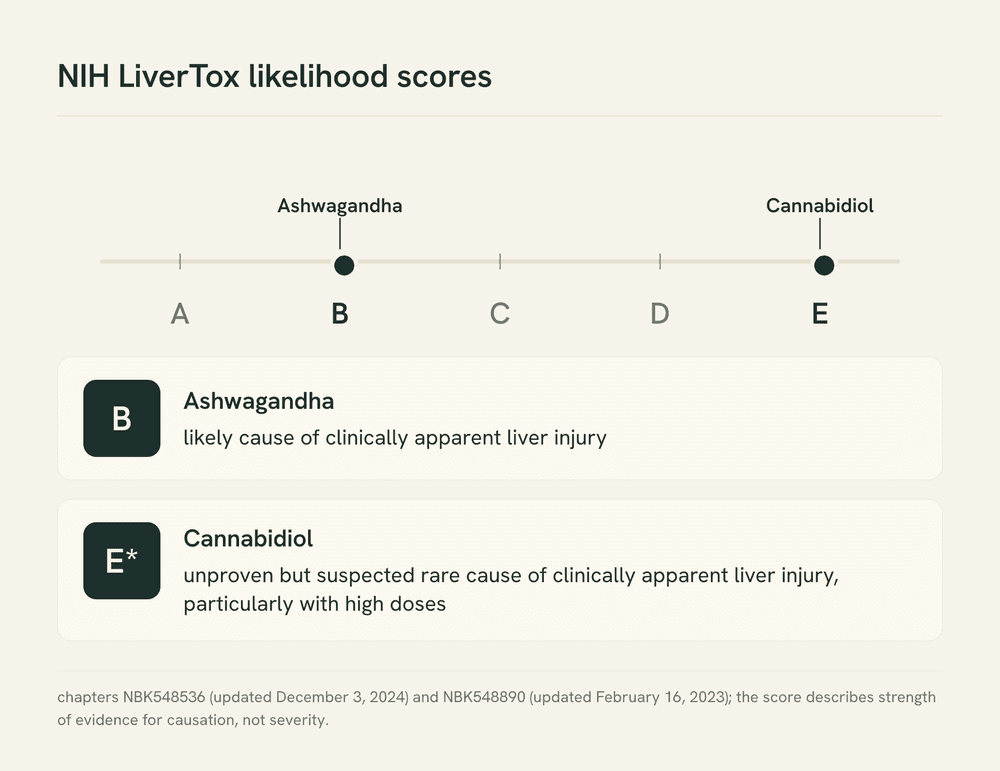
LiverTox is the National Institutes of Health reference work on drug-induced and herb-induced liver injury. Substances that get a chapter also get a likelihood score on a scale running from A to E, and that score describes how strong the published evidence of causation is, not how dangerous a substance is. The LiverTox chapter on ashwagandha, whose header reads "Last Update: December 3, 2024" and which we reread on August 7, 2026, assigns a likelihood score of "B (likely cause of clinically apparent liver injury)". The chapter on cannabidiol, in the same reference work and on the same scale, assigns "E*", which it spells out as an unproven but suspected rare cause of clinically apparent liver injury, particularly with high doses. Two substances, one grading system, two different grades. Neither grade appears on any page-one result.
The chapter gives something more useful than a count: a phenotype. Ashwagandha-associated liver injury typically appears 2 to 12 weeks after starting, follows a cholestatic or mixed pattern, and presents with jaundice and itching. Two peer-reviewed case series describe that same picture from opposite ends of the world. A 2020 series in Liver International pooled five patients, three from Iceland in 2017 and 2018 and two from the US Drug-Induced Liver Injury Network in 2016, mean age 43 with a range of 21 to 62. Jaundice and raised bilirubin lasted 5 to 20 weeks, liver tests returned to normal within one to five months in four of the five, nobody developed hepatic failure, and chemical analysis of the available supplements confirmed ashwagandha with no other toxic compounds identified. The authors also print the caveat that most summaries of them drop: "four were consuming additional supplements, and in one case, rhodiola was a possible causative agent along with ashwagandha."
A 2023 series from three centers in India is harder reading, and the difference between the two matters. Screening 23 patients treated for liver injury attributed to ashwagandha between January 2019 and December 2022, the authors report eight cases in which the person had taken a single-ingredient ashwagandha formulation, so nothing else in the bottle could be blamed. Cholestatic hepatitis was the commonest pattern, and chemical analysis "revealed only natural phytochemicals without adulteration or contamination", which rules out the comfortable explanation that this is really a story about adulterated imports. Five of the eight already had chronic liver disease. Three presented with acute-on-chronic liver failure, and all three died. These are referral hepatology centers, which means the sickest patients are the ones who arrive there, and eight people is eight people. It is a description of what has happened, not a prediction about anybody.
| Source | People | Period | Pattern | What was reported |
|---|---|---|---|---|
| NIH LiverTox monograph, NBK548536, chapter last updated December 3, 2024 | Not a case count | Onset typically 2 to 12 weeks after starting | Cholestatic or mixed, with jaundice and itching | Likelihood score B, likely cause of clinically apparent liver injury |
| Case series, Iceland and the US DILIN, Liver International 2020 (PMID 31991029) | 5 patients, mean age 43, range 21 to 62 | Iceland 2017 to 2018; DILIN 2016 | Cholestatic or mixed; jaundice and raised bilirubin lasting 5 to 20 weeks | No hepatic failure; liver tests normalized in 1 to 5 months in 4 of the 5; four were taking other supplements and rhodiola was a possible cause in one |
| Case series, three Indian centers, Hepatology Communications 2023 (PMID 37756041) | 8 single-ingredient cases, screened from 23 patients | January 2019 to December 2022 | Cholestatic hepatitis commonest; no adulteration or contamination found on analysis | 5 already had chronic liver disease; 3 presented with acute-on-chronic liver failure and all 3 died |
| Systematic review of herb-induced liver injury, 2021 (PMID 34307603) | 936 published cases across 79 herbal products, from 446 references | Literature reviewed to 2021 | Not applicable | Ashwagandha accounted for 9 of the 936 cases; He Shou Wu 91 and green tea 90 |
| NHANES analysis, JAMA Network Open 2024 (PMID 39102266) | 9,685 surveyed adults, of whom 28 reported ashwagandha use | January 2017 to March 2020 | An exposure survey, not an injury report | An estimated 15.6 million US adults had used at least one of six liver-flagged botanicals in the previous 30 days |
Now the paragraph that keeps all of that honest, because none of those numbers is a rate. A 2021 systematic review of herb-induced liver injury worked through 446 references and catalogued 936 published cases across 79 herbal products; ashwagandha accounted for 9 of them, against 91 for He Shou Wu and 90 for green tea. Nine is a numerator with nothing underneath it. For the other side of the fraction, an analysis of NHANES data published in JAMA Network Open in 2024 found 28 ashwagandha users among 9,685 surveyed adults, and estimated that 15.6 million US adults had taken at least one of six liver-flagged botanicals in the previous 30 days, a figure comparable to the 14.8 million taking NSAIDs or the 14.0 million taking simvastatin. Those two numbers cannot be divided into each other: one counts published papers, the other counts survey respondents. Supplement adverse events are not systematically reported to anybody, so the true denominator does not exist. The NIH's plain-language fact sheet compresses the whole situation into one sentence: "Although it is rare, there have been a number of cases that link liver injury to ashwagandha supplements." The same page says ashwagandha "may be safe when taken in the short term (up to 3 months)" and that there is "not enough information" about longer use, and those two halves travel together or not at all.
CBD's own side of the ledger, in one paragraph
CBD is not the innocent half of this pair and this page will not pretend otherwise, but the argument belongs to another article. In short: a randomized, double-blind, placebo-controlled trial run by the FDA's own regulatory-science division gave 201 healthy adults Epidiolex oral solution at 5 mg/kg a day for 28 days and reported liver enzyme elevation above three times the upper limit of normal in 8 participants in the cannabidiol arm, 5.6% of that group, against 0 participants on placebo. That was pharmaceutical CBD, at a weight-based dose, for four weeks, in a healthy group whose median age was 36, and it is not a statement about a hemp tincture in either direction. The full picture, including the mouse study behind the headlines and what the prescription label actually reports, is in our page on whether CBD is bad for your liver.
Ask the other bottle the questions you ask ours
We worked this move out on our page about CBD and melatonin: when you stack two products, you inherit two label problems, and the one you did not buy from a transparent seller is usually the weaker document. Ashwagandha is a botanical extract, which means the words on the front of the bottle are doing a great deal of work. An analysis published in Phytotherapy Research in 2026, from the National Center for Natural Products Research at the University of Mississippi, quantified three steroidal lactones in 25 commercial ashwagandha supplement products by HPLC with photodiode-array detection and compared them against British and US Pharmacopoeia standards. The findings, verbatim: "over 44% of products failed to meet BP standards, and 60% failed to meet USP standards", and "Only 10 of 25 supplement products met both standards; only two were confirmed as root-derived, while the remainder contained varying proportions of (un)disclosed aerial parts." That last clause is the one to sit with. The NIH fact sheet notes that these supplements "typically contain ashwagandha root, leaf, or root/leaf extracts", so which part of the plant is in the capsule is a real variable, and it is frequently unstated on the label.
| Ask the bottle | Why it matters | The same check, on our side |
|---|---|---|
| Which plant part is in it: root only, or root and leaf? | Only 2 of the 25 commercial products analyzed in 2026 were confirmed root-derived; the rest contained varying proportions of undisclosed aerial parts (PMID 41386716) | How to read a CBD label |
| What withanolide percentage does it claim, and measured by which method? | A standardization figure without a method behind it is a marketing number. Products in that study failed partly on a co-elution artifact that made one marker read lower than it was | How to read a COA |
| Is there a certificate of analysis for this batch, matching the lot code on this bottle? | A certificate for a different lot certifies a different bottle. Most ashwagandha products publish none at all | How to read a COA |
| Who ran that test, and are they independent of the seller? | Third-party tested is a claim, not a status. The real questions are who paid for the test and who chose what would be measured | What third-party tested means |
| Does it include a contaminant panel: heavy metals, pesticides, residual solvents? | Botanical contamination is a documented category risk, and the case series that found no adulteration only knew that because somebody ran the chemistry | What third-party tested means |
Every one of those questions has a page behind it on this site, written about our own category, and all five transfer without modification: how to read a CBD label for what a front label does and does not guarantee, how to read a certificate of analysis for what the document should contain and how to match it to a lot, and what third-party tested actually means for the difference between an independent laboratory and a friendly one. If a seller cannot answer the plant-part question, you have already learned something useful, and you learned it in one email.
It is worth saying why this is genuinely hard, rather than implying that every seller is lazy. LiverTox records that Withania somnifera extracts contain more than 100 different chemical constituents, and that the ingredient responsible for the plant's effects and side effects is not known, though withanolides are suspected. Sit with that pair for a moment: withanolides are simultaneously the molecule class a label standardizes on and the class suspected in the injury cases. Characterizing a single extract properly is a project in itself. A 2025 analytical paper needed ultra-high-performance liquid chromatography with photodiode-array, charged-aerosol and high-resolution mass-spectrometry detection running together to semi-quantify and identify more than 60 constituents in one ashwagandha root extract, and two of its authors are employed in the personal-care industry, which the paper declares. For contrast, the one ashwagandha trial cited most often by the pages ranking for this question, a 2012 study of 64 adults over 60 days, used a trademarked extract drawn only from the roots and standardized to at least 5% withanolides by HPLC, supplied by its manufacturer Ixoreal Biomed, and states "Source of Support: Nil Conflict of Interest: None." Both of those sentences are in the paper and both belong in any honest description of it. We are deliberately not reporting what that trial found, because this page makes no claim about what either substance does.
The thyroid line that page one does not print
The same NIH fact sheet quoted above carries a sentence no seller page reproduces. Ashwagandha, it says, "is not recommended for people who are about to have surgery, or for those who have autoimmune or thyroid disorders." The page also lists the categories of medicine it might interact with, and the list is longer than the drowsiness warning that page one offers.
- Medicines for diabetes
- Medicines for high blood pressure
- Medicines that decrease the immune system response (immunosuppressants)
- Sedatives
- Anti-seizure medications (anticonvulsants)
- Thyroid hormone medications
Behind that sentence sits a small, specific literature that should be weighted precisely rather than dramatized. A 2005 Dutch case report describes a 32-year-old woman who developed thyrotoxicosis after increasing her ashwagandha intake, with TSH below 0.01 mU/L and free T4 at 33.9 pmol/L against a normal range of 11 to 22; it resolved by itself after she stopped, and the authors note that the relationship had not been reported in humans before. A 2022 case report in Cureus describes a 73-year-old woman who developed supraventricular tachycardia with hyperthyroid symptoms and a low TSH after two years of self-administered ashwagandha root extract, and who fully recovered after stopping. That is two people, seventeen years apart. Case reports establish that something has happened; they do not establish how often it happens, and they cannot be turned into a probability for you.
The harder piece of evidence is a trial. In a double-blind, placebo-controlled study of 50 adults with subclinical hypothyroidism at a single center in Varanasi, participants took 600 mg a day of root extract or a starch placebo for eight weeks, and TSH, T3 and T4 all moved significantly compared with placebo. We are citing that trial for exactly one purpose and no other: it demonstrates that the herb is not inert with respect to thyroid laboratory values. It was small, single-center, eight weeks long and conducted in a patient population, and it says nothing about what would happen to anyone else. A 2026 narrative safety review arrives at the same practical destination from the literature as a whole, concluding that ashwagandha "poses significant risks to specific populations, such as pregnant women, patients with thyroid disorders, and individuals with liver or kidney dysfunction" and recommending stronger label warnings. That is a review's recommendation and not a regulation; no US agency has acted on it. Taken together, this is enough to retire the idea that a plant cannot interact with anything, and nowhere near enough to predict anything about one reader.
"Different pathways, so they complement each other" is not a finding
The pathway sentence is the most confident line on page one, and nothing behind it was measured in a person. What has been measured is enzyme activity in glassware, and those experiments do not agree with each other. A 2022 paper in Frontiers in Pharmacology reported that, in vitro in human liver microsomes, an aqueous ashwagandha extract had no inhibitory effect on CYP3A4, CYP2C8 or CYP2D6, either alone or alongside remdesivir, while the same assay did detect moderate inhibition by remdesivir itself, which is how you know the assay was working; its authors write that ashwagandha "seems to be safe" to co-administer with substrates of those three enzymes and that "preclinical and clinical PK studies would be helpful." A 2025 study in Drug Metabolism and Disposition went wider, running four ashwagandha root and leaf extracts through a seven-enzyme inhibition panel built on the cytochromes the FDA asks about, and reported no reversible inhibition of any of them at extract concentrations up to 100 micrograms per milliliter. So far, so quiet. Then a 2025 study in the Journal of Dietary Supplements asked a different question, using primary human hepatocytes instead of microsomes and looking for enzyme induction instead of inhibition, and reported that a 70% ethanol root extract modulated CYP3A4 expression and activity, while a high concentration of the 70% ethanol leaf extract reduced hepatocyte viability in a dose- and time-dependent way.
Every one of those is a test tube or a dish. None of them is a person, none of them had cannabidiol anywhere in it, and the extracts differ from each other in solvent and in plant part, which is the same variable the label section above turns on. Read together they cut in every direction except the confident one, which is the useful part. They do not support the version that circulates in AI summaries, where the two substances supposedly compete for one liver enzyme, because the inhibition panels found nothing to compete over. They do not support the seller version either, because an enzyme assay is not a statement about two substances inside a person, and "complement" is a claim about an outcome nobody has measured in anyone. And the one place where something did move, an ethanolic extract of one plant part in a dish of liver cells, is a reason to ask what is actually in the capsule rather than a reason to relax about it. The general framework for cytochrome enzymes and cannabidiol lives in our page on CBD and other medications, which is why this page reports only what has been measured about ashwagandha and stops there. The one mechanism-free point page one does make, and under-explains, is additive drowsiness: the NIH fact sheet lists sedatives among ashwagandha's possible interactions and drowsiness among its adverse effects, and drowsiness is on our own list of CBD side effects. The general argument about stacking two sedating things is worked through on our page about CBD and alcohol.
CBD and magnesium: a different animal, and a different question
The other stack people ask about is CBD and magnesium, and it needs its own treatment because almost nothing above transfers. Magnesium is a mineral, not a botanical extract. There is no withanolide question, no plant-part question and no LiverTox chapter with a likelihood score in it. What changes from product to product is the salt, and the salt is the whole story. An over-the-counter magnesium citrate oral solution label on DailyMed lists 1.745 g of magnesium citrate per fluid ounce, gives its purpose as "Saline laxative", and states that it "generally produces bowel movement in 1/2 to 6 hours". The same salt appears in evening stacks sold alongside CBD. The gastrointestinal side of that overlap belongs to our page on whether CBD causes diarrhea.
- The salt can be a drug in its own right. One magnesium citrate oral solution is labeled a saline laxative expected to produce a bowel movement in half an hour to six hours.
- The spacing rule that actually exists runs the other way. That same label instructs: "Take this product 2 or more hours before or after other drugs."
- The documented magnesium interaction is with certain medicines, not with cannabidiol. Nothing in the 14 records that search returns measures magnesium against CBD absorption in a person.
That inversion is worth carrying around, because it is the mirror image of the advice on page one. Several pages tell you to take magnesium about two hours apart from your CBD oil because magnesium may affect CBD absorption, which is asserted and uncited. A spacing rule does exist on real labels, and it is about drugs: a ciprofloxacin label, which we reread on August 7, 2026, records that magnesium and aluminum antacids decrease the antibiotic's absorption and produce lower serum and urine levels, and instructs prescribers to "Administer ciprofloxacin at least 2 hours before or 6 hours after magnesium/aluminum antacids". That is specific to a class of drugs sensitive to multivalent cations. It is not a general claim that magnesium blocks everything, and it is not about CBD. The antibiotic side of this is covered on our page about CBD and antibiotics.
And the data situation is the same one as before. On August 7, 2026 the PubMed query for cannabidiol and magnesium in the title or abstract returned 14 records, and the only interventional study among them is a 40-person pilot lasting three and a half days of a beverage powder containing cannabidiol, CBG, beta-caryophyllene, branched-chain amino acids and magnesium citrate together, given for muscle soreness. A five-ingredient formulation cannot isolate a cannabidiol and magnesium effect, and it was never designed to. Its disclosure states that authors were employed by Canopy Growth Corporation and received stock options during employment, and that one is currently an employee of Charlotte's Web. The single adverse event reported in the active arm was diarrhea.
What to actually do with all of this
There is no protocol at the end of this page, because a protocol would imply a body of evidence that does not exist. What there is instead is a conversation, and it is a better use of ten minutes than any timing chart on page one. Have it with a pharmacist or with the prescriber who already holds your medication list. You do not need an appointment to ask a pharmacist a question, and interactions are literally their subject. Bring the following.
- 1Both actual containers, or clear photographs of the front and of the supplement facts panel of each. The extract name, the strength and the plant part live on the panel, not in your memory.
- 2The plant part and the standardization claimed by the ashwagandha product: root only or root and leaf, what withanolide percentage it claims, and by which method.
- 3Every prescription and over-the-counter medicine you take, including the ones you think are too minor to mention, and every other supplement in the cupboard.
- 4Any liver or thyroid condition, any autoimmune condition, any pregnancy, and any surgery scheduled in the next few weeks. The NIH fact sheet names all of these.
- 5How long you have already been taking each one. The published ashwagandha liver cases cluster in the first 2 to 12 weeks, so where you sit on that timeline is information a clinician will want.
If you take several prescriptions, that conversation matters more rather than less, and the reason is arithmetic rather than age: every additional substance adds a pair of unknowns, and supplements are the ones people forget to mention. Our page on CBD for seniors covers why polypharmacy plus supplements is the profile where those unknowns stack fastest.
Who is telling you this
You should know where this page comes from before you weigh it. Planntz sells CBD tinctures, in 60 mL bottles, with a per-batch third-party certificate of analysis published for every flavor. We do not sell ashwagandha. We do not sell magnesium. We do not sell a combination product of any kind, and several of the companies ranking above this page for this exact search do sell CBD-with-ashwagandha products. That is a reason to check our reasoning rather than to trust us, which is why every number above is attached to a source you can open in one click and read for yourself. And to be precise about what we are and are not saying: we are not telling anyone not to take ashwagandha, we are not telling anyone that it is fine, and we cannot tell you what happens when it is taken with CBD, because nobody has measured it. The document that would settle that question has not been written. The document that does exist is the certificate of analysis for whatever is already in your cupboard, and it is worth asking whoever sold it to you for a copy.
The honest answer is that nobody has published a study of a person taking both. A PubMed search on August 7, 2026 for cannabidiol together with ashwagandha or Withania somnifera returns 11 records, and not one of them is a trial of the combination; filtered to clinical trials it returns zero. That is not the same as saying the combination is safe, and it is not the same as saying it is dangerous. Anyone who answers with either of those words is filling the gap with a guess. The useful move is to tell a pharmacist or your prescriber exactly what you take, supplements included.
There is no documented human interaction, because the pair has not been studied in people. Two things are documented separately. The NIH fact sheet on ashwagandha lists sedatives among the medicine categories it might interact with, and drowsiness is a recognized effect of both substances, which is the additive-sedation question. And the in vitro work on ashwagandha and the drug-metabolizing enzymes does not agree with itself: inhibition panels in human liver microsomes and in recombinant enzymes found none, while a 2025 study in primary human hepatocytes reported that an ethanolic root extract modulated CYP3A4 expression and activity. Those are dishes and test tubes, run without any cannabidiol present, and none of them is clearance for a person.
The NIH's LiverTox reference work grades it B, a likely cause of clinically apparent liver injury, based on published cases. The pattern it describes is specific: injury usually appears 2 to 12 weeks after starting, is cholestatic or mixed, and presents with jaundice and itching. The published series are small. Five patients from Iceland and the US injury network, among whom liver tests normalized within one to five months in four of the five and nobody developed hepatic failure. Eight single-ingredient cases from three Indian centers, among whom five already had chronic liver disease and the three who presented with acute-on-chronic liver failure died. These are case reports and registry cases. They establish that the injury happens; they do not tell you how often, because supplement adverse events are not systematically reported and the denominator is unknown.
Drowsiness is listed for each substance on its own, and the NIH fact sheet names sedatives among ashwagandha's possible interactions, so additive sedation is the most plausible thing to expect. Nobody has measured the combination, so there is no number for how much more, and any page that gives you one has invented it. Our page on CBD side effects covers what the adverse-effect picture looks like for the half of this pair that we do sell.
The data answer is the same one: on August 7, 2026 the PubMed search for cannabidiol and magnesium in the title or abstract returned 14 records, and the only interventional study among them is a small pilot of a five-ingredient beverage powder, which cannot isolate anything. Two label facts are worth knowing anyway. Some magnesium salts, such as magnesium citrate oral solution, are sold as saline laxatives and are labeled to produce a bowel movement within half an hour to six hours. And magnesium-containing antacids decrease the absorption of some oral antibiotics, which is why a ciprofloxacin label instructs that the antibiotic be given at least 2 hours before or 6 hours after them. The interaction magnesium demonstrably has is with certain medicines, not with CBD.
Ask it the questions you should ask any supplement. Which plant part is in it, root only or root and leaf. What withanolide percentage it claims, and measured by which method. Whether there is a certificate of analysis for the specific batch on the bottle, from a laboratory independent of the seller, and whether it includes a contaminant panel for heavy metals, pesticides and residual solvents. In a 2026 analysis of 25 commercial ashwagandha products against pharmacopoeia standards, only 10 met both the British and the US standards, and only two were confirmed as root-derived; the rest contained varying proportions of undisclosed aerial parts. If the seller cannot answer the plant-part question at all, you have learned something.
Writing about hemp, wellness and the small rituals that keep us balanced.