Is There a Breathalyzer for Weed? What the Studies Show
Weed breathalyzers exist, and some are sold to employers. None measures how high you are, and a federal lab found one reading often could not tell before from after. Why THC is so hard to breath-test, what the studies found, and where the law stands.
Is there a breathalyzer for weed? Yes, in a sense. Weed breathalyzers, devices that collect breath for THC testing, exist; police agencies have piloted some, and companies market them to employers. But none of them measures how high you are, and when the federal lab that studies these devices ran a pilot in 2023, a single breath reading often could not tell a sample taken before smoking from one taken after. Here is why THC is so much harder to breath-test than alcohol, what the controlled studies since 2013 actually found, and where the law stands as of October 4, 2026.
The short answer. A cannabis breath test can show that THC is in your breath. It cannot show how impaired you are, and it often cannot show when you last used. Alcohol breathalyzers work because you exhale a lot of ethanol, and breath limits were set from blood limits using an assumed ratio. THC comes out in trace amounts, regular users can carry some in their breath after a day without using, and no study has tied a breath THC level to impairment.
Is there a breathalyzer for weed? What actually exists
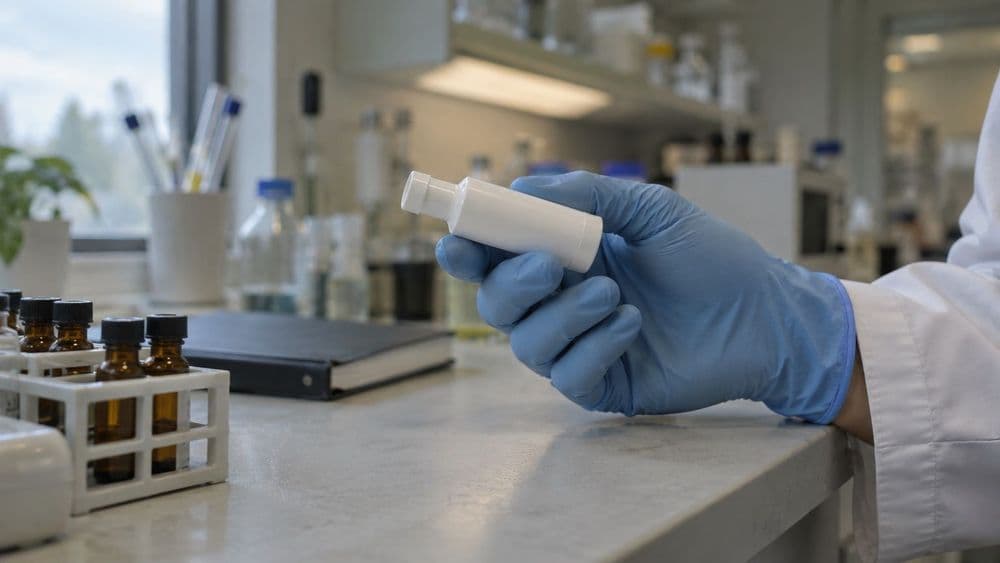
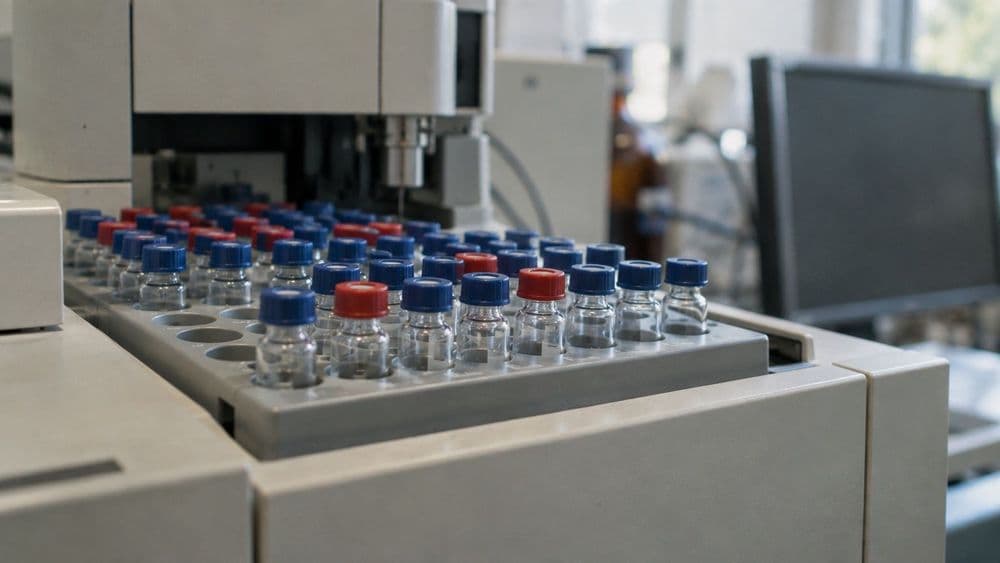
In the published research, a "weed breathalyzer" is really two pieces. The first is a handheld collector you breathe into, which traps what you exhale on a filter or pad. The second is a laboratory instrument, usually a mass spectrometer, that later measures how much THC landed on that filter. None of the systems used in the controlled human studies shows a number on the spot the way an alcohol breathalyzer does. Two companies appear in the paper trail. Hound Labs funded the 2019 UCSF study described below, and its device collected that study's breath samples. Cannabix Technologies co-funded a 2026 lab method paper with Omega Laboratories. We name them because the research names them; we have not evaluated and do not recommend any device.
The federal lab that studies these devices is blunt about where things stand. In an August 2024 announcement, the National Institute of Standards and Technology (NIST) wrote: "Several breath tests are currently being piloted by law enforcement agencies across the country, but there is still no scientific consensus on whether they work." Many of the articles that rank first for this question still lean on 2019 headlines about a "breakthrough" sensor. That University of Pittsburgh paper on a carbon-nanotube sensor is sensor engineering: the device was tested on THC bubbled from a lab standard and on exhaled smoke caught in steel wool, with machine learning to separate signals. It was not tested on people before and after controlled use. And the ordinary alcohol breathalyzer an officer carries measures ethanol; it is not built to detect THC.
Why alcohol is easy to breath-test and THC is not
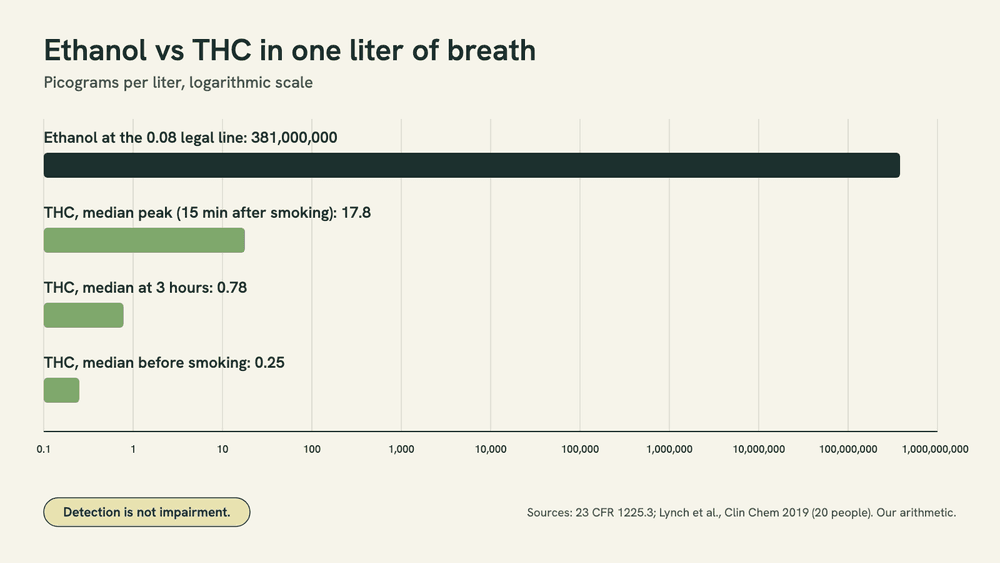
Alcohol is volatile. After a drink, ethanol moves from your blood into the air in your lungs and leaves as a gas, in quantity, with every breath. The law is written around that: federal rules define alcohol concentration as "grams of alcohol per 100 milliliters of blood or grams of alcohol per 210 liters of breath", so a 0.08 breath reading means 0.08 grams of alcohol in 210 liters of breath. THC is a large, oily molecule with a very low vapor pressure, and only traces of it leave in breath. NIST chemical engineer Tara Lovestead, quoted by CU Boulder in 2023, put the gap this way: "NIST research has shown that individuals exhale 1 million times more ethanol with a single breath than cannabis users exhale of THC in 12 breaths."
Here is how we got the third number, so you can check it. The legal alcohol line is 0.08 grams per 210 liters, which is 0.000381 grams, or 0.381 milligrams, of ethanol per liter of breath. One milligram is a billion picograms, so that is 381,000,000 picograms per liter. The 2019 UCSF study measured a median peak of 17.8 picograms of THC per liter of breath. Divide one by the other and you get roughly 21 million. Three hours after smoking, the same study's median was 0.78 picograms per liter, a gap of about 490 million. This is our arithmetic, combining a regulatory unit with one study's median measured on one device; other studies report THC per device rather than per liter, so the numbers are not directly comparable. NIST's "1 million times" is the conservative version of the same story. None of these numbers says anything about impairment. Alcohol breath testing, by contrast, is old science: our piece on CBD and alcohol describes 1979 studies that already relied on breathalyzer readings.
Scientists are still settling how THC travels in breath at all. NIST's 2023 pilot described THC as "hypothesized to be carried in breath by aerosol particles", tiny droplets formed from the fluid lining the lungs. But NIST's 2026 vapor-pressure measurements, a lab study with no human subjects, predicted that THC, CBD and CBN "reside primarily in the vapor phase of exhaled breath", and that "relatively small changes in temperature or aerosol concentration can significantly impact" that balance. If that holds up, collectors designed to catch droplets may miss part of the THC, one candidate explanation for why breath numbers vary so much. Getting THC off the filter is a second problem: a separate 2026 NIST method study, run on spiked filters rather than people, found that "the recovery of cannabinoids remained relatively low" and depended on details as small as the vial material.
Even the alcohol breathalyzer is a calibrated estimate, not a direct readout of blood. A 2025 review of breath alcohol testing explains that statutory breath limits were derived by dividing blood limits by an assumed blood-to-breath ratio (2000:1, 2100:1, 2300:1 or 2400:1, depending on the country), and that the real ratio varies between people by about 8% to 12%. The NIST pilot authors described the alcohol work as roughly a century in the making. THC breath testing has nothing comparable yet, as the table below shows.
| Alcohol breathalyzer | THC breath test | What it means for you | |
|---|---|---|---|
| What is exhaled | Ethanol gas, in quantity | Trace THC; whether it travels as vapor or droplets is still debated (NIST 2023 vs NIST 2026) | Much harder to capture and measure |
| How much | 0.381 mg per liter at the 0.08 line | About 17.8 pg per liter at the median peak (UCSF 2019) | Roughly a 21 million-fold gap |
| Where it is measured | In the device, on the spot | In the published studies, collected on a filter and measured later on a lab mass spectrometer | No instant reading in the research systems |
| What the number tracks | Blood alcohol, through an assumed blood-to-breath ratio | Exposure, imperfectly; regular users can test positive before they use | A positive is not a time stamp |
| Validated impairment threshold | Yes: per se limits in state law (0.08 in most states) | No (NHTSA 2024 report to Congress; Wurz 2022) | No breath number means too high to drive, or safe to drive |
| Legal status (October 4, 2026) | Used as evidence in every state | We found no state that accepts it as evidence of impairment | Roadside drug laws use saliva or blood |
What the human studies found, 2013 to 2026
The first careful look came from the National Institute on Drug Abuse. In a 2013 NIDA study of 24 people who each smoked one 6.8% THC cigarette, 13 chronic and 11 occasional smokers, every chronic smoker had detectable breath THC at 0.89 hours, 53.8% still did at 2.38 hours, and one tested positive at 4.2 hours. One occasional smoker never tested positive. The authors described the method's "short detection window (0.5-2 h)". One co-author part-owned the company that made the sampling device. That window was a property of the assay, not of the body: later, more sensitive methods found THC in breath before anyone smoked. And none of these times says when a person is fit to drive. Detection is not impairment.
Six years later, a 2019 UCSF study of 20 people who smoked their own cannabis, 9 of them chronic users, found that breath THC peaked about 15 minutes after smoking (median 17.8 picograms per liter, range 2.8 to 222.6) and fell to under 5% of that peak by three hours. In 17 of the 20, the fall in breath THC tracked the fall in blood THC (correlation 0.76 to 0.99). The same study found THC in every participant's breath at baseline, after a self-reported 24 hours without cannabis. Its disclosures list "Research Funding: Hound Labs, Inc. to institution", and breath was collected with a Hound Labs device. A falling curve on a chart is a measurement, not a countdown to sober driving: the study did not measure impairment.
| Study | People | How cannabis was taken | What breath showed | Main limit | Funding or interest disclosed |
|---|---|---|---|---|---|
| Himes et al., 2013 (NIDA) | 24 (13 chronic, 11 occasional) | One 6.8% THC cigarette | THC detectable for roughly 0.5-2 h with that assay; one chronic smoker positive at 4.2 h | One cigarette; less sensitive than later methods | A co-author part-owned the maker of the sampling device |
| Lynch et al., 2019 (UCSF) | 20 (9 chronic) | Smoked own cannabis | THC in all 20 at baseline; peak at 15 min; under 5% of peak by 3 h | Smoked only; abstinence self-reported | Hound Labs funding to the institution; Hound Labs collection device |
| Wurz and DeGregorio, 2022 | 30 to 44, depending on the analysis | Inhaled | Baseline breath THC rose with blood THC in people who were not impaired | Small groups | Authors founded RCU Labs and hold pending patents on a competing method |
| Jeerage et al., 2023 (NIST pilot) | 18 (14 with before-and-after samples) | Legal-market flower, used at home | 8 of 14 rose 1 h after use; the rest were undetected or no higher than baseline | Pilot; abstinence unverified; dose not controlled | Federal lab and university study |
| Melén et al., 2024 | 23 cannabis-naive patients | Prescription THC/CBD mouth spray | THC and CBD in breath in all 23, detectable longer than in blood | Spray deposits drug in the mouth | Not listed in the abstract |
| Berry et al., 2025 (NIST) | 29 | Own dispensary edible, 5-100 mg THC per label | THC before eating in 27 of 29; rose after eating in 19 | Proof of concept; doses and abstinence unverified | Federal lab and university study |
| Deeb et al., 2026 | 3 daily smokers | Smoked | Lab method measured four cannabinoids down to 2.5 pg/L; THC trend resembled blood | Three people; delta-8/delta-9 separation questioned | Funded by Omega Laboratories and Cannabix; 2 of 5 authors at Cannabix; conflicts declared: none |
Read down the table and one pattern stands out. The "detection window" kept moving with the chemistry. The 2013 method lost THC within a couple of hours. The more sensitive methods that followed found it in regular users before they had used at all. Breath testing did not get worse; it got sensitive enough to show that the question "is there THC in this breath?" is not the same as "did this person just use cannabis?"
The baseline problem: one reading cannot date your last use
NIST's 2023 pilot with CU Boulder put this to a real-world test. Eighteen participants gave 42 breath samples, using legal-market flower (about 25% THCA) at home, with a sample an hour after use. THC was quantified in 31% of the baseline samples taken at the intake visit, 36% of the baseline samples taken on the day of use, and 80% of the samples taken an hour after use. Of the 14 people who gave both a before and an after sample that day, 8 showed the expected rise. In three, THC was not detected after use at all, and the remaining samples were similar to or lower than baseline. You may have seen "8 of 18" in press coverage; the paper's denominator is 14. It was a pilot: participants were asked to abstain beforehand but this was not verified, the dose was not controlled, and one device was used.
“Our results do not support the idea that detecting THC in breath as a single measurement could reliably indicate recent cannabis use.”
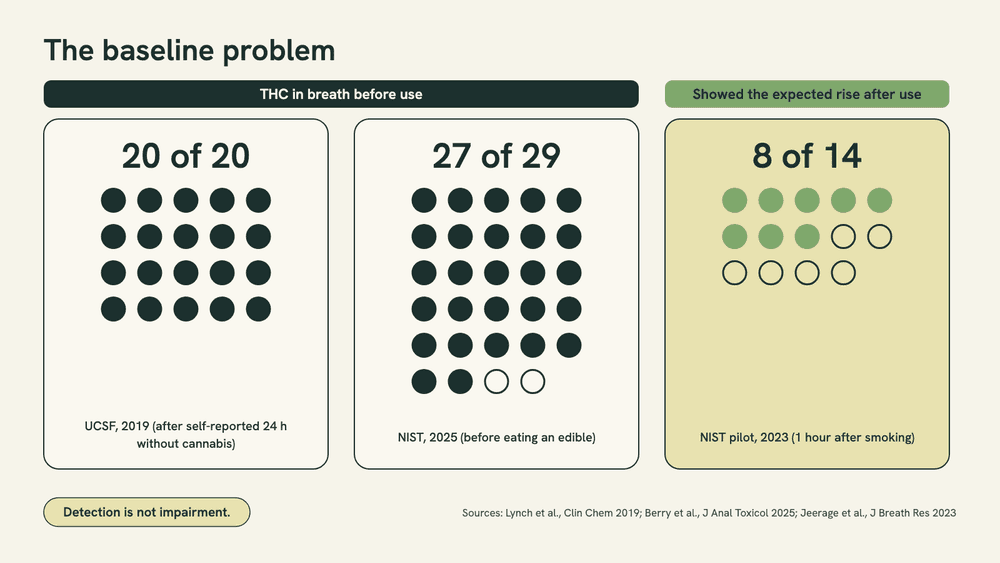
If a regular user can blow a positive with no recent use, as nearly all participants in the UCSF and 2025 NIST studies did, a single positive cannot tell an officer or an employer whether use happened an hour ago or the day before. NIST's response is a different design: two breath samples taken a set time apart, on the theory that breath THC falls steeply in the hours after recent use and would not show the same decline in someone who used days earlier. The August 2024 announcement describes a study of about 45 participants aged 25 to 50 under a $1.5 million interagency agreement, and CU Boulder's December 2024 update describes it as work in progress. As Cinnamon Bidwell, a CU Boulder associate professor of psychology and neuroscience, put it in that update: "Scientifically, we just aren't there yet." We found no published results as of October 4, 2026. It is a plan under test, not a finding.
Detection is not impairment
Even a perfect breath test for recent use would leave the harder question open: is this person impaired right now? A 2022 study in Scientific Reports found blood THC above 5 ng/mL in 16 of 30 participants after 12 hours without cannabis, "in the absence of any impairment", and found that baseline breath THC rose with blood THC in the same unimpaired people. The authors concluded that "single measurements of Δ9-THC in blood, and now in exhaled breath, do not correlate with impairment following inhalation". Its authors founded RCU Labs and hold pending patents on a competing test method. In a 191-person randomized, placebo-controlled trial, the best marker of use within the past three hours was an oral-fluid cutoff, and the authors wrote that this "does not equate to impairment. Behavioral assessment of impairment is still required" to establish driving under the influence. In its April 2024 Report on Marijuana Research to Congress (DOT HS 813 570), NHTSA reaffirmed the "lack of correspondence between THC levels in biosamples and objective impairment" as "still relevant and correct". Blood and saliva limits, per se statutes and the driving trials are covered in our guide to CBD, THC and driving, and how long the effects themselves last is a separate question we cover in how long a weed high lasts.
This is an active argument in the journals, not a settled matter. A 2026 method paper in the Journal of Analytical Toxicology validated a lab test that measures delta-9 THC, delta-8 THC, CBD and CBN in breath down to 2.5 picograms per liter, tested it in three daily smokers, and described it as "suitable for use in workplace drug testing and in the investigation of" drugged-driving cases. It was funded by Omega Laboratories and Cannabix Technologies, two of its five authors work at Cannabix, and it lists "Conflicts of interest: None declared." In a published reply, a forensic consultant argued that the paper "discusses potential impairment-related applications despite the absence of direct measures of impairment", that "THC concentrations in biological matrices cannot be used as a reliable indicator of impairment", and that its separation of delta-8 from delta-9 THC (a resolution of about 0.9) fell short of the 1.5 usually needed. The critic discloses paid expert testimony and consulting through ARO Consulting. Both sides carry disclosed commercial interests; neither disclosure implies misconduct.
Can a breathalyzer detect edibles?
The usual story is that breath THC means you smoked or vaped recently. Edibles complicate it. In a 2025 NIST proof-of-concept study, 29 participants ate their own dispensary edible (5 to 100 mg THC per the label, which researchers did not verify), with breath samples before eating and at 47, 92 and 180 minutes. Breath THC peaked after eating in 19 of the 29. But 27 of the 29 had THC in their breath before they ate, 6 had their highest reading before the edible, and 4 showed no significant change. Researchers also found other cannabinoids: CBD in 11 people, CBN in 17 and CBG in 12. The study ran no statistics, asked for but did not verify abstinence (12 hours from edibles, 8 from inhaled cannabis), used two devices and measured no impairment. A 2026 correction to the paper fixed the first author's name and nothing else. The minutes in this paragraph describe detection only, not when anyone was or was not fit to drive.
Why would swallowed THC show up in breath at all? The oral route is slow and runs through the liver, which is why edibles take so long to kick in and why they produce more of the metabolite 11-hydroxy-THC. Mouth contact may also play a part. A 2024 Swedish study of 23 cannabis-naive patients given a single dose of a prescription THC/CBD mouth spray (2.7 to 18.9 mg THC, 2.5 to 17.5 mg CBD) found that "Δ9-THC and CBD were present in plasma, OF, and exhaled breath in all 23 patients", and that both were detectable longer in breath and saliva than in blood. A spray deposits drug directly in the mouth, so some of that breath signal may come from the mouth rather than the lungs. Three things follow:
- Breath THC is not proof of smoking: in the 2025 study, most people who ate an edible showed a rise in breath THC.
- It is not proof of recent use either: most of those same people had THC in their breath before they ate.
- Products held in the mouth, like sprays, may leave cannabinoids in breath longer than they stay in blood. That is detection, not impairment.
Can a breathalyzer detect CBD?
Breath can carry CBD; that much is documented. In a 2020 French case report, CBD was detected in one man's breath for about 45 minutes after a single 22 mg capsule bought at a US grocery store, peaking at 302 picograms per filter at 30 minutes. That is one person, and it tells you breath can carry CBD, not what any commercial test would report, and not anything about impairment. The larger studies point the same way: CBD appeared in breath in all 23 patients in the mouth-spray study, in 11 of 29 people in the 2025 edibles study, and in 3 sample extracts in NIST's 2023 pilot (CBN in 5).
What has not been studied is the question you probably care about: whether a THC-focused breath device would flag someone who uses a hemp CBD product. We found no study that tested it. Full-spectrum hemp products can contain trace THC, and that trace THC is the variable that matters. No CBD product can guarantee a test result, on breath or anywhere else. For the much more common urine tests and how cutoffs work, see our guide to CBD and drug tests.
Where the law stands (checked October 4, 2026)
As of October 4, 2026, we found no US state statute or regulation that authorizes a THC breath test as evidence of impairment or of a per se violation. We searched the federal record (NHTSA's April 2024 report to Congress and NIST's 2024 announcement) and state legislative records for THC breath-test laws, and found only oral-fluid (saliva) laws and bills. That is the result of our search, not a guarantee, and state law changes. At the federal level, NHTSA told Congress in April 2024 that it funds small-business research projects on oral fluid and breath analysis, and that "if the SBIR projects succeed, they will offer non-invasive methods to quantify a driver's THC at the roadside." Even newer roadside proposals use saliva: New York's pending bill A5271 "implements oral fluid tests which tests a person's saliva for the presence of cannabis", and it was in committee as of its last action on January 7, 2026. Roadside drug cases still rely on what an officer observes, which is why questions like whether the smell of weed is probable cause matter more today than any breath device. Whether you must submit to a roadside test, and what refusing means, is set by state law; a local lawyer can tell you how it works where you live.
Workplace testing is a separate world. NHTSA's report notes its impaired-driving research "is discrete from workplace drug testing", and the 2026 method paper pitches its test for both workplace testing and drugged-driving investigations. An employer's testing policy is governed by employment rules and contracts, not by DUI law, so the stakes and protections differ; see whether you can be fired for failing a drug test and how a 10-panel drug test works. For the federal and state legal frame for hemp and CBD products, start with our hub on whether CBD is legal.
How to read the next weed breathalyzer headline
New devices and press releases appear every year. These eight questions, drawn from the limits of the studies above, will tell you quickly how much a headline actually shows:
- 1Does the device measure THC on the spot, or only collect a sample for a lab?
- 2Was it tested on people, or on THC generated in a lab? If people, how many?
- 3Was the dose controlled, and was abstinence beforehand verified or only requested?
- 4Did the researchers measure a baseline in regular users before they used?
- 5Does the claim rest on one sample, or on two taken a set time apart?
- 6Was cannabis smoked, vaped, eaten or held in the mouth? Results differ by route.
- 7Who paid for the work, and do any authors work for or own the device maker?
- 8Does it claim to detect impairment? If so, how was impairment measured?
What nobody knows yet. There is no validated breath THC level for impairment, and no study we found suggests one is close. The two-sample approach has no published results. Edible data come from one proof-of-concept study with unverified doses. No one has tested whether THC-focused breath devices flag people who use hemp CBD products. And the basic physics, whether THC leaves the lungs mostly as vapor or as droplets, is still being worked out. Any device sold today sits on top of those open questions.
Frequently asked questions
Devices that collect breath for THC analysis exist, have been piloted by some law enforcement agencies and are marketed for workplace testing. In the published research they collect a sample that a lab measures later. None has a validated impairment threshold, and as of October 4, 2026 we found no state that accepts a THC breath test as evidence of impairment.
No. A standard alcohol breathalyzer measures ethanol. THC needs a different collection device and, in the published studies, lab analysis on a mass spectrometer. Drugged-driving cases today rest on officer observation, drug recognition evaluations and saliva or blood tests, which our CBD and driving guide covers in detail.
It depends on the test. With a 2013 method, THC was detectable for roughly half an hour to two hours after one cigarette, with one chronic smoker positive at 4.2 hours. With newer, more sensitive methods, regular users often have THC in their breath with no recent use: all 20 people in a 2019 study after a self-reported 24 hours without cannabis, and 27 of 29 in a 2025 study. None of these figures is a driving window. Detection is not impairment, in either direction.
In a 2025 NIST proof-of-concept study, breath THC rose after eating an edible in 19 of 29 people, peaking at 47, 92 or 180 minutes. But 27 of the 29 already had THC in their breath before eating, and 6 peaked before the edible. Doses were not verified and impairment was not measured, so these times describe detection only.
CBD has been measured in breath: in one man for about 45 minutes after a 22 mg capsule, in all 23 patients given a prescription THC/CBD mouth spray, and in 11 of 29 people after edibles. Lab methods can quantify it. Whether a THC-focused device would flag someone using a hemp CBD product has not been studied. Full-spectrum products contain trace THC, and no product can guarantee a test result.
At measuring tiny amounts, lab methods are sensitive: one 2026 method quantifies THC down to 2.5 picograms per liter. At telling recent use from older use, accuracy is unproven: in NIST's 2023 pilot, only 8 of 14 people showed the expected rise after smoking. At measuring impairment, no breath test has been validated, according to NHTSA's 2024 report to Congress and the studies above.
Hound Labs is a company that developed a breath collection device for THC. It funded the 2019 UCSF breath study, whose samples were collected on its device, and the paper discloses that funding. We have not evaluated and do not recommend any breath-testing device, and we do not repeat vendor accuracy claims.
Where to go next. Breath testing is one piece of the roadside picture. For how per se THC laws work in each kind of state, why a blood THC number is a weak proxy for impairment, and how roadside testing differs from workplace testing, read our guide to CBD, THC and driving.
Writing about hemp, wellness and the small rituals that keep us balanced.