Is CBD Bad for Your Liver? What the Trials Actually Measured
Headlines about CBD liver damage come from a mouse study; the clinical signal comes from three human sources measured at four very different doses. This page separates them, prints the label's real numbers, and converts every trial dose into drops of a 250 mg/mL bottle.
Search for CBD liver damage and you get two answers that cannot both be right: a 2019 headline about mice with injured livers, and a reassurance that it only ever happened to epilepsy patients who were also taking a second drug. Both are built on real documents. Neither one survives what the FDA published in July 2025. Here is what has actually been measured, in whom, at what dose, and what those doses look like next to a bottle you could hold.
The short answer first. Cannabidiol has been shown, in randomized human trials, to raise liver enzymes in some people. The FDA's own regulatory-science division ran a double-blind, placebo-controlled trial in 201 healthy adults at 5 mg/kg a day for 28 days and reported ALT or AST above three times the upper limit of normal in 8 participants in the CBD arm of 151, against none of the 50 people on placebo. For a 70 kg adult, 5 mg/kg a day is about 350 mg a day. Nobody had a serious adverse event and nobody felt it happening: the signal was found on weekly blood tests. What that trial cannot tell you is what a hemp tincture does, because the study drug was pharmaceutical CBD oral solution, not an oil sold as a supplement. This page separates the four bodies of evidence and prints the numbers each one actually produced.
CBD liver damage: the question hides four sets of experiments
Four separate bodies of evidence sit behind that phrase, and they were run at doses that differ by a factor of forty. Blending them is how the internet manufactures both the scare and the reassurance from the same raw material. Read separately, they say something more useful, and more uncomfortable, than either version.
The unit is the thing to hold on to. Epidiolex, the prescription cannabidiol solution, is dosed by body weight in milligrams per kilogram per day. Consumer oils are sold in milligrams per bottle. Mouse studies are published in milligrams per kilogram of mouse. Those are three different units, and a number quoted without its unit and its species is not information. Section five converts all of them into drops of one real bottle so the ladder is visible at a glance. If you want the plain chemistry first, our hub on what cannabidiol actually is covers it, and the wider side-effect picture covers everything the liver is not.
- 1Mouse toxicology, 2019. A cannabidiol-rich cannabis extract given by gavage to 8-week-old male B6C3F1 mice, six animals per group, for at most ten days. This is where the headlines came from.
- 2The Epidiolex clinical programme. Children and adults with severe epilepsy syndromes taking 10 to 25 mg/kg/day of prescription CBD, most of them on other antiseizure drugs. The results are printed in the FDA-approved label.
- 3Phase I in healthy adults, 2021. Sixteen volunteers on 1,500 mg a day of pharmaceutical CBD for about three and a half weeks. No epilepsy, no valproate, no other medication.
- 4The FDA's own randomized trial, 2025. Two hundred and one healthy adults at 5 mg/kg/day for 28 days, double-blind and placebo-controlled. The newest evidence here, and the lowest daily dose of the four.
The mouse study behind the headlines, read at the dose level
The 2019 headline wave traces to a single paper: a mouse study published in Molecules by a team at the University of Arkansas for Medical Sciences. It matters what was in the gavage tube. The animals received a cannabidiol-rich cannabis extract assayed at 57.9% CBD, containing 1.69% delta-9-THC along with cannabichromene and cannabigerol, diluted in sesame oil and delivered by oral gavage to 8-week-old male B6C3F1 mice, six animals per group. It was not pure CBD, it was not Epidiolex, and it was not a tincture.
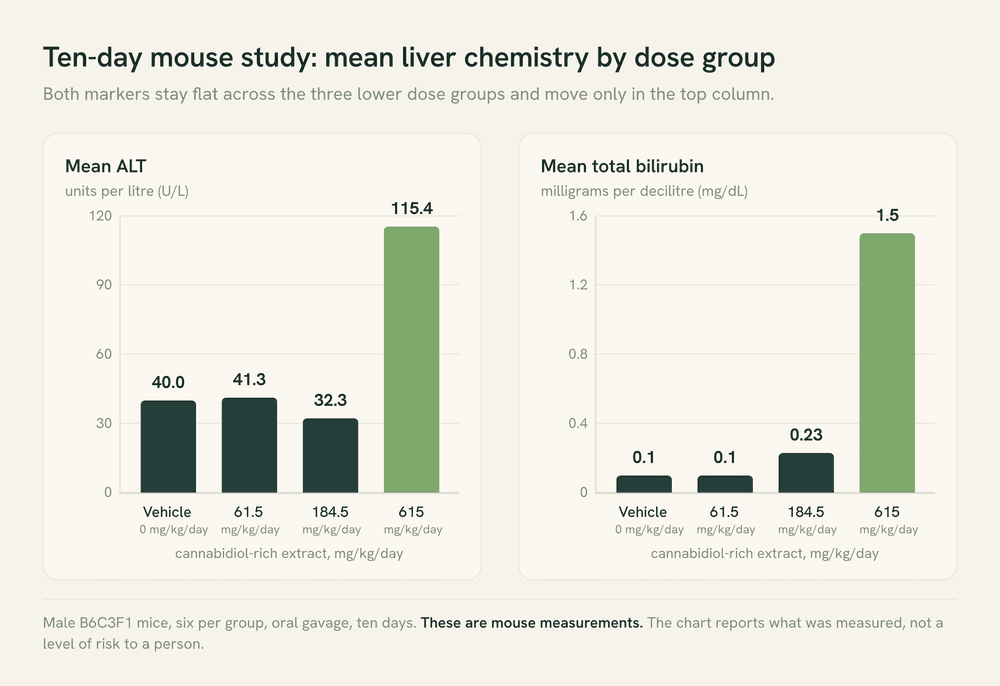
It matters even more which dose did what. The authors scaled their doses from Epidiolex's 20 mg/kg maintenance dose using a standard mouse scaling factor, then tested that scaled dose and multiples of it. In the single-dose arm, the mice's liver enzymes, bilirubin and liver-to-body-weight ratio moved only at the top dose, 2,460 mg/kg, which the paper scales to a human equivalent of 200 mg/kg. At the dose scaled from the prescription maintenance dose itself, 246 mg/kg, nothing significant happened in those mice. In the ten-day arm, the top-dose group of six mice at 615 mg/kg/day was stopped on day three; the paper's abstract reports that 75% of those animals became moribund, and in that group the mean ALT went from 40 to 115 and total bilirubin from 0.1 to 1.5. The authors' own summary of everything below that, in the discussion: "No measurable toxicological responses associated with liver injury were observed in mice gavaged with CBD at 184.5 mg/kg (MED of 15 mg/kg CBD) or lower, however, foci of hepatocyte cytoplasmic swelling were often detected."
The funding line is worth knowing because it cuts against the usual accusation: the work was paid for by the National Institute of General Medical Sciences, the AASLD Foundation and the Arkansas Biosciences Institute, with no CBD-industry and no pharmaceutical sponsor, and one of eight authors declared a consultancy while the rest declared none. A second 2019 paper from the same laboratory shows why rodent numbers cannot be carried across to people at all: aged female CD-1 mice given the extract by gavage for three days, then injected on day four with 400 mg/kg of acetaminophen in a standard overdose model, had 37.5% mortality at the lower CBD dose and none at the higher one, an inversion the authors call paradoxical. A dose-response that runs backwards in aged female mice is not a rule you can apply to a person, and nothing in either paper says anything about a human being taking CBD and a painkiller.
What the FDA-approved CBD label actually says
The clinical signal does not come from mice. It comes from the trials that supported the approval of Epidiolex, and it is printed in section 5.1 of the FDA-approved prescribing information, a section titled Hepatic Injury. Its opening sentence: "EPIDIOLEX can cause dose-related elevations of liver transaminases (alanine aminotransferase [ALT] and/or aspartate aminotransferase [AST])." In the controlled trials, ALT above three times the upper limit of normal occurred in 13% of treated patients at 10 and 20 mg/kg/day, and 12% at 25 mg/kg/day, against 1% on placebo. Fewer than 1% had ALT or AST above twenty times the upper limit, and the same section records transaminase elevations associated with hospitalization. The dose relationship is on the same page: 17% at 20 mg/kg/day against 1% at 10 mg/kg/day in that population.
This is a prescription drug label, describing patients with Lennox-Gastaut syndrome, Dravet syndrome and tuberous sclerosis complex, most of them taking several antiseizure medications, at 10 to 25 mg/kg/day. It is not a statement about a hemp tincture in either direction. It is, however, where the most-quoted reassurance on this topic comes from, and where that reassurance falls apart. The elevations do concentrate heavily with co-medication. They do not disappear without it.
| Concomitant medication | Share with ALT above 3x the upper limit of normal |
|---|---|
| Valproate and clobazam together | 30% |
| Valproate, without clobazam | 21% |
| Clobazam, without valproate | 4% |
| Neither drug | 3% |
| Placebo | 1% |
| Neither drug, tuberous sclerosis trial at 25 mg/kg/day | 6% |
Three percent is not zero, and in the tuberous sclerosis trial the figure for patients on neither valproate nor clobazam was 6%, against 1% on placebo. The FDA's consumer page makes the same point in plainer words. The agency writes that "CBD can cause liver injury", and that although the risk was increased when taken with other drugs that impact the liver, "signs of liver injury were seen also in patients not on those drugs". Note the verb, because it does a lot of work. The agency says CBD can cause liver injury, which is a risk statement drawn from a drug review. It is not a report that the agency tested consumer oils and found damage. Valproate and clobazam appear on this page only because the label puts them there; the enzyme mechanism behind co-medication belongs on our page about how CBD interacts with other medications.
The label also describes what supervised use looks like, and that description is the most practically useful thing in it. Prescribers are told to obtain serum transaminases and total bilirubin before starting, again at 1 month, 3 months and 6 months, periodically after that, and within a month of any dose change or any new medication known to affect the liver. Elevations typically appeared in the first two months, though some were seen up to 18 months in, particularly in patients taking valproate. They resolved on stopping or reducing the drug in about two thirds of cases, and in about one third they resolved during continued treatment without a dose change. Resolved is not a synonym for harmless: the same section reports the hospitalizations and the small number above twenty times normal.

The two human trials that closed the escape hatch
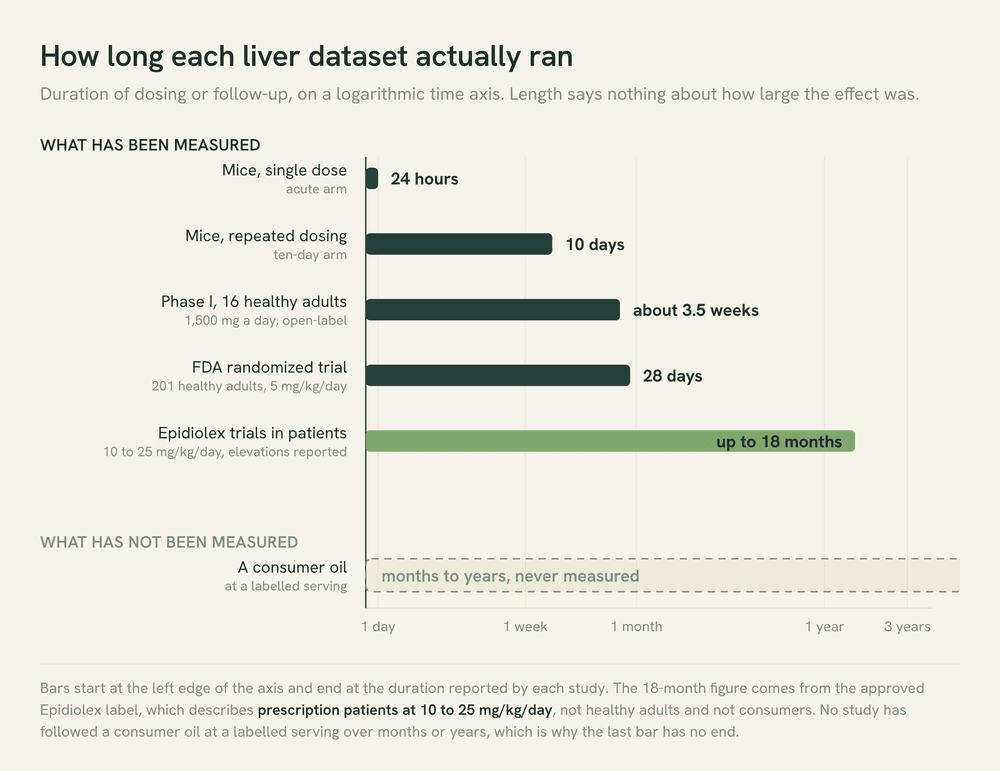
Two later trials removed the epilepsy, removed the other medications, and found the signal anyway. The first was a phase I trial in sixteen healthy adults, published in 2021, who titrated up to 750 mg of pharmaceutical CBD twice a day, 1,500 mg a day, for about three and a half weeks. Seven of the sixteen had peak ALT above normal, and five exceeded five times the upper limit, meeting the international consensus definition of drug-induced liver injury. Six were withdrawn before completion. All the elevations began within two to four weeks of first exposure, and in every withdrawn participant they were first detected between trial days 23 and 27. Blood levels of CBD did not predict who was affected, and neither did CYP2C19 genotype nor any baseline characteristic the authors examined, although with sixteen people, "no correlation found" is weak evidence that no correlation exists. This is the same trial our page on CBD and caffeine covers for its caffeine results; the liver findings were reported separately.
“These observations suggest that people without baseline liver conditions, not receiving valproate, and taking lower CBD doses should be at a much lower risk of hepatotoxicity than patients with DS/LGS. We were therefore surprised to observe that in this phase I caffeine drug-drug interaction (DDI) trial involving 16 healthy adults receiving 1,500 mg/day CBD (~ 20 mg/kg/day in a 70 kg person), 5 (31%) participants experienced drug-induced liver injury (DILI), as defined by international consensus criteria (serum ALT exceeding 5x ULN).”
Take that trial for exactly what it is: sixteen people, open-label, no placebo arm, one dose level, one pharmaceutical formulation, healthy volunteers screened to exclude anyone whose liver enzymes were already meaningfully raised. Thirty-one percent of sixteen is five people, which is a signal rather than a rate. The trial was sponsored by GW Research Ltd, two of the authors are paid consultants to GW who state they were not compensated for preparing the manuscript, and two are employees of Greenwich Biosciences.
The second trial is the one that changed the answer, and it is the reason this page exists. In 2025 the FDA's own Division of Applied Regulatory Science, the part of the agency that runs studies on what it regulates, published a randomized, double-blind, placebo-controlled trial in 201 healthy adults aged 18 to 55, with a median age of 36. Participants took 2.5 mg/kg twice a day, 5 mg/kg/day in total, for 28 days, with laboratory work every week. The trial registry records the arms: 151 people started on CBD and 50 on placebo. Eight in the CBD arm crossed ALT or AST above three times the upper limit of normal, reported as 5.6% by the trial's Kaplan-Meier analysis, against none of the 50 on placebo. Seven participants met the withdrawal criteria for potential drug-induced liver injury, picked up at day 21 in two of them and day 28 in the other five. There were no serious adverse events in either arm. Eosinophilia, a rise in a type of white blood cell that often accompanies a drug reaction, appeared in seven on CBD and none on placebo.
Three details decide how much weight that result carries. The dose, 5 mg/kg/day, is a quarter of the maximum approved Epidiolex maintenance dose and half the usual maintenance dose, which is why the authors' own conclusion calls for more work on the safety of lower doses commonly used by consumers. The detection was weekly blood tests, and without them nobody would have known, since not one of these events rose to a serious adverse event. And the study drug was Epidiolex oral solution, not a hemp extract, so this trial does not show that a tincture raises liver enzymes and does not show that it does not. It measured one pharmaceutical formulation, at one weight-based dose, for four weeks.
One caution before anyone lines the percentages up side by side. The FDA trial defined the upper limit of normal for ALT by consensus criteria as 33 U/L for men and 25 U/L for women, so three times normal is 99 and 75. The 2021 phase I trial used its laboratory's own ALT ceiling of 68 U/L, roughly two to three times higher. Percentages built on different ceilings are not comparable, which is why this page prints arms and counts rather than one headline rate.
What those doses look like in a bottle you can hold
Now the arithmetic, with both denominators stated out loud. The reference adult is 70 kg, which is a stated reference weight and not your weight. The reference bottle is a Planntz 60 mL tincture at 250 mg/mL, which is 15,000 mg of CBD in the bottle, with a standard dropper delivering about 0.05 mL per drop, so about 12.5 mg of CBD per drop and about 1,200 drops per bottle. Drop size varies with the dropper and with technique, so treat the drop column as an illustration rather than a measurement. To run this on the bottle you own, work out the milligrams in your own drops and, before that, find the milligram figure on your own label.
| Study or figure | Dose as published | mg per day for a 70 kg adult | Drops of a 250 mg/mL oil | One 60 mL bottle would last |
|---|---|---|---|---|
| Mice, single dose, top arm (liver signal) | 2,460 mg/kg once; authors' human equivalent 200 mg/kg | 14,000 mg at once | 1,120 drops at once | 93% of the bottle, in one go |
| Mice, single dose, lowest arm (no liver signal) | 246 mg/kg once; human equivalent 20 mg/kg | 1,400 mg at once | 112 drops at once | 10.7 such doses per bottle |
| Mice, ten-day arm, top dose (stopped day three) | 615 mg/kg/day; human equivalent 50 mg/kg/day | 3,500 mg/day | 280 drops/day | 4.3 days |
| Mice, ten-day arm, middle dose (no measurable response) | 184.5 mg/kg/day; human equivalent 15 mg/kg/day | 1,050 mg/day | 84 drops/day | 14.3 days |
| Epidiolex maximum maintenance, LGS and Dravet | 20 mg/kg/day | 1,400 mg/day | 112 drops/day | 10.7 days |
| Epidiolex maintenance, tuberous sclerosis | 25 mg/kg/day | 1,750 mg/day | 140 drops/day | 8.6 days |
| Phase I in healthy adults, 2021 | 1,500 mg/day, 750 mg twice daily | 1,500 mg/day | 120 drops/day | 10 days |
| FDA randomized trial, 2025 | 5 mg/kg/day for 28 days | 350 mg/day | 28 drops/day | 42.9 days |
| Meta-analysis: no cases reported below | 300 mg/day | 300 mg/day | 24 drops/day | 50 days |
| Industry-funded acceptable daily intake, 2023 | 0.43 mg/kg/day, their own 30 mg/day | 30 mg/day | 2.4 drops/day | 500 days |
| EFSA provisional safe dose, 2026 | 0.0275 mg/kg/day, their own 2 mg/day | about 2 mg/day | about one sixth of a drop | about 20 years |
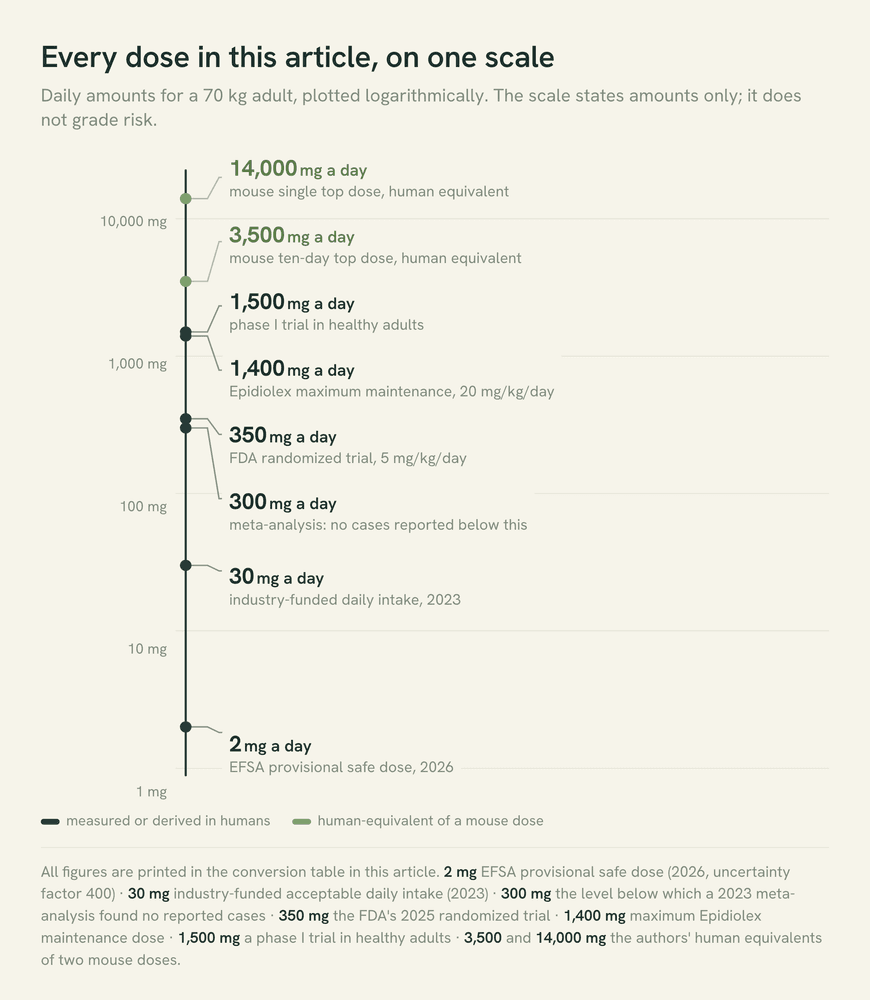
Read the top row and the FDA row together, because that pair is the whole story. The single dose that moved liver enzymes in those mice works out, once the paper's own scaling is applied to a 70 kg adult, to 14,000 mg of CBD at once: 56 mL out of a 60 mL bottle, about 1,120 drops, 93% of the bottle swallowed in one sitting. The dose in the FDA's 2025 randomized trial works out to 350 mg a day, about 28 drops of the same bottle. Those two numbers are fortyfold apart, and only one of them is a plausible thing for a person to do. That is the honest shape of this topic: the mouse headline describes an amount nobody takes, and the trial that found something describes an amount somebody might.
One thing not to over-read. The 2023 meta-analysis further down found no reported cases in adults below 300 mg a day, which is 24 drops, and the FDA trial dosed 350 mg a day for a 70 kg adult, which is 28 drops. Four drops apart looks like a discovered threshold, and it is not one. They are different kinds of number answering different questions: one is an absence of reported cases across trials published up to February 2022, the other is a weight-based dose in a single trial conducted in 2024 that enrolled people from 50 kg upward, so participants were taking anywhere from roughly 250 mg to well over 500 mg a day. What the proximity honestly shows is that the line the literature has drawn sits inside the range of amounts people buy, not comfortably above it. The separate question of a single large amount at once lives on our page about what taking too much actually looks like.
Four expert bodies, four different daily limits
Ask four expert bodies for a daily amount and you get four answers spanning 2 mg to 300 mg, a 150-fold spread, plus a prescription range measured in milligrams per kilogram. None of them is wrong. They are answering different questions, and the difference between those questions is the single most useful thing on this page.
| Body | The number | What it was derived from | Who funded it |
|---|---|---|---|
| EFSA NDA Panel, 2026 | 0.0275 mg/kg of body weight per day, their own gloss: approximately 2 mg/day for a 70 kg adult | Benchmark-dose modelling of animal studies with a 400-fold uncertainty factor, for supplements at 98% purity or above, under EU novel-food law | EU agency |
| Henderson and colleagues, 2023 | Acceptable daily intake 0.43 mg/kg/day, their own gloss: 30 mg/day for a 70 kg adult; supplement upper limits of 70 to 160 mg/day depending on the population | Published human clinical trials plus guideline-compliant animal toxicity studies | Canopy Growth Corporation and Charlotte's Web, with a stated no-role clause |
| Lo and colleagues, 2023 | No cases reported in adults using under 300 mg/day | Systematic review and meta-analysis of 28 clinical trials, 1,533 participants, searched to February 2022 | Academic, no conflict statement in the PubMed record |
| FDA-approved Epidiolex label | 10 to 25 mg/kg/day, the approved therapeutic range, with mandatory liver tests at baseline, 1, 3 and 6 months | The phase 3 clinical programme in severe epilepsy syndromes | Jazz Pharmaceuticals for the labelling, FDA for the approval |
The spread is the information. EFSA's 2026 opinion is a food-safety derivation for lifetime exposure across a whole population including children, built by benchmark-dose modelling of animal studies with a 400-fold uncertainty factor under EU novel-food law. It is not a clinical threshold and it is not US law. Its own conclusion is that the safety of CBD "for individuals under 25 years of age, pregnant or lactating women, and those on concurrent medications, cannot be established", which means not enough data, not shown to be unsafe. The 2023 paper deriving 30 mg a day is a supplement risk assessment for healthy adults, funded by Canopy Growth Corporation and Charlotte's Web; its disclosure adds that neither the funders nor the industry-employed author were involved in the selection of studies, the analysis of data or the determination of the derived limits. Both halves of that sentence matter.
The 2023 systematic review and meta-analysis pooled 28 trials in 1,533 participants and put liver enzyme elevation at 7.4% and drug-induced liver injury at 3.0%, with the odds of both several times higher than placebo across the twelve placebo-controlled trials it could compare. It identified high doses, meaning 1,000 mg/day or more or 20 mg/kg/day or more, and concomitant antiepileptic drugs as the risk factors, reported no cases below 300 mg a day, and recorded no cases of severe drug-induced liver injury. Its own framing is that these events "meet the criteria of common adverse drug events", which is a pharmacovigilance category rather than a severity claim. It searched to February 2022, so it could not have counted the FDA's 2025 trial. And the Epidiolex range is a supervised therapeutic dose with mandatory blood tests attached, which is a different category from anything anyone buys for themselves. Our practical dosage guide covers how labelled servings are usually structured, and what the FDA actually says about CBD covers the regulatory position in full.
Who this page is actually for: a risk checklist
Most people arrive here having read a headline. The readers this page is genuinely for are a narrower group, and the useful thing is knowing whether you are in it. Nothing below is a contraindication list, and none of it is dosing advice. It is the set of facts that make a conversation with a doctor or pharmacist worth having before rather than after. Regular drinking is its own hepatic exposure and this page does not analyse it: that belongs on our page about what happens when CBD and alcohol are taken together.
- You take valproate, clobazam, or any medicine a prescriber has told you is handled by the liver. In the label's own trials the figure runs from 3% on neither drug to 30% on both.
- Your liver enzymes are already above normal. At 20 mg/kg/day, ALT above three times normal appeared in 30% of label-trial patients with a raised baseline against 12% with a normal one.
- You have a diagnosed liver condition. Both trials in healthy adults screened those people out, so that group has the least evidence attached to it and the most reason to ask.
- You drink regularly, or you have been told to watch your liver for any other reason.
- You take more than a labelled serving, or you take several CBD items at once without adding up the total milligrams across them.
- You are under 25, pregnant or breastfeeding. EFSA's 2026 opinion states plainly that safety in those groups cannot be established.
- You have recently started or stopped another medication. The approved label tells prescribers to recheck liver tests within a month of any new drug known to affect the liver.
What none of this shows
Start with the sentence most likely to be quoted at you. The NIH's LiverTox monograph on cannabidiol says that "the lower doses of cannabidiol found typically in over-the-counter CBD products are generally well tolerated without evidence of liver injury". The same page also says: "There have been few studies of liver test abnormalities during therapy with lower doses of CBD or with commercially available, over-the-counter CBD products." Those two sentences belong together, and quoting either one alone misrepresents the page. The chapter was last updated in February 2023, we reread it on August 6, 2026, and it rates cannabidiol E*, meaning an unproven but suspected rare cause of clinically apparent liver injury, particularly at high doses. It also predates the FDA's randomized trial by more than two years.
So here is the boundary, in both directions, stated plainly. Nothing on this page shows that a hemp tincture is safe for your liver, and nothing on it shows that a tincture damages one. No trial has measured a consumer oil, at a labelled serving, in ordinary people, over the months or years people actually use it. The longest randomized liver dataset in healthy adults runs 28 days, and the only human liver data covering months comes from prescription patients at 10 to 25 mg/kg/day. What has been measured is a pharmaceutical formulation at weight-based doses, and the lowest of the four doses on this page, 5 mg/kg/day, is also the most recently tested, in 2025. This page also stays out of the other half of the internet's liver story: the work suggesting cannabinoids do something useful in fatty liver is rodent research answering a different question, and it is not a reason to take anything. The FDA's own authors ended their trial report by saying the result "underscores the need for further investigation on the long-term effects of CBD use, its impact on various populations, and the safety of lower doses commonly used by consumers". That is a regulator describing an open question, which is what this is.
The FDA's consumer page says, in its own words, that CBD can cause liver injury. What has actually been measured in trials is narrower than the phrase suggests: elevations of the liver enzymes ALT and AST, usually without symptoms, found on blood tests. In the FDA's own 2025 randomized trial, 8 participants in the CBD arm of 151 crossed three times the upper limit of normal at 5 mg/kg a day for 28 days, against none of the 50 on placebo, with no serious adverse events in either arm. The NIH's LiverTox monograph rates cannabidiol E*, an unproven but suspected rare cause of clinically apparent liver injury, particularly at high doses. Enzyme elevation and clinically apparent liver injury are not the same event, and the honest summary is that the first is documented and the second is suspected rather than established.
No authority has published a number everyone agrees on, and the gap between the published numbers is enormous. EFSA's 2026 opinion derives a provisional safe dose of about 2 mg a day for a 70 kg adult, using a 400-fold uncertainty factor for lifetime food-style exposure across a whole population. A 2023 industry-funded assessment derives 30 mg a day, with supplement upper limits of 70 to 160 mg a day. A 2023 meta-analysis of 28 trials reported no cases below 300 mg a day. The FDA-approved drug is prescribed at 10 to 25 mg/kg/day with mandatory blood tests. On a 250 mg/mL oil at about 12.5 mg per drop, those figures work out for a 70 kg adult to roughly one sixth of a drop, two or three drops, 24 drops, and 56 to 140 drops a day. They differ because they answer different questions, not because three of them are mistakes.
In clinical trials, yes, in a minority of participants. The FDA-approved CBD label reports ALT above three times the upper limit of normal in 13% of treated patients against 1% on placebo. A 2023 meta-analysis of 28 trials in 1,533 participants put the pooled rate of liver enzyme elevation at 7.4% and of drug-induced liver injury at 3.0%, with the odds of both several times higher than placebo. The FDA's 2025 trial found it in 8 of 151 at a dose a quarter of the prescription maximum. One warning about arithmetic: trials define the upper limit of normal differently. The FDA trial used consensus values of 33 U/L for men and 25 U/L for women, while the 2021 phase I trial used a laboratory ceiling of 68 U/L, so percentages from the two are not comparable.
The Epidiolex label tells prescribers to measure liver enzymes promptly in a patient with unexplained nausea, vomiting, right upper quadrant abdominal pain, fatigue, anorexia, or jaundice and dark urine. The uncomfortable part is that in the trials most elevations came with no symptoms at all and were found only because somebody drew blood, which is how the FDA describes it too. That is the argument for asking a clinician rather than waiting to feel something. If any of those symptoms appear, the next step is a doctor, not a search engine.
No, and this is the point most pages get wrong. Co-medication does concentrate it: in the label's Lennox-Gastaut and Dravet trials, ALT above three times normal appeared in 30% of patients taking both valproate and clobazam and 21% taking valproate alone. But it was still 3% in patients taking neither drug, against 1% on placebo, and 6% in the tuberous sclerosis trial for patients on neither. Beyond the label, two trials in healthy adults taking no antiseizure medication at all, the 2021 phase I study and the FDA's 2025 randomized trial, found the signal anyway. Valproate raises the odds. It is not the whole explanation.
That decision belongs to a clinician, and the most useful thing we can do is describe what supervised use looks like for the prescription version. The approved Epidiolex label instructs prescribers to obtain serum transaminases and total bilirubin before starting treatment, again at 1 month, 3 months and 6 months, periodically after that, and within a month of any dose change or any new medication known to affect the liver. That is a prescription protocol for a prescription drug at 10 to 25 mg/kg/day, not advice we are giving anyone about a supplement. If you have a liver condition, enzymes already above normal, or a medication your prescriber handles carefully, that protocol is a good description of the conversation worth having before you start anything.
Writing about hemp, wellness and the small rituals that keep us balanced.