What the FDA Actually Says About CBD (and When It Said It)
Exactly one CBD product has FDA approval, and it is a prescription medicine for three seizure syndromes. Here is what FDA's own Q&A, its warning letters, its laboratory data and its April 2026 memo actually say about the CBD you can buy. Verified August 2, 2026.

Type "fda cbd" into a search box and you are really asking four questions at once. Is CBD FDA approved? Can it be sold as a dietary supplement? Does the FDA actually do anything about the products already on sale? And did any of that change recently? The short answers are no, no, yes but selectively, and yes in one narrow lane that has nothing to do with anything you can buy. This page gives each answer with a date attached, because on this topic the date is half the answer. Every source here was re-read against the primary federal document on August 2, 2026. None of it is legal advice.
Here is why the answers you find online contradict each other so badly. The FDA's consumer explainer on CBD carries a line at the foot of the page reading Content current as of 03/05/2020. Its detailed question-and-answer page for industry is stamped July 16, 2024. Its warning-letter list is stamped September 3, 2025. Meanwhile the three federal actions that moved this subject in 2026 (an executive order signed in December 2025, an FDA enforcement memorandum dated April 1, 2026, and a Medicare pilot that started the same day) are published somewhere else entirely: in the Federal Register, in a PDF on FDA's media server, and on a CMS webpage. So a brand page that says "as of 2026" while summarizing a 2020 FDA page is dating its own writing, not the agency's position. One thing to settle before you read on: what the FDA says about how a product may be marketed is a different question from whether you can lawfully buy CBD where you live.
"FDA approved" means one drug, and it is not on any shelf
Start with the agency's own words. In its 26-question Q&A on cannabis and cannabis-derived products, FDA is asked whether there are other approved drug products containing CBD, and the whole answer is two sentences: "No. There are no other FDA-approved drug products that contain CBD." A few questions earlier it says that "to date, the agency has not approved a marketing application for cannabis for the treatment of any disease or condition", and that it has approved one cannabis-derived and three cannabis-related drug products. The three related ones contain no CBD at all: Marinol and Syndros contain dronabinol, a synthetic form of THC, and Cesamet contains nabilone, a synthetic cannabinoid. So the whole approved category is four prescription products, exactly one of which contains cannabidiol. The approval belongs to that product, not to CBD as an ingredient, which is why no tincture, capsule, gummy, drink or cream can inherit it.
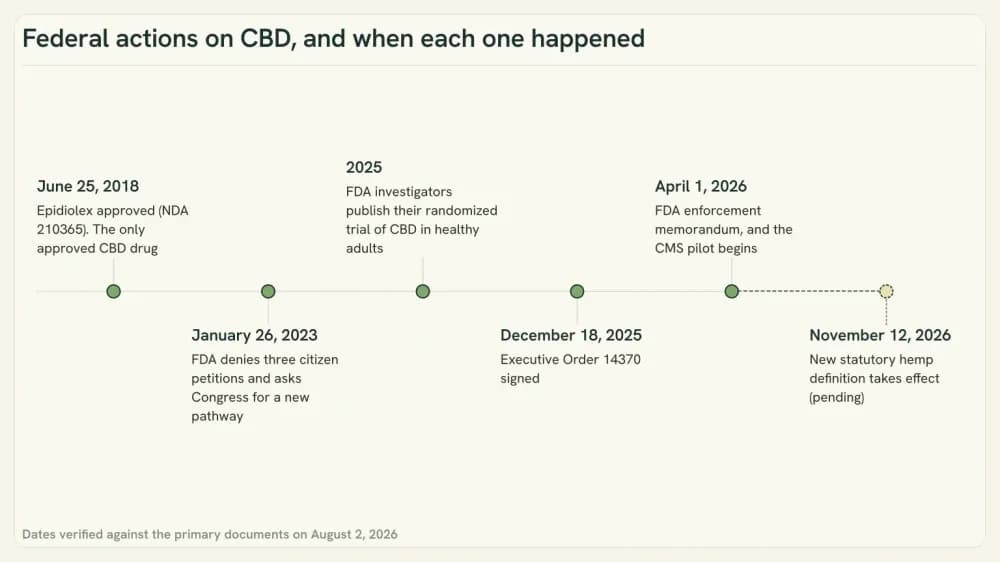
That one product is Epidiolex. Its FDA-approved prescribing information on DailyMed, revised in May 2026 when we read it on August 2, 2026, says it "is indicated for the treatment of seizures associated with Lennox-Gastaut syndrome, Dravet syndrome, or tuberous sclerosis complex in patients 1 year of age and older". It is an oral solution at 100 mg/mL. It was first approved on June 25, 2018 under new drug application 210365, with a priority review, as a new molecular entity. It is dosed by body weight under a prescriber's supervision, and before the first dose the label directs clinicians to "obtain serum transaminases (ALT and AST) and total bilirubin levels in all patients prior to starting treatment". Section 9.1 states plainly: "EPIDIOLEX is not a controlled substance." Every one of those facts describes a prescription medicine for three rare seizure syndromes, evaluated at doses set per kilogram of body weight with blood tests around them. A retail tincture is none of those things, and whatever the trials of that drug showed belongs to that drug.
Why your CBD bottle is not a dietary supplement, even when it looks like one
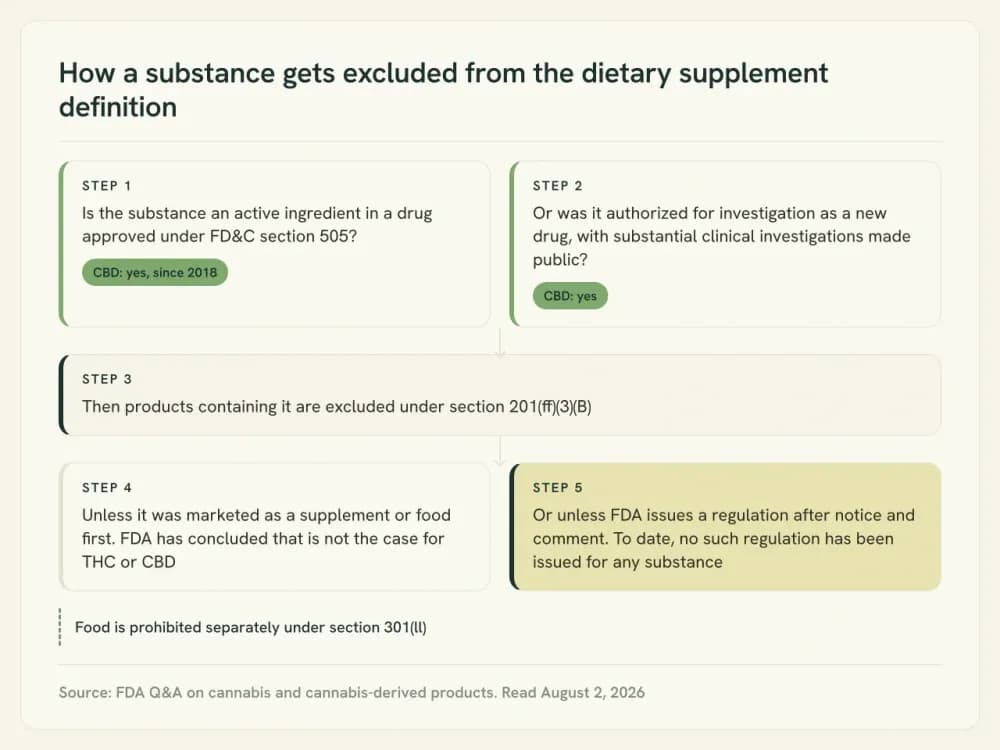
This is the part that surprises people, and it turns on statute rather than opinion. FDA's answer, verbatim: "Based on available evidence, FDA has concluded that THC and CBD products are excluded from the dietary supplement definition under section 201(ff)(3)(B) of the FD&C Act." The mechanism is worth reading slowly, because it explains why the answer has almost nothing to do with whether CBD is risky. If a substance is an active ingredient in a drug approved under section 505, or has been authorized for investigation as a new drug for which substantial clinical investigations have been instituted and made public, then products containing that substance are excluded from the definition of a dietary supplement. Cannabidiol trips both triggers. Public clinical investigation of CBD as a drug began years before the approval, and the approval landed in 2018. From that point the supplement door closed by operation of the statute, not by an agency verdict on safety.
There is an exception written into the same section, and FDA says CBD does not fit through it. The exclusion does not apply if the substance was marketed as a dietary supplement or as a conventional food before the drug was approved or before the investigations were authorized. FDA's position is that, based on available evidence, this is not the case for THC or CBD, and it openly invites contrary evidence: interested parties may present the agency with any evidence they think has bearing on the issue. The other exit is a regulation. FDA may, at its discretion and after notice and comment, issue a rule finding that the article would be lawful. Its own Q&A closes that thought with the sentence that ends most arguments about paperwork backlogs: "To date, no such regulation has been issued for any substance." Not for CBD, and not for anything else. Food is prohibited on a separate track, under section 301(ll), which bars introducing into interstate commerce any food to which an approved drug's active ingredient has been added. The one carve-out is the seed: hulled hemp seed, hemp seed protein powder and hemp seed oil have cleared FDA's GRAS notification process and are legal in food, because hemp seed ingredients contain essentially no CBD or THC.
So why does your bottle carry a Supplement Facts panel and the familiar line about statements not evaluated by the Food and Drug Administration? Because the panel is a format, not a permission. Companies borrow the layout from the dietary supplement rules at 21 CFR 101.36 and the disclaimer wording from 21 CFR 101.93, since it is the standard way to present a serving size and an amount per serving on something you swallow. It is not evidence that an agency reviewed the numbers inside it. The National Center for Complementary and Integrative Health, part of NIH, states the same conclusion in consumer language: "The FDA has determined that products containing THC or CBD cannot be sold legally as dietary supplements." That page is stamped Last Updated: November 2019, and the position has not moved since. For the anatomy of the panel itself, line by line, see how to read a CBD label.
What the FDA actually enforces: warning letters, and what they say
Enforcement in this category runs mostly through one instrument, the warning letter, and reading one is more instructive than reading a hundred summaries of them. Take a letter FDA issued on August 25, 2025 to a company selling a CBD product for eye health. The letter FDA sent does not argue that CBD is unsafe, and it does not allege that the product was contaminated. It argues that the seller's own marketing turned the product into a drug: because it is "intended for use in the diagnosis, cure, mitigation, treatment, or prevention of" disease, it meets the definition of a drug under section 201(g)(1), and because no application has been approved for it, it is "an unapproved new drug under section 505(a)". The firm had fifteen working days to respond in writing, and the letter warns that failure to address the matter "may result in legal action", naming seizure and injunction among the possibilities. Notice what does the damage. It is the claims, not the cannabinoid.
- "Protects from macular degeneration" was quoted by FDA out of the seller's own product page as evidence of what the product was intended to do.
- "Reduces the risk of diabetic retinopathy" appeared in the same citation. Naming a disease is the fastest way to turn a wellness item into an unapproved drug.
- "Protects against computer radiation exposure" is in the same letter, which shows the test is intended use, not whether the claim sounds plausible.
- The five verbs that trigger the drug definition: diagnose, cure, mitigate, treat, prevent. Any one of them, aimed at a disease, is enough on its own.
- The definition also reaches articles intended to affect the structure or any function of the body, which is why the line between wellness language and a drug claim is thinner than it looks.
- None of these lines is quoted here as information about CBD. They are quoted as the reason FDA said this particular product was being sold illegally.
| Year | Firm entries listed | What the page shows for that year |
|---|---|---|
| 2015 | 6 | Each letter published alongside FDA's own laboratory results for the product |
| 2016 | 8 | Same format, and the last year FDA published analytical tables on this page |
| 2017 | 4 | Letters only. The year before the 2018 Farm Bill |
| 2018 | 1 | The quietest year on the list, and the year Epidiolex was approved |
| 2019 | 22 | Includes a single batch of 14 letters issued on one day in November |
| 2020 | 21 | Two tables under one heading: 8 entries plus 13 tied to COVID-19 claims |
| 2021 | 7 | A lull between the two heaviest years |
| 2022 | 30 | The peak, issued in multi-firm batches on a handful of dates |
| 2023 | 15 | Half the 2022 volume, in the year FDA asked Congress for a new pathway |
| 2024 | 9 | Back to single digits |
| 2025 | 7 | The most recent year with rows. The page itself is stamped 09/03/2025 |
| 2026 | None published | No 2026 table exists on the page as of August 2, 2026 |
Three caveats belong in the same breath as those numbers. Method: we enumerated every firm entry on FDA's warning-letter page for cannabis-derived products on August 2, 2026, then enumerated the whole page a second time independently. Both passes returned the same figure for every year, and 130 firms across 2015 to 2025. One detail changes the arithmetic if you skip it: in the 2015 and 2016 tables a line is one product sample rather than one firm, so a company whose products were tested several times is counted once here. Scope: this is FDA's curated list for this product category, not the agency's full warning-letter database, so actions that touch cannabinoids from another angle (a 2025 wave aimed at CBD marketed for food-producing animals, for instance) may never appear in the table. Delta-8 products share this same list. Date: the page is stamped Content current as of 09/03/2025, so the absence of a 2026 table means the page has not been updated, not that no letters issued. And FDA says out loud how it chooses: "When a product is in violation of the FD&C Act, FDA considers many factors in deciding whether or not to initiate an enforcement action. Those factors include, among other things, agency resources and the threat to the public health."
The FDA has tested CBD products, and published the results
FDA's most quoted sentence about this market sits in its consumer update on cannabis and CBD, and it is worth reading with the verbs intact: the agency has tested the chemical content of cannabinoid compounds in some of the products, and "many were found to not contain the levels of CBD they claimed." Immediately after, and this is a different statement about a different thing, it says: "We are also investigating reports of CBD potentially containing unsafe levels of contaminants (e.g., pesticides, heavy metals, THC)." Those two sentences get merged constantly into "the FDA found contaminants in CBD products". FDA did not say that. The tested-and-found finding is about how much CBD was in the bottle. The contaminant sentence describes an open investigation into reports. Both sentences were still on that page when we reread it on August 2, 2026, and the page is stamped Content current as of 03/05/2020, which tells you how long this has been the official consumer position.
The receipts for the first of those sentences are sitting on a different FDA page, and almost nobody connects them. Alongside its 2015 and 2016 warning letters, FDA published tables comparing each product's label claim against the cannabinoid content its own laboratory measured. Those tables are still there. Here is what three rows of them look like.
Read those tables with three limits attached, and the middle one matters most. The samples are from 2015 and 2016, roughly a decade old. The firms were already enforcement targets, so this is not a random draw from the market and it is not a prevalence rate for anything. And the counts are small. For a modern check you need independent analytical work, and the largest recent example is a 2024 analysis in Frontiers in Pharmacology of 202 CBD products bought online in late 2021, covering tinctures, gummies, vapes and topicals: 74% of them deviated from their labeled CBD potency "by at least 10%", and 26% did not meet the definition of the spectrum type printed on the package. Its funding statement has to travel with that number. The work was supported by Jazz Pharmaceuticals, which makes the one approved CBD drug, and the company "was involved in the study design, collection, analysis, interpretation of data, the writing of this article, and the decision to submit it for publication", while other authors disclosed ties to hemp companies. It also tested one unit per product. Take the direction of the finding seriously and the exact percentage loosely, then read what third-party tested actually means for the part of this you can control.
January 2023: the door FDA closed, and the sentence that explains everything since
On January 26, 2023 FDA published a statement concluding that the existing frameworks for foods and supplements are not appropriate for CBD, and three things happened in it. It denied three citizen petitions that had asked the agency to write rules allowing CBD to be marketed as a dietary supplement. It concluded that "a new regulatory pathway for CBD is needed that balances individuals' desire for access to CBD products with the regulatory oversight needed to manage risks", and said the agency was prepared to work with Congress on it. And it explained why, in what is probably the most useful single sentence any federal agency has written on this subject: "we have not found adequate evidence to determine how much CBD can be consumed, and for how long, before causing harm." The concerns it named were the liver, interactions with certain medications, and possible harm to the male reproductive system, with children and pregnant people flagged as the populations of concern. The tools it floated for a future framework were mundane and concrete: clear labels, prevention of contaminants, limits on CBD content, and measures such as a minimum purchase age. That statement is dated, it is a statement of intent rather than a rule, and it has never been withdrawn.
Then the FDA ran the trial itself
If you want to understand where that caution comes from, the most direct evidence is a study the agency's own scientists ran to fill the gap they had described. A randomized, double-blind, placebo-controlled trial published in JAMA Internal Medicine in 2025, conducted by investigators at FDA's Center for Drug Evaluation and Research between January and August 2024, gave 201 healthy adults either CBD at 5 mg/kg per day (2.5 mg/kg twice daily) or a matching placebo for 28 days, with weekly blood draws. 151 took CBD, 50 took placebo, and 188 completed. In the per-protocol analysis, 8 participants on CBD (5.6%, 95% CI 1.8% to 9.3%) had ALT or AST above three times the upper limit of normal, against 0 on placebo (0%, 95% CI 0% to 7.6%). Seven met the trial's withdrawal criteria for potential drug-induced liver injury, first detected at day 21 in two of them and at day 28 in five. There were no differences between the groups in total testosterone, inhibin B, thyrotropin, total T3 or free T4. FDA's own summary of the trial describes the dose as 250 to 550 mg per day across the body weights enrolled.
Now the limits, which are substantial. This was healthy adults, one dose level, four weeks, and a per-protocol analysis. The endpoint is a blood marker, not liver disease: FDA's own writeup states that participants did not experience clinical symptoms related to liver function during the 28 days, and that enzymes returned to normal within 1 to 2 weeks of stopping. It tested a fixed weight-based dose of a pharmaceutical-grade solution under clinical supervision, which is not a product on a shelf and not a Planntz batch. And the interpretation is contested in the literature: a February 2026 commentary in the same journal, titled "Reassessing Clinical Relevance of Cannabidiol-Associated Liver Enzyme Elevations", argues that the clinical meaning of those elevations is not settled. What the trial does establish is the regulator's own point: the dose-and-duration question FDA raised in 2023 was still open enough in 2024 that the agency went and ran a study about it. The other half of FDA's stated concern, how CBD interacts with other medications, has its own page here.
What changed in 2026 for FDA CBD enforcement, and what did not
Three things moved between December 2025 and April 2026, and none of them appears on FDA's consumer pages. The first is Executive Order 14370, Increasing Medical Marijuana and Cannabidiol Research, signed December 18, 2025 and published in the Federal Register on December 23, 2025 at 90 FR 60541. It opens with the size of the market: "One in 5 United States adults and nearly 15 percent of seniors reported using CBD in the past year". It then describes the status quo in the administration's own words: "the current legal landscape leaves American patients and doctors without adequate guidance or product safeguards for CBD." It directs the White House to work with Congress on updating the statutory definition of final hemp-derived cannabinoid products, including "development of guidance on an upper limit on milligrams of THC per serving with considerations on per container limits and CBD to THC ratio requirements", and directs HHS, the Commissioner of Food and Drugs, CMS and NIH to develop research methods using real-world evidence. Keep the genre in mind: an executive order is a direction to agencies. It is not a law, it changes nothing in the FD&C Act, and its own text says it creates no enforceable rights.
The second is a memorandum dated April 1, 2026 from Martin A. Makary, the Commissioner of Food and Drugs, to the Deputy Commissioner for Human Foods and the Acting Director of the Center for Drug Evaluation and Research, on the subject of hemp-derived cannabidiol products in medical research models. The memorandum states that "the FDA does not intend to enforce sections 502(f)(1) or 505 of the Federal Food, Drug, and Cosmetic Act with respect to an orally administered, hemp-derived CBD product solely on the basis that it contains CBD", provided that the product meets four conditions at the same time: (1) it "is manufactured, marketed, and labeled in a manner that would be consistent with the dietary supplement framework, including bearing a supplement facts panel and structure/function claims", (2) it "is not contaminated", (3) it "is not packaged or labeled in a manner that would be attractive to or marketed for children", and (4) it "is provided to a beneficiary through a program of medical items or services payable under Title XVIII of the Social Security Act, under the direction of the patient's treating physician, in a manner ancillary to the covered items or services furnished under such program". Those four are cumulative, and the fourth is decisive: Title XVIII is Medicare. So this is not approval. It is a statement that FDA does not intend to enforce two provisions in one narrow lane, and nothing you can buy in a shop or online is in that lane. No Planntz product is covered by this memorandum, no retail CBD product is, and enforcement discretion can be withdrawn at any time. The memo itself restates that the 2018 Farm Bill "explicitly preserved FDA's authority" and that "FDA-regulated products containing cannabidiol (CBD) are subject to the same legal and regulatory requirements as other FDA-regulated products".
The third is the lane the memo was written for. CMS's Substance Access Beneficiary Engagement Incentive lets participants in certain CMS Innovation Center payment models consult with eligible Medicare beneficiaries about the possible use of eligible hemp products to improve symptom control, and furnish those products up to $500 a year per eligible beneficiary. It became available on April 1, 2026 in the ACO REACH and Enhancing Oncology models, with the LEAD model scheduled for January 1, 2027. Eligible products are federally legal hemp-derived products containing no more than 0.3% delta-9 THC, and the program expressly excludes inhalable products, orally administered products with more than 3 mg per serving of tetrahydrocannabinols, and any product containing cannabinoids the cannabis plant does not naturally produce. They must be furnished directly by a qualified physician after documented shared decision-making that includes a review of the patient's current medications and potential interactions. And there is a quality bar written into the criteria, which is the most interesting line in the whole document for an ordinary buyer: the products must "be tested by a third party for potency (including accurate cannabinoid measurement) and for contaminants and microbial hazards with negative results." That is the federal government writing down, for the first time in a program document, what it considers adequate evidence that a hemp product is what it says it is.
What the FDA still has not done
One deadline has already passed. Section 781 of Public Law 119-37 rewrites the federal definition of hemp with effect from November 12, 2026, and it required FDA, within 90 days of enactment (roughly February 10, 2026), to publish several lists: all cannabinoids the plant can naturally produce, the THC-class cannabinoids known to occur naturally, other known cannabinoids with effects similar to those, and additional detail on what counts as a container. We searched the Federal Register API on August 2, 2026 for FDA documents published since November 12, 2025 matching "cannabinoid" and got two results, neither about CBD (an international drug-scheduling notice and a medical-device exemption notice); the same search for "hemp" returned zero. So the lists that will decide which cannabinoids fall inside the new definition were not published as of that date, which means the exact edge of the coming rule is not yet knowable by anyone. The nonpartisan Congressional Research Service made the practical observation in an insight published December 3, 2025: "Both FDA and DEA may lack the resources to broadly enforce" the new definition. For the statute itself rather than its FDA-facing consequence, the definition of hemp and how it changes in November 2026 is the page for it. And for a measure of how much weight the word approved carries elsewhere in federal law: when DEA moved cannabis products to Schedule III in a final rule effective April 28, 2026, the categories it moved were FDA-approved drug products containing marijuana and marijuana handled under a state medical marijuana license, not marijuana in general.
If something does change, here is where it will show up before it shows up on anybody's blog. New rules, proposed rules and notices publish in the Federal Register, which is searchable by agency and by term and puts a publication date on every document. Draft and final guidance appear in FDA's guidance-documents database. Guidance still under White House review appears on reginfo.gov, in the list of regulatory actions pending under Executive Order 12866, which is where a new FDA CBD compliance policy would surface first. We could not reach reginfo.gov on August 2, 2026, so we are asserting nothing about what is or is not sitting there today. That is deliberate: on this topic, naming the place to look is worth more than repeating what somebody heard was in it.
How to check the FDA's position yourself in five minutes
Nothing above requires you to trust us, and on a subject that moves this fast you should not. Every claim on this page comes from a document you can open in a browser. The one skill worth building is dating what you read, because most of the disagreement online is not disagreement about facts: it is people quoting the same agency pages from different years without saying which year. A worked example from this very topic: the strongest non-FDA summary of the enforcement record we found prints approximate ranges for the yearly counts (5 to 6 for 2021, 20 or more for 2022) where the underlying FDA page supports exact figures of 7 and 30. Nobody was lying. Somebody just did not open the page. Here is the five-minute version of the check.
- 1Open FDA's cannabis and CBD page and scroll to the very bottom before you read a word of it. The last line reads Content current as of, followed by a date.
- 2Compare that date to the claim you are checking. A page stamped 2020 cannot tell you what changed in 2026, however authoritative the rest of it looks.
- 3Open FDA's warning-letter page for cannabis-derived products and read its stamp and its most recent year. That tells you how current the enforcement picture on it is.
- 4Search the Federal Register by agency and term, with a date filter. It carries every rule, proposed rule and notice, each with its own publication date.
- 5Check DailyMed for what is actually approved. If an FDA-approved drug product exists, its label is there with a revision date on it, in the agency's own words.
- 6Treat a brand page's as of date as the date that brand wrote its post, which is not the date the agency last spoke. Then ask which document it is summarizing.
- 7If the visible stamp is hard to find, read the page source. On August 2, 2026 the Q&A page's article:modified_time meta tag carried 07/16/2024, while its article:published_time read 01/06/2026, a CMS timestamp rather than the date of the answers.
| Source | What it settles | Date it carries |
|---|---|---|
| FDA Q&A on cannabis and cannabis-derived products | Approval status, the supplement exclusion, the food prohibition, how enforcement is decided | Content current as of 07/16/2024 |
| FDA consumer update on cannabis and CBD | The plain-language version, plus FDA's summary of its own product testing | Content current as of 03/05/2020 |
| FDA warning letters for cannabis-derived products | The enforcement record year by year, plus the 2015 and 2016 laboratory tables | Content current as of 09/03/2025 |
| NCCIH page on cannabis and cannabinoids (NIH) | Independent federal corroboration of the supplement and food position | Last Updated: November 2019 |
| Executive Order 14370 | The administration's direction to agencies on CBD research and definitions | Signed December 18, 2025 (90 FR 60541) |
| FDA Commissioner's memorandum | Non-enforcement of two provisions in one Medicare-linked lane | April 1, 2026 |
| CMS Substance Access BEI page | The program the memorandum was written for, and its product criteria | Live April 1, 2026; LEAD from January 1, 2027 |
| DailyMed label for the one approved CBD drug | The indication, form, strength, dosing basis and warnings of that product | Label revised May 2026 |
What this means when you are actually buying
Put the pieces together and the consequence for a shopper is specific rather than vague. There is no premarket review of a retail CBD product. No agency checked its potency, its purity or its label before it shipped, because there is no process under which it could: the supplement route is closed by statute, the food route is closed by statute, and the drug route requires an approved application that nobody is filing for a wellness tincture. FDA's own description of enforcement is that it weighs "agency resources and the threat to the public health", which is an honest account of a regulator triaging an enormous market with a few letters a year. That does not mean the market is lawless and it does not mean products are inaccurate. It means the evidence has to come from the batch, and the only document that carries batch-level evidence is a third-party certificate of analysis.
- Third-party tested for potency and for contaminants, with negative results on the contaminant panel. That phrasing is the federal government's own, from its 2026 Medicare pilot criteria.
- The report matches the batch or lot number printed on the bottle in your hand, not a generic report for the product line or an undated PDF.
- Cannabinoids reported in milligrams and in mg per mL, so you can check the bottle total against the concentration yourself and see whether they reconcile.
- The label carries the standard statement that the claims have not been evaluated by the Food and Drug Administration, and makes no claim to diagnose, treat, cure or prevent any disease.
- No FDA approved, FDA compliant, FDA registered or FDA cleared language anywhere on the product, the packaging or the website. None of those phrases is available to a CBD wellness product.
- A report date recent enough to be about the stock actually being sold, and a laboratory that is genuinely independent of the seller.
For what it is worth as a data point rather than a pitch: Planntz publishes a per-batch third-party certificate of analysis for every 60 mL tincture, and prints concentrations in mg per mL (250 mg/mL of CBD in the Broad Spectrum and Full Spectrum tinctures, 150 mg/mL of CBD with 100 mg/mL of CBG in the CBD+CBG blend, and 133 mg/mL of CBD with 67 mg/mL of CBN in the CBD+CBN blend). That is a transparency practice, not a federal clearance. It does not make these products approved, compliant, or eligible for anything described anywhere in this article, and any brand that tells you otherwise about its own line has just told you something useful about the brand. The point of publishing the report is that the check described above is possible at all. If you have never opened one, how to read a certificate of analysis walks through the panels line by line, and a buyer's checklist for comparing CBD oils covers the rest of the decision.

No. The FDA has approved one drug that contains CBD, Epidiolex, and its own Q&A answers the question in as many words: there are no other FDA-approved drug products that contain CBD. That approval covers a specific prescription oral solution at a specific strength, for seizures associated with Lennox-Gastaut syndrome, Dravet syndrome and tuberous sclerosis complex, in patients 1 year of age and older. It does not cover cannabidiol as an ingredient. So no tincture, capsule, gummy, drink, cream or vape is FDA approved, and a consumer CBD product described that way is misdescribed. That is true of every brand, ours included.
Not under FDA's current position. Because CBD is the active ingredient in an approved drug, and was the subject of public clinical investigation as a new drug before that approval, section 201(ff)(3)(B) of the Federal Food, Drug, and Cosmetic Act excludes products containing it from the definition of a dietary supplement. Adding it to food is separately prohibited by section 301(ll). FDA can create an exception by notice-and-comment rulemaking, and its own Q&A says no such regulation has ever been issued, for any substance. In January 2023 the agency went further and said it does not intend to pursue that rulemaking, asking Congress for a new pathway instead. A Supplement Facts panel on a CBD bottle is an industry format, not evidence that any of this changed.
In one narrow way. A memorandum dated April 1, 2026 states that FDA does not intend to enforce sections 502(f)(1) or 505 against an orally administered, hemp-derived CBD product solely because it contains CBD, provided four conditions are met at the same time. The fourth is that the product reaches the patient through a program of medical items or services payable under Title XVIII of the Social Security Act, which is Medicare, under the treating physician's direction. That is enforcement discretion inside a specific clinical program, not approval, not a rule, and not a change in the law. Nothing sold at retail is covered by it, no consumer product qualifies, and FDA can withdraw it. The statutory exclusion of CBD from the dietary supplement definition is untouched by it.
Because the panel is a format, not a permission. Companies borrow the layout from the dietary supplement regulations at 21 CFR 101.36 and the disclaimer wording from 21 CFR 101.93, since it is the conventional way to present a serving size and an amount per serving on something you swallow. Nobody at FDA reviewed the numbers inside it before the bottle shipped, and printing the panel does not move the product into the supplement category that the statute excludes it from. The panel tells you how a company chose to present its own figures. The certificate of analysis for that specific batch tells you what a laboratory actually measured.
Yes, and it published the results. Alongside its 2015 and 2016 warning letters, FDA posted tables comparing each product's label claim against the cannabinoid content its laboratory measured. One 1 oz tincture labeled 200 mg of CBD returned no detectable CBD. A product sold as 25.2% CBD measured between 0.017 and 0.061 mg/g of CBD across three samples, against 13 to 19 mg/g of delta-9 THC. Several 2015 samples were reported negative for cannabinoids. Three limits matter when you use those numbers: the samples are about a decade old, they came from firms that were already enforcement targets, and the counts are small. They are the receipts behind FDA's statement that many products it tested did not contain the CBD levels they claimed. They are not a prevalence estimate for today's market.
It is a formal notice, not a fine and not a recall. The letter states that FDA considers the product an unapproved new drug, quotes the company's own marketing back to it as evidence of what the product was intended to do, and gives the firm fifteen working days to respond in writing describing the corrections it will make. It warns that failure to address the matter may result in legal action, and names seizure and injunction among the possibilities. FDA also says openly that it weighs agency resources and the threat to the public health when deciding whether to act at all, which is part of why the yearly counts swing as widely as they do, from a single entry in 2018 to 30 in 2022.
Those are two different questions decided under different statutes. FDA's position governs how a product may be marketed under federal food and drug law: whether it can be sold as a dietary supplement, added to food, or advertised with disease claims. Whether you can lawfully buy, carry or use CBD where you are depends on the federal definition of hemp, on your state's own law, and on the rules of anywhere you travel through. The two questions overlap, and a product can be lawful to buy in your state while being marketed in a way FDA considers a violation. Our guide to CBD legality in the United States covers the second question in detail.
The short version, dated. As of August 2, 2026: one CBD product has FDA approval and it is a prescription medicine for three rare seizure syndromes; CBD is excluded from the dietary supplement definition by statute, and adding it to food is separately prohibited; FDA's enforcement runs through warning letters that overwhelmingly target disease claims rather than the cannabinoid itself; the agency ran its own trial in 2024 because it could not answer its own dose-and-duration question; and the April 2026 memorandum changed enforcement in one Medicare-linked lane without changing the law or touching anything you can buy. Every one of those statements can move, which is why the dates in this article are attached to individual claims rather than to the article as a whole, and why none of this is legal advice. Two next steps, depending on which question you actually arrived with. If you want to know whether you can lawfully buy and carry CBD where you live, that is a different body of law and it lives in our guide to CBD legality in the United States. If you want to know whether a specific bottle contains what its label says, that answer is in the batch's lab report, and it is not in anything any federal agency has published about the category.
Writing about hemp, wellness and the small rituals that keep us balanced.