Delta 8 vs CBD: Same Starting Material, Different Chemistry
Delta-8 and CBD start as the same molecule from the same plant. What separates them is a chemical reaction, not a species and not a statute. Here is what that reaction does, what published analyses have found in the products it makes, and what US law says as of August 1, 2026.
Delta 8 vs CBD is not a question about two plants or two laws. It is a question about one extra manufacturing step. The CBD in a tincture is extracted from hemp. Almost all of the delta-8 THC sold in the United States is CBD that has been put through a chemical reaction, and the FDA says so plainly: delta-8 "is not found in significant amounts in the cannabis plant" and "concentrated amounts of delta-8 THC are typically manufactured from hemp-derived cannabidiol (CBD)." Everything else follows from that one step. This is general information, current as of August 1, 2026, and it is not legal advice.
Three questions hide inside that comparison, and they stack. What are the two molecules before anyone does anything to them? What is actually in a finished delta-8 product once the reaction is over? And what does US law say about a cannabinoid the plant makes in traces and a reactor makes in kilograms? This article takes them in that order, because the chemistry explains the composition, and the composition is what the safety record and the legal fight are both arguing about. Where an answer depends on the state you are standing in, we say so and stop.
Delta-8 and CBD: what they are before anything is done to them
Start with the molecules. CBD, cannabidiol, is not a tetrahydrocannabinol at all. It lacks the closed ring that defines that class, and creating that ring is precisely what the reaction later in this article does. Delta-8-THC and delta-9-THC are both tetrahydrocannabinols, and they differ by the position of a single double bond, which is what the 8 and the 9 count. A 2024 review in Molecules collects the chemistry and pharmacology of delta-8 in one place, including the detail that delta-8 was isolated from Maryland-grown cannabis in 1966 "but in very low yield." Delta-8 interacts with the same CB1 and CB2 receptors delta-9 does; CBD does not engage CB1 in that way, which is the two-sentence version of a longer story told in the wider cannabinoid family and in whether CBD is intoxicating at all. That review is a narrative review rather than new measurement, and one of its authors discloses work as an industry consultant.
The reason the reaction only ever runs in one direction is arithmetic. Hemp makes CBD by the percent and delta-8 by the trace, so CBD is the cheap starting material and delta-8 is the expensive destination. The FDA states it directly in its consumer update on delta-8 THC: delta-8 "is one of over 100 cannabinoids produced naturally by the cannabis plant but is not found in significant amounts in the cannabis plant," and so "concentrated amounts of delta-8 THC are typically manufactured from hemp-derived cannabidiol (CBD)." The same page adds that "additional chemicals are needed to convert other cannabinoids in hemp, like CBD, into delta-8 THC (i.e., synthetic conversion)." We reread that page on August 1, 2026 and both of those sentences were still on it, so read it as a federal statement of the chemistry rather than a description of today's market.
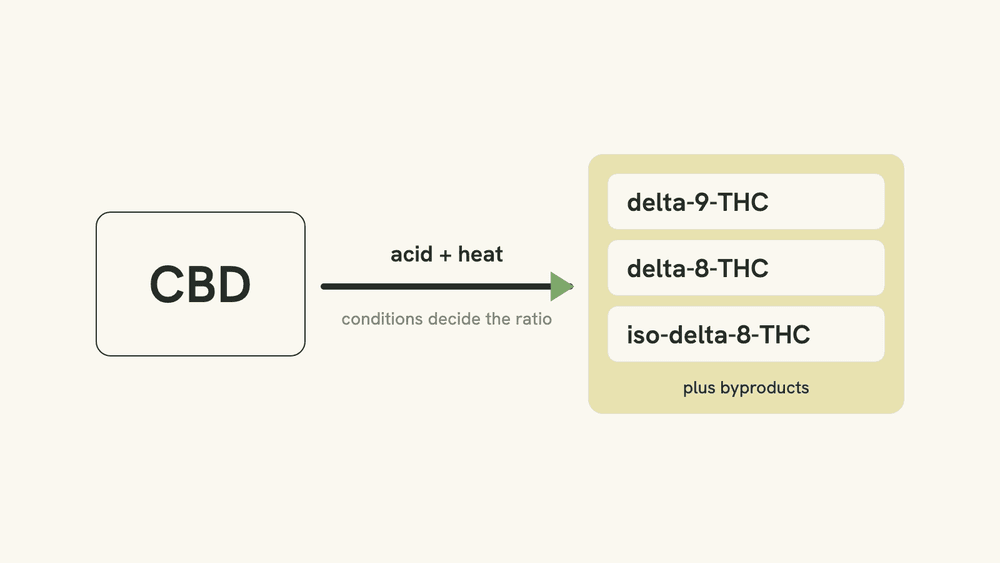
The step that makes delta-8: what an acid-catalyzed conversion actually does
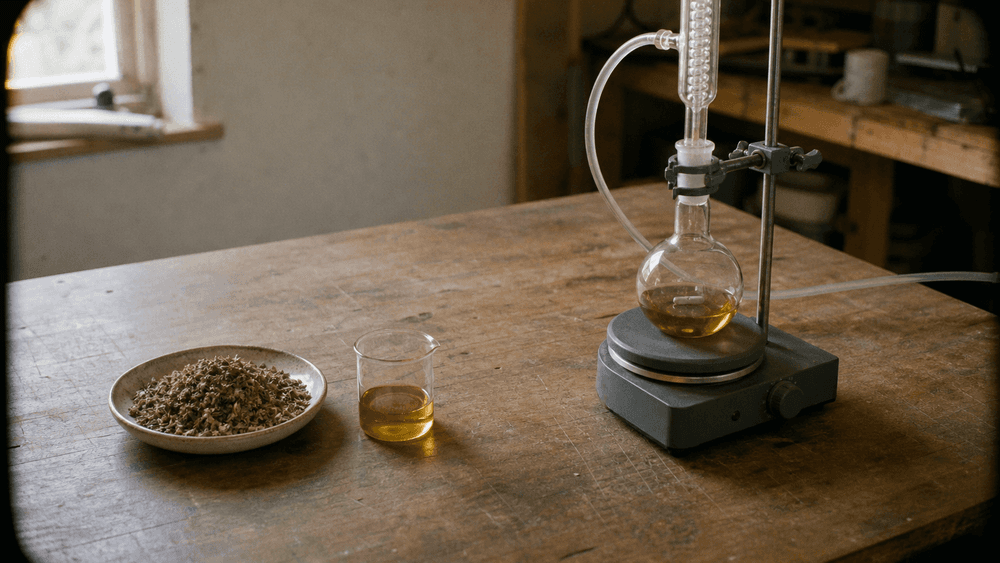
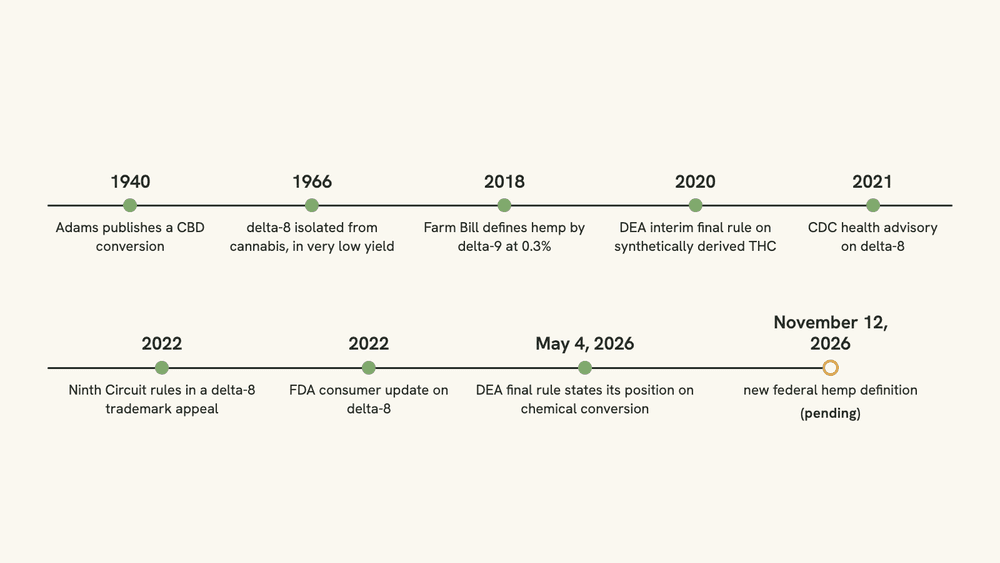
Acid-catalyzed cyclization of CBD does not have one product. It has several, and which one you get depends on the conditions. A 2026 paper in Organic and Biomolecular Chemistry combined bench experiments with computational modeling and worked out why the same starting material yields delta-9-THC, delta-8-THC or iso-delta-8-THC depending on the acid and the temperature. Under one class of acid, harsher conditions push the mixture toward delta-8; under another, longer and hotter runs favor the iso form instead. Delta-9 is the kinetic product; delta-8 and iso-delta-8 are the thermodynamic ones. Two batches made from the same CBD under different conditions are two different mixtures. None of this is new chemistry, either: Roger Adams published a conversion of cannabidiol into a product with marijuana activity in the Journal of the American Chemical Society in 1940, a paper cited here secondhand through the analytical work below because it has no stable online record to link. This is bench chemistry and computation, not a survey of anything on sale.
How wide is the variation? A 2024 study in Food Chemistry ran three independent analytical methods across eight acid-treated CBD samples and found delta-8-THC anywhere from 0% to 89% by weight, delta-9-THC up to 49%, delta-8-iso-THC up to 55% and delta-4,8-iso-THC up to 17%, plus three hydrated THC isomers. Keep the two halves of that paper apart. The 0% to 89% range describes CBD the researchers treated with acid in a laboratory, not products anyone bought. Separately, the same team analyzed commercial delta-8 gummies and reported overclaimed delta-8, excessive delta-9, and undeclared delta-8-iso-THC and delta-4,8-iso-THC. The first result shows how much room the reaction has. The second shows that the room gets used. This is a Netherlands and China collaboration, not a US market survey, and the gummy work is an illustration rather than a prevalence estimate.
What analysis actually finds in delta-8 products
In a 2022 study in Chemical Research in Toxicology, researchers at the University of Rochester analyzed 27 delta-8 vaporizer products from 10 brands using quantitative NMR, gas chromatography mass spectrometry and ICP-MS. None of the 27 carried accurate delta-8 labeling. Eleven contained cutting agents that were not on the label. Every one of the 27 contained reaction side-products, including delta-4(8)-iso-THC at between 2.36% and 12.79%, and olivetol was identified in 22 of them. Measured delta-8 varied by as much as 40% from the labeled value. The limits belong in the same breath: these were 27 vaporizer products bought in a single purchasing round in 2021, with the brands anonymized, no gummies and no tinctures, and "accurate" was the authors' own criterion, meaning their measured value against the value each brand reported. It is not a claim that 0 of 27 fell inside some published tolerance band.
In 2023, a group at the University of Mississippi's National Center for Natural Products Research took one commercial delta-8 distillate and isolated eleven individual impurities, working out each structure by NMR and mass spectrometry: several iso-tetrahydrocannabinols, two hydroxy-hexahydrocannabinols, an epoxide, iso-tetrahydrocannabifuran, cannabicitran, olivetol and delta-9-THC. Four more compounds, including hexahydrocannabinol and delta-8-THCV, were identified in the chromatograms without being isolated. For many of them, that paper was the first report of their presence in a delta-8 product. What it is: a compound inventory, built from a screen of several products and deep isolation work on one distillate. What it is not: a prevalence study, or evidence of toxicity. It tells you what can be in there, not how often it is.
| Compound | What it is | Where it was reported |
|---|---|---|
| Delta-9-THC | The isomer the current federal hemp definition measures | Meehan-Atrash 2022 (27 vaporizers); Radwan 2023; Huang 2024; Gul 2024 (21 vaporizers); Kaczor 2024 (7 of 20 retail items) |
| Delta-4(8)-iso-THC and other iso-THCs | Byproducts of the same acid-catalyzed reaction | Meehan-Atrash 2022 (all 27 samples, 2.36% to 12.79%); Radwan 2023; Huang 2024; Gul 2024 |
| Olivetol | A precursor used in the synthesis of THCs | Meehan-Atrash 2022 (22 of 27); Radwan 2023; Gul 2024 |
| 9-ethoxy-hexahydrocannabinol | A documented byproduct of the conversion | Meehan-Atrash 2022 |
| Hexahydrocannabinol (HHC) | A hydrogenated cannabinoid; DEA gave it its own Schedule I drug code effective May 4, 2026 | Radwan 2023 (identified in the chromatograms, not isolated) |
| Iso-tetrahydrocannabifuran | A cannabinoid that had not been described before it was first reported here | Meehan-Atrash 2022; Radwan 2023 |
| Unlabeled cutting agents | Diluents present in the product but absent from the label | Meehan-Atrash 2022 (11 of 27) |
| Metals including lead, mercury, nickel and chromium | Measured by ICP-MS; the authors call them likely leachates from vaporizer components | Meehan-Atrash 2022 (10 devices tested) |
Why does none of this show up on the certificate that came with the product? Because a cannabinoid potency panel is a targeted test. It answers "how much of these named compounds is in here," against a reference standard for each one, and it is silent about everything it was not built to look for. Accreditation works the same way: NIST's laboratory accreditation program grants accreditation against a scope listing the specific test methods a laboratory has been accredited for, not against a general ability to find anything unexpected. The point is not that laboratories are careless. It is that in 2024 a team had to develop and validate a new gas chromatography method specifically to quantify delta-8 alongside thirteen named impurities, publishing detection limits of 1.5 micrograms per milliliter for most of them. If that method had to be built, the routine panel was not already running it. Applied to 21 commercially marketed vaping products, it found all of them above the 0.3% trans-delta-9-THC figure the federal hemp definition uses for the crop, which is a comparison against a crop standard rather than a determination about any product's legality. Two of that paper's authors are employed by the US Pharmacopeia, which sells reference standards for this kind of analysis.
The 2022 vaporizer study found something more useful than a bad number. It found why the number was bad. For one brand, the sum of delta-8 plus delta-4(8)-iso-THC in each product matched the delta-8 content that brand reported, which the authors read as evidence that the HPLC-UV method named on its certificate of analysis "cannot discriminate the two." The byproduct was not missing from the report. It was being counted as the product. Another brand printed a single reported figure, 93.0821%, on five different products whose measured delta-8 ranged from 62.7% to 78%: six significant figures on a number that was off by up to thirty points. That is one brand's inference in one 27-product study, not a verdict on laboratories in general. It is also the clearest published demonstration of why what a potency panel is actually counting matters more than the size of the headline number, and why whether the lab is independent of the seller is a separate question again.
Vaporizers are not the whole market, so here is the retail counterpart. In a 2024 paper in the Journal of Medical Toxicology, toxicologists bought 20 delta-8 products from stores in Pittsburgh and measured them by validated UPLC-MS/MS. Delta-8 was detected in 19 of the 20. The correlation between advertised and measured delta-8 was weak, a Spearman's rho of 0.40. Delta-9-THC turned up in 7 of the 20. And products carrying a "lab tested" label were associated with a larger gap between advertised and measured content, not a smaller one. Twenty products, one city, a purchase window in 2022 and 2023, brands not named, and an assay panel covering only delta-8, delta-9 and CBD, so it says nothing at all about the iso-THCs. A correlation is not a pass rate, and this one should not be converted into a percentage that matched its label.
So are those byproducts harmful? A 2023 review in Cannabis and Cannabinoid Research assembled what its authors call the first comprehensive list of documented byproducts of that reaction and concluded that, apart from delta-8 itself, the compounds in those mixtures have not been subjected to any human toxicological evaluation. Read that carefully. It is a statement about missing evidence, not a finding of harm. Nobody has shown these compounds are dangerous. Nobody has shown they are not. That paper is a narrative review arguing a position rather than new measurement, and its authors state their own: one runs an integrative clinical practice and one leads a chemistry company, which is worth knowing when a review makes a case.
Is delta-8 weaker than delta-9? Two 2025 trials tested it
The line every comparison page repeats is that delta-8 is about half as strong as delta-9. That estimate is real, and it has an address. CDC's 2021 health advisory to clinicians put delta-8 at "about 50-75% as psychoactive as delta-9 THC." Follow CDC's own citations and the estimate rests on a 1984 book chapter and on a 1973 clinical pharmacology paper by Hollister and Gillespie, which is where the human comparison originally came from. No figures from that 1973 work are printed here: a paper of that age, with no abstract in the public record, should carry provenance and nothing more. The estimate is CDC's, not ours, and it is worth knowing how old the evidence under it is.
In 2025 researchers at Johns Hopkins, with co-authors at SAMHSA, tested it directly, twice. In a randomized, double-blind, within-subjects crossover trial, 20 healthy adults inhaled vaporized delta-8, vaporized delta-9 or placebo across five outpatient sessions. Every delta-8 condition and the delta-9 condition produced subjective drug effects that differed from placebo; delta-9 produced stronger "drug effect" and "unpleasant" ratings than the lowest delta-8 condition; and no other subjective measure separated the two. Less of the psychoactive 11-hydroxy metabolite formed after delta-8. A companion oral trial in 19 adults eating brownies of known cannabinoid content found delta-8 clearly weaker than delta-9 milligram for milligram, and then found no pharmacodynamic difference between its largest delta-8 condition and the delta-9 condition, with comparable drug liking, which the authors read as similar misuse potential. Both trials are small and acute, both used material of verified content, a corrigendum to the oral trial was published in the same journal in 2025 (PMID 40442005) and could not be read on our cutoff date, so no figure-level number from it appears here, and two of the authors declare paid consulting relationships with cannabis and pharmaceutical companies. What these trials do not support is the folk reading of that CDC estimate: that a weaker molecule guarantees a weaker experience.
The safety record, in numbers rather than adjectives
Between January 1, 2021 and December 31, 2022, US poison centers logged 5,022 cases in which delta-8, delta-10 or THC-O acetate was the primary substance, and delta-8 was 98.1% of them. The rate per 100,000 people rose 89.1% across those two years, from 0.55 to 1.04. Children under six accounted for 30.1% of cases, with a mode at age two, and 94.2% of all exposures were ingestions. The most commonly recorded effects were mild central nervous system depression at 25.0%, tachycardia at 23.0% and agitation at 15.6%. More than a third, 38.4%, had a serious medical outcome. Those are calls to poison centers, not a measure of how many people were harmed. The system is passive, it has no denominator of users, the product identity is whatever the caller reported, and, as the previous section shows, the label may have been wrong anyway.
The federal counts are older and smaller. The FDA received 104 adverse-event reports involving delta-8 products between December 1, 2020 and February 28, 2022. Fifty-five percent required intervention or hospital admission, and 66% followed eating a delta-8 food product such as a brownie or a gummy; the effects listed include hallucinations, vomiting, tremor, anxiety, dizziness, confusion and loss of consciousness. Over an overlapping window, from January 1, 2021 to February 28, 2022, national poison control centers logged 2,362 exposure cases, 41% of them involving people under 18, with one pediatric case coded with a medical outcome of death. Two caveats belong in the same breath. The poison-center series starts on January 1, 2021 because that is the day a delta-8 product code was added to the database, so it begins at zero by construction and cannot be compared with anything earlier. And both of those windows closed on February 28, 2022: we reread the FDA page on August 1, 2026 and those were still the only counts it carries, so treat them as four-year-old federal numbers rather than a picture of the market now.
The earliest federal count is CDC's. From January 1 to July 31, 2021, 660 delta-8 exposures were recorded under that new product code, plus one case recoded from October 2020. Of those 661, 18% required hospitalization and 39% involved patients under 18. CDC's national syndromic surveillance program, which matches emergency-department chief complaints by text, logged suspected delta-8-related visits climbing month by month through 2021, from 3 in January to 48 in July, with 73% of them in two federal regions covering the South. CDC says plainly that those numbers are likely an underestimate, and chief-complaint text matching is a blunt instrument in either direction. The sentence from that advisory that has aged best is the chemical one: this conversion "may create harmful by-products that presently are not well-characterized." Nearly five years later the compounds have been characterized chemically. They still have not been characterized toxicologically.
Two more findings keep this honest. First, most of what users themselves report is not exotic. A 2023 case series in the Journal of Cannabis Research sampled 10,000 posts from a delta-8 forum and found 335 describing an adverse event, most often psychiatric at 41.2%, respiratory at 29.3% and nervous system at 23.3%, with anxiety, cough and paranoia the leading individual terms; the authors concluded that most of these resemble acute cannabis intoxication. That is self-report on a forum, from a self-selected population, with unverifiable products, and one author declares consulting fees from a web analytics company. Second, an analysis of the same poison-center data compared US states and found that in 2022 the mean report rate was 1.36 per 100,000 where delta-8 was unregulated against 0.17 where it was banned. That is an ecological association at state level, not a causal finding, and it is a report rate rather than a harm rate. On the question most people ask next: standard immunoassay panels are not designed to separate THC isomers, which is covered properly in how THC isomers behave on a screening panel.
The sharpest end of that record is accidental ingestion by small children. A 2025 analysis in Injury Epidemiology examined 232 single-substance delta-8 ingestions in children under six reported to poison centers, with a median age of three. Central nervous system depression was recorded in 75.5% of them, and children who had swallowed more had significantly higher odds of both severe and prolonged toxicity than children who had swallowed the least. Every one of those cases is an accident. The amounts are estimated from what a caregiver read on a package that, as this article has spent three sections explaining, may not have been accurate in the first place. None of it is a reference for anybody's use of anything.
Delta 8 vs CBD in the law: two federal positions, one date on the calendar
The 2018 Farm Bill never mentions delta-8. What it does is define hemp, at 7 U.S.C. 1639o, as the plant and "all derivatives, extracts, cannabinoids, isomers, acids, salts, and salts of isomers" with "a delta-9 tetrahydrocannabinol concentration of not more than 0.3 percent on a dry weight basis." One cannabinoid is named and one number is set. Everything argued since has been about what those words cover, and that definition is in force through November 11, 2026. How the 0.3% figure is actually measured is the subject of how total THC is actually measured, and the federal and state layering that decides what is lawful where you live sits in our legal overview. This section stays on the narrow question of chemically converted cannabinoids.
Here the honest answer is that two federal positions point in opposite directions and both are real. DEA's stated position, most recently in a final rule published and effective on May 4, 2026, is that "tetrahydrocannabinols produced through chemical conversion, even when hemp derived are considered synthetically produced for purposes of the CSA," and so do not qualify as tetrahydrocannabinols in hemp. Read that with its context attached: the rule itself is about hexahydrocannabinol, not delta-8, and the sentence is DEA's general statement of position in a rulemaking, not a court's holding. Its 2020 interim final rule had already said that "all synthetically derived tetrahydrocannabinols remain schedule I controlled substances," without defining the contested word. Against that, on May 19, 2022 the Ninth Circuit held in a trademark appeal that "the plain and unambiguous text of the Farm Act compels the conclusion" that the delta-8 products before it were lawful, and that an intent to cover only industrial hemp "appears neither in hemp's definition nor in its exemption from the Controlled Substances Act." That was a preliminary-injunction ruling in a private dispute, on the record available, interpreting the 2018 sentence. State law is a separate layer again and varies. None of this is legal advice, and we draw no conclusion here about which reading will prevail.
On November 12, 2026 the federal definition of hemp will change under section 781 of Public Law 119-37, and one clause in it reads as though it were written with this category in mind. From that date, hemp-derived cannabinoid products will be excluded from the definition if they contain cannabinoids that "are capable of being naturally produced by a Cannabis sativa L. plant" and "were synthesized or manufactured outside the plant." Delta-8 occurs in the plant in trace amounts and is manufactured outside it. What that will mean in practice is not settled here or anywhere: the Congressional Research Service wrote in an analysis dated December 3, 2025 that "it remains unclear if and how federal law enforcement will enforce the new prohibitions when the new definition goes into effect," and that both FDA and DEA "may lack the resources to broadly enforce" them. The fuller treatment of that definition, including the total-THC test and the per-container limit, is in the full text of the new definition.
As of August 1, 2026 the change is scheduled, not final. FDA has not published the cannabinoid lists section 781 requires, so the exact edge of the new definition is not yet knowable. Bills to repeal the change (H.R. 6209, referred to subcommittee on January 13, 2026) or to push it back by three years (H.R. 7010 and H.R. 7024, referred to subcommittee on May 20, 2026, and S. 3686, referred to committee on January 15, 2026) were introduced and sent to committee, where they remain. None of them has had floor action. A bill is not a law, and neither is a bill's absence.
What you can and cannot tell from a delta-8 label
- 1Read the analyte list on the certificate of analysis, not just the headline number, and notice which compounds are absent from that list entirely.
- 2Find the method line. HPLC-UV, GC-FID and LC-MS/MS are not interchangeable, and a method separates only what it was validated to separate.
- 3Check whether delta-9-THC is reported at all, and in what units. It is one of the most frequently found unlabeled compounds in the published surveys.
- 4Match the batch number and the test date on the report against the physical item, and check whether the same figure turns up across several different products.
- 5Treat unusual precision as a question, not a reassurance. In one published study a figure carried to six significant figures was off by up to thirty points.
- 6Remember that a lab-tested badge is a claim, not a document. In one 2024 analysis, items carrying that badge showed a larger gap between advertised and measured content.
- 7Check whether the laboratory is named, and whether it is independent of the seller. An unnamed lab cannot be checked at all.
- 8Accept the limit. A targeted panel cannot tell you about compounds it was never asked to look for, and for this category the literature says there are several.
Each of those steps has a longer version elsewhere on this site. Reading the method line on a lab report walks through a certificate section by section. Whether a testing claim means anything covers independence and accreditation, which is the part a badge cannot carry. If your question is really about the law rather than the chemistry, where the state rules sit is the place to start, and the federal definition that changes in November has the statutory detail. And if it is about effects, the intoxication question in full answers what this page has deliberately left alone.
What this comparison does not settle
Four limits belong on this page in plain sight. The analytical work is small and dated: 27 vaporizers bought in 2021, 21 vaping products, 20 retail items from one city, one distillate taken apart compound by compound. None of that is a survey of what is on shelves today, and none of it names a brand. The surveillance data is passive, which means it counts reports rather than harms and has no denominator of users, so a rising rate can reflect a rising number of products, a new product code, or better recognition by the people taking the calls. The human potency evidence is two acute crossover trials with 20 and 19 participants, using material of verified content, which is the opposite of the retail situation described above. And the central toxicology question is genuinely open: the byproducts have been identified, not evaluated. Anyone telling you confidently that delta-8 is dangerous, or that it is fine, is ahead of the evidence in one direction or the other.
One more thing needs saying, because a CBD company writing about delta-8 has an obvious interest and this page should be read with that in mind. Planntz sells CBD. It does not sell delta-8. Delta-8's psychoactivity is not a defect; it is the property some adults are deliberately looking for, and in a 2022 survey of 4,348 adult cannabis users, 16.7% of recent cannabis users reported delta-8 use, with legal access named as a primary motivation. That was an online convenience sample of people who already use cannabis, not a prevalence estimate for US adults. The category is not marginal either: a 2024 JAMA analysis of the Monitoring the Future survey reported that 11.4% of the 2,186 US 12th graders surveyed between February and June 2023 said they had used delta-8 in the past year, self-reported and school-based, which describes adolescents rather than adult buyers. This article is not an argument that one cannabinoid is good and the other is bad. It is an argument that a converted cannabinoid raises questions an extracted one does not, and that those questions have partial answers you are entitled to see.
Questions people actually ask
Almost all of it is made from CBD. The FDA says delta-8 is not found in significant amounts in the cannabis plant, and that concentrated amounts are typically manufactured from hemp-derived cannabidiol, with additional chemicals needed to do the converting. The reaction is an acid-catalyzed cyclization, and it does not produce a single compound. A 2026 study in Organic and Biomolecular Chemistry showed that the same CBD yields delta-9-THC, delta-8-THC or iso-delta-8-THC depending on which acid is used and at what temperature, which is why two batches run under different conditions are two different mixtures.
Both answers are defensible, which is exactly why it is disputed. Delta-8 does occur in the cannabis plant in trace amounts, and it was first isolated from cannabis in 1966, in very low yield. The delta-8 in commercial products is not that; it is made in a reactor from CBD. DEA's stated position, in a final rule published on May 4, 2026, is that tetrahydrocannabinols produced through chemical conversion, even when hemp derived, are considered synthetically produced for purposes of the Controlled Substances Act. A federal appeals court read the 2018 statutory text differently in 2022. Both are covered above, with dates.
They are not on the same scale. CBD is not intoxicating; delta-8 is. The FDA states that delta-8 has psychoactive and intoxicating effects similar to delta-9 THC. Comparing the two by strength is a bit like comparing decaf coffee with beer: the question assumes one axis where there are two. If what you want is the intoxication question itself, our article on whether CBD gets you high covers it in full.
Nobody can answer that honestly at the level of the word delta-8, because what is in the container varies. What can be said: US poison centers logged 5,022 cases involving delta-8, delta-10 or THC-O acetate between 2021 and 2022, 98.1% of them delta-8, with 30.1% in children under six and 38.4% recording a serious medical outcome, from a passive reporting system with no denominator of users. And a 2023 review found that, apart from delta-8 itself, the byproducts of the conversion have not been subjected to any human toxicological evaluation. That is missing evidence, not proof of harm, and it is why the composition question matters more here than it does for an extracted cannabinoid.
Because a potency panel is a targeted test. It quantifies the compounds it was built and calibrated to quantify, against a reference standard for each one, and it says nothing about the rest. In the 2022 vaporizer study, one brand's own certificate named HPLC-UV as its method, and the researchers concluded that the method cannot discriminate delta-8 from one of its byproducts, so the byproduct was in effect being counted as delta-8. Our guide to reading a certificate of analysis covers what a panel does and does not include.
Standard immunoassay panels are not designed to distinguish THC isomers, so a delta-8 product can produce a positive result. That question has its own article with the testing detail, and we would rather send you there than summarize it badly here.
This is a persistent claim, and the laboratory evidence does not support it. Federal forensic scientists incubated three THC-free CBD products in synthetic gastric fluid for three hours and measured what formed; a very small amount of delta-9 THC appeared, and no delta-8 THC formed at all (Hart and colleagues, Journal of Analytical Toxicology, 2023). That is a beaker rather than a stomach, three products rather than a market, and it is a limited body of evidence, but there is no measured basis for the idea that taking CBD produces delta-8 inside you.
Two sentences to keep. Delta-8 and CBD start as the same molecule from the same plant, and what separates them is a reaction, not a species and not a statute. And the document most people rely on to check a converted product, the certificate of analysis, is built to count named compounds, so it can be entirely accurate about what it measured and still tell you very little about what else the reaction left behind. If the question underneath yours is what is lawful where you happen to be standing, the federal and state picture is the better place to take it. This is general information current as of August 1, 2026. It is not legal advice and it is not medical advice.
Writing about hemp, wellness and the small rituals that keep us balanced.