CBD and Blood Pressure Medication: Which Drug You Take Changes the Answer
Page one gives one verdict for five drug classes. Lisinopril is not metabolized at all, amlodipine is a CYP3A substrate, and losartan has to be metabolized in order to work. Here is what each FDA label says, and who was actually in the trial run in hypertensive patients.
Type CBD and blood pressure medication into a search box and you get one answer for an entire medicine cabinet. That cabinet holds at least five different pharmacologies. One of those drugs is not metabolized at all, another has to be metabolized before it works, and the label on the bottle decides which conversation you are actually having.
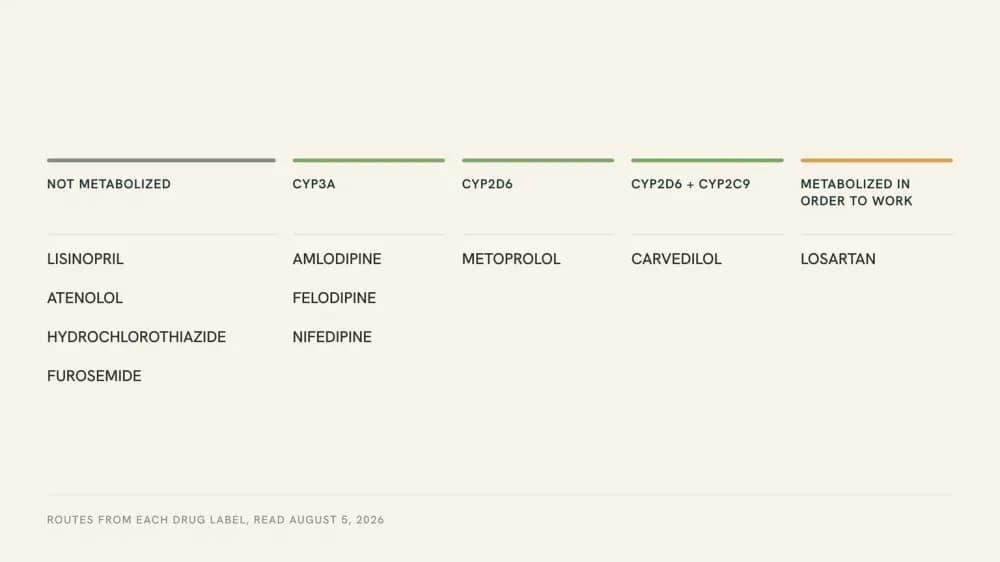
The short version, before the detail. The FDA-approved labels for these medicines put them on at least five different clearance routes: lisinopril is excreted unchanged and is not metabolized at all, amlodipine is a CYP3A substrate, metoprolol runs mainly through CYP2D6, carvedilol runs through CYP2D6 and CYP2C9, losartan has to be metabolized by CYP2C9 and CYP3A4 before it becomes active, and hydrochlorothiazide is not metabolized at all either. As of August 5, 2026, no clinical study has given CBD to people taking a blood pressure medicine at a treatment dose and then measured that drug's blood levels. The randomized trial that comes closest was designed to enroll hypertensive patients on ACE inhibitors, calcium channel blockers and diuretics, it measured their blood pressure for five weeks, and it never measured anyone's drug level. That is the honest state of the field, and the person who wrote the prescription is the person to raise CBD with.
What "CBD and blood pressure medication" is actually asking
Two different questions get merged into one on the first page of results, and they need different evidence. The first is pharmacokinetic: does CBD change the level of the medicine in your blood by interfering with the enzymes or transporters that clear it? That one is answered by drug labels and by interaction studies, one drug at a time. The second is hemodynamic: do CBD and the medicine act on the same physiology, so that whatever each one does to a blood pressure reading lands on top of the other? That one is answered by trials that measure blood pressure in people. An answer to either question does not transfer to the other, and page one routinely quotes evidence for the second while making a claim about the first. Our general framework for how CBD interacts with other medications carries the enzyme primer and the wider drug list; if you want the plain chemistry first, start with what cannabidiol actually is. This page takes the blood pressure cabinet one drug at a time.
The overlap is not rare. A 2025 cross-sectional survey in the Journal of Clinical Medicine handed questionnaires to 681 eligible respondents in the adult and pediatric emergency departments of one Level 1 trauma center in eastern North Carolina. 254 of them (37.3%) reported CBD use in the household, and among those, 69.7% reported concurrent use of at least one medication the authors classified as carrying drug-interaction risk. The two most common prescription categories were antidepressants (64.4%) and antihypertensives (41.8%). Read the design before the number: this is self-reported household use at a single hospital, the median respondent was 34, and the interaction risk was assigned by the authors from an FDA enzyme table rather than observed in anybody. It is not a national estimate. It is a reason this question keeps getting typed into search boxes.
Your blood pressure medication's route, drug by drug
Every medicine below has an FDA-approved label, and that label states how the body clears it. We read all of them on DailyMed on August 5, 2026. Start with the one page one names most often: the lisinopril label says in section 12.3 that lisinopril "does not undergo metabolism and is excreted unchanged entirely in the urine". A drug with no metabolism has no metabolism to inhibit. That is the single most useful correction available on this topic, and notice what it does and does not do: it closes the metabolic question for that drug and it closes nothing else. The amlodipine label is the opposite case, stating that amlodipine is "extensively (about 90%) converted to inactive metabolites via hepatic metabolism" and that coadministration with moderate and strong CYP3A inhibitors "results in increased systemic exposure to amlodipine and may require dose reduction". The metoprolol label puts that drug somewhere else entirely: primarily metabolized by CYP2D6, and "not a significant P-glycoprotein substrate".
| Medicine (class) | What its own FDA label says | What that does and does not imply |
|---|---|---|
| Lisinopril (ACE inhibitor) | "Lisinopril does not undergo metabolism and is excreted unchanged entirely in the urine." | There is no metabolic step available to inhibit. It says nothing about anything other than metabolism, and it is not a green light. |
| Amlodipine (dihydropyridine calcium channel blocker) | About 90% converted to inactive metabolites by hepatic metabolism. CYP3A inhibitors, moderate and strong, increase systemic exposure and may require dose reduction. Diltiazem 180 mg/day raised amlodipine exposure 60%. | A genuine CYP3A route, established by the label. The 60% figure belongs to diltiazem, a named drug, and not to anything else. |
| Felodipine and nifedipine (same class as amlodipine) | "Felodipine is metabolized by CYP3A4", and its bioavailability was increased approximately 2-fold with grapefruit juice. Nifedipine: grapefruit juice roughly doubled AUC and Cmax, and the label says to avoid it. | Same class, opposite grapefruit answer from amlodipine. Grapefruit juice is not CBD, and neither label names a cannabinoid. |
| Metoprolol (beta blocker) | "LOPRESSOR is primarily metabolized by CYP2D6" and is "not a significant P-glycoprotein substrate". Strong CYP2D6 inhibitors such as quinidine, fluoxetine, paroxetine and propafenone were shown to double metoprolol concentrations. | A different enzyme from the whole CYP3A story. The doubling figure belongs to those four named drugs. The label also notes CYP2D6 is absent in about 8% of Caucasians. |
| Carvedilol (beta blocker) | "The primary P450 enzymes responsible for the metabolism of both R(+) and S(-)-carvedilol in human liver microsomes were CYP2D6 and CYP2C9 and to a lesser extent 3A4, 2C19, 1A2, and 2E1." | The one beta blocker with a CYP2C9 route, which makes it the only place the losartan finding below is even conversationally relevant. Nobody has tested it. Its own label says interactions with potent CYP2D6 inhibitors "have not been studied". |
| Atenolol (beta blocker) | "TENORMIN undergoes little or no metabolism by the liver, and the absorbed portion is eliminated primarily by renal excretion." | Same class as metoprolol and carvedilol, opposite pharmacology. "Beta blockers" is never one answer. |
| Losartan (angiotensin receptor blocker) | "Substantial first-pass metabolism by cytochrome P450 enzymes", converted in part to an active metabolite "responsible for most of the angiotensin II receptor antagonism". About 14% of an oral dose becomes that metabolite. "In vitro studies indicate that cytochrome P450 2C9 and 3A4 are involved." | The direction-flip case: this drug has to be metabolized in order to work, so blocking the enzyme would point the effect down, not up. "In vitro studies indicate" is the label's own hedge and it stays attached, and no study has measured any of this with CBD in a person taking losartan as treatment. |
| Hydrochlorothiazide (thiazide diuretic) | "Hydrochlorothiazide is not metabolized but is eliminated rapidly by the kidney." | Rules out a metabolic interaction. It establishes nothing at all about anything else, in either direction. |
| Furosemide (loop diuretic) | "Furosemide is predominantly excreted unchanged in the urine." | Not a cytochrome story. The label does note a glucuronide as the major biotransformation product, which is a different family of enzymes and has not been studied with CBD. |
Two of the most-prescribed medicines in that table are not on the cytochrome map at all. Atenolol's label says outright that it undergoes little or no metabolism by the liver, and the hydrochlorothiazide label says the drug is not metabolized but eliminated rapidly by the kidney. Furosemide's label says it is predominantly excreted unchanged in the urine. Carvedilol's label is the interesting outlier in its class, naming CYP2D6 and CYP2C9 as its primary routes. So a page that answers this question with one sentence about the liver has already got at least three of these nine medicines wrong before it starts.
The grapefruit analogy deserves a paragraph of its own, because it is the most repeated line on this topic and it falls apart inside a single drug class. The felodipine label states in its clinical pharmacology section that "the bioavailability of felodipine was increased approximately 2-fold when taken with grapefruit juice", and its drug interactions section puts the same result as "more than 2-fold increase in the AUC and C max". The nifedipine label reports approximately a doubling in nifedipine AUC and Cmax with grapefruit juice, and tells patients to avoid it. Amlodipine, the most prescribed of the three and a member of the same chemical family, says the opposite in as many words: "Co-administered cimetidine, magnesium-and aluminum hydroxide antacids, sildenafil, and grapefruit juice have no impact on the exposure to amlodipine." Its label also records that erythromycin coadministration in healthy volunteers did not significantly change amlodipine systemic exposure.
What CBD has actually been measured to do to those enzymes
There is exactly one cannabidiol product in the United States whose interaction program was reviewed by a regulator, and its label is public. Reading the FDA-approved cannabidiol oral solution label on DailyMed on August 5, 2026, section 12.3 reports that coadministration of that medicine at 750 mg twice daily with a single 2.5 mg dose of midazolam, a sensitive CYP3A4 substrate, "did not result in changes in plasma concentrations of midazolam compared to midazolam administered alone". Keep the units attached, every time: 750 mg twice daily is 1,500 mg a day of a prescription oral solution, given inside an epilepsy program, and midazolam is a probe drug chosen because it is easy to move, not a blood pressure medicine. A null result in a probe study is not a safety finding, and it is not a finding about amlodipine. What it does do is undercut the sentence page one repeats without a source, that CBD blocks CYP3A4 and therefore your calcium channel blocker builds up. At the highest dose a regulator has reviewed, the most sensitive CYP3A4 probe available did not move.
The same label tells prescribers which routes to consider a dose change for, and the list is worth reading for what is missing as much as for what is on it. Section 7.2 names substrates of CYP1A2, CYP2C8, UGT1A9 and orally administered P-glycoprotein, plus CYP2B6 and CYP2C19 substrates, plus a specific line about everolimus. CYP3A4 substrates are not on that list. Neither are CYP2C9 substrates, and that absence cuts against the losartan section below rather than for it, which is why we are printing it here rather than leaving it out. Absence from a label list is not proof that nothing happens. It is a record of what one regulator reviewed and what it asked for, on one formulation, at doses used to treat seizures.
Now the part that cuts the other way, and it is the most interesting number in the whole label. The same document reports that coadministration of that cannabidiol oral solution at 12.5 mg/kg twice daily with the P-glycoprotein and CYP3A4 substrate everolimus, 5 mg, in healthy subjects "led to an approximately 2.5-fold increase in everolimus mean Cmax and AUC", and section 7.2 files that under Orally Administered P-gp Substrates, adding that increases in exposure of other orally administered P-gp substrates such as sirolimus, tacrolimus and digoxin may be observed. That is transport, not metabolism: P-glycoprotein is a pump in the gut wall that throws drug molecules back out before absorption finishes. So the biggest measured effect on the label belongs to a pathway most consumer pages never mention. Two things keep it in proportion. 12.5 mg/kg twice daily is roughly 1,875 mg a day for a 75 kg adult, and none of the nine blood pressure medicines in the table above is flagged as a P-glycoprotein substrate. Metoprolol's label says explicitly that it is not one.
One more line from the same label, because it teaches the logic for the next section. It describes cannabidiol as a moderate inhibitor of CYP2C19 and a weak inhibitor of CYP1A2, then works the consequence out loud: for CYP2C19 substrates such as clopidogrel, where efficacy is mainly due to their active metabolites, concomitant use "may decrease plasma concentration of the active metabolite(s) and may therefore decrease efficacy". Clopidogrel is an antiplatelet drug and belongs to our page on anticoagulants and antiplatelets, not this one. It is quoted here only for its shape: when a drug has to be metabolized in order to work, blocking the enzyme points the effect down, not up. Hold that thought.
The one time a blood pressure drug was actually in the room
A 2023 double-blind randomized crossover study in Clinical Pharmacology and Therapeutics gave 18 healthy adults, 11 men and 7 women with a mean age of 30, a brownie on three separate occasions at least a week apart: with placebo, with a CBD-dominant cannabis extract containing 640 mg of CBD and 20 mg of THC, or with a THC-dominant extract containing 20 mg of THC. Thirty minutes later each participant swallowed a five-drug probe cocktail: 100 mg caffeine, 25 mg losartan, 20 mg omeprazole, 30 mg dextromethorphan and 2 mg midazolam. In the CBD-dominant arm, the authors report that the brownie "significantly increased the AUC GMR and Cmax,GMR of LOS by 63-77%", decreased the ratio of losartan's acid metabolite to losartan by 30%, and had no effect on losartan's half-life. Across the whole cocktail, exposure rose for omeprazole, losartan, midazolam and caffeine by 207%, 77%, 56% and 39%. Dextromethorphan, the CYP2D6 probe, was unaffected.
The 30% drop in the metabolite ratio is the number worth slowing down for, because it points the opposite way from the story on page one. Losartan behaves like a prodrug: its own FDA label says about 14% of an oral dose is converted to an active carboxylic acid metabolite "that is responsible for most of the angiotensin II receptor antagonism". The same label records what happened when a named CYP2C9 inhibitor was tested: "Fluconazole, an inhibitor of cytochrome P450 2C9, decreased the AUC of the active metabolite by approximately 40%, but increased the AUC of losartan by approximately 70% following multiple doses." Parent drug up, active metabolite down, measured in humans, printed by the manufacturer. The label adds that rifampin decreased the AUC of losartan and its active metabolite by 30% and 40% respectively. Two independent sources, one a prescription label and one a federally funded trial, point the same direction for this one drug: when a CYP2C9 inhibitor is in play, the parent rises and the active piece falls. That is a direction, not a verdict about CBD. Fluconazole is not CBD, the label's own hedge is that in vitro studies indicate the enzymes involved, and nobody has measured what losartan does to a blood pressure reading with CBD on board.
Now the limits, and they are large enough to change what the finding means. 25 mg of losartan is a probe dose in healthy volunteers, not treatment in a person with hypertension. The extract also contained 20 mg of THC, so this is not a CBD arm in any clean sense. It was a single dose. And no blood pressure was recorded at any point, because the study was built to read enzymes, not readings. The authors' own first limitation says so: the probe interactions were evaluated after a single dose of CBD plus THC, effects of chronic dosing were predicted with models rather than measured, and "a CBD multiple-dose study is needed to confirm these predictions because CBD may induce CYPs, particularly CYP3A". The funding line is worth printing whole, because it is unusual in this literature: the work was supported by the National Institutes of Health National Center for Complementary and Integrative Health, grant U54 AT008909, and in part by the National Institute on Drug Abuse, grants P01 DA032507 and T32DA07209. Four authors disclose consulting, advisory or contract relationships with cannabis and pharmaceutical companies, and the statement ends "All other authors declared no competing interests for this work." None of that tells anyone what to do about a losartan prescription, and this page does not.
The trial run in hypertensive patients, and who was in it
The closest thing that exists to a direct answer is a trial called HYPER-H21-4, published in Cannabis and Cannabinoid Research in 2024. Its full text sits behind a paywall that refused our request on August 5, 2026, so everything quoted here from the trial paper is the abstract, and we would rather say that than imply we read more. The abstract reports that "seventy patients with mild or moderate primary hypertension, who were untreated or receiving standard of care therapy, were randomly assigned to receive either 5 weeks of oral CBD or placebo-matched controls", then crossed over after a washout of more than two weeks. None of the six results we read on page one for this phrase cite it.
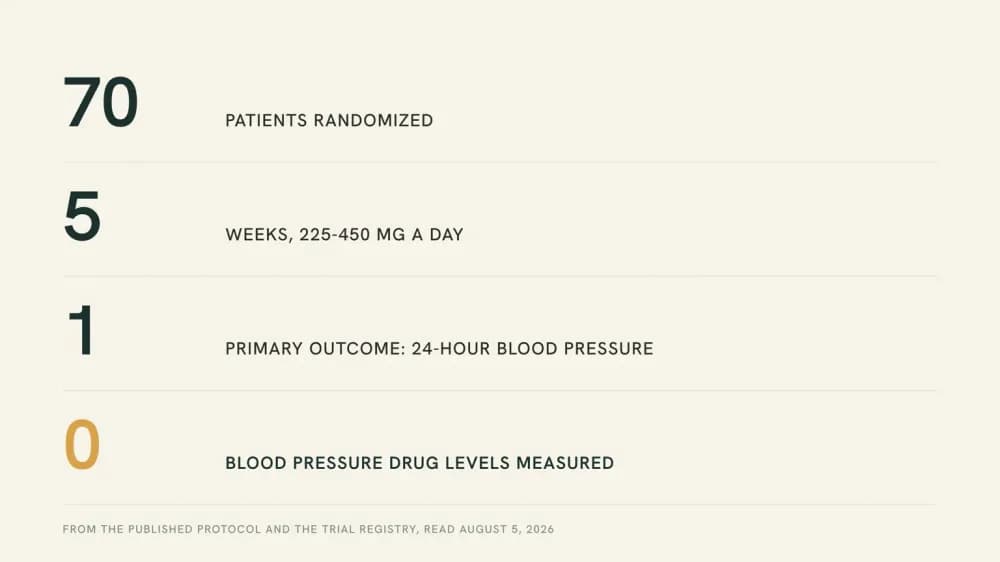
The trial's protocol paper is open access, and it is the reason this article can answer the question every competing page skips. The protocol specifies the regimen: participants first received 225 to 300 mg of cannabidiol depending on sex and weight, split across three doses a day for 2.5 weeks, then 375 to 450 mg split three times daily for the next 2.5 weeks, with the final daily dose described as 450 mg, approximately 4.5 mg/kg/day. The capsules were the DehydraTECH2.0 formulation, described in the protocol as the sponsor's "patented mixture of long chain fatty acid rich triglyceride oil and tetrahydrocannabinol-free, purified cannabidiol distillate oil", filled into size 00 vegan gel capsules at a target strength of 75 mg CBD per capsule as independently verified via HPLC. That is a patented, absorption-enhanced, pharmaceutical-grade capsule on a fixed three-times-daily schedule. It is not an oil anybody buys, and nothing measured in it transfers to one.
“At least 30 antihypertensive drug-naive subjects. At least 30 subjects treated with (1) angiotensin converting enzyme (ACE) inhibitors with or without diuretics or (2) ACE inhibitors with calcium channel blocker with or without diuretics.”
The exclusion criteria are just as informative. The protocol rules out "dual blood pressure therapy other than ACE inhibitors with diuretic or ACE inhibitors with Calcium Channel blocker with or without diuretics", giving ACE inhibitors with beta blockers as its own worked example. It also excluded heart failure, diabetes, chronic kidney disease, secondary hypertension, current smokers, cannabis users and liver disease, and enrolled ages 40 to 70. So the trial closest to this page's question was designed to include people taking ACE inhibitors, calcium channel blockers and diuretics, and designed to exclude anyone on a beta blocker regimen or an ARB. Those are the planned criteria, which is as far as the evidence goes: the actual split between treated and untreated participants is not published anywhere we could read, because the main paper is paywalled and the registry record, NCT05346562, showed no results posted when we checked it on August 5, 2026.
Here is how the abstract reports the measurements, with everything attached. In those 70 patients with mild or moderate primary hypertension, on a fixed 225 to 450 mg daily regimen of the patented capsule split three times a day for five weeks, in a placebo-controlled crossover design measured by 24-hour ambulatory monitoring, the abstract reports that administration of CBD "reduced average 24 h mean, systolic, and diastolic BP after 2.5 weeks" by -3.22 plus or minus 0.90 mmHg, -4.76 plus or minus 1.24 mmHg and -2.25 plus or minus 0.80 mmHg, all at p less than 0.05, and that "these values largely remained stable following the uptitration of CBD dosing". Every one of those numbers is a group average across those 70 people on that regimen. A 2 to 5 mmHg shift in a group average is a measurement in a study population. It is not a result for any individual, it is not a treatment effect, and it is not a claim that anything was improved. The uptitration clause is the part nobody quotes: going up to 450 mg a day did not move the numbers further, which is not how a dose-dependent drug effect usually behaves.
And here is the cleanest original point on this page. The registry lists 24-hour ambulatory blood pressure as the primary outcome, and a secondary outcome list that runs to more than twenty entries: physical activity in kilocalories, awakenings, total sleep and wake time, circulating cannabidiol, nitric oxide markers, C-reactive protein, internal carotid flow, cholesterol, catestatin, liver enzymes, heart rate, salt intake, sleepiness, memory, perceived stress, general health, anxiety and more. No antihypertensive drug concentration appears anywhere on that list. The trial that came closest to the reader's question never measured the thing page one says changes. That is not a criticism of the trial, which was answering a different question. It is the reason nobody can honestly tell you what CBD does to the level of your blood pressure medicine: the measurement has not been made.
The funding statement is worth reading whole rather than half. In the protocol paper: "This research was funded by Lexaria Bioscience Corp., Grant number 406-07/22-02/0008. All the authors had full access to all of the data obtained in the study and take full responsibility for the integrity of the data and accuracy of the data analysis. Lexaria Bioscience Corp. will not interfere with the results of the trial." The conflicts of interest section reads, in full: "The authors declare no conflict of interest." The registry lists the University of Split School of Medicine as lead sponsor with Lexaria Bioscience Corp. as an industry collaborator, registers the intervention as a dietary supplement, and lists the phase as Phase 1. So a company funded a trial of its own patented formulation and disclosed it in print, alongside a stated limit on its role. That is not a disqualification. It is a fact you are entitled to weigh, and it is exactly the kind of line worth looking for in any study a page quotes at you.
That overlap is easy to verify: the urotensin-II sub-analysis states in its own abstract that it included 51 patients from the randomized crossover study, and the other two name 54 and 64. One more trial appears in the same search and is often quoted alongside them: a double-blind, placebo-controlled crossover pilot published in Advances in Therapy in 2023, which the publisher also refused our fetcher, so this too is the abstract. It reports that 16 volunteers with untreated hypertension, eight of them female, were given oral cannabidiol at 150 mg every 8 hours or placebo for 24 hours, and that systolic blood pressure was about 5 mmHg lower and mean arterial pressure about 3 mmHg lower over that period. Note the word untreated: by design, nobody in it was taking a blood pressure medicine, so it cannot answer this page's question either. Sixteen people, 24 hours, and Europe PMC lists Lexaria BioScience Corp. as the funding agency. The authors' own conclusion is the sentence to carry out: "The clinical implications and safety of longer-term cannabidiol usage in treated and untreated hypertension remains to be established."
The study the whole internet is quoting, and who was in it
One paper does most of the work on page one, and of the six results we read, exactly one attaches an identifier to it. It is a 2017 randomized crossover study in JCI Insight. Its abstract says "nine healthy male volunteers were given 600 mg of CBD or placebo in a randomized, placebo-controlled, double-blind, crossover study", and reports that CBD reduced resting systolic blood pressure by 6 mmHg and stroke volume by 8 ml, with heart rate up about 10 bpm and cardiac output maintained. The Methods section describes the recruits as "ten healthy young male volunteers, mean age 24 years (range 19-29), with no underlying cardiovascular or metabolic disorders", and lists among the exclusion criteria "use of any medication".
Read that last clause again, because it is the whole point. The single study this entire category rests on structurally could not contain anyone taking a blood pressure medicine. No women. Nobody with hypertension. One 600 mg dose. Nine participants analyzed of ten recruited. The authors' own discussion asks for precisely the caution the internet dropped: these hemodynamic changes "should be considered for people taking CBD" and "further research is warranted to establish whether CBD has any role in the treatment of cardiovascular disorders". Their conflict statement, whole: "GW Pharma supplied the cannabidiol (CBD) and placebo but did not fund the study." A paper that says further research is warranted to establish whether there is any role is not a paper that established one.
Two follow-ups complicate it further, and both are usually left out. A 2020 randomized trial in the British Journal of Clinical Pharmacology gave 600 mg of CBD or placebo to 26 healthy males for seven days, 13 per group, and its abstract reports that CBD "significantly reduced resting mean arterial pressure" by 2 mmHg after acute dosing, "but not after repeated dosing". Its stated conclusion is that CBD reduces blood pressure at rest after a single dose "but the effect is lost after seven days of treatment (tolerance)". And a 2017 systematic review and meta-analysis in Frontiers in Pharmacology pooled 22 publications across six species, blood pressure in 344 subjects and heart rate in 395, and reported that "acute CBD dosing had no effect on BP or HR under control conditions". Six species means this is not a human meta-analysis, its authors rate the median study quality at 5 out of 9, and it was published before HYPER-H21-4 existed. None of that is reassurance and none of it is alarm. It is the reason one number should never be a headline: a measurement moving is not the same as an outcome moving, and here even the measurement disagrees with itself across studies.
The dose gap nobody prints
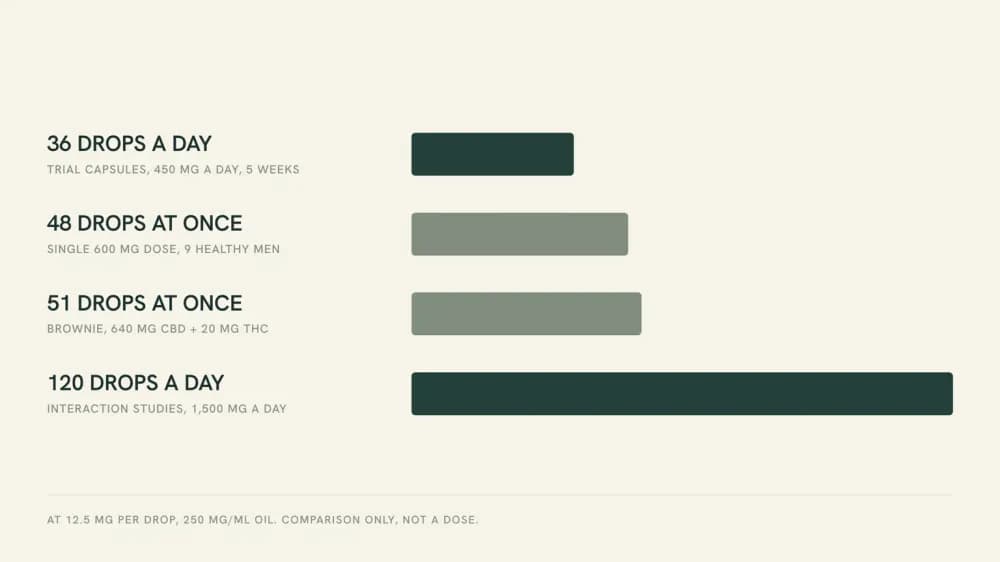
Every figure on this page comes from a fixed, weighed, pharmaceutical-grade dose, and not one of them is a serving of a consumer oil. It is worth doing the arithmetic once, in drops, purely to show the distance. Planntz Broad Spectrum and Full Spectrum CBD tinctures are 60 mL at 250 mg/mL, which is 15,000 mg of CBD per bottle, and a standard dropper delivers roughly 0.05 mL per drop, so roughly 12.5 mg of CBD per drop. Drop size varies with the dropper and with technique, so treat every conversion below as an order of magnitude rather than a measurement.
- The 2017 JCI Insight study: a single 600 mg dose, roughly 48 drops swallowed at once, in nine healthy men who were taking no medication of any kind.
- HYPER-H21-4: 225 to 450 mg a day of a patented absorption-enhanced capsule, split three times daily for five weeks. The top of that range is roughly 36 drops a day, every day, for 35 days.
- The 2023 probe-cocktail study: 640 mg of CBD baked into one brownie with 20 mg of THC, roughly 51 drops, in a single sitting.
- The FDA-approved cannabidiol interaction studies: 750 mg twice daily, or 1,500 mg a day, roughly 120 drops a day. That is a whole 15,000 mg bottle every ten days, inside an epilepsy program.
- The everolimus arm went further still: 12.5 mg/kg twice daily, roughly 1,875 mg a day for a 75 kg adult, of a prescription oral solution.
That arithmetic exists to show the distance, not to suggest anyone take those amounts. This page publishes no CBD amount at all, for blood pressure or for anything else, and there is no amount that has been studied against a blood pressure prescription. If you want to work out what is in one drop of the oil already in your cupboard, our per-drop calculator does the conversion, and our general guide to CBD amounts is where that discussion lives. Neither is a dose for a medical condition, and choosing anything for a person on a prescription is a clinician's decision.
The rare interaction question you can actually see
Most interaction questions in this area share a frustrating shape: a plausible route on paper and no ordinary way to observe whether anything happened. We worked through the sharpest example on our page about CBD and blood thinners, where apixaban and rivaroxaban sit on a transporter pathway the cannabidiol label does flag, while their own labels say routine clotting tests are not useful for monitoring them. Plausible mechanism, no routine number, and therefore no way for a person at home to know anything at all.
Blood pressure is the opposite, and it is genuinely unusual in this respect. It is one of the very few things in this entire subject that is measured at home, by millions of people, with equipment that costs little and is often already sitting in the same house as the prescription. That does not make this question safe, and it emphatically does not make it a do-it-yourself project. It makes it observable, which changes what a conversation with a clinician can be built on: the person who wrote the prescription can work from something rather than from nothing. This page prints no schedule, no frequency and no threshold, and nothing here is a reason to start or stop checking anything. Whether a reading is taken, how often, and what any of it means are decisions for that clinician. Where dizziness, light-headedness and somnolence are concerned, those are documented CBD side effects and belong in the same conversation. The FDA-approved cannabidiol label carries somnolence and sedation as a labelled warning, at 10 to 25 mg/kg/day in an epilepsy population.

What is genuinely unknown, and how to check a claim in 60 seconds
It would be easy to write that no research exists on CBD and blood pressure medication. That is false as an absolute, and a superlative deserves its own search rather than a confident sentence. Here are ours, run on August 5, 2026, with the exact queries so you can rerun them and get your own count.
- PubMed, cannabidiol AND (blood pressure OR hypertension) AND randomized controlled trial[pt]: 28 records. Only five treat blood pressure as the outcome, and four of those five are the same trial.
- Those 28 do not include the 2017 JCI Insight study, because PubMed indexes it as a journal article rather than a randomized controlled trial. A record count describes a query, not a literature.
- PubMed, cannabidiol paired with amlodipine, lisinopril, metoprolol, losartan, atenolol, carvedilol, felodipine or nifedipine, plus pharmacokinetics or drug interactions: 4 records.
- PubMed, cannabidiol AND antihypertensive AND (drug interaction OR pharmacokinetics): 7 records.
- Remove a rat absorption study, an in vitro calcium study, an ex vivo placental study, a THC pharmacokinetics trial and the HYPER-H21-4 papers, and one human record is left in which cannabidiol and a named blood pressure drug went into the same people.
- In that one record, losartan was a 25 mg probe dose in healthy adults.
- So: no clinical study has given CBD to people taking a blood pressure medicine at a treatment dose and measured that drug's blood levels. That is not evidence that nothing happens, and it is not evidence that something does.
There is also a check worth learning, because this topic invites it. When a page attaches an identifier to a claim, paste it after pubmed.ncbi.nlm.nih.gov and see whether the paper is about what the page says it is about. We ran that on the six results ranking for this phrase on August 5, 2026. One of them attaches an identifier to its own headline claim that CBD lowers blood pressure, and that identifier resolves to the nine-person single-dose study described above, which is at least a real and correctly named paper. Another prints what it labels a PMID beside a safety claim; entered as a PMID, that number resolves to a 1971 paper about chromatid breaks in the journal Chromosoma, because the number is actually a PubMed Central identifier belonging to a different 2017 review. We are not naming anyone and it is an easy slip to make. It is also the entire argument for handing you the check instead of asking you to trust a summary, including ours. If you are weighing this question as an older adult, the population side of it sits on our page about CBD and older adults; this page keeps to the drug class.
What to bring to the prescriber or pharmacist
None of the above is a decision, and none of it is a reason to change anything. It is preparation. If you take a blood pressure medicine and CBD is on your mind, the useful move is to make the conversation specific, because the honest answer is specific. Everything below is something to tell, not something to do with the medication.
- 1The exact name and strength of every prescription you take, including the ones that have nothing to do with blood pressure.
- 2Which route your medicine sits on, from the table above. No metabolism: lisinopril, atenolol, hydrochlorothiazide, furosemide. CYP3A: amlodipine, felodipine, nifedipine.
- 3The rest of that table: CYP2D6 for metoprolol, CYP2D6 with CYP2C9 for carvedilol, and losartan, which has to be metabolized in order to work.
- 4The milligrams of CBD per serving printed on the label of the item you are considering, and whether it is broad spectrum or full spectrum, since full spectrum carries trace THC below the 0.3% federal limit.
- 5The certificate of analysis for that specific batch, which is where measured cannabinoid content lives rather than in the marketing copy.
- 6Anything else you take or eat that is already known to interact, including grapefruit juice, which three of the medicines in the table name on their own labels, with two opposite answers.
- 7The question itself, asked plainly: has this combination been studied, and what would you want to know before I add anything?
Common questions about CBD and blood pressure medication
That is not one question, which is why one answer never fits it. The FDA-approved labels put these medicines on at least five different clearance routes: lisinopril is not metabolized at all, amlodipine is a CYP3A substrate, metoprolol runs through CYP2D6, carvedilol through CYP2D6 and CYP2C9, atenolol and hydrochlorothiazide are cleared without meaningful metabolism, and losartan has to be metabolized before it works. On top of that, no clinical study has given CBD to someone taking a blood pressure medicine at a treatment dose and measured that drug's blood levels, as of three dated PubMed searches run on August 5, 2026. So there is no evidence base that supports a yes and none that supports a no. The person who prescribed the medicine is the person to ask, with the specifics in hand.
Four human measurements are quoted on this topic and they do not agree with each other, so the useful answer names the population and the dose every time. In a 2017 crossover study, nine healthy men with a mean age of 24 given a single 600 mg dose showed resting systolic blood pressure about 6 mmHg lower and heart rate about 10 bpm higher. In a 2020 trial, 26 healthy men on 600 mg a day showed a 2 mmHg drop in resting mean arterial pressure after the first dose and no drop after seven days, which the authors describe as tolerance. In a 24-hour pilot, 16 volunteers with untreated hypertension on 150 mg every 8 hours showed systolic pressure about 5 mmHg lower. In HYPER-H21-4, 70 hypertensive patients on 225 to 450 mg a day of a patented capsule for five weeks showed 24-hour ambulatory averages 2 to 5 mmHg lower across mean, systolic and diastolic pressure. A 2017 meta-analysis pooling 22 publications across six species found no effect on blood pressure at rest under control conditions. These are group averages in trial populations on fixed pharmaceutical doses. They are not a property of CBD, they are not a property of anything sold as a supplement, and nothing on this page claims that CBD treats, manages or improves anything.
Lisinopril is the weakest possible case for a metabolic interaction, which is odd given how often it is the example page one reaches for. Its FDA label says the drug does not undergo metabolism and is excreted unchanged entirely in the urine. A drug with no metabolism has no metabolism to inhibit, so the cytochrome story that carries every article on this topic simply does not apply to it. That closes the metabolic question and it does not close every question, and it is not a green light: it means the mechanism most pages assert for this pairing is not available, not that a combination has been tested and cleared. Nobody has tested it.
Amlodipine is a real CYP3A substrate. Its label says about 90% is converted to inactive metabolites by hepatic metabolism, and that moderate and strong CYP3A inhibitors increase systemic exposure and may require a dose reduction. But the step page one asserts, that CBD blocks CYP3A4, is the step that has been measured and did not happen: the FDA-approved cannabidiol label reports no change in midazolam, the standard sensitive CYP3A4 probe, at 750 mg twice daily, and CYP3A4 substrates are absent from its dose-modification list. The counterweight belongs in the same answer. The same label reports an approximately 2.5-fold rise in everolimus at 12.5 mg/kg twice daily, filed under transport rather than metabolism, and a 2023 single-dose study of a cannabis extract containing 640 mg CBD and 20 mg THC in 18 healthy adults raised midazolam exposure 56%. Amlodipine itself has never been studied with CBD in anyone.
Beta blockers are not one answer either. Metoprolol's label says it is primarily metabolized by CYP2D6 and is not a significant P-glycoprotein substrate. Carvedilol runs mainly through CYP2D6 and CYP2C9. Atenolol undergoes little or no metabolism by the liver and is cleared renally. Two details are worth knowing. In the one human cocktail study, dextromethorphan, the CYP2D6 probe, was the single probe the CBD-dominant arm did not affect. And HYPER-H21-4 excluded people on beta blocker combinations by design, so the trial that comes closest to this question contains no beta blocker data at all. Carvedilol's CYP2C9 route makes it the one place the losartan finding is even conversationally relevant, and nobody has tested that either.
It has been measured, with the same caveats about who was measured. In the 2017 crossover study, the nine healthy male participants showed heart rate about 10 bpm higher alongside the blood pressure drop, after a single 600 mg dose, with cardiac output maintained. The 2017 meta-analysis, pooling 22 publications across six species, reported no effect on heart rate at rest under control conditions and a reduction in the stress-induced rise. Those are measurements in study populations, not a property of any product, and the adverse effects that are actually documented for cannabidiol are catalogued on our page about CBD side effects rather than here.
This page publishes no amount, and that is a deliberate refusal rather than an oversight. Every figure quoted here is a fixed pharmaceutical regimen designed to answer a research question: 600 mg once in healthy men, 225 to 450 mg a day of a patented capsule in a five-week trial, 1,500 mg a day in an epilepsy interaction program. None of them is a serving of a consumer oil, and none of them was chosen for a person taking a blood pressure prescription, because no study has ever done that. Choosing an amount for someone on a prescription is a clinician's decision, not a blog's, and taking anything with the intention of changing a blood pressure reading is a medical decision that belongs with the person who manages it.
Writing about hemp, wellness and the small rituals that keep us balanced.