How Many Grams in an Eighth? 3.5 by Convention, 3.54 by Math
An eighth is 3.5 grams by convention and 3.54 by arithmetic. Here is the full gram-to-ounce chart, what the law asks of the scale and the label, the 3% drying allowance adopted in 2024, and the one data-based estimate we found of how much weed is in a joint.
How many grams in an eighth? 3.5, by convention. An eighth of an ounce works out to 3.54 grams by arithmetic, because an ounce is 28.35 grams, not 28. The trade rounds the ounce down, so every unit on the menu, from an eighth to a full ounce, runs about 1.2% under its literal value. Below: the full chart, the rules the dispensary scale must meet, why your jar reads lighter at home, and what a joint holds.
What is an eighth of weed? It is one eighth of an avoirdupois ounce, the ordinary US ounce. NIST Handbook 44, the federal reference that states adopt for commercial weighing, defines that ounce as exactly 28.349523125 grams. Divide by eight and you get 3.5437 grams. Dispensaries, packaging and nearly every chart online use 3.5 grams instead, about 0.04 grams less. That gap is rounding, not cheating, and it is smaller than the other things that change what your jar weighs. This guide is written for adults 21 and over and covers weight and measurement only. For judging the flower itself, see our graded checklist for what good weed looks like.
How many grams in an eighth, a quarter and an ounce
Here is every common unit with two columns: the exact value from the NIST constant and the rounded value the trade uses. The trade numbers come from treating an ounce as 28 grams, so the gap is the same 1.23% on every row. That is why a quarter is sold as 7 grams although a true quarter ounce is 7.09 grams, and a half ounce as 14 grams against 14.17.
| Name | Share of an ounce | Exact grams (NIST) | Trade grams | Trade vs exact |
|---|---|---|---|---|
| Gram | About 0.035 oz | 1 | 1 | n/a |
| Eighth | 1/8 oz | 3.5437 | 3.5 | 1.23% less |
| Quarter | 1/4 oz | 7.0874 | 7 | 1.23% less |
| Half ounce | 1/2 oz | 14.1748 | 14 | 1.23% less |
| Ounce (zip) | 1 oz | 28.3495 | 28 | 1.23% less |
So, how many grams in a quarter? 7 by convention, 7.09 by arithmetic. A half ounce is 14 or 14.17, and a full ounce, sometimes called a zip, is 28 or 28.35. For larger amounts, a pound is exactly 453.59237 grams, also per Handbook 44. One unit to set aside: the troy ounce, 31.1035 grams, is the precious-metals ounce. The ounce on a cannabis label is the ordinary avoirdupois one. Slang such as a dime bag has no defined weight in any of the measurement rules cited on this page, so there is no gram figure to give it; licensed flower is labeled by net weight instead.
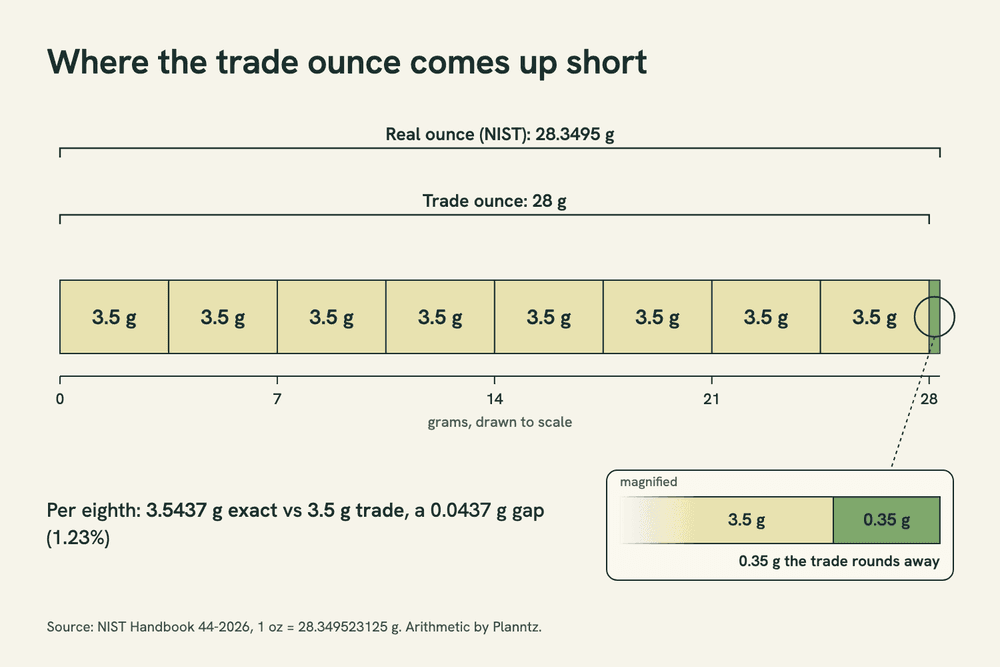
Why an eighth is 3.5 grams and not 3.54
No standards agency picked 3.5. None of the federal or state measurement documents we read for this page defines an eighth as 3.5 grams; they deal in grams and ounces and leave the slang to the market. The rounded figures are also older than legal stores. In a 2005 field study of street marijuana purchases in Manhattan, researchers who weighed 99 purchases from 96 buyers in that unregulated market already recorded the units sold by weight in rounded grams.
“eighth ounces (3.5 grams), quarter ounces (7 grams), half ounces (14 grams), and ounces (28 grams)”
One plausible reason the convention stuck: 28 divides cleanly by 2, 4 and 8, and 28.35 does not. Today it runs into label law. California, for example, requires a flower package to print the net weight in both metric and US customary units, so a single jar can say 3.5 g and 1/8 oz at the same time: two numbers that are not quite equal. Which one counts has a real answer, and it is two sections down.
Who checks the scale at the counter
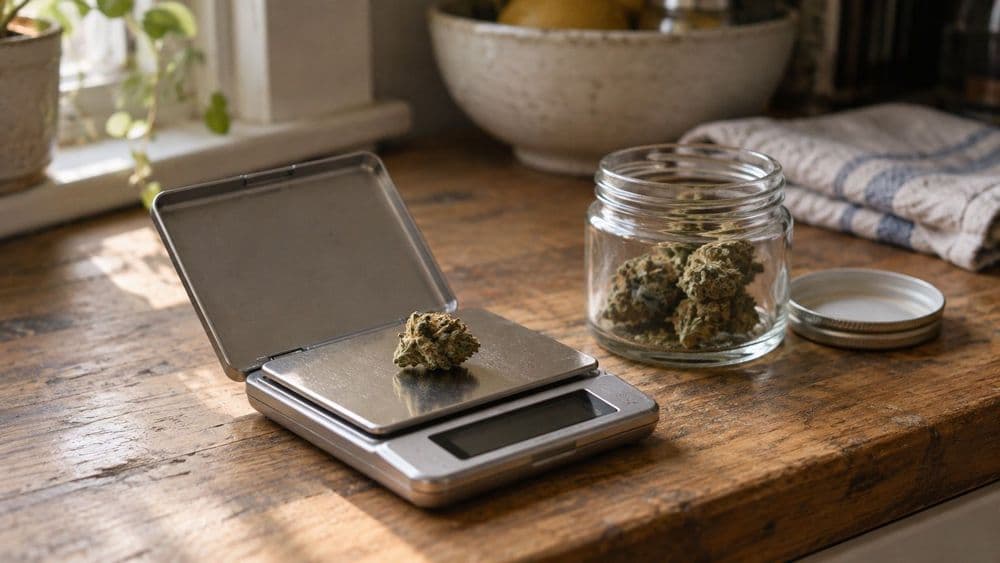
A dispensary scale is a commercial weighing device, covered by the same code as a grocery or jewelry scale. That code is Handbook 44, a model that states adopt by reference and then enforce through their weights-and-measures programs. Handbook 44 sorts scales into accuracy classes. The high-precision Class II is the one it lists for laboratory, precious-metal and gem weighing, and it is the class state guidance points to for small cannabis packages. In California the requirement also sits in the cannabis rules themselves: licensees must use weighing devices that are approved, tested and sealed, and registered with the county sealer, whenever cannabis is bought, sold or packaged by weight. California's Division of Measurement Standards, in scale guidance revised in December 2023, wants a scale used for 1-10 g packages to read in steps of 0.01 g, and one used for eighth-to-half-ounce packages in steps of 0.1 g or finer. Here is what that adds up to on the device itself.
- A type-approval certificate for the scale model: NTEP nationally, or CTEP in California. These programs certify a model before it can be used for trade.
- An accuracy class marking, typically Class II for small cannabis packages.
- A division size fine enough for the package: 0.01 g in Oregon's guidance for eighths and quarters.
- An inspector's seal showing it was tested, as California requires.
- A registration or license with the state or county, such as Oregon's license with its agriculture department.
Inspection is the enforcement end. Washington's weights-and-measures guide for licensees, dated November 2014, says inspectors make unannounced visits with certified test weights, that short-weight or mislabeled packages will be ordered off sale, and that the state may assess civil penalties. It recommends an NTEP Class II scale with 0.1 g divisions or finer for packages of one ounce or less. Oregon's cannabis weights-and-measures guide, updated in 2018, requires the scale to be licensed with the state before use, says an inspector will typically make a first evaluation within 30 days and another every year, and asks for 0.01 g divisions on the scale used for retail eighths and quarters. Vermont's cannabis weights-and-measures handout likewise asks for Class II or better on direct-sale scales for packages of 100 g or less. Even a certified scale is allowed a small error. Under Handbook 44, a Class II scale in service may be off by one division at an eighth's weight, which on a scale reading to 0.01 g is 0.01 g either way, and half that when the scale is new. That worked example assumes the scale's display and verification divisions are both 0.01 g.
What the label must say, and which number the inspector checks
Package checks follow a second federal model, NIST Handbook 133, the national procedure for checking the net contents of packaged goods. Two of its rules matter most for an eighth. First, when a label declares both metric and US units, the larger of the two declarations must be verified. Washington's guide says the same thing in plainer words: the greatest weight is used. Second, inspectors judge a lot, meaning a sample of packages from the same run, rather than one jar. The average net weight of the sample must reach the label, and packages short by more than the maximum allowable variation (MAV), which for labels under 36 g is 10% of the labeled quantity, count as unreasonable errors; too many of them fail the lot. Here is how that plays out on three common eighth labels. The figures are our worked arithmetic on Handbook 133's rules, not an inspector's ruling.
| Label reads | Number verified | Max shortfall, one package (10% MAV) | Plus 3% moisture allowance | One package is an unreasonable error below |
|---|---|---|---|---|
| 3.5 g (1/8 oz) | 3.544 g, because 1/8 oz is the larger number | 0.354 g | 0.106 g | About 3.08 g |
| 3.5 g (0.12 oz) | 3.5 g, because 0.12 oz is only 3.402 g | 0.35 g | 0.105 g | About 3.05 g |
| 3.5 g only | 3.5 g | 0.35 g | 0.105 g | About 3.05 g |
Two things follow. A label that prints "1/8 oz" commits the seller to 3.544 g, not 3.5 g, because the ounce figure is the larger one. A lot whose average comes in under the label either fails or, if the shortfall is small enough to be drying, lands in a gray area that the inspector has to investigate. One jar a few hundredths light inside a lot that averages full weight passes. The moisture column is new: it has existed only since 2024, and it is the reason a sealed jar can legally read lighter than its label.
Why your eighth weighs less at home
Flower is plant material, and it keeps losing water after it is weighed and sealed. A NIST cannabis chemist, quoted in a 2024 analysis by NIST's Office of Weights and Measures, noted that cannabis is cured to moisture levels typically no more than 15%, and that a wetter package has more water to lose: a jar packed at 14% moisture can shed more weight than one packed at 6%. In July 2024, the National Conference on Weights and Measures approved a moisture allowance for cannabis, and Handbook 133 now lists a 3% moisture allowance for cannabis, marked as amended in 2024. It covers plant material only, not products made with cannabis, and it is the same figure the handbook uses for flour and dry pet food. On a 3.5 g package, 3% is about 0.1 g.
Read the allowance for what it is. Handbook 133 calls it a gray area, not a tolerance: a lot whose average falls short by less than 3% is not automatically fine, it triggers more investigation before a decision. It is also a policy number more than a settled measurement. In 2023, NIST's weights-and-measures office told the national conference it did not concur with adding a 3% weight variance without study. In June 2024 it noted that the one supporting study, from Michigan, used samples of about 3.5 g over 12 weeks with one source per packaging type, and that glass seemed to retain moisture best. A proposed allowance for packages that gain weight from moisture was dropped, so only loss is covered. And Handbooks 44 and 133 are models: each state decides whether and when to adopt a new edition, so the 3% may not apply where you live yet. At home, a short reading usually comes down to one of three ordinary causes.
- 1Water loss after packaging, the reason the 3% allowance exists. The longer since packing, the more time the flower has had to dry.
- 2The container. Net weight means flower only. Zero (tare) the scale with the empty container first, or weigh the container afterward and subtract it.
- 3Your scale. A 1 g step scale cannot tell 3.0 g from 4.0 g, and a 0.1 g step scale cannot resolve the 0.04 g rounding gap. Home scales are rarely checked against test weights.
Two places to look before you blame anyone. In California, the lab report for dried flower must print the moisture content as a percentage, alongside a water activity result that has to be 0.65 or lower to pass, under the state's cannabis testing rule, 4 CCR 15717. That tells you how wet the flower was when it was tested, and our five-minute guide to reading a lab report shows where those lines sit. The packaging date, where the label shows one, tells you how long it has had to dry since. How storage speeds that up, and when dry turns into degraded, is covered in what storage studies found about whether weed goes bad.
Rounding, drying or short weight? How to tell
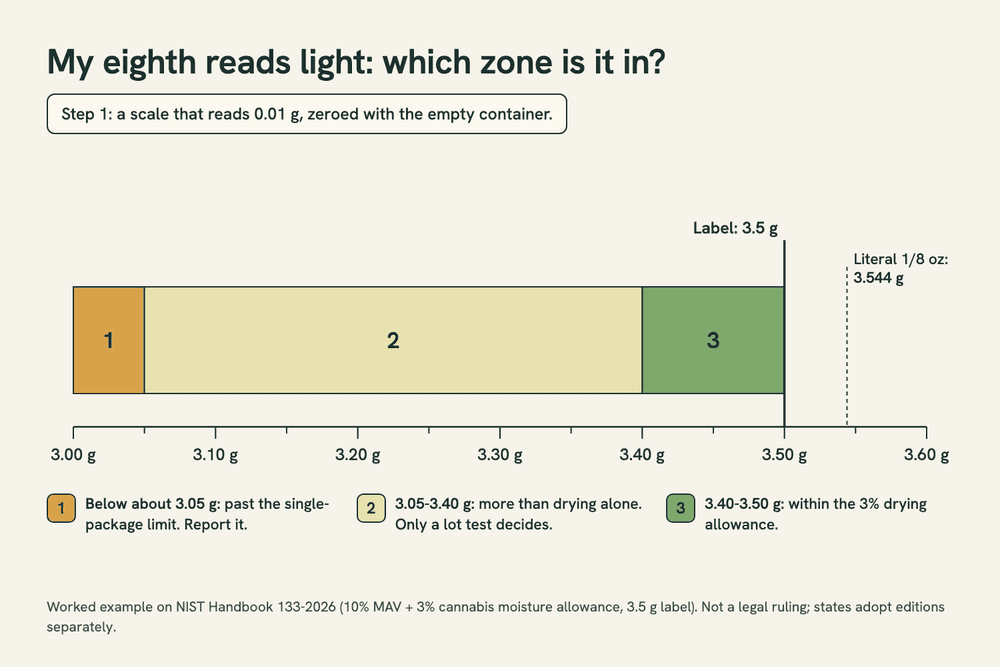
Say your eighth reads 3.3 g at home. Work through these steps in order. The thresholds are our worked example on Handbook 133 for a plain 3.5 g label: 3.40 g is the 3% drying allowance (3.5 x 0.97), and 3.05 g is the single-package limit with that allowance added (3.5 minus 0.35 minus 0.105). One home reading cannot prove a lot is short, because inspectors test samples. A label that also says 1/8 oz moves each line up by about 0.04 g.
- 1Check the scale first. It needs 0.01 g steps and must be zeroed with the empty container. A reading from a 1 g step scale is not evidence of anything.
- 2Read the label: which weights are printed, the packaging date if shown, and the moisture percentage on the lab report if your state requires one.
- 33.40 to 3.5 g: within the 3% drying allowance the national model now recognizes. Most likely nothing is wrong.
- 43.05 to 3.40 g: more than the drying allowance alone, but inside the single-package limit (10% plus 3%). Only a test of the whole lot decides. Keep the package and receipt.
- 5Below about 3.05 g: past the single-package limit under the national model, even after the moisture allowance. That is worth reporting.
Where to report. Short weight is a weights-and-measures matter as well as a cannabis one. In California that means the county sealer; in Washington, the state agriculture department, which can order packages off sale; in Oregon, the Oregon Department of Agriculture. Colorado's agriculture department, in its measurement standards FAQ, says short-weight packages violate the state's Measurement Standards Act and that inspectors issue stop-sale orders. Your state cannabis regulator takes complaints too. The system exists for a reason. In the unregulated 2005 New York market studied above, actual weights ran from 11% over to 24% under what buyers were told, and about three in four purchases came in at 90% or less of the promised weight. That describes street sales two decades ago, not licensed stores; it is the problem scale and package rules were written to stop. The person who proposed the 2024 moisture rule also told the national conference that underweight packages were Oregon's top consumer complaint and that states keep no official records of them. That is a claim from the proposal itself, not a state audit.
How much weed is in a joint
Most charts say a joint holds 0.5 to 1 gram. Those are forum numbers. The only data-based estimate we found is a 2016 analysis by Greg Ridgeway of the University of Pennsylvania and Beau Kilmer of RAND, published in Drug and Alcohol Dependence (the link is the authors' free working-paper version). They used 10,628 purchases reported to the Arrestee Drug Abuse Monitoring program from 2000 to 2010, priced in grams, ounces or joints, and worked out the weight of a joint from what people paid. The average came out at 0.32 g, with a 95% interval of 0.30 to 0.35 g, and it stayed roughly constant across the decade.
Three limits come with that number. No joint was weighed: the weight is inferred from prices. The buyers were people arrested in 43 US communities, buying in an illegal market between 2000 and 2010. And the authors say the figure may still be a little large if dealers sold light grams. The paper's own review of earlier estimates ran from 0.3 to 0.66 g, and its model found a second, flatter cluster near 0.6 g, so plenty of joints are bigger than average. As plain arithmetic, 3.5 g rolls about 11 joints at 0.32 g (10 to 11.7 across the interval), 7 at 0.5 g and three and a half at 1 g. That measures material; it says nothing about how much anyone should use. How a blunt differs, from the wrap to what burning it adds, is in our blunt vs joint comparison.
What weight does not tell you
Grams are not milligrams of THC. On paper, 3.5 g of flower labeled 20% THC holds about 700 mg of THC (3,500 mg x 0.20). That is a label calculation, not what reaches you, and whether the label percentage is accurate is a separate question that our guide to whether THC percentage matters covers, including what independent label audits found. Weight also says nothing about grade: an eighth of shake, which is a mix of broken pieces rather than a grade, weighs the same as an eighth of whole buds.
Hemp flower is weighed by the same rules. Handbook 133's 3% cannabis allowance covers plant material at or below 0.3% total delta-9 THC, which is hemp, as well as material above it, so a jar of hemp flower can dry out within the same allowance. Whether hemp flower is legal where you live is a different question, answered in our guide to the federal rule and state bans on CBD flower. If a legal limit you are reading is written in ounces, the chart above converts it. This page does not list state limits; for the legal side, start with the federal rule and state exceptions for CBD.
The honest limits of these numbers
Only one number on this page is exact: 3.5437 g, straight from NIST's definition of the ounce. Everything else is softer. The 3% moisture allowance is a policy number adopted in 2024 over NIST analysts' doubts, and states adopt it on their own schedules. Our inspection thresholds are worked arithmetic on the national model, not rulings. No state we checked publishes cannabis package test results, so there is no public rate of short-weight eighths in licensed stores. The joint figure is inferred from a decade of illegal-market prices, and the street-weight study covers one city in 2005. Planntz does not sell flower, so, as on our dabs vs flower comparison, we have no stake in how much your jar weighs. We make hemp CBD tinctures, and if a CBD oil is what you are weighing up, the buyer's checklist for choosing CBD oil applies the same label-reading habits.
Frequently asked questions
Yes, by trade convention. An eighth of an ounce is exactly 3.5437 g, because an ounce is 28.3495 g, so 3.5 g is about 1.2% (0.04 g) less than a literal eighth. The trade treats the ounce as 28 g, which is why every unit from an eighth to an ounce runs the same 1.23% under. If a label prints both 3.5 g and 1/8 oz, inspectors following NIST Handbook 133 verify the larger number, 3.544 g.
By trade convention, 7 g, 14 g and 28 g. By exact arithmetic on NIST's ounce, 7.09 g, 14.17 g and 28.35 g. A pound is 453.59 g. The ounce on a cannabis label is the ordinary avoirdupois ounce, not the 31.1 g troy ounce used for precious metals.
As arithmetic, about 11 at 0.32 g, the average in the only data-based estimate we found (a 2016 RAND and Penn analysis of 10,628 purchases), or 7 at 0.5 g. That estimate was inferred from prices paid by people arrested between 2000 and 2010, not from weighing joints, and many joints are larger. It measures material, not how much anyone should use.
Usually one of four things: rounding (if you expected 3.54 g), water loss after packaging, a container you did not tare, or a home scale too coarse to tell. Since 2024 the national model, NIST Handbook 133, recognizes a 3% moisture allowance for cannabis, about 0.1 g on an eighth, though not every state has adopted it. By our worked arithmetic on that model, a single 3.5 g package below about 3.05 g is past the single-package limit even with the allowance, and worth reporting to your state or county weights-and-measures office.
State and county weights-and-measures officials, working from NIST Handbook 44 as each state adopts it. Scales need type approval (NTEP, or CTEP in California), are usually Class II, and are inspected and sealed. Washington's guide says inspectors visit unannounced with certified test weights; Oregon licenses each scale, and its guide says an inspector typically makes a first evaluation within 30 days and another every year.
On paper, multiply the grams by the label percentage: 3.5 g at 20% THC is about 700 mg. That is a label calculation, not what you would take in, and label accuracy varies. Our guide to whether THC percentage matters covers the conversion and what label audits have found.
A zip is slang for an ounce: 28 g by convention, 28.35 g exactly. A dime bag has no defined weight in any of the measurement rules on this page. Vermont's weights-and-measures handout, for example, says cannabis may not be sold by the bag, bottle or container, and that dried flower is sold by net weight.
Where to go next. Weight tells you how much you have, not what it is. For the other half, read the graded checklist for judging flower by look, smell and feel, then learn how to read the lab report that should come with it.
Writing about hemp, wellness and the small rituals that keep us balanced.