White Ash vs Black Ash Weed: What Ash Color Really Means
White ash is supposed to prove weed was flushed and grown clean. In the only blind rating of ash by flush length, white was the rarest color in every group. Here is what ash color can tell you, what it cannot, and what to check instead.
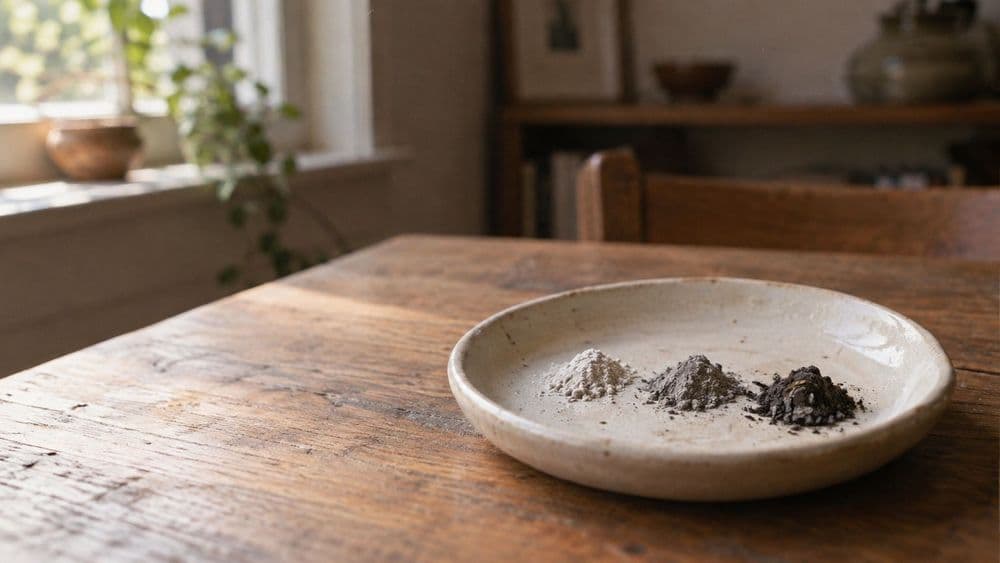
Tap a joint over an ashtray and someone will read the ash. White ash weed, the story goes, was flushed before harvest and grown clean. Black ash weed was rushed, still full of leftover nutrients, maybe worse. It is one of the most repeated quality tests in cannabis. We went through the evidence behind it, and the answer is simpler and more useful than the folklore.
The short answer: ash color tells you how completely that bit of flower burned at that moment. Lighter ash means more complete combustion; darker ash holds more unburned carbon. It does not prove the plant was flushed, and it says nothing reliable about potency, cure, pesticides or mold. In the only trial that rated ash by flush length, white was the rarest result in every group. The things that move ash color most are outside the plant's history: your paper, how damp or dry the flower is, how it is ground and packed, and how you light and draw it. If you want to know whether flower is clean, the batch lab result is the only check. This guide is a companion to our graded checklist of what good weed looks like, and it is written for adults 21 and over where cannabis is legal, and for anyone buying hemp flower.
What ash actually is
Ash is what is left when plant material burns: a mix of mineral residue and whatever carbon did not finish burning. The minerals a plant takes up while it grows, potassium, calcium, magnesium, phosphorus and sulfur among them, cannot burn away, so they stay behind as oxides and other salts. Carbon can burn away if the fire is hot enough and gets enough oxygen. When it does not, it stays as char, and char is black. That is the whole color story in one line: the more carbon left behind, the darker the ash.
Fire scientists use this as a rough thermometer. In a 2022 study that graded ash from three US wildfires from white to black, lighter ash marked higher combustion temperatures, and dark gray ash released the most organic carbon and nitrogen when soaked in water, while white ash released the least. Even finished-looking ash carries a lot of carbon: across 148 wildfire ash samples in a 2023 global dataset, organic carbon averaged 204 g per kilogram, about a fifth of the weight. A wildfire is not a joint, so read these as the general rule of combustion, not as a measurement of cannabis.
Cannabis ash itself has been analyzed in at least one study. In a 2025 industry-funded study of moisture and smokability, published in a trade journal rather than a peer-reviewed one, researchers burned pre-rolls made from one CBD-dominant hemp cultivar and ran the ash through elemental analysis. Most elements were about seven times more concentrated in the ash than in the flower, which is what you would expect when the organic mass burns off and the minerals stay. Compared with tobacco ash, the cannabis ash carried markedly more sulfur and phosphorus and markedly less calcium. That matters for the folklore: the bright white ash many people picture comes from tobacco, and the two plants do not leave the same minerals behind.
Where the white ash belief comes from
The cannabis version of the story runs like this. Near harvest, a grower stops feeding nutrients and gives the plants plain water for a week or two, a practice called flushing. The plant supposedly uses up the minerals stored in its tissue, so the finished flower burns cleaner, tastes smoother and leaves white ash. Unflushed flower, in this telling, is loaded with leftover fertilizer salts that burn black and harsh. Some guides go further and say black ash signals chemicals or pesticides.
Reading ash is much older than legal cannabis, and it comes from tobacco, where buyers graded leaf partly on how it burned. A 1928 Plant Physiology paper on the burning qualities of tobacco listed the elements of a good burn as fire-holding capacity, the evenness and completeness of combustion, and the character of the ash, and described the top grade as leaf that burns evenly until consumed "without coaling and with light colored ash". Writing in Cannabis Business Times, cannabis scientists Allison Justice and Markus Roggen have argued that the white ash smokers associate with tobacco was partly engineered with added calcium and magnesium salts. That is an opinion column, not a study, but it is a useful reminder: the benchmark people hold cannabis ash up against was never entirely natural.
Does flushing weed matter? What the studies measured
Three pieces of work have tested flushing in cannabis, and they are different kinds of evidence. One is peer-reviewed, one is an industry trial run by a company that sells nutrients, and one is a master's thesis. Only the industry trial rated the ash.
| Study | Who ran it | Design | What it found | Did it rate the ash? |
|---|---|---|---|---|
| RX Green Technologies flushing trial (2019, reissued 2026) | A company that sells nutrients. Industry research, not peer-reviewed | 48 plants of one cultivar, feeding stopped 14, 10, 7 or 0 days before harvest, 12 plants per group | No significant difference in yield (97.3 g per plant on average), THC (21.9% on average) or terpenes (1.46-1.64%) | Yes, by a blind panel. No significant difference, and white was the rarest rating in every group |
| Saloner, Sade and Bernstein (2024), Industrial Crops and Products | Volcani Center, Israel. Peer-reviewed | Five medical cultivars, fed to harvest or switched to plain water before harvest | Limited effect on cannabinoids, terpenes, minerals in the plant, biomass and plant function | No |
| Stemeroff (2017), University of Guelph | Master's thesis | Three flowering cycles, clear water for the last two weeks | No significant difference in nutrient levels in the dried bud | No |
The industry trial is the one that speaks to ash. In a 2019 flushing trial run by RX Green Technologies, a company that sells cannabis nutrients, researchers grew 48 plants of a single cultivar in coco and stopped feeding them 14, 10, 7 or 0 days before harvest, with 12 plants per group across four replications. Weight, THC and terpene content came out the same, statistically, in every group. A blind panel of what the report calls cannabis industry experts then smoked a sample from each group and rated, among other things, the ash as white, gray or black.
The report's text says flush length had no significant effect on the ash. Its chart (Figure 5c in the full report) shows a little more. White was the least common answer in every group: about 5% of ratings at 14 days, 2% at 10 days, 14% at 7 days and 8% with no flush. Black was the most common answer for the two longest flushes, about 48% of ratings at 14 days and 61% at 10 days, against about 41% at 7 days and 34% with no flush; gray made up the rest (about 47%, 37%, 45% and 58% in the same order) and led for the 7-day and no-flush groups. We read those figures off a stacked bar chart, so treat them as approximate, and the report does not say how many people sat on the panel. None of the differences were statistically significant, and that is the point: if flushing turned ash white, the longest flushes should have produced the most white ash. They did not.
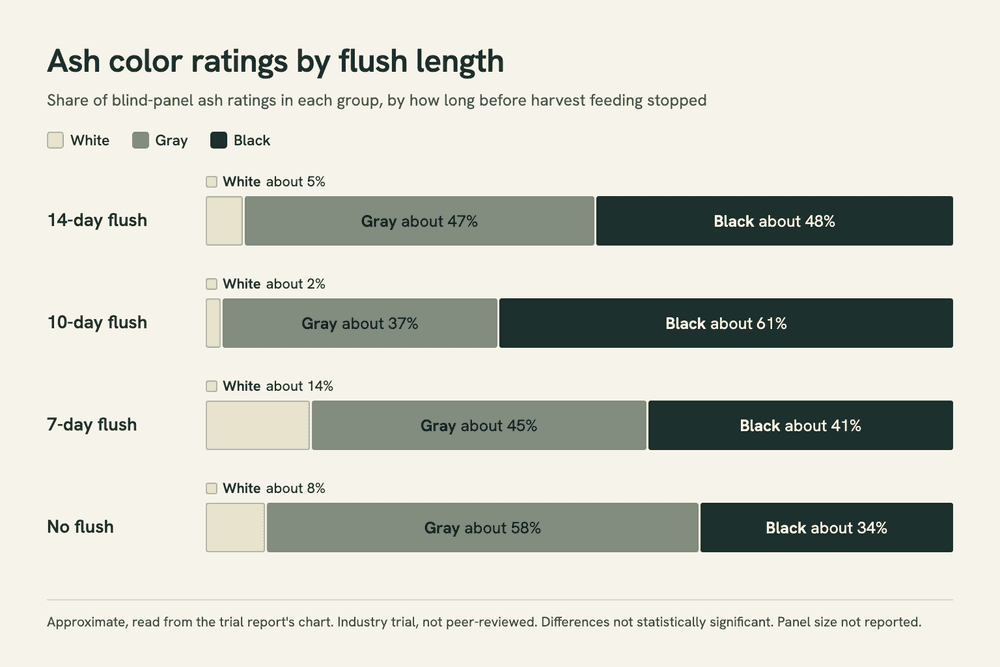
Taste went the same direction as the ash. In the panel's ratings, 36% called the never-flushed flower smooth, against 19.4% for the two-week flush, and the two-week flush drew the highest share of harsh ratings at 41.7%. That trend was not significant either. One cultivar, one facility, one run, a sponsor that sells nutrients and an unreported panel size make this weak evidence. It is also the only blind rating of cannabis ash by flush length we found, and it does not support the folklore.
Why flushing could not whiten the ash anyway
For a flush to change ash color, it would have to change what ends up in the ash: the minerals. The evidence says it barely does. In the industry trial, phosphorus, potassium, calcium, magnesium and sulfur in the flower came out similar across all four groups. Nitrogen was 6.7% lower after the 14-day flush, and iron and zinc actually rose slightly in the longest flushes, all within normal ranges for the plant.
The two independent sources agree. A 2024 peer-reviewed study from Israel's Volcani Center compared flushed and unflushed plants in five medical cannabis cultivars and found flushing had limited effect on the cannabinoids, the terpene profile and the minerals that accumulated in the plants. It did not look at ash or smoke. A 2017 University of Guelph master's thesis measured nutrients in the dried bud after a two-week flush in three separate grows and found no significant difference between treatments; the author concluded that flushing was ineffective at removing any significant amount of nutrient from the bud. (An erratum attached to the thesis corrects its irrigation-stress findings, not the flushing section.) If the minerals in the flower do not change, the flush has no route to the color of the ash.
Tobacco research adds a clue, and it points the opposite way from the folklore. The 1928 tobacco paper found that chlorine clearly harmed the burn of cigar leaf, and that its test plots with too little potash (potassium) and too much lime (calcium) did not reach the best burning quality. In tobacco, then, a good burn with light ash went with enough potassium, not with stripping minerals out. If that held for cannabis, a flush that removed minerals would be expected to hurt the burn rather than help it. The cannabis data above suggest a flush does not remove much in the first place, so for flushing the point is moot either way.
What really changes ash color: the evidence table
If the grower's flush is not driving the color, what is? Here is every variable we found, with what it does to the ash, how strong the evidence is, and what to check instead. "Measured in cannabis" means someone tested it on cannabis. "Inference" means the logic comes from another plant or from general combustion science.
| Variable | What it does to the ash | Evidence and strength | What to check instead |
|---|---|---|---|
| Flushing before harvest | No whiter ash. White was the rarest rating in every group | Measured in cannabis: one industry trial, differences not significant | The batch lab result, not the grow story |
| Flower too damp | Likely darker ash. Water has to boil off first, which cools the burn | Inference from lab burns of shrub fuel (2026). Damp cannabis was not rated for ash | Water activity on the COA (California ceiling: 0.65) |
| Flower overdried | Darker ash than flower at 0.65 water activity, and rated more irritating | Measured in cannabis: one industry-funded study of one cultivar (2025) | Storage, age and water activity |
| Rolling paper or wrap | Paper fillers can whiten ash. Papers carry their own elements | Documented: a 1998 cigarette-paper patent and a lab analysis of rolling papers | Compare flowers in the same paper |
| Grind and packing | Changes burn speed: fine grind burned out in 28 machine puffs vs about 52-54 for coarse | Measured in cannabis for burn speed (2023). Ash color not rated | Keep it consistent between sessions |
| Flame and draw | A hotter, steadier burn should leave lighter ash; going out and relighting leaves char | Combustion logic only. Not measured in cannabis | Nothing to check: it is technique |
| Plant minerals (potassium, chlorine) | In tobacco, chlorine hurt the burn and low potassium burned poorly | Inference from 1928 tobacco research | Nothing visible. Not on a standard COA |
| Pesticides, mold, adulterants | No known visible sign in the ash | Measured: pesticide residues pass into the smoke (2013 lab study) | Pesticide, microbial and mycotoxin panels on the COA |
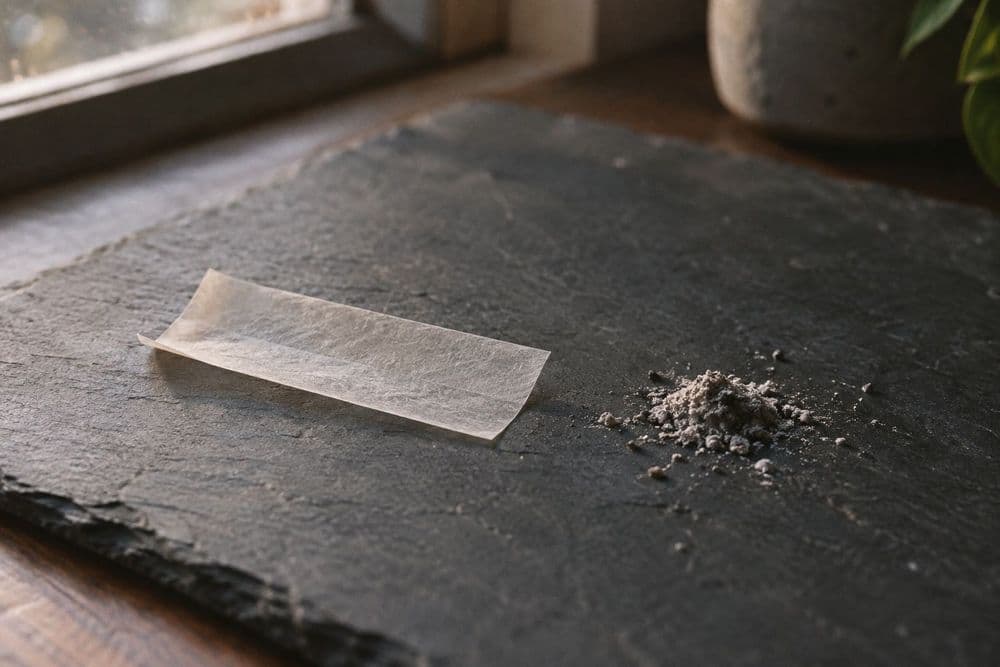
Paper deserves a closer look because it is the variable most people never think about. White ash can be manufactured. A 1998 US patent for cigarette paper with improved ash characteristics describes adding very fine calcium carbonate, a chalk-like mineral, to the paper to produce "a whiter ash and a more cohesive ash", and notes that "a whiter ash has a more aesthetic appearance and is thus more desirable". A patent shows what is possible, not what any given rolling paper contains. Papers also carry elements of their own: a lab analysis of commercial rolling papers flagged copper, chromium and vanadium, with the highest copper in colored papers and chromium in metallic-colored tips. Wraps made from tobacco leaf are a different material again; our comparison of blunts and joints covers what changes when you switch. The practical upshot: if you want to compare two flowers by their ash, use the same paper.
How you build and smoke the joint matters too. In a small 2023 lab test of grind size, run on a smoking machine with 18 joints, finely ground flower burned out in 28 puffs, against about 52 to 54 puffs for coarser grinds, and the coarsest grind delivered the most THC per joint. That test did not rate ash, so nobody knows what grind does to color. The same goes for how tightly you pack, lighter versus hemp wick, and how hard or how often you draw. Combustion logic says a burn starved of air, or one that goes out and gets relit, leaves more char, but we found no cannabis measurement of any of them.
Moisture cuts both ways
The most common explanation for black ash weed is that the flower was wet. That is half right. Water activity, the number labs use for moisture, is a 0 to 1 scale of how much free water a material holds. Plant matter has to drive off its water before it can burn properly, and that evaporation pulls heat out of the fire. In lab burns of four chaparral shrub species, higher fuel moisture increased the products of incomplete combustion, mostly carbon monoxide and hydrocarbons, and smoldering produced 10 to 70 times more particulate than flaming. That was shrubland fuel, not cannabis, and nobody has measured what damp flower does to ash color, but the basic physics of a wet fuel is the same. Very damp flower is a problem in its own right, too: the 2025 smokability study did not give its wettest samples, at a water activity of 0.85, to consumers at all because of the microbial risk, and in machine tests those pre-rolls delivered only about 30% of the cannabinoids in smoke that the drier ones did.
The other half is where the folklore goes wrong. Drier is not whiter. In the same study, pre-rolls made from flower at a water activity of 0.65 left lighter ash than the same flower dried to 0.45. On the study's six-step color guide, both groups landed toward the white end, but the most common rating was step 2 for the 0.65 group and step 3 for the 0.45 group. Consumers also rated the drier pre-rolls as more irritating, a statistically significant difference. One hemp cultivar, industry sponsors and a trade journal: hold it loosely, but it is the only cannabis study we found that rated ash against moisture. Harshness and coughing have causes of their own, which our guide to why weed makes you cough covers.
Regulators already police the wet end. California's testing rules will not let dried flower be sold if its water activity is above 0.65. That rule is a ceiling, so it cannot tell you whether flower has dried out on a shelf since it was tested. For how storage pushes flower toward either end, see our guide to whether weed goes bad over time. Without a meter, these are rough signs you can notice yourself. None of them is a measurement, and none has been tested against ash color:
- Possibly too damp: buds that feel spongy or wet, condensation inside the jar, a joint that keeps going out. Damp flower carries more microbial risk; the 2025 study kept its dampest samples from consumers for that reason.
- Possibly too dry: buds that crumble to powder at a touch, a faded smell, smoke that feels harsher than the same flower did when it was fresher.
- Both ends can darken the ash, so a dark ash on its own does not tell you which problem you have.
Does black ash mean pesticides, mold or a bad cure?
No, and white ash does not mean the opposite. Pesticides do not announce themselves in the ash; residues can travel into the smoke instead. In a 2013 lab study of pesticide residues in cannabis smoke, researchers spiked cannabis with three pesticides and a plant growth regulator and smoked it through several devices. Through a glass pipe, 60.3% to 69.5% of the residue was recovered in the smoke. The study used deliberately spiked flower and four compounds, so it does not tell you how much is in any real product. What it shows is that a residue can leave the flower in the smoke without leaving any sign you could see in the ash.
Mold and microbes are the same story. Visible fuzz or webbing on a bud is a reason to stop before you light anything, but microbial contamination is not always visible, which is why licensed markets test for it, and nothing about the ash reveals it. A poor cure can leave flower damp or overdried, which can show up in the burn, yet identical ash can come from a humid day, a different paper or a slow draw. Adulteration is its own question; our guide to whether you can tell if weed is laced explains why black ash, harsh smoke and crackling do not point to any specific adulterant.
Where ash is a real lab number
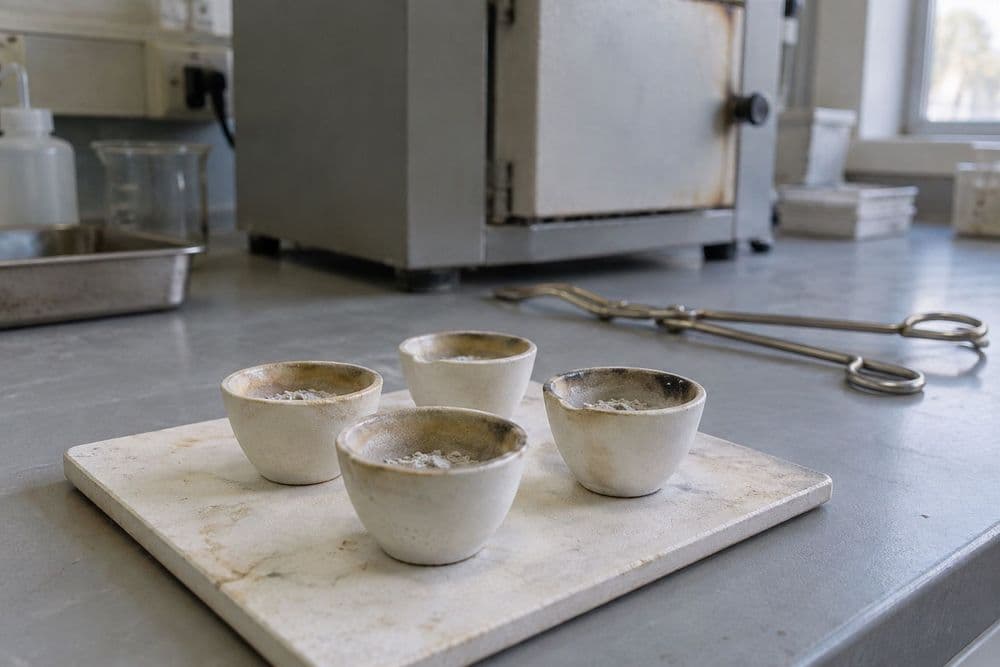
There is one place where ash is a genuine quality measurement, and it has nothing to do with a joint. In a lab, total ash is the weight left after a sample is burned completely in a furnace, a standard pharmacopoeia test for herbal material. A proposed New Zealand quality standard for medicinal cannabis caps total ash at 20% of the plant material's weight, using the European Pharmacopoeia method, next to a 10% limit on loss on drying. The adopted standard may differ from the consultation draft.
Europe went the other way. When the European Pharmacopoeia published its monograph for cannabis flower in January 2024, in force from July 1, 2024, it left the total ash test out. As a trade summary of the regulator's briefing on the new monograph reports, mineral contamination of cannabis flower is expected to be very low. Either way, the lesson is the same: when a lab cares about minerals, it weighs them in a crucible. Neither standard looks at ash color.
What to check instead of the ash
The questions people hope the ash will answer, was it grown clean, is it fresh, is it strong, all have better answers, and most of them sit on the batch certificate of analysis (COA). The US Pharmacopeia's cannabis expert panel recommended that a quality specification for flower include limits for pesticide residues, microbes, mycotoxins and elemental contaminants. In legal markets, state rules turn that list into required tests. Run through it in this order:
- 1Before you light anything, look and smell for mold or damp: fuzz, webbing, a musty smell, a spongy feel. Any one of them ends the check.
- 2Find the batch lab result and confirm its batch number matches your package.
- 3Pesticides: the panel should show a pass against the state's limits.
- 4Water activity: a pass, ideally with the number. California's ceiling for dried flower is 0.65.
- 5Microbial and mycotoxin results, including Aspergillus where the state tests for it.
- 6Heavy metals: these are the minerals a lab actually sets limits for, and no eye can see them.
- 7Total THC and total CBD, as tested, plus the lab name and test date.
Two limits to keep in mind. A home kit measures cannabinoids, not pesticides or microbes, as our review of what home test kits can and cannot detect explains. And a THC figure has its own problems, from lab-to-lab variation to label drift, covered in does THC percentage matter.
Vaporizers and dabs leave no ash
A dry-herb vaporizer heats flower below the point where it burns, so there is no ash to read; what is left is browned, dried-out plant material. Concentrates leave residue, not ash. If you use either, the ash test was never available to you, and the same advice applies: the lab result tells you what the device cannot. Our comparisons of vaping dry herb versus smoking it and dabs versus flower cover how those methods differ.
What we still don't know
The evidence on ash is thin, and being clear about where it runs out is part of the answer:
- No peer-reviewed study has rated cannabis ash color against how the plant was grown. The one blind rating came from a nutrient company and did not report its panel size.
- The 2024 peer-reviewed flushing study measured plant chemistry and minerals, not ash or smoke. Its full text is paywalled, so we worked from the abstract.
- Potassium, chlorine and burn quality have been studied in tobacco, not in cannabis flower.
- No study has isolated paper versus wrap, lighter versus hemp wick, or draw technique on cannabis ash color.
- The only cannabis study of moisture and ash used one hemp cultivar in pre-rolls.
- Grind has been tested for burn speed and THC delivery in 18 machine-smoked joints, but not for ash.
Frequently asked questions
No. It means that bit of flower burned more completely. Paper, moisture, grind and packing, and the way you light and draw all change it. In the one blind rating of ash by flush length, white was the rarest result in every group, flushed or not. Quality questions like pesticides, mold and potency are answered by the batch lab result.
More unburned carbon: the burn was cooler or less complete. Common causes are flower that is too damp or too dry, tight packing, a joint that keeps going out, or a slow, interrupted draw. It does not identify pesticides, mold or an adulterant.
Yes. Gray was the most common rating for two of the four groups in the industry flushing trial, and most ash from plant material sits somewhere between white and black because it always holds some unburned carbon.
No evidence says so. In the only trial that rated ash by flush length, the differences were not significant, and the two longest flushes drew the most black ratings. Separate studies found flushing barely changed the minerals in the flower, which are what ash is made of.
Yes. A 1998 cigarette-paper patent describes adding fine calcium carbonate to the paper specifically to make the ash whiter. Tobacco-leaf wraps are a different material again. To compare two flowers by their ash, use the same paper for both.
Not in the one study that tested it. Pre-rolls made from flower dried to a water activity of 0.45 left darker ash, and were rated more irritating, than the same flower at 0.65. Both very damp and very dry flower can darken the ash.
No. In a 2013 lab study, up to 69.5% of spiked pesticide residue passed into the smoke through a glass pipe, without any visible sign in the ash. Only a lab pesticide panel can show whether residues are there, and white ash does not rule them out.
Ash color is a snapshot of one burn, not a verdict on the flower. For the questions people hope the ash will answer, the document to learn is the lab report, and our guide on how to read a certificate of analysis walks you through it line by line.
Writing about hemp, wellness and the small rituals that keep us balanced.