CBG vs CBD: The Real Difference, and What Research Shows
The comparison table you keep meeting online has no study behind it. Here is what can actually be measured about CBG and CBD: the molecule, the plant chemistry, what the receptor experiments really tested, and how much human evidence exists for each. Plus how to check a bottle.
Almost every comparison page you will find puts the same row in the same table: CBG for focus and energy, CBD for calm. There is no published human study behind that row. The first placebo-controlled trial of CBG on its own was published in 2024, it gave 34 people a single 20 milligram dose, and what it measured was anxiety and stress. This page runs the CBG vs CBD comparison on the four things that can actually be measured: the molecule, the plant, the receptor data, and the size of the human evidence base. Then it shows you how to check the number on a bottle.
The short version. Cannabidiol and cannabigerol are built on the same 21 carbons and sit two hydrogens apart, but the difference that matters is structural: CBD's terpene tail is closed into a ring, and CBG's is still an open chain. In the plant, CBG's acid form is the raw material the others are made from, which is where the nickname mother cannabinoid comes from. Everything after that is asymmetry. About fifteen times as many published papers carry cannabidiol's name, and one CBD medicine has cleared FDA approval for specific seizure conditions. Cannabigerol has three published human trials in total, all of them small. If you want the map of the whole family first, start with the wider cannabinoid family, and what cannabidiol is on its own terms covers the CBD half in its own right.
CBG vs CBD: the table you keep seeing, and the one you can check
Search CBG vs CBD and the results converge on one layout. A two-column table, a row labeled something like primary effects, one word set on each side, and no citation underneath. The pages carrying it are not fringe. Several are long, carefully formatted and confident. What none of them do is name the study, the species, the assay or the dose behind that row. The claim travels because it is easy to repeat and it makes a purchase feel decided, not because somebody measured it.
Four things can be compared with sources attached: the molecule itself, where each one sits in the plant's chemistry, what the receptor experiments actually measured and in what, and how much human evidence exists for each. Here is that table. Every number in it appears again further down the page, with the study it came from and the limits that travel with it.
| What can be compared | CBD | CBG |
|---|---|---|
| Molecular formula and weight | C21H30O2, 314.5 g/mol (PubChem CID 644019) | C21H32O2, 316.5 g/mol (PubChem CID 5315659) |
| Structure | Terpene tail folded back and closed into a ring | Terpene tail still an open geranyl chain |
| Where it sits in the plant | Made from CBG's acid form by the enzyme CBDA synthase | Its acid form, CBGA, is the first cannabinoid the plant builds |
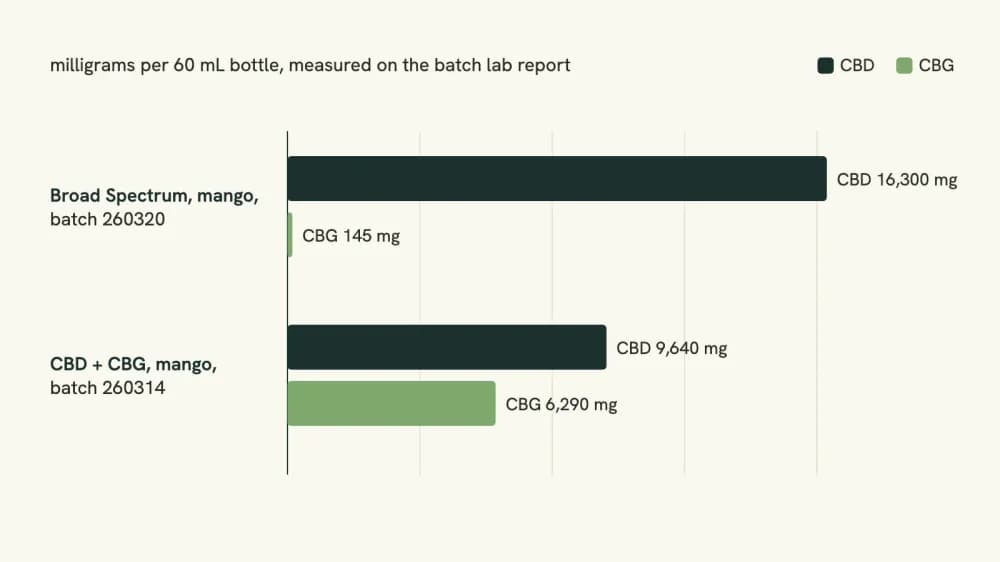
| How much is in a bottle here | The headline ingredient: 16,300 mg in our broad spectrum mango batch 260320 | A trace component in that same bottle: 145 mg of 16,600 mg total cannabinoids |
| Receptor evidence, and in what | Negative allosteric modulator at CB1, in HEK293 cells and a striatal cell model (Laprairie 2015) | Alpha-2 adrenoceptor agonist and CB1 antagonist in mouse tissue (Cascio 2010); partial CB2 agonist in transfected cells (Navarro 2018) |
| PubMed records, July 29, 2026 | 8,383 | 563 |
| Of those, tagged randomized controlled trial | 342 | 7, and only 3 of them gave the compound to a person |
| Registered studies on ClinicalTrials.gov | 531 | 13, none with results posted |
| FDA-approved medicine | One, purified pharmaceutical CBD, for specific seizure conditions | None |
The molecular difference is one closed ring
CBD and CBG are two hydrogens apart. PubChem lists cannabidiol as C21H30O2 with a molecular weight of 314.5, and cannabigerol as C21H32O2 at 316.5. Written out that way they look nearly identical, and most explanations stop there. They should not, because the count of hydrogens is not the interesting part. The interesting part is a ring. In CBG, the terpene half of the molecule is an open geranyl chain, a straight tail hanging off the aromatic core. In CBD, that tail is folded back and closed into a second ring. Nearly the same atoms, a different shape.
A single enzyme does the folding, and it was purified in 1996. The paper describing it is titled, in part, a novel enzyme that catalyzes "the oxidocyclization of cannabigerolic acid to cannabidiolic acid". Oxidocyclization is the ring closure. The enzyme turned out to be a 74 kilodalton single polypeptide with an isoelectric point of 6.1 that needs no coenzyme, no metal cofactor, no oxygen and no peroxide to do the job. That is plant biochemistry from 1996, done in vitro on a purified protein, and it says nothing whatsoever about what either compound does in a person. What it does establish is the direction of travel: CBG's acid form goes in, CBD's acid form comes out.
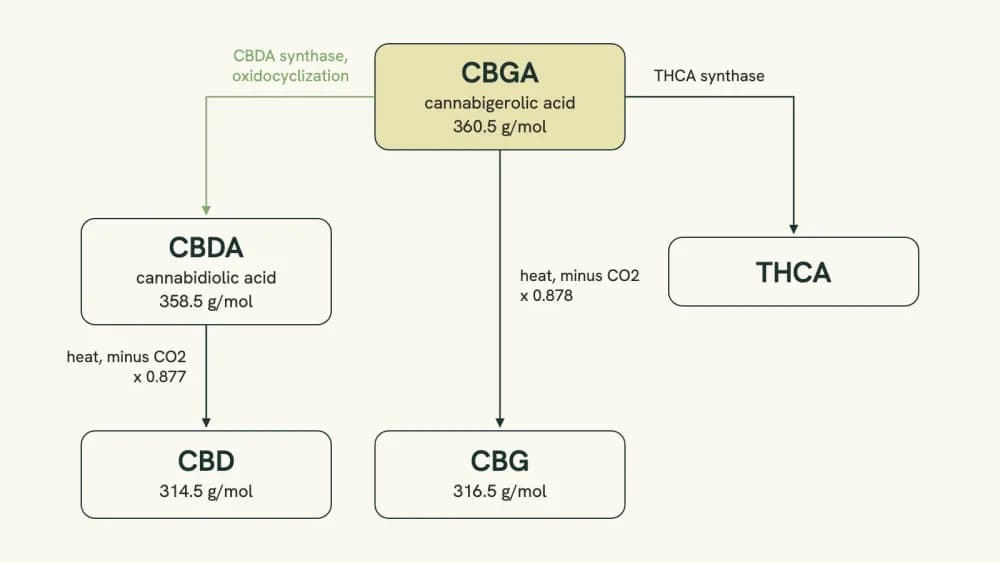
There is one more piece of arithmetic worth carrying to a lab report. Both cannabinoids leave the plant in their acid form and shed a molecule of carbon dioxide when heated. Cannabigerolic acid weighs 360.5 and becomes CBG at 316.5, a factor of 0.878. Cannabidiolic acid weighs 358.5 and becomes CBD at 314.5, a factor of 0.877, which is the same 0.877 that appears in the USDA's total-THC formula. When a lab report prints a total CBG figure, it has already done that multiplication for you, and knowing which of the three numbers you are reading is step two of the checklist further down.
Why the plant makes so much CBD and so little CBG
Cannabinoid chemistry starts at CBGA. A 1998 paper identified the enzyme that builds it, geranylpyrophosphate:olivetolate geranyltransferase, and called it "the first enzyme in the biosynthesis of cannabinoids". It joins two ordinary plant building blocks and it is fussy about its ingredients: give it olivetolic acid and it works, give it plain olivetol and nothing happens. From CBGA, competing synthase enzymes take the molecule in different directions, one producing CBDA and another THCA. That is the entire basis of the mother cannabinoid nickname. It is a biosynthetic fact about a pathway, not a claim about how anything feels. If you want the single-molecule version of the story rather than the comparison, we keep a standalone profile of CBG.
That pathway also explains the scarcity, and corrects a common misreading of it. CBG is not scarce in mature hemp because the plant struggles to make it. It is scarce because the plant spends it. By harvest most of the CBGA has already been converted into something else, and what a lab measures is the remainder. Breeders proved the point directly, by selecting plants that never complete the conversion. A 2021 study of a purpose-bred CBG-dominant hemp cultivar measured total CBG at 7.78 percent in the diploid plants and 11.23 percent in the tetraploids, with total THC around 0.14 percent in both. That was seven plants per group, grown indoors, one cultivar, and all but one of the authors were employed by the hemp seed company that bred it. The CBG-predominant type itself is not new either: it was formally described as an inherited chemotype in 2005.
The route has also been rebuilt outside the plant entirely. A 2019 paper in Nature reported yeast engineered to produce CBGA, and from it CBDA, THCA and two propyl analogs, starting from nothing more than the sugar galactose. Several of that paper's authors were affiliated with the companies commercializing the process. It is a demonstration of biochemistry, not a description of how anything on a shelf is made, and no Planntz product involves it.
What the receptor data actually says, and what it cannot tell you
Start with the sentence that gets repeated most: that CBG binds CB1 and CB2 directly while CBD does not. It is wrong in both halves. On the CBD side, a 2015 study using HEK293 cells and a striatal neuron cell model found that CBD reduced both the potency and the efficacy of 2-AG and of THC at CB1, and concluded that it "behaved as a non-competitive negative allosteric modulator" of the receptor. That is an interaction with CB1. It is simply not the on-switch kind, and it was measured in cell lines rather than in people. The receptor mechanics themselves belong to another page: how CB1 and CB2 actually work covers them properly, so this one does not have to.
On the CBG side the picture is messier than "binds directly". In 2010, a group working with mouse brain membranes and mouse vas deferens reported that CBG activated alpha-2 adrenoceptors with an EC50 of 0.2 nanomolar, antagonized the 5-HT1A receptor with an apparent KB of 51.9 nanomolar, bound both mouse CB1 and human CB2, and at 10 micromolar behaved as a competitive antagonist at CB1. Antagonist, not agonist. The authors flagged an inconsistency between two of their own assays. A 2018 study in transfected HEK-293T cells found CBG acting as a partial agonist at CB2, with a Ki of 152 nanomolar in living cells, while stating that its effect at CB1 "was measurable but the underlying molecular mechanisms remain uncertain". Four of that study's authors were employed by Phytoplant Research S.L., a cannabis company. All of it is mouse tissue and transfected cell lines. None of it was measured in a person.
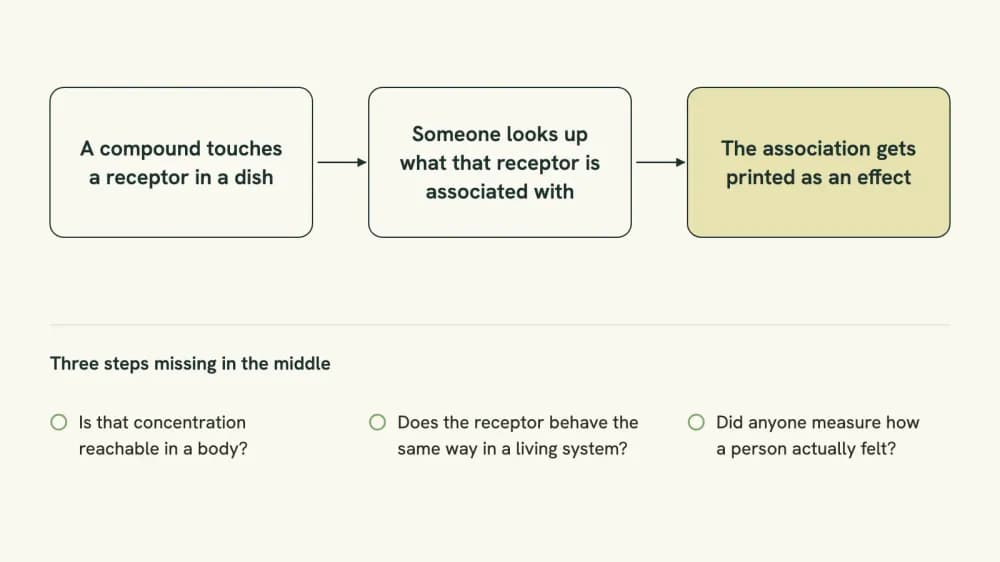
A receptor name is not a feeling. The alpha-2 adrenergic receptor that CBG activated in that mouse preparation is the same target as two very different approved medicines. Guanfacine, sold as INTUNIV, carries an FDA label describing the product as "a central alpha2A-adrenergic receptor agonist indicated for the treatment of Attention Deficit Hyperactivity Disorder (ADHD)", and the same document states that "INTUNIV is not a central nervous system (CNS) stimulant" and that "The mechanism of action of guanfacine in ADHD is not known." Dexmedetomidine, sold as PRECEDEX, carries a label calling it "a relatively selective centrally acting alpha2-adrenergic agonist with sedative properties." One receptor family, one non-stimulant attention medicine and one intensive-care sedative. None of that tells you what a cannabinoid does in a person, and none of it is a claim about CBG.
How much human evidence each one has
On July 29, 2026, PubMed indexed 8,383 records with cannabidiol in the title or abstract and 563 with cannabigerol. Filtered to the randomized-controlled-trial publication type, the same searches returned 342 and 7, and only three of those seven actually gave CBG to a person. ClinicalTrials.gov listed 531 studies with cannabidiol as an intervention and 13 with cannabigerol, and none of the 13 had results posted. A registration is a plan, not a result, and an unposted result is not a failed one. It just means the answer is not in yet.
Those are counts of papers, not counts of good papers, and both numbers move, which is why the date is printed beside them. What they establish is the shape of the asymmetry: on one side a literature large enough to argue about, on the other a literature you could finish reading in a weekend. The first placebo-controlled trial of CBG on its own arrived in 2024. Thirty-four healthy adults took a single 20 milligram dose of a hemp-derived CBG tincture or a placebo, in a double-blind crossover design with a one-week washout, run as a field trial at home over Zoom. It reported lower self-rated anxiety overall and lower stress at one timepoint. The trial's limits are the usual ones for a young field: 34 healthy volunteers, one 20 milligram dose, self-reported measures collected at home over Zoom, and no replication. One co-author is the founder and chief executive of a company that formulates CBG. The authors' own conclusion is hedged: CBG "may represent a novel option to reduce stress and anxiety in healthy adults."
“There was no evidence of subjective drug effects or impairment.”
Alongside its main measures the trial also ran a verbal memory test and a digital impairment app. Those were secondary measures in a single-dose study of 34 people that has not been replicated, and they are not a basis for any claim about a product.
Before that trial, the human record was a survey. In 2022, 127 US adults who had used CBG-predominant cannabis in the previous six months were asked online what they used it for, and the commonest answers were anxiety at 51.2 percent, chronic pain at 40.9 percent, depression at 33.1 percent and insomnia at 30.7 percent. A survey of people who already chose a product measures beliefs, not effects: no control group, no blinding, no verified dose, and its first author is the same founder and chief executive named above. The authors' own conclusion is that CBG-predominant preparations "should be studied in randomized controlled trials". There is also one human pharmacokinetics pilot, which gave adults a single 25 milligram dose and found that dietary fat affected CBG blood levels more than the delivery vehicle did. That is a measurement of absorption, not of benefit.
Everything else in the CBG file is preclinical, and it is worth seeing what that word actually covers. A 2020 paper reported CBG activity against MRSA in bacterial cultures and in a mouse infection model. A 2013 paper reported CBG reducing markers of chemically induced colitis in mice. Bacteria and mice. The second paper's own conclusion was that CBG "could be considered for clinical experimentation", meaning the human work had not been done, and it still has not. Neither result is a reason to take anything, and neither has any bearing on a consumer tincture. One asymmetry cuts the other way and is worth stating plainly: cannabidiol has cleared a regulatory bar exactly once, in the form of a single FDA-approved medicine using purified pharmaceutical CBD for specific seizure conditions, and none of that evidence transfers to a hemp tincture either. There is no approved CBG medicine at all. Meanwhile the NIH's National Center for Complementary and Integrative Health puts the general position plainly: "Research on cannabis or cannabinoids for other conditions is in its early stages." That sentence applies to both columns of the table above.
How to check a CBG product before you believe it
Effect claims are hard to verify. Milligrams are not. Six checks, in order, take about three minutes with a batch lab report open beside the bottle, and they work on any brand including this one.
- 1Find cannabigerol as its own line on the potency panel, in milligrams and mg/mL. If CBG only appears folded into a total cannabinoids number, you have no idea how much of it you are buying.
- 2Check which form the number describes. CBG, CBGA and total CBG are three different figures, and a total CBG value has already had the acid weight converted at a factor of about 0.878.
- 3Match the batch code on the report to the batch code on the bottle. A report for a different batch is a document about a different bottle.
- 4Do the price math per milligram of each active separately, not per bottle. A cannabinoid you are paying extra for should have a price you can actually state.
- 5Read what the panel covers and what it does not. Potency, heavy metals, microbials, pesticides and residual solvents are separate tests, and a report that runs some of them is not a report that ran all of them.
- 6Do the per-drop math before you decide anything, because a bottle's headline milligrams say nothing about a serving. Drop size varies with the dropper and with technique.
Here is that worked on our own numbers, so you can see what each step returns. On the Mango and Peach batch of our CBD+CBG tincture, batch 260314, produced March 26, 2026, the lab measured 9,640 mg of CBD and 6,290 mg of CBG in a 60 mL bottle, against a label of 9,000 mg and 6,000 mg. That is 7.1 percent above label on the CBD line and 4.8 percent above on the CBG line. Set it beside a broad spectrum bottle of the same size, batch 260320, where CBG is 145 mg out of 16,600 mg of total cannabinoids, or 0.87 percent. Divide 6,290 by 145 and the CBD+CBG bottle carries roughly 43 times more CBG in the same 60 mL. On step five, our reports cover potency, heavy metals and microbials; there is no pesticide panel and no residual-solvent panel on them, which is exactly the kind of thing step five exists to make you look up. If you want the walkthrough rather than the summary, we have a lab report read line by line.
The swap, not the bonus
Our CBD+CBG tincture is not the CBD tincture with something added. It is a different split of the same 15,000 milligrams of actives: 9,000 mg of CBD and 6,000 mg of CBG on the label, against 15,000 mg of CBD in the CBD-only bottle, for $84 against $80. On the Mango and Peach batch 260314 the lab measured 9,640 mg of CBD and 6,290 mg of CBG. Choosing it means choosing less CBD, not more of everything. That is the whole of what we are able to tell you about the difference, because it is the part that was measured.
| What you are buying | Full Spectrum CBD | Full Spectrum CBD + CBG |
|---|---|---|
| Label | 15,000 mg CBD in 60 mL | 9,000 mg CBD plus 6,000 mg CBG in 60 mL |
| Concentration | 250 mg/mL CBD | 150 mg/mL CBD plus 100 mg/mL CBG |
| Price | $80 | $84 |
| Cost per mg of total actives | $0.0053 | $0.0056 |
| Cost per mg of CBD | $0.0053 | $0.0093 |
| Roughly what one 0.05 mL drop carries | 12.5 mg CBD | 7.5 mg CBD plus 5 mg CBG |
| Drops to reach 12.5 mg of CBD | 1 | About 1.7, which also delivers about 8.3 mg of CBG |
Which leaves the question the whole search result is trying to answer, and an honest answer to it. No human study has compared CBG against CBD head to head, so there is nothing anyone can point at that says one suits you and the other does not. What you can decide on is composition, cost and verifiability: how many milligrams of each active you are buying, what each costs per milligram, whether the spectrum matches what you want in the bottle, and whether a batch report says so. If the spectrum question is the one you are actually stuck on, full spectrum, broad spectrum or isolate is the page for it. Then run a trial instead of an expectation: pick one product, hold the amount and the timing steady for two weeks, write down what you notice, and use the start-low approach we use rather than a number from a comparison table. One more thing worth knowing before you start, since our full spectrum bottles carry trace THC below the federal limit and batch 260314 reports 88.5 mg, or 0.158 percent: that trace THC, not the CBG, is the part that matters for the honest answer on drug tests.
One caution applies to either bottle equally. Cannabinoids can interact with prescription medicines, and that is documented rather than theoretical, so talk to a clinician if you take prescription medication before adding either one to your routine.
What is still unknown
The honest inventory is short, and it is the accurate one. No trial has compared CBG and CBD head to head in people, so any sentence ranking them is an opinion in a lab coat. No trial has given CBG on its own for more than a single dose and published the result: the one repeated-dose study delivered it inside a five-ingredient sports beverage, which means nothing in that result can be attributed to CBG rather than to the other four ingredients. On the registry side, of the 13 registered CBG studies, four are listed as completed and two as terminated, and on July 29, 2026 not one had posted results. Nobody has established a CBG serving size either, not even in the loose conventional way that consumer CBD servings exist, because the only published human doses of CBG on its own are single administrations of 20 and 25 milligrams, in one placebo-controlled trial and one pharmacokinetics pilot. And the preclinical work quoted most often is mouse tissue, bacterial culture and transfected cells, some of it produced by researchers employed by companies that sell cannabinoids. None of that makes CBG uninteresting. It makes it early.
There is a regulatory blank too, and it is easy to misread. The FDA's cannabis page names THC and CBD and says products containing them are "excluded from the dietary supplement definition". It does not mention cannabigerol at all. That is a gap in guidance, not a permission, and it is not a reason to treat CBG as the safer or freer of the two. Hemp rules at federal and state level are also in motion, which is a subject of its own: where the law actually stands is the page for it.
Questions people ask about CBG and CBD
Chemically, very little, plus one thing that matters. Both are 21-carbon molecules and they sit two hydrogens apart: cannabidiol is C21H30O2 at 314.5 g/mol, cannabigerol is C21H32O2 at 316.5. The difference that counts is shape. CBG's terpene tail is an open geranyl chain, while in CBD that tail is folded back and closed into a ring by an enzyme called CBDA synthase, purified in 1996 and described by the researchers who isolated it as catalyzing the oxidocyclization of cannabigerolic acid to cannabidiolic acid. In the plant, CBG's acid form is the raw material CBD is made from, which is where the mother cannabinoid nickname comes from. That is the whole of the established difference. Everything past it is a difference in how much research exists.
Neither has been shown, and the honest answer is that nobody has measured it. The receptor usually quoted in support of the stimulating story is the alpha-2 adrenergic receptor, which CBG activated in mouse brain membranes in a 2010 study. That same receptor is the target of guanfacine, sold as INTUNIV, whose FDA label states that the product is not a central nervous system stimulant and that guanfacine's mechanism of action in ADHD is not known, and of dexmedetomidine, sold as PRECEDEX, whose label describes it as a relatively selective centrally acting alpha2-adrenergic agonist with sedative properties. One receptor family, two opposite clinical uses. The one placebo-controlled trial of CBG on its own gave 34 healthy adults a single 20 milligram dose, measured anxiety and stress rather than stimulation, and reported no subjective drug effects and no impairment. Anyone assigning either cannabinoid to a time of day is reading a receptor name, not a result.
There is no head-to-head human study of the two, so stronger has nothing to measure against. What can be compared is how much is known. On July 29, 2026, PubMed held 8,383 records with cannabidiol in the title or abstract against 563 for cannabigerol, and ClinicalTrials.gov listed 531 studies with cannabidiol as an intervention against 13 with cannabigerol, none of the 13 with results posted. The other half of the answer is more practical: strength in a bottle is a milligram question. A tincture with 100 mg/mL of one cannabinoid delivers more of it per drop than one with 5 mg/mL, and that is answerable from a batch lab report rather than from pharmacology nobody has finished.
They already occur together. Both appear in whole-plant hemp extracts, and products are sold containing both: our own CBD+CBG batch 260314 measured 9,640 mg of CBD and 6,290 mg of CBG in a 60 mL bottle. Whether the combination does anything more than either one alone has not been established in humans. The one published trial that combined them tested a five-ingredient formula rather than the pair on its own, with authors employed by cannabinoid companies, so nothing in it can be attributed to CBG specifically. If you take prescription medication, talk to a clinician before adding either, because cannabinoid interactions with medicines are documented.
Standard workplace screens look for THC metabolites, not for CBG, so the question that actually matters for any full-spectrum product is the trace THC it contains rather than the CBG. Separately, CBG has been studied as a forensic marker of very recent cannabis smoking: a 2023 study in Clinical Toxicology found that whole-blood CBG at or above 0.2 micrograms per liter was 96 percent specific but only 50 percent sensitive for cannabis smoked in the previous 30 minutes. That was a blood assay in people who had just smoked cannabis, not a workplace urine screen and not a study of anyone taking a CBG product, so it says nothing about what a tincture does to a test result. No product can guarantee a drug-test outcome.
Because of what is in it and what had to be grown to get it there. In an ordinary broad spectrum bottle, CBG is a trace component: 145 mg out of 16,600 mg of total cannabinoids on our mango batch 260320, which is 0.87 percent. Putting CBG in at gram scale means sourcing material from a CBG-dominant cultivar, which has to be bred and grown on purpose, and it means giving up CBD in the same bottle. Our CBD+CBG tincture is $84 against $80 for the CBD-only bottle, and it carries 9,000 mg of CBD on the label instead of 15,000 mg. Per milligram of total actives that works out at $0.0056 against $0.0053. Per milligram of CBD it is $0.0093 against $0.0053.
The comparison that started this page turns out to be answerable, just not in the direction the tables suggest. One of these is a molecule with a closed ring and a large literature full of real limits. The other is the molecule it was made from, with a literature you could read in a weekend and exactly one placebo-controlled trial of its own inside it. Between them sits a decision you can genuinely make on evidence: how many milligrams of each you are buying, at what price per milligram, verified by which batch report, tested for what. Ours are printed on every product page and lab report, with cannabigerol on its own line.
See the CBG line on the lab report
Every Planntz batch has a third-party report covering potency, heavy metals and microbials, with cannabigerol printed as its own line in milligrams. Compare the numbers before you compare the claims.
See the tincturesWriting about hemp, wellness and the small rituals that keep us balanced.