Can You Get Unemployment if You Fail a Drug Test? (2026)
Fired after a positive test, failed a pre-hire test while collecting, or asked to test when you apply: each is a different legal question. What federal law allows, what 9 state statutes say, and what unemployment hearings look at, current as of October 2026.

Can you get unemployment if you fail a drug test? Sometimes, and the answer turns on two things: which of three situations you are in, and which state's law applies. Being fired after a positive test, failing a pre-employment test while you are already collecting, and being asked to test when you file a new claim are three different legal questions, decided under different parts of the law. Federal law sets the outer frame. Your state's unemployment agency makes the decision. This guide is current as of October 2026.
This is legal information, not legal advice. We read the federal statute and rule directly, the text of nine state laws, and the U.S. Department of Labor's most recent summary of all state unemployment laws. That is not a 50-state survey, and we say below exactly what we could not verify. Our guide to whether you can be fired for failing a drug test covers the firing itself, off-duty cannabis protections and safety-sensitive jobs. This page picks up where that one stops: what happens to your unemployment benefits afterward.
Can you get unemployment if you fail a drug test? Three situations, three rules
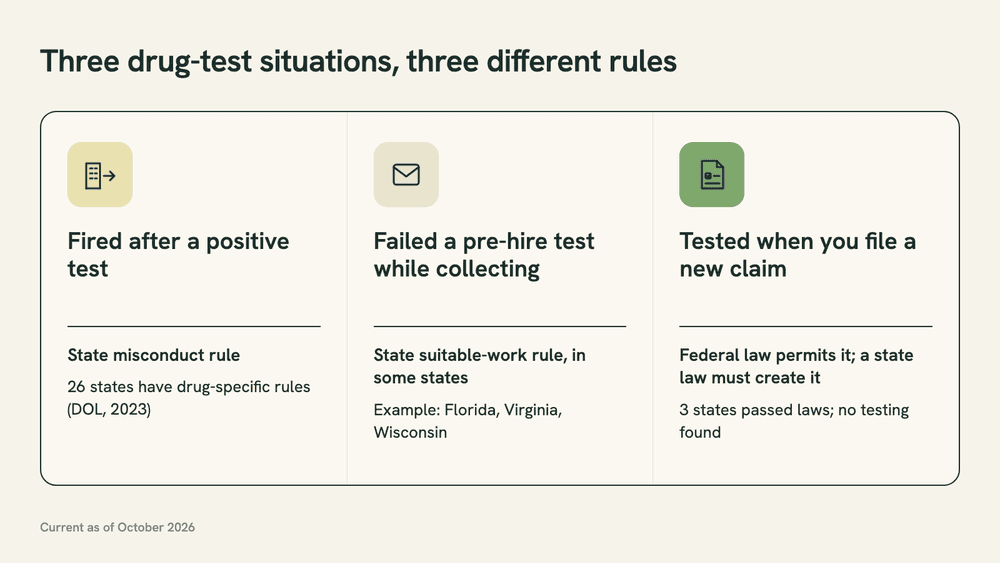
Most pages that answer this question treat it as one question. It is really three. The first is the common one: you were fired after a positive or refused test, and your state decides whether that firing was "misconduct," which is the usual reason benefits are denied after a discharge. The second catches people off guard: you are already collecting, you apply for a job, and the pre-employment test comes back positive. Some states treat that as turning down suitable work. The third is the one people search for most often, "does unemployment drug test you," and it is the rarest in practice. The table sorts them.
| Your situation | What the agency asks | Which law decides | Examples from the laws we read |
|---|---|---|---|
| Fired after a positive or refused drug test | Was the firing for misconduct connected with the work? | Your state's misconduct rule. Federal law does not set this rule | Florida, Oklahoma, Michigan, Arizona and Virginia name a failed test as misconduct; Minnesota and New Jersey use general misconduct; Montana carves out medical cardholders |
| Failed a pre-employment test while collecting | Did you refuse suitable work, or is this a week that cannot be paid? | Your state's suitable-work or weekly eligibility rule, where one covers drug tests | Florida and Wisconsin treat it as refusing suitable work; Virginia bars benefits for that week; Wisconsin offers treatment first |
| Asked to test when you file a new claim | Has your state passed an applicant-testing law and started using it? | 42 U.S.C. 503(l) and 20 CFR part 620 permit it; only a state law can create it | Mississippi, Texas and Wisconsin passed laws; we found no record that any has begun testing |
Most readers are in the first row. If you are collecting and job hunting, the second row matters too, because a positive pre-hire test can stop benefits that were already approved. The third row is mostly a question about what the law allows, not something claimants are running into today.
What federal law allows, and what it does not
Unemployment insurance is a federal-state program: the federal government sets broad conditions, and each state writes its own eligibility rules. On drug testing, federal law does very little. Section 303(l) of the Social Security Act says nothing in federal law prevents a state from testing an applicant for the "unlawful use of controlled substances" if the applicant was fired from their most recent job because of that use, or if suitable work for that person "is only available in an occupation that regularly conducts drug testing." A state that does test may deny benefits on the result. That is permission, not a requirement. The provision was added in February 2012 by the Middle Class Tax Relief and Job Creation Act, section 2105.
The second group, people whose work is in an occupation that regularly tests, needed a federal definition. The Department of Labor's first version, published August 1, 2016, did not survive: Congress disapproved it under the Congressional Review Act, approved March 31, 2017, after supporters argued it was too narrow. DOL then reissued a broader rule on October 4, 2019, effective November 4, 2019. According to the Congressional Research Service, it was the first time an agency had reissued a rule after the original was disapproved under that law. The rule, codified at 20 CFR part 620, lists ten categories of occupations. They group into five kinds:
- Jobs that require carrying a firearm.
- Jobs covered by federal transportation testing rules: aviation (FAA), trucking (FMCSA), rail (FRA), transit (FTA), pipelines (PHMSA) and the Coast Guard.
- Any other job where federal law requires drug testing.
- Any job where state law requires drug testing.
- Jobs where the state has "a factual basis" for finding that employers in that occupation test as a standard practice.
Two details in the rule matter for real people. First, it covers new claims only. The rule says an applicant "excludes an individual already found initially eligible and filing a continued claim," so it does not authorize testing someone who is already collecting. Second, the rule says outright that "No State is required to drug test UC applicants under this part 620." On marijuana specifically, DOL wrote that it had no power to change the federal definition of a controlled substance, and then added:
“States that choose to drug test as a condition of UC eligibility are permitted to omit marijuana, or any other controlled substance(s), from drug testing.”
What about the 2026 rescheduling? On April 28, 2026, a federal order moved two categories of marijuana to Schedule III: marijuana in FDA-approved drug products and marijuana subject to a state medical license. Everything else stays in Schedule I. Either way, marijuana is still a "controlled substance," because both the statute and the rule use the federal definition, which covers schedules I through V. The order does not mention drug testing or the workplace. As of October 5, 2026, we found no unemployment guidance from DOL or any state agency that applies the April 2026 order, and no change to 20 CFR part 620 since 2019. We are not inferring any effect.
Does unemployment drug test you when you apply?
Rarely, if at all, based on everything we could find. Only three states have passed laws to test unemployment applicants: Mississippi (2012), Texas (2013) and Wisconsin (2015). When DOL finalized its rule in 2019, it wrote that these states "have not yet begun testing because the prior rule was rescinded, and this rule was not yet published." DOL's 2023 comparison of state unemployment laws still says only that "Three states have enacted such laws, the implementation of which is subject to applicable federal law." We found no public record that any of the three has started testing applicants since. That is not the same as proof that none has, so if your state asks you to take a test as part of a claim, the agency is the place to ask which law it is relying on.
States that name a failed drug test as misconduct
Most unemployment denials after a drug test happen in the first situation: the employer reports that you were fired for a positive or refused test, and the agency decides whether that was misconduct. In its 2023 comparison, DOL lists 26 states with rules written specifically about drug or alcohol use or testing: Alabama, Alaska, Arizona, Arkansas, California, Connecticut, Florida, Georgia, Illinois, Kansas, Kentucky, Louisiana, Michigan, Missouri, Montana, Nebraska, New Hampshire, New Jersey, Oklahoma, Oregon, Pennsylvania, South Carolina, Tennessee, Utah, Virginia and West Virginia. The states not on that list are not silent: as the Congressional Research Service put it in 2019, "Virtually all states currently disqualify individuals for UC benefits if they lost their jobs because of illegal drug use," mostly through a general misconduct rule. We read nine state laws in their official or archived official text, chosen to show the different approaches:
| State | Statute | What it says, in short | Disqualification length we found | Text as of |
|---|---|---|---|---|
| Florida | Fla. Stat. 443.101(1)(d), (2)(c), (11) | A firing for drug use "as evidenced by a positive, confirmed drug test" is misconduct. Losing a job offer over a required pre-hire test counts as refusing suitable work | DOL 2023 summary for misconduct: the week of separation plus 1 to 52 weeks, and 17 times the weekly benefit in new wages | 2026 Florida Statutes |
| Oklahoma | 40 O.S. 2-406.1 | A positive or refused test under the state testing act "shall be considered" misconduct. The claimant has the burden to show the test was not properly conducted. A claimant who did not request a confirmation test "shall not be eligible" | Until re-employed with wages of 10 times the weekly benefit (40 O.S. 2-406, which 2-406.1 applies) | Senate compilation posted Dec 2019 |
| Michigan | MCL 421.29(1)(m) | Disqualifies for "testing positive on a drug test" given "in a nondiscriminatory manner." The lab report is "conclusive unless there is substantial evidence to the contrary" | Statute term not re-checked. DOL 2023 summary for misconduct: 17 times the weekly benefit in new wages | Archived Jan 9, 2026 (through PA 38 of 2025) |
| Arizona | A.R.S. 23-619.01(B)(3); 23-775(2) | Failing or refusing an employer drug test given under the state's testing law is misconduct | Until new wages reach 5 times the weekly benefit | Read Oct 2026 |
| Virginia | Va. Code 60.2-618(2)(b), (3)(d) | A confirmed positive for a nonprescribed controlled substance under a known workplace policy is misconduct. The commission "may consider evidence of mitigating circumstances" | Firing: until 30 days or 240 hours of new work. Pre-hire positive: no benefits for that week | Read Oct 2026 |
| Montana | MCA 39-51-2303(3) | Failing or refusing a test under a written policy disqualifies, but the rule "does not apply" to marijuana tests of registered medical cardholders | Drug-test rule: not covered here. General misconduct: until new wages reach 8 times the weekly benefit | MCA 2025 |
| Wisconsin | DWD program page citing Wis. Stat. 108.04(8)(b) and 108.133 | A failed pre-hire test while claiming is presumed a refusal of suitable work. The claimant is offered treatment and a skills assessment first | Benefits stop if treatment is declined | Agency page, read Oct 2026 |
| Minnesota | Minn. Stat. 268.095 subd. 6 | No drug-test clause. General misconduct "on the job or off the job." Conduct caused by a substance use disorder is excluded, with limits | DOL 2023 summary: new wages equal to half the amount needed to qualify for a benefit account | 2025 Minnesota Statutes |
| New Jersey | N.J.S.A. 43:21-5(b) | Misconduct includes breaking "reasonable standards for a workplace free of drug and substance abuse." The employer has the burden of proof | The week of discharge plus the next 5 weeks | NJ DOL compilation, Dec 2024 |
Florida names both of the first two situations. Its reemployment assistance law (Florida's name for unemployment) disqualifies a worker discharged for misconduct "consisting of drug use, as evidenced by a positive, confirmed drug test," and treats a person rejected for a job "as the direct result of a positive, confirmed drug test required as a condition of employment" as having refused suitable work. When the employer runs a drug-free workplace program under Florida's workers' compensation law and uses a licensed lab, the lab results and chain-of-custody paperwork create "a rebuttable presumption" of drug use. Florida's definition of misconduct applies "irrespective of whether the misconduct occurs at the workplace or during working hours."
Oklahoma writes the hearing rules into the statute itself. Under 40 O.S. 2-406.1, a discharge for a positive test conducted under the state's workplace testing act "shall be considered" misconduct; "the claimant has the burden to prove that the test was not properly conducted"; the employer must provide chain-of-custody documentation when a claimant asks; and "When the claimant fails to request a confirmation test pursuant to Section 556 of this title, the claimant shall not be eligible for benefits." The disqualification runs under the general misconduct section, 2-406, which lasts until the worker is re-employed and has earned ten times the weekly benefit amount. Oklahoma's agency shows how that last sentence is applied. In a 2015 decision recorded in the Oklahoma Employment Security Commission's precedent manual, a commercial truck driver with a second positive test had not requested a $150 confirmation test, and the board disallowed benefits until he was re-employed and earned at least ten times his weekly benefit amount. The section we read is from a compilation posted in December 2019; we could not reach the state's court-run statute site to check for later amendments.
Michigan disqualifies a worker discharged for "testing positive on a drug test, if the test was administered in a nondiscriminatory manner," meaning "impartially and objectively" under a policy, rule, notice or labor agreement (MCL 421.29, archived January 2026). If the worker disputes the result and no confirmatory test was run on the same sample, the statute says one "must be administered on that sample." A lab report showing a positive result "is conclusive unless there is substantial evidence to the contrary." We could not re-check the statute's requalifying term for this clause; DOL's 2023 summary lists 17 times the weekly benefit in new wages for Michigan misconduct generally. The statute does not mention marijuana, and we did not verify how Michigan's agency applies it to adult-use cannabis.
Arizona and Virginia both name a failed test as misconduct, with a difference worth noticing. Arizona counts "Failure to pass, or the refusal to take, a drug test" given under the state's employer testing law as misconduct (A.R.S. 23-619.01), and the disqualification lasts until the worker has earned five times the weekly benefit amount in new work (A.R.S. 23-775). Virginia counts a "confirmed positive test for a nonprescribed controlled substance" under "a known workplace drug policy" as misconduct, but adds that "The Commission may consider evidence of mitigating circumstances in determining whether misconduct occurred" (Va. Code 60.2-618). A misconduct disqualification there lasts until the worker has worked for an employer for 30 days or 240 hours. Virginia also says no one is qualified for benefits "during any week" in which a pre-employment test required for an offer of suitable work comes back confirmed positive.
Two states handle drug use without a test-specific firing rule. Minnesota has one general definition: "intentional, negligent, or indifferent conduct, on the job or off the job," that seriously violates the standards an employer can reasonably expect (Minn. Stat. 268.095). It then excludes "conduct that was a consequence of the applicant's substance use disorder," unless the person was already diagnosed or treated and has since "failed to make consistent efforts to control" it. Wisconsin speaks to the second situation. According to the state workforce agency's program page, failing or refusing a pre-employment test "is presumed to be a refusal of suitable work," but a claimant who fails one is first "offered the option to attend treatment and complete a skills assessment before UI benefits are denied." Claimants who agree and finish on time may keep collecting; claimants who decline cannot. Employers report the result within 3 business days.
Beyond the nine, DOL's 2023 summary describes some other states' rules in a line each. Missouri: "positive pre-employment drug/alcohol test is considered misconduct." Georgia: violating an employer's drug-free workplace policy. Oregon: a worker is not disqualified if participating in a recognized rehabilitation program within 10 days of separation. These are DOL's summaries, not statute text we read.
Legal cannabis, medical cards and unemployment
Buying cannabis legally in your state does not mean a positive test is safe for your benefits. Unemployment law and cannabis law are separate statutes, and most unemployment laws we read do not mention cannabis at all. One that does is Montana. Its automatic failed-test disqualification applies to drug tests under an employer's written policy, but MCA 39-51-2303 says: "This subsection does not apply to a drug test for marijuana or marijuana products that was administered to an individual who is a registered cardholder." That removes the automatic rule only. Montana's general misconduct rule still exists, so on-the-job impairment, for example, is still a separate question.
What a medical card can and cannot do shows up in a real case. In Skoric v. Department of Labor, decided by the Vermont Supreme Court in 2024, a part-time bus fueler and washer with a commercial driver's license worked in a safety-sensitive job at a transit district covered by federal transit testing rules. He had held a medical cannabis card since early 2020, tested positive on a random test in December 2022 and was fired in January 2023 for violating federal transportation rules. The administrative law judge upheld the finding that he was discharged for cause but "reduced the benefit disqualification period to a statutory minimum of six weeks in recognition of petitioner's use of cannabis for medical purposes." The employment security board found misconduct because he "was aware of MVRT's drug policy and still consciously violated it, regardless of his motivation." The Supreme Court affirmed on procedural grounds and never decided whether off-duty medical cannabis use is misconduct. It is one worker in one state, in a federally regulated job.
New Jersey shows how two laws can sit side by side without a clear answer. The state's unemployment statute counts breaking "reasonable standards for a workplace free of drug and substance abuse" as misconduct, puts "the burden of proof" on the employer, and disqualifies for the week of discharge and the five weeks after. Separately, the state's 2021 adult-use cannabis law bars adverse action by an employer "solely due to the presence of cannabinoid metabolites," as the state cannabis regulator's September 2022 workplace guidance restates it. The same guidance says a metabolite test "alone is insufficient to support an adverse employment action," though combined with documented signs of impairment during work hours it "may be sufficient." We found no ruling showing how New Jersey's unemployment tribunal reconciles the two, so we label it unverified.
New York is the other state where the record says something about marijuana. The state Unemployment Insurance Appeal Board's bench manual, in pages dated January 2020, describes a case in which the employer's policy only addressed coming to work under the influence, the worker "tested positive for marijuana," and the board found the policy insufficient for misconduct because "the record did not establish that the claimant used marijuana in the workplace or that his judgment or cognition were impaired while working." Those pages predate New York's 2021 adult-use cannabis law, so read them as how the board reasoned then, not as current policy. The off-duty employment protections themselves, in New York, New Jersey, Minnesota and elsewhere, are covered on our page about getting fired over a drug test.

If the positive came from CBD or hemp
People who use CBD sometimes end up here after an unexpected positive. The lab does not test for CBD. A workplace marijuana test looks for a THC metabolite, so the question is whether the product contained THC. Many did: in a 2017 JAMA analysis of 84 CBD products bought online, researchers detected THC in 18 of them, about 21%. In a 2020 controlled study run with federal testing scientists, six adults took 100 mg of pure CBD and none produced a confirmed positive urine test, but after a CBD-dominant product that also contained 3.7 mg of THC, some samples did confirm positive. The study was small and used single doses. Our guide to how CBD shows up on a drug test covers cutoffs and detection in detail, and the same logic applies to CBD gummies and drug tests.
For unemployment, the source of the THC is a fact about your case, not a defense that settles it. In federally regulated transportation testing, the Medical Review Officer, a physician who reviews lab results, "must not accept an assertion of consumption or other use of a hemp or other non-prescription marijuana-related product as a basis for verifying a marijuana test negative" (49 CFR 40.151). A urine result also has a built-in limit: as a 2007 review of cannabinoid testing put it, a positive "indicates only that drug exposure has occurred" and says nothing about when, or about impairment. That limit is the reason New York's board, in the marijuana case above, looked for evidence of use at work or impairment while working.
No record we found shows a CBD explanation winning an unemployment case. What the statutes do show is where a claimant's account enters the record: Virginia lets its commission weigh mitigating circumstances, Michigan treats the lab report as conclusive unless there is substantial evidence to the contrary, and in New York, when a claimant denies use, the board's manual says the evidence "must establish a complete chain of custody." In one New York case, a claimant said the result came from secondhand exposure, and the board required a complete chain of custody for the test to prevail over that denial. The science on those other routes lives in our pages on whether secondhand smoke can make you fail a drug test and whether hemp seed oil can cause a positive.
What unemployment hearings say they weigh
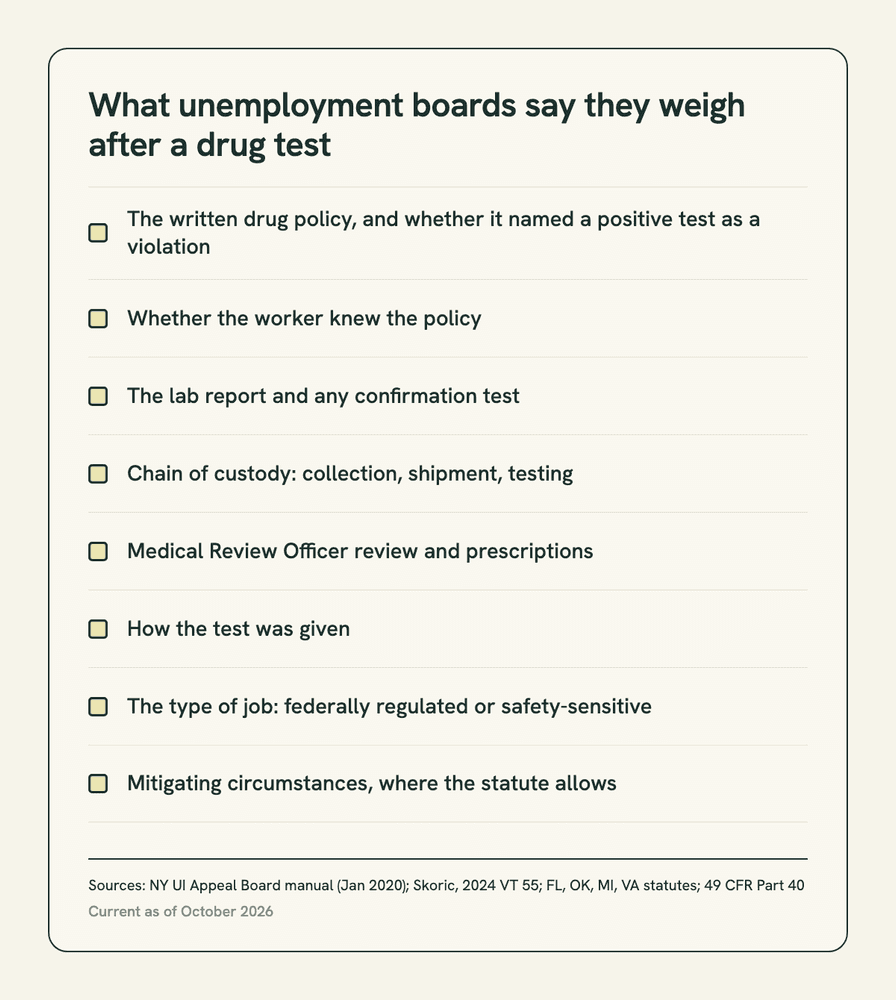
If a claim is denied and appealed, the decision is made on a record of documents and testimony. This list is not a strategy. It collects what the agencies and boards in the sources above say they look at, in their own words where possible:
- 1The written drug policy, and whether it said a positive test is a violation. New York's board manual says a positive test "alone" is not misconduct when the policy does not say so.
- 2Whether the worker knew the policy. Vermont's board pointed to the worker being "aware of" the drug policy.
- 3The lab report and whether a confirmation test was run. Michigan and Oklahoma both write confirmation testing into the statute.
- 4Chain of custody, which New York's board describes in three stages: collection of the sample, shipment of the sample, and testing of the sample.
- 5Medical Review Officer review, including any prescription. In federal transportation testing, a physician reviews a lab positive before the employer sees it.
- 6How the test was given. Michigan requires a "nondiscriminatory manner"; Florida's presumption needs a qualifying drug-free workplace program and a licensed lab.
- 7The type of job. A federally regulated or safety-sensitive role comes with its own testing and removal rules.
- 8Mitigating circumstances, where the statute allows them. Virginia's does, by name.
Two of those items come from the federal transportation rules. A Medical Review Officer "must offer the employee an opportunity to present a legitimate medical explanation" before verifying a positive (49 CFR 40.137), and after a verified positive the worker cannot perform safety-sensitive duties for any DOT-regulated employer until finishing a return-to-duty process (49 CFR 40.285). That federal duty to remove the worker is often what the unemployment record is built from. For how that review step fits into a standard workplace panel, see our pages on what a 10-panel drug test screens for and delta-8 THC and drug testing. New York's manual also notes that a positive for some drugs, such as cocaine, has been found to be misconduct "even in the absence of a formal policy," so the policy question does not cut the same way for every substance.
What this page cannot tell you
This is legal information, not legal advice. It describes federal law, DOL's published summary and nine state laws as we read them in October 2026. Several things that will matter in a real claim are outside what any general page can answer:
- Whether you qualify. Your state agency decides, on the record of your case. Nothing here predicts an outcome.
- The law in states whose text we did not read, including Georgia, Missouri, Pennsylvania and Texas, where we relied only on DOL's 2023 summary or nothing.
- Whether a statute has changed since the version we read. Our Oklahoma text, for example, is a compilation posted in December 2019.
- How New Jersey's tribunal reconciles its cannabis law with its misconduct rule, or how Michigan applies its drug-test rule to adult-use cannabis. We found no ruling on either.
- What the April 2026 Schedule III order means for unemployment. We found no DOL or state guidance applying it.
- Your appeal deadline. Each state sets its own and they can be short, so check your determination notice and your state agency.
Frequently asked questions
Often not, but it depends on your state and on your employer's policy. DOL's 2023 summary lists 26 states with rules written specifically about drug or alcohol use or testing, and nearly every other state reaches drug-related firings through general misconduct. Some states write in details that change the picture: Michigan requires the test to be given in a nondiscriminatory manner, Virginia lets its commission weigh mitigating circumstances, and New York's appeal board manual (January 2020) says a first positive alone is not misconduct unless the policy said so. Your state agency makes the decision.
Rarely, if at all, based on what we could find. Federal law lets states test two groups of new applicants: people fired for unlawful drug use, and people whose only suitable work is in an occupation that regularly drug tests. Only Mississippi, Texas and Wisconsin passed such laws. When DOL finalized its rule in 2019, none had started, and we found no record that any has begun since. The rule does not cover people already collecting.
In some states, it can stop your benefits. Florida treats losing a job offer over a required positive test as refusing suitable work. Virginia bars benefits for a week in which a pre-hire test for suitable work comes back confirmed positive. Wisconsin presumes a refusal of suitable work but first offers treatment and a skills assessment; claimants who complete both on time may keep collecting. DOL's summary lists Missouri as treating a positive pre-employment test as misconduct. Other states may handle it under their general suitable-work rules.
Generally not by itself. Montana is the one statute we found that carves out registered medical cardholders: its automatic failed-test rule does not apply to their marijuana tests, though general misconduct still can. In a 2024 Vermont case, a medical card shortened a disqualification to the six-week minimum but did not erase it, in a federally regulated transit job. Elsewhere, we found no general protection for cardholders in the unemployment laws we read.
Legalization alone does not answer it. Most unemployment laws we read do not mention cannabis, and a positive test under a known workplace policy can still be treated as misconduct. Some states protect off-duty cannabis use at work, which can matter to whether the firing itself was lawful; that side is covered on our page about getting fired for a failed drug test. How a state's unemployment tribunal applies those protections is something we could not verify for New Jersey or Michigan.
To the lab, a THC positive is a THC positive. A 2017 analysis found THC in about 21% of CBD products bought online, and in a small 2020 study a CBD product with 3.7 mg of THC produced confirmed positives. In federal transportation testing, the Medical Review Officer may not accept hemp or CBD use as an explanation. We found no unemployment decision accepting a CBD explanation.
It varies by state. In the laws we read: New Jersey disqualifies for the week of discharge plus the next five weeks; Virginia until you have worked 30 days or 240 hours for an employer; Arizona until you earn five times your weekly benefit in new work; Montana's general misconduct rule until you earn eight times it; Oklahoma until you are re-employed and earn ten times it. For other states, DOL's 2023 comparison of state laws summarizes each state's misconduct penalty, and your state agency's notice states the one that applies to you.
Eligibility is decided by your state agency on the facts of your case, not by the employer or by a general rule of thumb. A denial comes with appeal rights and a deadline that each state sets. Your state unemployment agency, a legal aid office or a licensed employment attorney can tell you how your state's rules apply to your situation.
Where to go next. If you have not lost your job yet, or want to know whether the firing itself was lawful, start with our guide to what happens at work when you fail a drug test. For how federal and state law treat CBD and hemp more broadly, including the changes coming in late 2026, see our hub on whether CBD is legal.
Writing about hemp, wellness and the small rituals that keep us balanced.